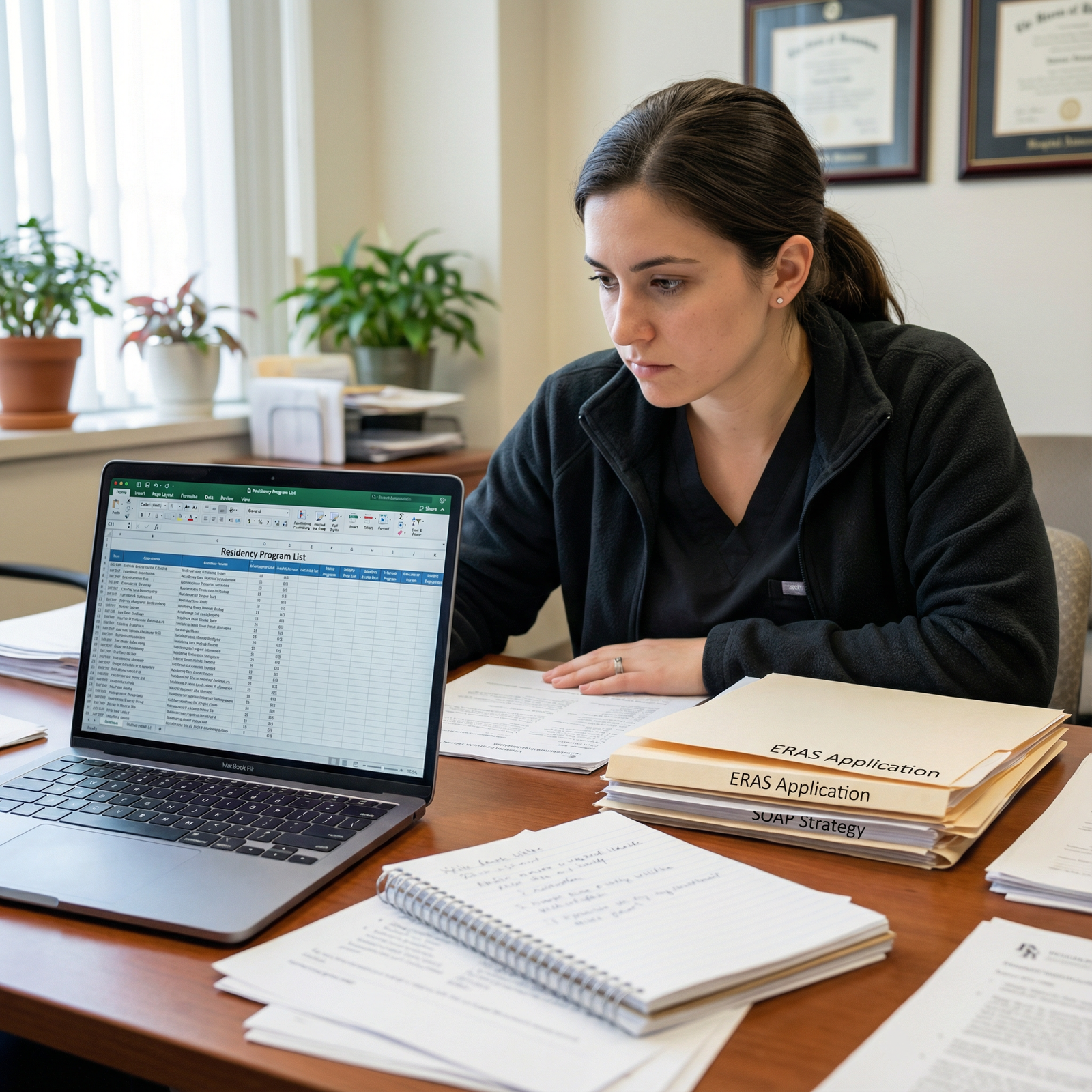
It is Monday. 9:58 a.m. ET. You are in a borrowed conference room, logged into ERAS and NRMP, watching the clock crawl toward 10:00. You did not match. You have few, maybe zero, confirmed interview prospects. The SOAP position list is about to unlock, and your stomach is somewhere around your ankles.
This is not theory. I have watched people sit in that exact chair. Some walked out with a PGY-1 spot. Some did not. The difference was not luck. It was how fast and how intelligently they moved in the first two hours.
You do not need comfort right now. You need a playbook.
Here it is.
1. What Matters in the First 2 Hours (and What Does Not)
From 10:00–12:00 ET on Monday, the only goal is this:
Get high-quality, correctly targeted applications submitted to as many realistic programs as possible before they are flooded.
You are not:
- Perfecting prose.
- Rewriting your entire personal statement from scratch.
- Grieving the match outcome.
- Debating whether SOAP is “worth it.” You are in it. Act like it.
You are:
- Making aggressive but rational specialty choices.
- Customizing quickly, not perfectly.
- Coordinating a small team (if available) like a pit crew.
You need to accept an uncomfortable truth: SOAP moves fast, and some decisions will feel rushed. That is fine. Thoughtful and fast beats paralyzed and perfect.
2. Pre-10:00 Setup (If You Are Reading This Before the List Opens)
If you are already past 10:00, skip to section 3. If not, use every minute.
A. Build your war room
You need:
- 2 screens if possible (laptop + monitor / tablet).
- ERAS open and logged in.
- NRMP/official SOAP instructions open for your year.
- A notepad (physical or digital) divided into:
- “High priority”
- “Secondary targets”
- “Long shots”
If you have support people (advisor, dean, trusted friend, partner), assign roles:
- Person A: Scanning the SOAP list, filtering programs.
- Person B: Updating a shared spreadsheet.
- You: Making final decisions, customizing documents, clicking submit.
If it is just you, you can still do this. Just be stricter about what you ignore.
B. Pre-draft your materials
You should already have:
- A core personal statement for your main specialty.
- A CV that matches ERAS.
- At least 2–3 letters of recommendation uploaded.
You should also prepare:
An emergency “transitional/IM/FM” personal statement
Generic but honest, focused on:- You are adaptable.
- You want strong foundational training.
- You like breadth, continuity, and team-based care.
A short “switch” paragraph you can paste into alternate-specialty statements:
Two to three sentences that justify a pivot. Example:“While I initially applied to emergency medicine, my core clerkship in internal medicine reminded me how much I value longitudinal patient care, complex problem solving over time, and close team-based collaboration. I am seeking a position where I can build a strong general medicine foundation and contribute meaningfully from day one.”
A 3–4 sentence “why this program type” paragraph you can adapt:
- For IM/FM: talk about inpatient/outpatient mix, primary care, community impact, continuity.
- For prelim/TY: emphasize need for a strong clinical year, procedural exposure, broad base.
Do not waste time crafting poetry. You need modular paragraphs you can drop in within seconds.
3. 10:00–10:20 — Triage the SOAP List Without Panicking
10:00 hits. List opens. Heart rate spikes. This next 20 minutes separates people who have a shot from people who drown in noise.
A. Filter ruthlessly
Start with filters like:
- Specialty(ies) you are realistically willing to do.
- Visa status (if applicable).
- States/regions you can genuinely attend interviews in and tolerate living in.
- Categorical vs prelim/TY, based on your Step scores and long-term goal.
If you are US-IMG or DO with limited interviews and mediocre scores, your realistic core will often be:
- Family Medicine
- Internal Medicine
- Pediatrics
- Psych (some cycles)
- Transitional/Prelim IM / Prelim Surgery
- Occasionally community EM, path, neuro — but less so if you already struck out.
If you are an MD senior who whiffed in a competitive specialty (ortho, derm, ENT, etc.), you should be looking strongly at:
- Categorical IM/FM/Peds/Psych
- Transitional / prelim IM
- Rare “reversion” spots in your original specialty, but those dry up fast and are hypercompetitive.
B. Create a quick scoring system
Do not get fancy. Ten minutes, max.
Make a simple 0–2 score for each of these:
Fit for your academic profile
2 = community / mid-tier program with a history of DO/IMG/flexibility
1 = mixed; unknown; borderline
0 = powerhouse academic program with historically high Step averagesGeographic viability
2 = you have ties or can convincingly claim interest
1 = neutral
0 = you have zero connection and the region is notoriously insularSpecialty fit / your willingness
2 = you would genuinely show up happy to train there
1 = acceptable if needed
0 = you would be miserable or it derails your long-term goals
Total score 0–6. Focus first on the 4–6 range.
Have a running spreadsheet or paper list. You do not need to score every program. Start scoring as you scroll; when you see something obviously bad for you (Step 260 average, you have 215; heavy research requirement, you have none), skip.
4. 10:20–11:20 — Build and Submit Targeted Batches
This hour is about structured speed.
You get up to 45 programs total across all SOAP rounds. You do not need to use all 45 in the first hour, but you also cannot trickle them out one at a time while everyone else floods programs at 10:01.
A. Create program tiers
From your quick scoring, mark:
- Tier 1: High-priority, strong fit (score 5–6)
- Tier 2: Reasonable but not ideal (score 3–4)
- Tier 3: Long shots or “only if desperate” (score 0–2)
Aim to send:
- First wave: 15–25 Tier 1 programs
- Second wave (after a short reassessment): Another 10–15 mixing high Tier 2 and any additional Tier 1 you uncover
Keep some slots in reserve if you are unsure about your list or expect movement later. But hoarding all 45 is foolish. You must get in play early.
B. Decide: stay in specialty vs pivot
This is where people make emotional decisions and pay for them later.
You need to ask:
Did my base application in my original specialty already get judged by 30–60 programs and mostly rejected or ignored?
- If yes, your odds of landing a SOAP spot in that same competitive specialty are low unless there is a unique angle (home program, incredible research, known to PDs).
Do I have a realistic alternate specialty where:
- My scores are at or above their average?
- My clinical letters can reasonably apply?
- I can live with this as a career, or as a stepping-stone?
Am I willing to do a prelim/TY year to keep pathways open?
- Prelim IM or TY can be a good move if you are set on a competitive advanced specialty and still have a reasonable shot next year.
If you had few or no interviews, clinging exclusively to ortho/derm/ENT/PR/Surg Onc in SOAP is usually magical thinking. I have seen people waste all 45 applications on impossible programs because they could not emotionally pivot. Almost all of them were unmatched in May.
Be brutally honest: where will a PD look at your file and think, “I can see this person working nights in my ICU tomorrow,” not “Why are they here?”
C. Customize efficiently, not beautifully
Here is how to customize in under 5 minutes per program:
Use a specialty-appropriate base personal statement.
Do not send your ortho love letter to family medicine. That is how you get instantly trashed.Swap in a short “why this specialty now” paragraph if pivoting.
Two to three sentences. Concrete. Not vague “I like helping people.”If possible, add one line tying to region or program type:
- “Having grown up in rural Ohio, I am particularly drawn to community-based training environments like yours with a clear commitment to underserved populations.”
- If you have no tie, skip. Flimsy, fake lines read worse than silence.
Ensure your ERAS experiences are cleaned up.
- Remove specialty-specific fluff that makes no sense (“My dream is to be a spine surgeon”) if you are applying to IM.
- Reorder your top 3 experiences to emphasize breadth, teamwork, continuity, or whatever fits the new target.
You are not writing bespoke love letters. You are aligning your branding enough that a PD does not dismiss you as lazy, confused, or dishonest.
D. Submit in batches, then move
Do not spend 40 minutes perfecting 4 applications while other candidates have already hit 20 programs.
Protocol:
- Assemble a batch of 10–15 Tier 1 programs.
- Confirm:
- Correct specialty PS attached.
- No obvious contradictions (e.g., “I am committed to radiology” in an IM PS).
- Submit that batch.
- Immediately continue filtering more programs while those go through.
- Repeat with next 10–15.
Between batches, take 30 seconds to check you are not re-applying to a program that already auto-rejected you in the main match for catastrophic reasons (professionalism flag, violation, missing USMLE, etc.). But do not re-litigate every prior rejection. That way lies paralysis.
5. 11:20–12:00 — Tighten, Expand, and Prepare for Calls
At this point, you should have:
- 20–35 applications out, mostly in Tier 1 and strong Tier 2.
- At least one personal statement template per specialty you used.
- A clear record (spreadsheet or list) of where you applied.
Now you do three things.
A. Fill gaps intelligently
Look at your remaining application slots. Ask:
- Do I have at least:
- 10–15 programs in my most realistic specialty?
- A reasonable geographic spread?
- A mix of community and mid-level academic programs?
If not, go back to the list and add more from your strongest-fit specialty first.
Only after that should you:
- Add true long shots you would still be willing to attend (Tier 3).
- Add more prelim/TY spots if you are using that as your bridge-year strategy.
Do not burn the last 10 slots on random programs in cities you hate just to hit 45. You may need those for late-appearing or newly attractive options after a quick consult with your dean.
B. Clean up your phone and email readiness
Programs will start contacting candidates fast once they review SOAP files.
In this window:
- Make sure:
- Your voicemail greeting is professional. No jokes. No music.
- Phone is off Do Not Disturb.
- Ringer volume is up.
- Email on your phone is syncing every few minutes.
Prepare a 20–30 second phone script for unexpected PD calls:
“Hello Dr. [Name], thank you for reaching out. I appreciate your consideration. I am very interested in [Program Name] because of [one concrete feature], and I would be excited to train in [City/Region]. I am happy to answer any questions about my application.”
Memorize your red-flag explanations: a failed Step, a leave of absence, no home program, career pivot. One clear, non-defensive sentence for each. You will regret winging this.
C. Ping your support infrastructure
Quick emails or messages to:
Dean’s office / student affairs:
- Let them know where you focused applications.
- Ask if they have any contacts at top-priority programs.
-
- Short, respectful note:
- You did not match.
- You are in SOAP targeting X and Y.
- If they know PDs at specific programs, a supportive email could help.
- Short, respectful note:
Do not spam 20 attendings. Two or three targeted messages are fine. Quantity does not matter; relevance does.
6. Choosing Between Categorical, Prelim, and Sitting Out
Let me be blunt: romantic ideas about waiting a year and “coming back stronger” are usually wrong outside very specific scenarios.
Categorical vs prelim/TY
Categorical IM/FM/Peds/Psych
- Pro: You have a full residency. Job and board eligibility at the end.
- Con: Less flexibility if you are dead set on another specialty, though transfers do happen.
Prelim IM / TY
- Pro: Keeps you clinically active, gets you solid letters, keeps doors open for competitive specialties next year.
- Con: You are not board-eligible from these alone. You must match again.
Situations where a prelim/TY year is rational:
- You are strongly committed to an advanced specialty (e.g., Radiology, Anesthesia, Derm, Rads Onc) and already have solid connections or scores, but timing or geography killed you this year.
- You had one catastrophic, temporary setback (family crisis during applications, late Step score, etc.) and have reason to believe next year’s application will be fundamentally stronger, not just a reprint.
Sitting out completely is usually only defensible if:
- Visa issues or personal circumstances absolutely block you from working this year.
- You had serious health/family events that must be addressed first.
- You are willing to accept that re-entering the match as a non-current graduate is harder, and you have a concrete plan to fill the year with relevant clinical/research work.
In SOAP, with few options, a decent categorical FM/IM/Peds spot is often far better than romance about another match cycle that might never pay off.
7. Common Mistakes in the First 2 Hours (and How to Avoid Them)
Let me walk you through the traps I see over and over.
Mistake 1: Refusing to pivot specialties
- Scenario: EM applicant with 6 interviews, did not match. Still applies exclusively to EM SOAP spots at top programs. Ends up completely unmatched.
- Fix: Apply broadly to IM/FM/Psych while keeping an eye on a small number of attainable EM SOAP spots, not just wish-list institutions.
Mistake 2: Sending obviously misaligned applications
- EM PS to Psych. Surgery love letter to FM.
- Programs read this as laziness or confusion. They are not wrong.
Fix: Use specialty-specific PS bases. If absolutely forced to reuse content, strip out specialty names and reframe around skills (acute care → complex care, procedures → hands-on patient management, etc.).
Mistake 3: Spending 45 minutes on one perfect application
You do not win SOAP style points. You win by being in the first wave of reasonable applicants at multiple programs. PDs skim.
Fix: Hard time caps.
- 5 minutes to decide if a program is a “yes.”
- 5 minutes to customize PS and double-check attachments.
- Move on.
Mistake 4: Spraying all 45 applications to any open spot
Overshooting in panic is as bad as paralysis.
Fix: Tiering. Commit your first 30–35 to places that at least somewhat make sense for your background and goals. Keep 5–10 in reserve for later in the day if new intel comes in.
8. Practical Tools: Simple SOAP Targeting Matrix
Use something like this while you are moving fast. It does not have to be pretty.
| Program | Specialty | Type | Fit Score (0-6) | Priority Tier |
|---|---|---|---|---|
| A | IM | Categorical | 6 | 1 |
| B | FM | Categorical | 5 | 1 |
| C | IM | Prelim | 4 | 2 |
| D | Psych | Categorical | 3 | 2 |
| E | TY | Transitional | 2 | 3 |
This is overkill if you try to make it perfect. It is gold if you keep it blunt and fast.
9. Emotional Management While You Execute
You are not a robot. Your brain is probably flipping between shame, panic, anger, and numbness.
That is normal. It is also a liability if you let it drive.
Simple protocol:
- Every 30–40 minutes:
- Stand up.
- Drink water.
- Take 5 deep, slow breaths.
- Look at your list and ask, “Have I made any obviously emotional, irrational choices?” Correct them.
Limit input:
- This is not the time for group chats full of classmates sharing rumors.
- One or two trusted advisors > 20 panicking peers.
If a program would be truly unsafe or intolerable for you (abusive reputation, location you could not function in), do not apply. But distinguish between “I dreamed of something else” and “I literally cannot do this.”
10. Visualizing the Process (So You Do Not Freeze)
Sometimes seeing the flow helps you act.

| Step | Description |
|---|---|
| Step 1 | 10 00 List Opens |
| Step 2 | Filter by Specialty and Visa |
| Step 3 | Score Programs 0 to 6 |
| Step 4 | Add to Tier 1 |
| Step 5 | Add to Tier 2 |
| Step 6 | Ignore or Tier 3 |
| Step 7 | Build First Batch 15 to 25 |
| Step 8 | Attach Correct PS |
| Step 9 | Submit Batch |
| Step 10 | Repeat Filtering for Next Batch |
| Step 11 | Reach 20 to 35 Apps |
| Step 12 | Check Phone Email Ready |
| Step 13 | Contact Dean and Key Faculty |
| Step 14 | Score 5 to 6? |
| Step 15 | Score 3 to 4? |
You are moving through these boxes. Not wandering. Not waiting for “signs.” Executing.
11. Simple Timeline of the Critical Window
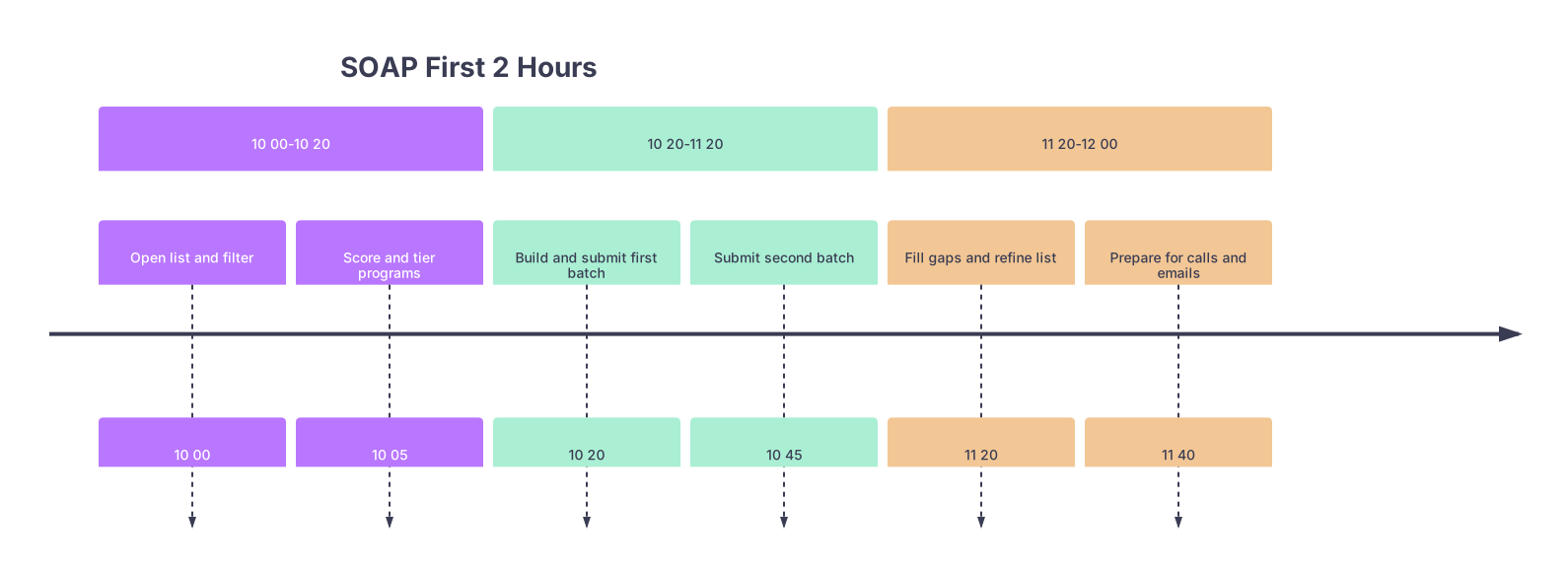
| Period | Event |
|---|---|
| 10 00-10 20 - Open list and filter | 10 00 |
| 10 00-10 20 - Score and tier programs | 10 05 |
| 10 20-11 20 - Build and submit first batch | 10 20 |
| 10 20-11 20 - Submit second batch | 10 45 |
| 11 20-12 00 - Fill gaps and refine list | 11 20 |
| 11 20-12 00 - Prepare for calls and emails | 11 40 |
Stick roughly to this pacing. Adjust only with intention.
12. Tracking Your Outreach and Responses
A small tracking tool helps once the phone starts ringing.
| Program | Applied Time | Contact Type | Outcome |
|---|---|---|---|
| A | 10:32 | Phone call | Scheduled interview |
| B | 10:45 | No response yet | |
| C | 11:05 | ERAS only | Rejected |
Do not obsess over it, but capture enough that you are not repeating yourself or forgetting who called.
13. A Quick Reality Check
You are in a rough spot. No sugarcoating. But many residents with excellent careers started here.
The ones who landed on their feet:
- Moved decisively in SOAP instead of emotionally.
- Were willing to reframe their identity from “future [insert competitive specialty]” to “future physician, starting wherever I can do good work.”
- Used prelim or categorical opportunities as platforms, not punishments.
Do not let pride or fear talk you into passivity. In SOAP, action is almost always better than hesitation.
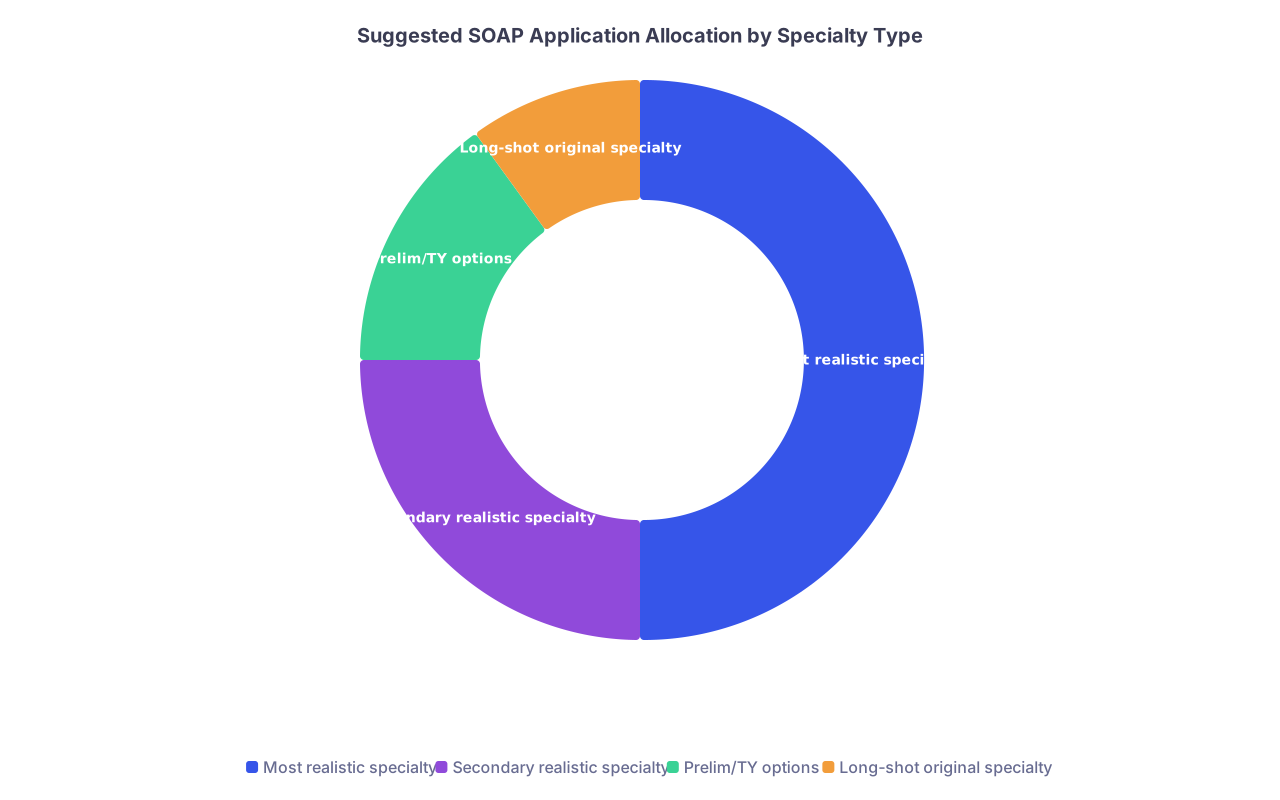
| Category | Value |
|---|---|
| Most realistic specialty | 50 |
| Secondary realistic specialty | 25 |
| Prelim/TY options | 15 |
| Long-shot original specialty | 10 |
Use this as a rough conceptual guide, not an exact prescription.
FAQ (Exactly 4 Questions)
1. Should I apply to programs that already rejected me in the main match?
Sometimes. If a program rejected you because of an automatic screen (Step failure, missing requirement), SOAP will not fix that. Do not waste a slot. If they never offered an interview but your profile is in range and they now have unfilled positions, it can still be worth applying. Programs sometimes re-evaluate in SOAP when they are under pressure to fill.
2. How many specialties should I apply to during SOAP?
For most people: one primary realistic specialty and at most one secondary plus prelim/TY if relevant. Spraying 4–5 specialties makes your application look unfocused and desperate. The exception is when your primary is something broad like IM and your secondary is a closely related field like prelim/TY or FM. That mix is defensible.
3. Do personal statements really matter in SOAP, or can I just use one generic one?
They matter enough to hurt you if they are wrong. No one is parsing every adjective, but if your PS screams “I am obsessed with ortho research” and you are applying to FM, you will get tossed aside. Use at least one specialty-specific PS per target. You can keep them short and focused, but they should not obviously contradict your application strategy.
4. If I do not get any interviews from the first SOAP round, what does that mean?
It usually means one of three things: your application is significantly misaligned with your targets (too competitive, wrong specialty), there are serious unaddressed red flags, or you applied too narrowly. Between rounds, re-evaluate your specialty choices with an advisor, expand to more realistic programs (including prelim/TY where appropriate), and tighten your explanations for any red flags. It is not an automatic death sentence, but it is a sign you must adjust, not just resend the same strategy.
Three key points to keep in your head as you work:
- Speed matters, but alignment matters more. Get a lot of good applications out fast.
- Use structure: tiers, time caps, and simple scoring to avoid emotional decisions.
- Do not let pride block realistic pivots. A solid SOAP spot can be the start of a very good career.