
The way most students stumble through SOAP Monday is brutal. They wander, they refresh email, they panic-text friends. That’s how you miss chances. With limited interviews, you cannot afford that. You need an hour‑by‑hour playbook.
You’re getting one.
This is your structured, ruthless, SOAP Monday timeline for students with few or no interviews. I’ll assume:
- You’re in the SOAP-eligible unmatched/partially matched group
- You’re reasonably sure you didn’t get 15+ interview offers
- You want to maximize every single slot
We’ll walk from predawn to SOAP application submission with “at this point you should…” instructions.
The Day Before SOAP Monday (Sunday Evening Prep)
If you’re reading this before Monday, good. You win.
By 7:00 pm Sunday – Stabilize your mindset
At this point you should:
- Accept reality: you’re in the SOAP pool. Denial wastes time.
- Pick 1–2 trusted people you’ll text with; mute everyone else. Group chats explode on Monday and destroy focus.
- Commit to this: you will not compare your list to classmates all day. That’s noise.
By 8:00 pm Sunday – Set up your command center
At this point you should:
- Choose your primary workstation:
- One main computer (laptop or desktop)
- Stable internet, plugged in, no “low battery” drama
- Set up:
- Browser 1: ERAS/NRMP + program list spreadsheet
- Browser 2: Email + school SOAP resources
- Put your phone on Do Not Disturb with:
- Allowed calls: advisor, dean’s office, family (maybe just one person)
By 9:00 pm Sunday – Build your specialty strategy
This is where students with limited interviews win or lose.
At this point you should:
Define your realistic SOAP target tier(s):
- If you had 0–3 interviews in a highly competitive specialty (Derm, Ortho, ENT, Rad Onc, Plastics): you must be ready to pivot. SOAP will not magically fix that.
- If you had 3–6 interviews in mid‑competitive specialties (EM, Anes, Rad, Psych in some regions): be prepared to apply broadly in related or less competitive fields.
- If you had interviews mainly in FM/IM/Peds/Path/Neuro/Psych: double down here and consider prelim/TY backups.
Draw three columns on paper or in your spreadsheet:
- Column A – Primary Specialty you’d still like to pursue if positions exist
- Column B – Acceptable Backup Specialties you would actually do for a career
- Column C – Transitional/Prelim/TY options you would accept as a 1‑year position
Do not put a specialty in B or C if you’d absolutely never do it. But also do not be precious. With limited interviews, you need flexibility.
By 10:00 pm Sunday – Prep your SOAP core documents
At this point you should have:
-
- 1 for IM/FM
- 1 for surgical prelim/TY (if relevant)
- 1 for Psych, Peds, or other specific field you’re realistically targeting
Updated CV in ERAS (you can’t change everything now, but fix obvious errors).
A quick reference sheet with:
- Step scores
- Class rank/quartile if known
- Honors/AOA/Gold Humanism
- Key experiences (3–5 max) you can highlight on calls or emails
By 11:00 pm Sunday – Build your SOAP spreadsheet shell
You’ll fill this in on Monday, but the structure should be ready.
At this point you should have a spreadsheet with columns like:
| Column | Purpose |
|---|---|
| Program Name | Exact program title |
| ACGME ID | For quick reference |
| Specialty | IM, FM, Prelim Surg, etc. |
| State/Region | Helps with geographic strategy |
| Program Type | Categorical, Prelim, TY |
Add more columns now (leave blank for Monday data):
- “Fit Level (1–3)”
- “Red Flags (Y/N)”
- “Contact Email/Phone”
- “Applied? (Y/N)”
- “Priority Rank”
Sleep by midnight if you can. You need your brain online.
SOAP Monday: Hour‑by‑Hour Plan
Times here assume Eastern Time. Adjust for your time zone but keep the sequence.
7:00–8:00 am ET – Wake Up & Systems Check
At this point you should:
Get up early. Not because ERAS needs you yet, but because your brain does.
Quick physical checklist:
- Shower
- Coffee/tea, breakfast you can actually eat
- Comfortable clothes (you may have surprise calls/Zooms; wear something decent from waist up)
Technical checklist:
- Test login to:
- ERAS
- NRMP
- School email
- Close all non‑essential apps:
- Streaming, social media, games
- Test login to:
No deep SOAP work yet. Just booting up.
8:00–9:00 am ET – Final Pre‑List Setup
You still do not know which programs are unfilled. Use this hour intelligently.
At this point you should:
Open your ranking logic file/spreadsheet
- Create a tab for each specialty you’re realistically going to target.
- Add 3 columns now:
- “Would I go here even if it’s my only option? (Y/N)”
- “Visa issues?” (if you’re an IMG)
- “Location dealbreaker?”
Clarify your guardrails (write these down):
- Absolute no‑go locations (family, health, visa constraints)
- Absolute no‑go program types (e.g., no prelim surgery if you’re not willing to redo applications next year)
- Salary/cost‑of‑living is not a valid guardrail today. Survival first.
Coordinate with your school:
- Check any SOAP‑specific instructions from your dean’s office. Some schools want everything routed through them; others give you freedom. Know which you’re in.
9:00–10:00 am ET – Unfilled List Drops
This is where things get real.
Typically, the List of Unfilled Programs becomes visible in the morning (exact time may vary; confirm with your year’s instructions).
The moment the list is available, at this point you should:
Download or copy the unfilled list immediately.
- Save a copy locally (Excel/Google Sheets).
- Filter out specialties you would never consider.
Sort by specialty and state.
- First pass: only look at specialties in your Columns A–C from last night.
- Ignore competitiveness illusions. If Derm or Ortho shows 1 unfilled spot, you’re not banking on that with limited interviews.
Create your target specialty order. With limited interviews, flame‑out risk is real. You cannot shotgun 45 random programs. Set a priority sequence like:
- FM categorical
- IM categorical
- Psych
- Prelim IM
- TY
Or similar, based on your profile.
10:00–11:00 am ET – Rapid Program Triage (Pass 1)
At this point you should be in ruthless filtering mode.
Goal by 11:00 am: A rough list of ~40–60 programs you’d be genuinely okay attending.
Your steps:
Filter out obvious NOs:
- Locations that are impossible for you (visa, major family/medical constraints).
- Programs that explicitly require criteria you do not meet (e.g., “Step 2 CK 245+ required” and you have 220).
- “No IMGs” if you’re an IMG, or visa not supported if you need one.
Skim program websites only for borderline cases.
Do not deep‑dive every program. 1–2 minutes each, max.Quick‑label each candidate program:
- Fit Level 1 – Strong match to your profile
- Fit Level 2 – Neutral but possible
- Fit Level 3 – Only if desperate
Drop Level 3s below everything else in your sheet.
11:00 am–12:00 pm ET – Detailed Prioritization (Pass 2)
Now you rank within your realistic options.
At this point you should:
Focus on Fit Level 1 and 2 only (for now).
- Start with your primary specialty if there are enough slots.
- Evaluate:
- Do they take your school/IMG status historically?
- Any stated Step cutoffs vs your score?
- Any explicit “US clinical experience required” issues?
Assign a “Priority Rank” number to your top 30–40 programs:
- 1–10: Highest priority – you’d be thrilled/relieved to match here
- 11–25: Solid options
- 26–40: Still acceptable but less ideal
Check your application limit.
- Most SOAP rounds have a strict cap on the number of programs you can apply to in each SOAP round (e.g., 45). Confirm your year’s exact rule.
- Plan to use every single slot intelligently.
By noon, your list should feel like a ranked board, not a chaotic brain dump.
12:00–1:00 pm ET – Lunch + Micro‑Review
Take 15–20 minutes away from the screen. You’re about to submit under pressure.
At this point you should:
- Eat something real (not just caffeine).
- Re‑check:
- Personal statements for each specialty bucket
- That you know which letter set is going to which specialties (ERAS configurations)
Quick mental reset. This next block is heavy.
1:00–2:00 pm ET – Final Target List Lock‑In
You’re preparing for the actual SOAP application window.
At this point you should:
Narrow down to your maximum allowed applications.
- Prioritize:
- Categorical > Prelim/TY (unless your career truly needs a prelim)
- Fit Level 1 > 2 > 3
- Programs that historically take profiles like yours (ask your dean if they have data)
- Prioritize:
Check for obvious duplicate programs.
- Same hospital system with both categorical and prelim – decide how much you’re willing to stack there.
Sanity check your geographic spread.
- If everything is in one region with high demand, that’s risky.
- Aim for a mix: community vs academic, multiple states.
Confirm which personal statement attaches to each program.
- IM → IM PS
- FM → FM/Primary Care PS
- Prelim/TY → Prelim/TY‑specific PS (if you have it; if not, use the closest fit and neutral language)
2:00–3:00 pm ET – SOAP Application Submission Window Opens
Exact time varies; check your year, but assume an early afternoon start.
The moment ERAS allows SOAP applications, at this point you should:
Enter your top‑priority programs first.
- Do not start with borderline Level 3 “backups.”
- Move down your ranked list from Priority Rank 1 onward.
Be methodical:
- For each program:
- Confirm specialty and program type
- Attach correct personal statement
- Verify correct set of LORs
- For each program:
Track every submission in your spreadsheet.
- Mark “Applied? (Y)” as you go.
- Aim to finish all your allowed applications in one pass, no dithering.
If you’re hesitating on a program, ask yourself: “Would I rather be unmatched than match here?” If the answer is no, apply.
3:00–4:00 pm ET – Clean Up and Second‑Guess (But Smartly)
Once all applications are submitted, panic loves to visit. Ignore it.
At this point you should:
Double‑check all submitted programs in ERAS.
- Right specialty?
- Right documents?
- No obvious typos in personal statement (you can’t fix submitted docs, but at least know what they’re seeing).
Look at unused slots (if any).
- If you undershot your max:
- Go back to Level 3 programs and selectively add a few that are still better than going unmatched.
- Avoid totally random specialties you’ve never prepared for just to fill a slot. Desperation reads clearly in applications.
- If you undershot your max:
Stop changing things unless there’s a clear error.
- Constant tinkering does not improve your odds at this stage.
4:00–5:30 pm ET – Strategic Outreach Window
SOAP rules differ by year, and some programs or schools have strict policies about contact. You must respect them.
But within those rules, at this point you should:
Coordinate with your dean’s office.
- Ask directly: “Are you able to reach out to any of these programs on my behalf?”
- Provide them with:
- Your top 5–10 programs
- 1–2 sentences per program on why you’re a good fit
Prepare ultra‑brief, compliant outreach messages (if allowed in your cycle):
Email template sketch:
- Subject: “SOAP applicant – [Your Name], [Specialty] interest”
- 3–4 sentences max:
- Who you are (school, grad year, specialty interest)
- That you’ve applied via SOAP to their program
- One specific reason you’re drawn to their program
- Polite close, no pressure
Do not send 50 generic emails. If you’re going to write, make it targeted and minimal.
- Have your phone fully charged and nearby.
- If programs are allowed to contact you, they may call.
- Answer unknown numbers professionally all week. “Hello, this is [Name].”
5:30–7:00 pm ET – Regroup and Plan for Tuesday–Thursday
The active application part of Monday ends, but the stress doesn’t.
At this point you should:
Document what you did.
- Number of programs applied to per specialty
- Your top 10 choices clearly highlighted
- Any programs your advisors agreed to contact
Schedule short check‑ins with:
- Your advisor or dean for Tuesday morning (“If I don’t hear anything by then, can we reassess?”).
- Yourself: set times to check email/phone instead of refreshing every 30 seconds.
Mentally prepare for interviews or quick conversations.
- Draft 3 talking points:
- Why this specialty?
- What do you bring to a small/medium/large program?
- How do you address any red flag (low Step, gap year, few interviews)?
- Draft 3 talking points:
Write them out. Say them out loud once.
Special Considerations for Students With Limited Interviews
You’re in a different game than the classmate who had 18 EM interviews and just got unlucky.
Here’s what changes for you on Monday, explicitly:
You must be more flexible.
- Hanging on to a dream specialty that hasn’t shown you interest across an entire season is how you end up completely unmatched.
- At this point, prioritizing any realistic path to residency is rational, not “giving up.”
You should over‑index on community programs.
- With limited interviews, your file likely doesn’t scream “top‑tier academic superstar.”
- Community and smaller academic‑affiliated programs often value hard work, stability, and clinical performance more than flashy research.
You can’t waste applications on lottery tickets.
- Those “top 10” name‑brand academic programs that somehow have an open SOAP spot? Every unmatched rock‑star in the country will apply there.
- Use maybe 1–2 slots for reach if you must. Not 10.
You need brutally honest feedback early.
- On Monday morning, if you haven’t already, get someone (advisor, PD, dean) to answer: “Given my record, which specialties are actually within range this week?”
- Do not argue. Listen, and adjust.
Concrete Example: How Your 45 SOAP Slots Might Look
Imagine you’re a US MD with 3 IM interviews (all mid‑tier), Step 1 P/F, Step 2 CK 228, decent but not amazing clinical grades, and you end up unmatched.
A smart Monday SOAP allocation might look like:
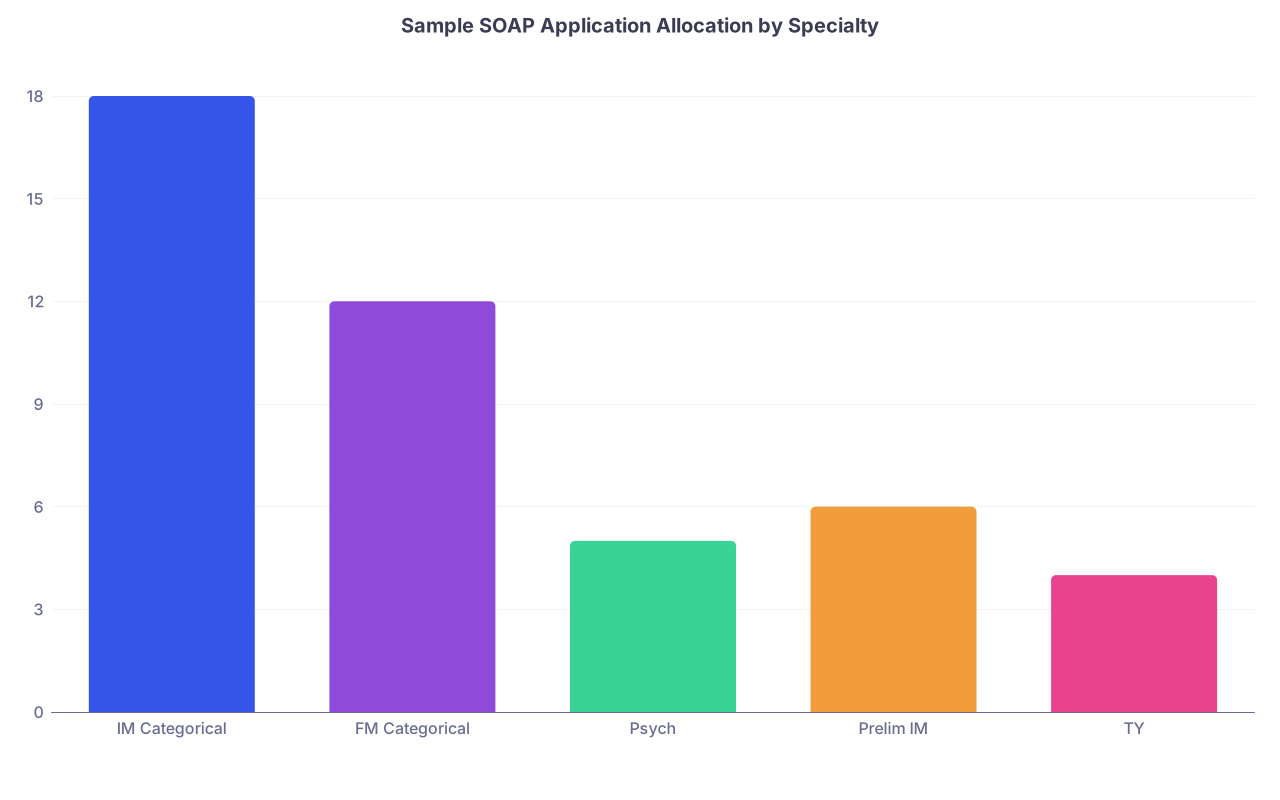
| Category | Value |
|---|---|
| IM Categorical | 18 |
| FM Categorical | 12 |
| Psych | 5 |
| Prelim IM | 6 |
| TY | 4 |
- 18 IM categorical (community and lower‑tier academic)
- 12 FM categorical (broad geography)
- 5 Psych (only programs whose criteria you meet)
- 6 Prelim IM (backup if categorical fails)
- 4 TY (where you realistically could see yourself)
This is the kind of spread you should be constructing during the 10:00 am–2:00 pm block.
What You Should Not Do on SOAP Monday
Sprinkled through the day, here are the landmines to avoid:
- Spending 30 minutes writing a “perfect” personal statement for one obscure program
- Rewriting your CV or experiences section mid‑day
- Checking social media for who matched where
- Arguing with your advisor about how you “really could match Ortho in SOAP” with 0 interviews
- Refreshing ERAS every 20 seconds to see if something “looks different”
All of that burns focus. Focus is your edge.
Quick Visual: Your SOAP Monday At a Glance
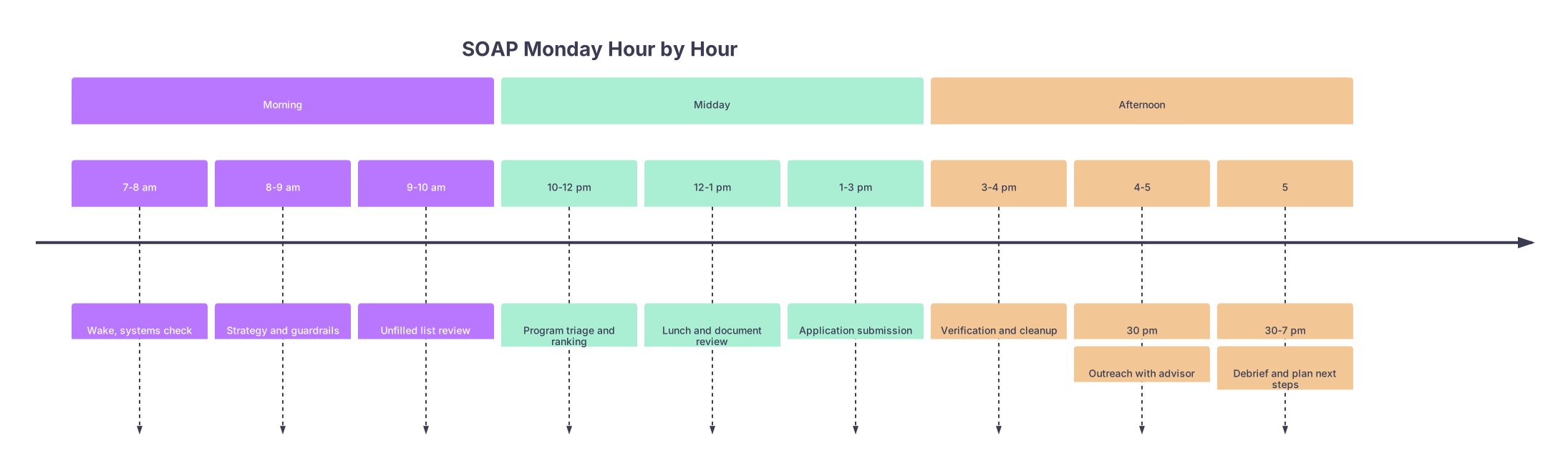
| Period | Event |
|---|---|
| Morning - 7-8 am | Wake, systems check |
| Morning - 8-9 am | Strategy and guardrails |
| Morning - 9-10 am | Unfilled list review |
| Midday - 10-12 pm | Program triage and ranking |
| Midday - 12-1 pm | Lunch and document review |
| Midday - 1-3 pm | Application submission |
| Afternoon - 3-4 pm | Verification and cleanup |
| Afternoon - 4-5 | 30 pm |
| Afternoon - 5 | 30-7 pm |
Right now, before you do anything else, open a fresh spreadsheet and create the exact column headers you’ll need for the unfilled list. When that list drops Monday morning, you should be typing program names into a system—not scrambling to invent one.