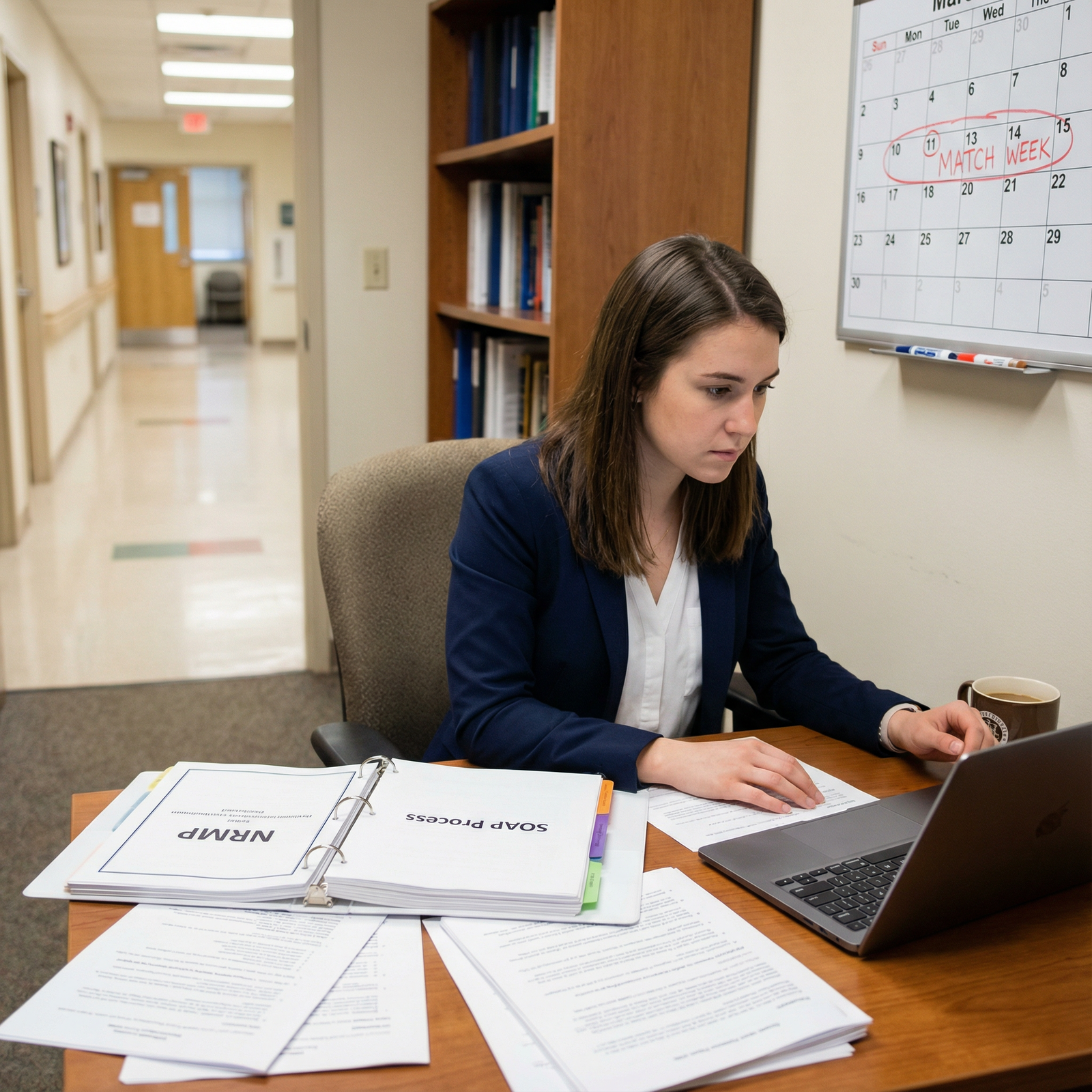
Most limited-interview applicants lose the SOAP before it even starts. Not because they are weak candidates—because they make preventable, predictable mistakes.
I am going to walk you through the disasters I see every single year from otherwise decent applicants who could have matched through SOAP… but sabotaged themselves.
If you have few or no interviews, you do not have margin for error. SOAP is not a second-chance party. It is a controlled fire. If you walk into it unprepared or emotional, you will get burned.
Let’s stop that.
1. Waiting Until Monday to “Figure Out” SOAP
The worst SOAP mistake is simple: starting too late.
Every March, I watch applicants open ERAS on Monday of Match Week and then start:
- Asking what specialties to consider
- Rewriting their personal statement from scratch
- Emailing letter writers for “SOAP letters”
- Trying to understand how SOAP rounds work
By the time they understand the rules, two rounds are gone. Sometimes all meaningful positions are gone.
You must not do this.
What you should have done before Monday
If you are reading this before Match Week, good. You still have time to avoid this mess. At a minimum, have the following pre-built:
- A SOAP-appropriate CV (ERAS is your main CV, but keep a concise version handy for emails)
- At least 2–3 different personal statements:
- One for your original specialty
- One for prelim / transitional / backup IM/FM
- One flexible “general” PS you can lightly edit
- A list of:
- All previous interview locations
- Programs where you rotated
- Programs where faculty you know now work
If you are already in Match Week and have none of this, your “SOAP plan” is now a damage-control operation. Do not waste Round 1 writing the perfect paragraph. You accept that your materials will be imperfect and focus on speed and clear communication.
2. Applying Too Narrowly (Or Too Proudly)
Every year someone with 0–2 interviews decides they are “only” applying to:
- University categorical IM
- Or only anesthesia programs
- Or only big-name institutions
They tell me: “I do not want to waste an application on community programs.”
Then Wednesday arrives. There is nothing left.
SOAP is not your brand curation phase. It is your “obtain a training position and a paycheck” phase.
The trap
The mindset that kills people:
- “I deserve better than that program / location.”
- “I will just reapply next year to something stronger.”
- “I do not want to explain a low-tier program forever.”
Reality: A completed residency from a less glamorous program beats another wasted year and a growing gap. Especially if you are IMG, non-traditional, or already have red flags.
How to avoid this mistake
On Monday, once you see “Did Not Match,” you should have:
- A clear list of all specialties you are realistically willing to train in
- A frank understanding: transitional year or prelim year may be your best door into the system
- A rule like:
- If I have 0–1 interviews initially, I apply broadly to IM/FM/prelim/transitional at almost any accredited program in the country that is not clearly toxic.
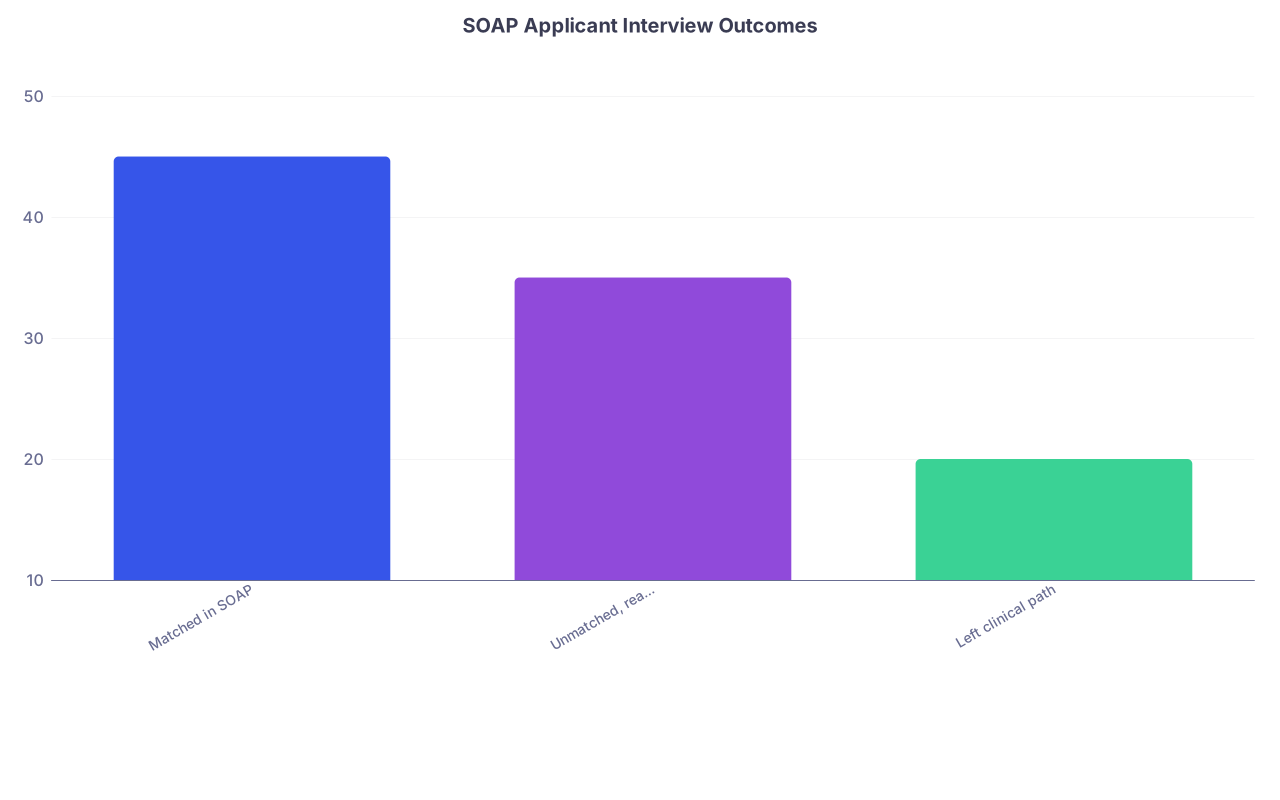
| Category | Value |
|---|---|
| Matched in SOAP | 45 |
| Unmatched, reapplied | 35 |
| Left clinical path | 20 |
People who get stuck are usually not underqualified. They are too narrow. Too proud. Or in denial.
3. Blindly Blasting the Same Personal Statement Everywhere
Here is a quiet disaster: the generic, obviously misaligned personal statement.
Examples I have actually seen in SOAP:
- Applying to Family Medicine with a PS that says “I am committed to a career in Plastic Surgery.”
- Applying to Prelim Internal Medicine with three paragraphs about lifelong dreams of Dermatology and zero mention of IM.
- Applying to Psychiatry with a PS that does not mention mental health once.
Program directors notice. In SOAP, they scan quickly for one thing: “Does this applicant appear to actually want what we train?”
If the answer is no, you are in the discard pile.
The worst versions
- Specialty name wrong in the PS
- Copy-paste errors from another field
- Arrogant tone: “I will use this prelim year as a stepping stone”
Stop doing that.
How to do this correctly (without rewriting 15 essays)
You do not have time for 15 custom essays in SOAP. But you can quickly:
Create 2–3 base templates, not 1:
- Medicine-focused
- Primary care / family-focused
- Non-procedural generalist (psych, neuro, etc.)
For each program type, adjust 2–3 sentences:
- Mention a relevant patient type, skill set, or setting
- Show you understand one real aspect of the field
Delete lines that scream “I am only here because my dream specialty ghosted me.”
This is not about artful storytelling. It is about avoiding giant, flashing “wrong specialty” flags.
4. Ignoring Prelim and Transitional Positions (Or Misunderstanding Them)
Another common failure: applicants treat prelim and transitional year spots like trash.
That is careless.
Prelim and TY positions are:
- A way to get into the system
- A year of U.S. experience
- Sometimes a path to re-apply internally for categorical spots
- Occasionally convertible into categorical positions when residents leave
The mistake is either:
- Not applying to them at all
- Or applying without realizing what they mean for your longer plan
Who absolutely should not ignore prelim/TY
- IMG with limited interviews
- US grads with exam failures or gaps
- Anyone with 0 interviews going into Match Week
A prelim IM year followed by a spot that opens up somewhere is not a fantasy. It happens every cycle. But only to people who are in the building, working, showing up on rounds, and known to PDs.
But do not confuse what prelim/TY is
- It is not automatically a categorical guarantee
- It is not identical across programs (some are brutal service, some are well-structured)
- It does require a realistic mental and financial plan for what happens after that first year
You avoid disaster here by being clear-eyed, not by dismissing these positions because they are not “ideal.”
5. Focusing Only on ERAS and Ignoring Direct Contact
Big mistake: believing that clicking “apply” in ERAS is the whole game.
During SOAP, programs are flooded. They may get hundreds of applications for a handful of spots in a few hours. Your job is to make sure your name does not just sit in a list.
No, you are not going to spam every PD in the country. But you should be strategic.
Common errors I see
- No outreach at all
- Or mass, copy-pasted emails to 80 programs with obvious mail-merge errors
- Or long, emotional narratives about failing the Match
The right approach is targeted, short, and professional.
What a reasonable outreach plan looks like
Priority list:
- Places where you rotated
- Places that previously interviewed you
- Programs connected to your med school alumni or mentors
Short email (3–6 sentences) sent to:
- Program director
- Program coordinator
Message content:
- Identify yourself
- Note you have applied through SOAP to their specific position
- Briefly highlight 1–2 fit points (e.g., prior rotation in similar setting, language skills, regional ties)
- Offer to send any additional info or be available immediately for interview

| Step | Description |
|---|---|
| Step 1 | See Unfilled List |
| Step 2 | Identify Target Programs |
| Step 3 | Check for Prior Connections |
| Step 4 | Apply via ERAS |
| Step 5 | Send Targeted Email |
| Step 6 | Be Phone Ready |
Do not overcomplicate this. One clean paragraph beats a page of desperation.
6. Letting Panic and Shame Control the Week
I have seen perfectly capable applicants destroy their SOAP chances because they emotionally collapsed on Monday.
Patterns:
- They stop responding to emails in real time
- They delay taking phone calls because they feel embarrassed or “not ready”
- They disappear from their advisor’s radar for 24–48 crucial hours
- They vent on social media about unfairness instead of executing a plan
You cannot afford this.
You are allowed to feel awful. You are not allowed to let those emotions run your schedule during SOAP week.
Practical emotional safeguards
- On Sunday night: decide who your one or two support people are (friend, partner, advisor). Not 10. Too many voices equals chaos.
- Block your calendar Monday–Thursday. You are “on call” for any program.
- Decide in advance:
- You will pick up any unknown U.S. number
- You will pause, breathe once, then answer professionally
If you need to break down, do it after 6 PM. SOAP is a short, brutal window. You can process the trauma later. Right now, you are running an operation.
7. Underestimating How Fast SOAP Moves (And Missing Calls)
Nothing kills an application faster than unavailability.
Programs often:
- Review applications quickly
- Phone-interview in short bursts
- Fill positions within hours of each round starting
If they cannot reach you, they move on. They rarely chase you.
Common disasters:
- Phone on silent / “Do Not Disturb”
- No voicemail set up or mailbox full
- Using only email while programs are calling
Set yourself up like this
- Keep your phone charged, sound on, volume high
- Professional voicemail greeting (no music, no jokes)
- Email notifications on, but do not let them distract you from calls
- Stay in a quiet environment where you can instantly switch to “interview mode”
If you are on rotations, you must talk to your attending in advance:
- Tell them you may receive urgent calls for programs
- Ask for flexibility to step out if necessary
- Coordinate coverage if you are scrubbed into cases
Programs do not care that you were “busy.” They care that 1) they called, and 2) you did or did not answer.
8. Going Into SOAP With Zero Honest Self-Assessment
Here is another brutal error: pretending SOAP will magically erase the underlying problems that got you here.
It will not.
If you had:
- Multiple exam failures
- Major professionalism issues
- Big gaps in training
- Very late applications or weak letters
Those issues still exist on Monday of Match Week. Programs see them instantly.
The mistake is denial. Applicants apply as if they are “average” candidates and make bizarre choices:
- Targeting hyper-competitive programs during SOAP
- Writing personal statements that do not address major red flags at all
- Acting shocked when they get no callbacks
What you need to do instead
Before SOAP starts, force yourself (or sit with a mentor) and answer:
- Why did I likely not match this year? Be specific.
- Which parts of that are fixable in the short term (e.g., new Step score, updated MSPE addendum)?
- What story am I going to tell programs succinctly about what changed or what I have learned?
This is not about self-loathing. It is about not repeating the same delusions that got you into SOAP in the first place.
If your Step 2 score is 204, you do not talk to programs like you are a 260 superstar. You highlight your strengths, but you also acknowledge reality and present a mature, grounded candidate.
9. Burning Bridges With Your Home Institution or Mentors
Match Week brings out the worst in people. I have watched applicants:
- Lash out at their dean’s office
- Blame advisors on email threads
- Argue with faculty who are still trying to help
- Publicly trash their school or program on social media
Guess who programs call for informal backchannel feedback?
Your dean’s office. Your department. The people you are currently yelling at.
This is career suicide.
What to avoid
- Angry emails about “you failed me” or “this school abandoned me”
- Posting about specific faculty or your med school name in a negative way
- Refusing to use available advisors because you feel they “do not get it”
You can absolutely be disappointed and frustrated. You do not get to torch the people whose phone calls and emails may quietly keep you in consideration.
Act like the attending you hope to be, not like an angry MS1 who bombed an anatomy exam.
10. Treating SOAP as the End of the Story, Not One Step
The final mistake: seeing SOAP as the entire story of your career rather than one brutal chapter.
Two dangerous patterns:
- Over-attaching identity to where you land (or do not land) in SOAP
- Failing to plan for the “what if I remain unmatched?” path
The result is paralysis. People either:
- Accept a truly toxic setup because “this is my only chance ever”
- Or refuse reasonable options because they cannot see how their career might still work out if they take a less direct route
You avoid this by doing something most applicants skip
You sketch out two parallel paths:
If I match in SOAP
- How will I use this year to strengthen my trajectory?
- What if I want to change specialties? How will I network and perform?
If I do not match in SOAP
- What is my 12-month plan? (Research, MPH, observerhips, improved scores, reapplying strategy)
- How will I address this in future applications in a composed, honest way?
| Path | Focus |
|---|---|
| SOAP Match | Performance, networking |
| No SOAP Match | Scores, research, mentorship |
| Prelim/TY Only | Internal networking, categorical transfer |
SOAP is painful. But it is not the end unless you let it be.
Quick Red-Flag Checklist: Are You Walking Into a SOAP Disaster?
If any of these are true right now, fix them today:
- You do not know the SOAP timeline and round structure.
- You have only one personal statement that screams your original specialty.
- You have not considered prelim/TY or backup specialties at all.
- Your phone voicemail is unprofessional or full.
- You have not talked to your dean’s office or advisor about a SOAP plan.
- You are secretly planning to “wait to see the unfilled list” before making any strategy decisions.
Correct these now. Not Monday at 10 a.m.
FAQs
1. Should I apply to programs in places I really do not want to live, just to get a spot?
You should not sabotage your life, but you also should not pretend you have leverage you do not. If you have limited interviews and no match, geographic pickiness is a luxury you probably cannot afford. The honest test is: “Could I tolerate living here for at least a year or two to secure my training and license?” If the answer is yes, apply. If the answer is absolutely no (extreme safety concerns, zero support system, serious medical issues), then you can reasonably exclude. But be aware: the more places you cross off, the lower your odds.
2. Do programs actually read personal statements during SOAP, or am I wasting time editing?
They read enough to screen you out. Not always every word, but they absolutely notice mismatched specialty statements, arrogant tones, or obvious copy-paste mistakes. You do not need literature-quality writing. You do need alignment and absence of glaring errors. Minimal, smart editing is worth it. Spending three hours polishing one paragraph while Round 1 is active is not.
3. How much should I mention my failure to match if programs ask?
Be concise, factual, and unemotional. One or two clear sentences is enough: what happened, what you learned, and what has changed. For example: “I applied late and too narrowly to highly competitive programs, and I did not receive enough interviews. I have reflected on that, broadened my scope, and I am committed to building a strong foundation in internal medicine.” Do not launch into a 10-minute monologue about unfairness or blame. Ownership and composure are far more attractive than perfect stats.
Open your ERAS account and your calendar right now. Block off Match Week, draft at least two alternative personal statements, and make a list of specialties and program types you would actually accept. That one hour of preparation today can stop you from sleepwalking into a SOAP disaster later.