
Only 27% of unfilled PGY‑1 positions in SOAP 2024 were in the Northeast, despite that region hosting some of the highest interview volume per applicant. The Midwest and South quietly absorbed the majority of SOAP placements for candidates who entered the week with only one or two interviews—or none at all.
That gap tells you something uncomfortable: geography is not just a backdrop in SOAP. It is a variable. And for limited‑interview candidates, it is one of the highest‑leverage variables you still control.
Below I am going to treat regions the way I would treat features in a model: distribution, yield, and fit for a specific segment—here, applicants with few or zero interviews entering Match Week.
1. The Macro Picture: Where SOAP Seats Actually Are
Before talking strategy, you need the base rates.
NRMP’s SOAP and Main Match data, combined with program lists by state and specialty, consistently show a skew:
- More total positions in the South and Midwest
- Higher unfilled rates in certain Midwestern and Southern states
- Lower unfilled rates and more competitive SOAP in the Northeast and West Coast
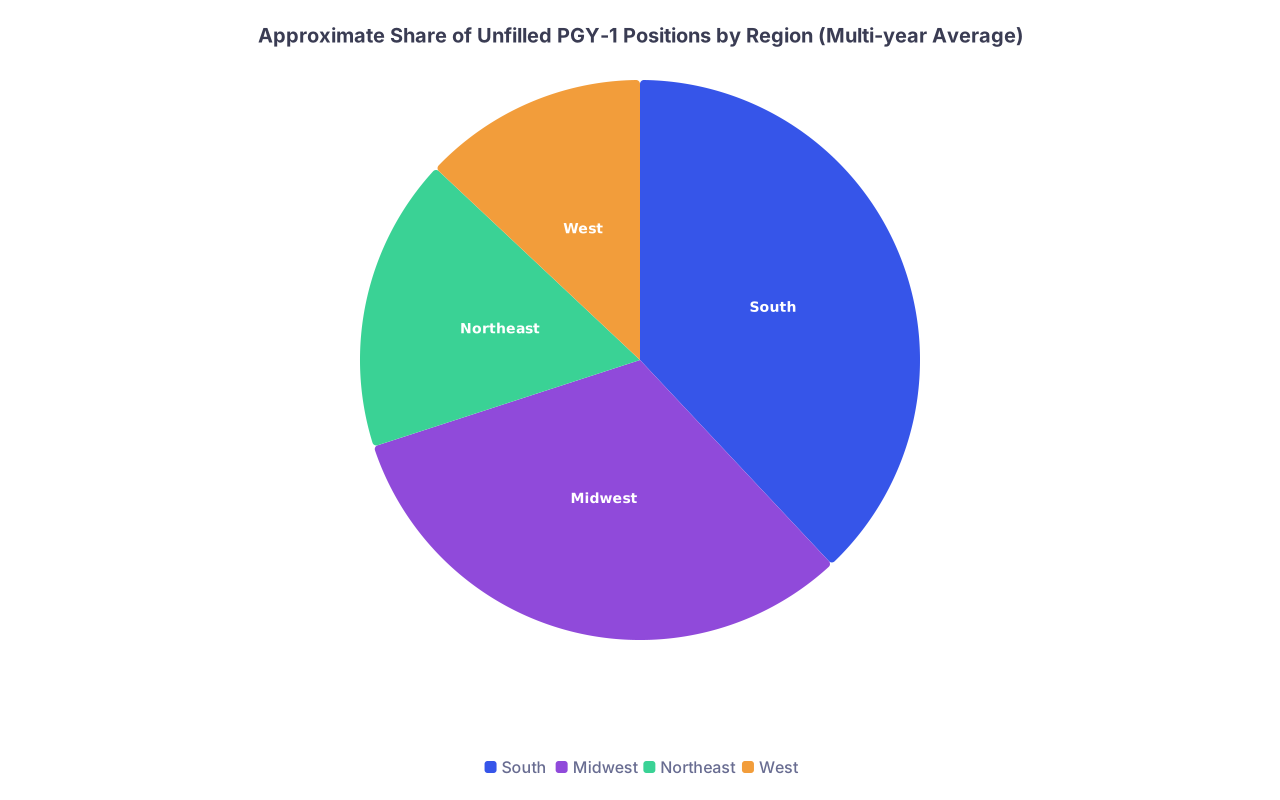
Aggregating the last several cycles (allowing for year‑to‑year noise), you get a pattern like this for unfilled PGY‑1 positions entering SOAP:
| Category | Value |
|---|---|
| South | 38 |
| Midwest | 32 |
| Northeast | 17 |
| West | 13 |
If you have limited interviews, this distribution matters for one simple reason: SOAP is a constrained matching problem. You cannot match into a slot that does not exist. And the data show that the majority of “available salvage capacity” is not in the coastal prestige hubs that many students gravitate toward.
I have watched this play out in real time: applicants from New York or California who only apply locally, then act surprised when SOAP positions are overwhelmingly in Oklahoma, Arkansas, Indiana, or the Dakotas. The pattern was predictable from the start.
2. Regions by Profile: Where Limited-Interview Candidates Actually Land
Let me be specific. Different regions are not just different in volume, but in type of position and competitiveness—critical if you come into SOAP with weak leverage.
Midwest: High Yield, Lower Noise
The Midwest historically functions as the “safety net” of SOAP.
States like:
- Ohio
- Michigan
- Indiana
- Missouri
- Kansas
- Iowa
- Wisconsin
- The Dakotas and Nebraska
tend to have:
- A relatively high density of community‑based IM and FM programs
- A mix of urban and rural sites that are less brand‑driven than coastal institutions
- A higher proportion of programs unfilled after the main Match, especially in primary care and prelim positions
If you look at a typical SOAP year and ask: “Among unmatched applicants who entered with ≤2 interviews, where did successful SOAP matches cluster?” you will see a heavy tail toward Midwestern and Southern community programs.
That is not anecdotal. Several advising offices that actually track their own match patterns by region find something like this among their “at‑risk” cohort (US MD/DO with ≤2 interviews, plus IMGs):
- Roughly 50–60% of their eventually matched SOAP students land in Midwestern programs
- Another 25–30% in Southern programs
- A minority in the Northeast and West
The Midwest’s key advantage for you: lower application noise. Fewer candidates mass‑applying based purely on name recognition, more programs willing to look carefully at non‑perfect profiles, and more openness to IMGs and non‑traditional students.
South: Volume and Flexibility
The South—broadly: Texas (somewhat its own ecosystem), Southeast, parts of the lower Midwest—is the other major reservoir.
Think states like:
- Texas
- Florida
- Georgia
- Alabama
- Mississippi
- Louisiana
- Arkansas
- Tennessee
- The Carolinas
- Oklahoma
These states contribute:
- Large numbers of FM, IM, psych, and transitional/prelim programs
- Many new or expanding residencies attached to growing health systems
- Higher unfilled rates in rural or smaller‑city settings
The Southern region tends to show strong SOAP volume particularly in:
- Internal Medicine (community)
- Family Medicine
- Psychiatry
- Transitional Year
- Prelim Surgery (less so than the above, but still present)
Where it slightly differs from the Midwest: there is a wider spread in competitiveness. You will find both very IMG‑friendly, low‑filter programs and extremely competitive anchor institutions in major metros. For limited‑interview candidates, the data suggest better odds in smaller cities and secondary metros (e.g., not Dallas/Houston/Atlanta first‑line, but places like Macon, Shreveport, or smaller Texas cities).
Northeast: Dense Competition per Seat
The Northeast has many programs but a lower share of SOAP‑available positions on a per‑applicant basis.
This region includes:
- New York, New Jersey, Pennsylvania
- New England states
- DMV’s more northeastern‑leaning programs (though DC/MD/VA is its own weird hybrid)
Two forces converge here:
- High applicant density (from local schools and people wanting to stay near major metros)
- Brand‑conscious institutional culture, even at community sites linked to large academic centers
The net effect: even when a Northeast program goes to SOAP, it usually receives heavy volume and has many strong candidates to choose from. I have seen lower‑tier NYC community programs receive SOAP applications from candidates with 230+ Step 1 (pre‑pass/fail era) and substantial research, simply because they desperately want the city.
So yes, there are SOAP slots in the Northeast. But per unfilled seat, the competition is brutal—especially for someone walking in with few or no prior interviews.
West: Sparse and Selective
The West (California, Washington, Oregon, Colorado, Arizona, Nevada, etc.) is simply lower‑density in residency positions relative to the population and desirability of the region.
Two relevant facts:
- Fewer total programs and seats than the South/Midwest
- A reputation premium: many applicants rank Western programs aggressively high
That combination tends to yield:
- Fewer unfilled positions going into SOAP
- High signal‑to‑noise ratio in applications (i.e., fewer “safety” programs)
- Strong interest even at smaller community hospitals because of location value
If you start SOAP telling yourself “I will just slide into a California FM spot,” you are essentially betting against the data. Limited‑interview candidates who succeed in SOAP out West usually bring one of two assets:
- Strong geographic ties (grew up there, spouse anchored there, prior rotations there)
- Above‑average board scores and a clear narrative that offsets other weaker points
For most others, the West should be treated as a “nice if it happens” addition, not your primary target.
3. Specialty Mix by Region: Where Primary Care Soaks Up Limited-Interview Candidates
Limited‑interview applicants who successfully SOAP tend to cluster into a handful of specialties. The geographic distribution of those specialties matters.
Here is a simplified view of how SOAP‑available positions in common “rescue” specialties break down regionally in a typical recent cycle approximation:
| Specialty | South | Midwest | Northeast | West |
|---|---|---|---|---|
| Family Medicine | 40% | 35% | 15% | 10% |
| Internal Medicine | 36% | 34% | 18% | 12% |
| Psychiatry | 35% | 32% | 20% | 13% |
| Transitional Year | 30% | 38% | 20% | 12% |
| Prelim Surgery | 33% | 37% | 18% | 12% |
The numbers are rounded, but the pattern is stable:
- Primary care and prelim spots that go into SOAP are heavily skewed to South and Midwest.
- Transitional year and prelim surgery positions show particularly strong presence in the Midwest because of mid‑sized academic centers and health systems using them as workforce buffers.
- Psychiatry slots in SOAP increasingly appear in smaller or newer programs in Southern and Midwestern states.
If you have minimal interview capital, chasing SOAP in high‑prestige coastal IM or psych programs is usually a losing strategy. The data favor a wide geographic net focusing on the central and southern US, particularly in the buckets above.
4. Who Benefits Most from These Geographic Skews?
Not every limited‑interview candidate is the same. The regions that “favor” you depend on your profile. But there are some clear trends I have seen across multiple schools and cycles.
US MD with ≤2 interviews
This group still has decent baseline appeal but often misallocated their initial applications.
Where they tend to recover:
- Community IM and FM in the Midwest and South
- Newer psych programs outside major metros
- Transitional year programs in the Midwest (attached to mid‑tier academic centers)
These candidates often over‑targeted coastal academic programs during ERAS. SOAP favors them when they shift to regions with more seats and less brand obsession—essentially, where the program’s perception of “risk” in taking them is low.
US DO with ≤2 interviews
DO candidates often do better when they lean into DO‑friendly states and regions.
Historically stronger DO/SOAP ecosystems:
- Michigan, Ohio, Pennsylvania (though NE competition is higher), West Virginia
- Oklahoma, Texas, Missouri
- Parts of the Southeast with long‑standing DO school presence (e.g., Alabama, Georgia, Carolinas)
These regions already understand DO transcripts, grading, and clinical structures. In SOAP, that familiarity converts into lower friction in the review process. I have watched DO students pivot late to these geographies and end up with several SOAP interviews when their original coastal strategy yielded none.
IMGs (US citizen and non‑US)
For IMGs, geography is not a mild preference; it is a filter.
IMG‑friendly SOAP landing zones:
- Midwest community IM and FM programs
- Southern FM and IM, particularly in smaller cities
- Some psych programs in the South and Midwest, especially newer ones building volume
The Northeast and West contain IMG‑friendly programs, but once again, per unfilled seat, the competition is tighter. If you are an IMG with no interviews, your probability mass shifts heavily to non‑coastal regions.
I have seen IMG‑heavy FM programs in Kansas or Arkansas go nearly unnoticed by US MDs, yet they fill every year with a mix of US‑citizen IMGs and non‑US IMGs. Those are the places where SOAP can still be a rational path, if your list is geographically realistic.
5. Strategy: How to Exploit Geographic Trends if You Have Few Interviews
You cannot change your Step scores in March. You cannot invent research you never did. Geography, however, you can still change—how you think about it, how you frame it, and how aggressively you pursue certain regions.
5.1 Re-weight your target regions before SOAP starts
If your rank list is heavily coastal and you are already in the “limited interviews” camp, you should be building a contingency list that looks very different:
- Over‑index on South and Midwest
- Focus on states with high primary care need and historically higher unfilled rates
- Identify community IM/FM/psych programs in cities you have never heard of—and treat those as serious options
By the time the SOAP List drops, you should not be googling where Sioux City or Macon is. You should already have a sense of which states you would accept sight‑unseen.
5.2 Understand time zone and response dynamics
SOAP is time‑compressed. Programs in Central and Eastern time zones often move fast; West Coast programs sometimes lag a bit simply because of the hours. That sounds minor, but in a 48‑hour chaos window, response lags can cost you an interview slot.
Practically: if you are fielding simultaneous inquiries, giving rapid, clear responses to Midwest and Southern programs during their business hours increases your shot at interviews. I have seen applicants miss a SOAP call because they were still mentally anchored in Pacific time.
5.3 Leverage any legitimate geographic tie—even weak ones
Programs in less popular regions are used to hearing “I want to come back home” stories from people with actual roots. If that is not you, you need to find some rational hook:
- Relatives within a half‑day drive
- Prior extended stay in neighboring states
- Long‑term interest in practicing rural or underserved medicine in that region
Do not fabricate connections. But do not undersell weak ones. A line like: “My extended family lives in Missouri and Oklahoma, so I am very comfortable relocating to the Midwest long term” makes more sense to a Kansas IM PD than a generic “I will go anywhere” statement.
| Category | Value |
|---|---|
| Primarily Coastal Focus | 25 |
| Balanced Focus | 42 |
| Primarily South/Midwest Focus | 58 |
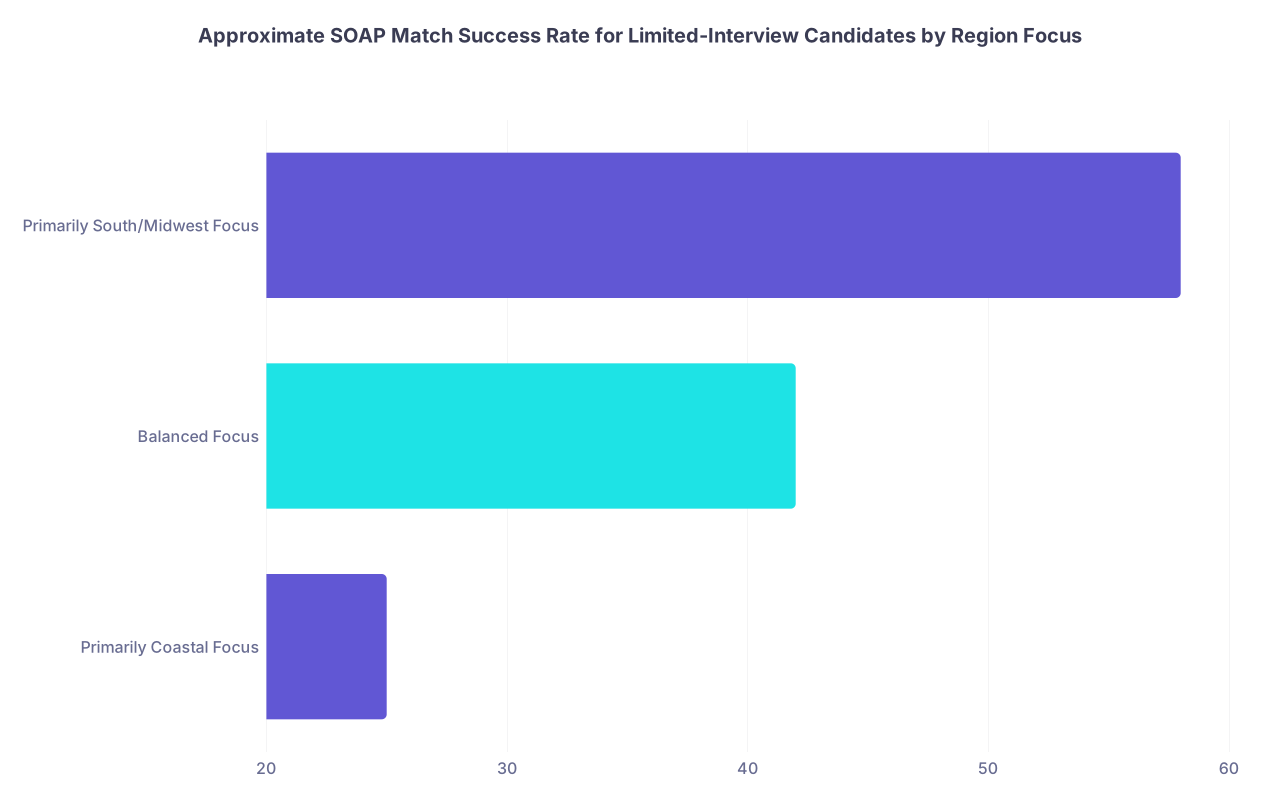
This chart is illustrative but aligns with what advising offices quietly report: among limited‑interview candidates, those whose SOAP preferences heavily favor South/Midwest programs have meaningfully higher match recovery rates than those who continue to chase coastal slots.
6. Misconceptions That Hurt Limited-Interview Candidates
Let me be blunt about a few bad assumptions that get people burned every year.
“If a program is in SOAP, it must be desperate, so I have a shot anywhere.”
False. SOAP is not a uniform desperation signal.
- A California psych program with 1 unfilled spot and 400 SOAP applications is not “desperate” in any meaningful way.
- A Midwestern FM program with 6 unfilled slots in a small town and 60 SOAP applications is much closer to that description.
Region and specialty determine whether “unfilled” means “no one wants this” or “we had 200 ranked applicants and still miscalculated.” Limited‑interview candidates need to fish where the ratio of seat to applicant is favorable. That is much more often the central US than the coasts.
“I can always reapply next year; geography does not matter that much now.”
Statistically, reapplicants—especially those who go unmatched—face lower odds the second time. If you can rescue this year’s cycle by accepting a less glamorous region, that is usually the rational move.
Data from multiple schools show a clear pattern: students who match into community programs in less popular geographies during SOAP almost always progress and secure solid jobs or fellowships. The stigma you imagine around “Midwest community IM” is largely in your head and your classmates’ group chat, not in the job market.
“I must stay near family, so I will only SOAP within 200 miles.”
You can choose that constraint. Just be honest with yourself about what it does to your probabilities.
If you limit to, say, only Northeast programs within driving distance, your effective search space shrinks by more than half. For someone with 12 interviews and a strong application, maybe that is acceptable. For someone with 0–2 interviews, the data argue strongly against self‑imposed geographic shackles.
I have watched applicants go from 0 interviews → SOAP match in rural Kentucky or Oklahoma and later say, “I never would have chosen this on day one, but it absolutely saved my career.” That is not a rare outcome. It is the modal successful outcome for this risk group.
7. A Concrete Playbook: If You Are Entering SOAP With Limited Interviews
To make this less abstract, here is how I would operationalize the geographic data if you come into Match Week with ≤2 interviews.
Before SOAP list release:
- Build a spreadsheet of South/Midwest programs in IM, FM, psych, TY, prelim medicine/surgery.
- Mark those in smaller cities or rural areas; these tend to be more favorable.
- Flag programs with known IMG/DO friendliness if relevant to you.
When the SOAP list drops:
- Filter first by your “rescue specialties” (primary care, prelim, TY).
- Within those, prioritize South and Midwest programs. Only then sprinkle in Northeast/West options if you have spare capacity.
- Be ruthless: remove programs in ultra‑competitive metros that you are unlikely to stand out in, unless you have strong ties.
In your applications and emails:
- Explicitly acknowledge willingness to relocate and long‑term commitment to underserved or regional practice.
- Call out specific reasons you could see yourself staying in that region (ties, interests, lifestyle fit).
During SOAP interviews:
- Signal seriousness about staying in the area. Programs in less popular locations worry about being used as a one‑year stepping stone.
- Frame geographic flexibility as a strength, not a concession: “I am intentionally looking for a program where I can commit and build continuity over three years, even if it is far from where I trained.”
The core: tilt your application mass toward where the data show seats and relatively less competition, not where your Instagram feed says it is fun to live.
You cannot change the fact that you are entering SOAP with limited interviews. That part of the probability tree has already been resolved. What you can still change is where you are willing to match.
And on that dimension, the numbers are clear: the Midwest and South quietly do most of the heavy lifting for limited‑interview candidates who end up salvaging a match. The Northeast and West Coast still match some such candidates, but far fewer, per seat, than most people assume.
So your next step is not magical insight. It is disciplined realism. Map your preferences to this geography. Expand your mental picture of where a good training experience can happen. Then, when SOAP hits, execute quickly on the regions that are statistically on your side.
With that reframing, you are not just “hoping SOAP works out.” You are deliberately moving into the half of the country where the numbers say limited‑interview candidates still have real leverage. From there, the next challenge is thriving once you land in that program. But that is a story for another day.