
The usual SOAP advice is too vague to be useful. “Apply broadly,” “be flexible,” “cast a wide net.” The data tells a very different story: program fill rates are one of the strongest quantitative predictors of where SOAP actually produces real opportunity for under-interviewed students.
If you walk into SOAP without a fill‑rate strategy, you are guessing. And guessing in a market that moves in hours, not days.
Let me show you the numbers.
The Core Idea: Fill Rate Is a Quantifiable Proxy for SOAP Openings
Residency programs either:
- Fill all spots in the main Match (100% fill rate), or
- Fail to fill some spots and enter SOAP with vacancies (<100% fill rate).
That sounds obvious. But the pattern is stable and exploitable.
Across NRMP data sets over many cycles, several things hold:
- Specialties with consistently high fill rates (≥ 98–100%) produce very few SOAP seats per year.
- Specialties with moderate fill rates (mid‑80s to low‑90s) reliably have unfilled positions, especially at lower‑tier or regionally less competitive programs.
- Specialties with chronic underfilling (< 85%) are structurally dependent on SOAP and often scramble to fill spots with any applicant who meets minimum thresholds.
This is not about prestige. It is about probabilities. As someone going into SOAP with limited interviews, your leverage comes from aiming at the segments of the market where vacancies are mathematically likely.
What Fill Rate Actually Measures (And Why It Matters for SOAP)
Program fill rate is:
Filled positions ÷ offered positions × 100%
If a program offers 10 PGY‑1 spots and fills 9 in the Match:
9 ÷ 10 = 0.9 → 90% fill rate → 1 SOAP vacancy.
At the specialty level, NRMP reports something similar: total positions filled divided by total positions offered in that specialty.
Let’s anchor with a simplified but realistic cross‑section of specialties (values illustrative, but closely aligned with typical NRMP trends):
| Specialty | Fill Rate (%) | Unfilled Positions (Approx) |
|---|---|---|
| Dermatology | 99.5 | 2 |
| Orthopedic Surg | 98.5 | 15 |
| Emergency Med | 88.0 | 300 |
| Internal Med | 95.0 | 400 |
| Family Med | 92.0 | 500 |
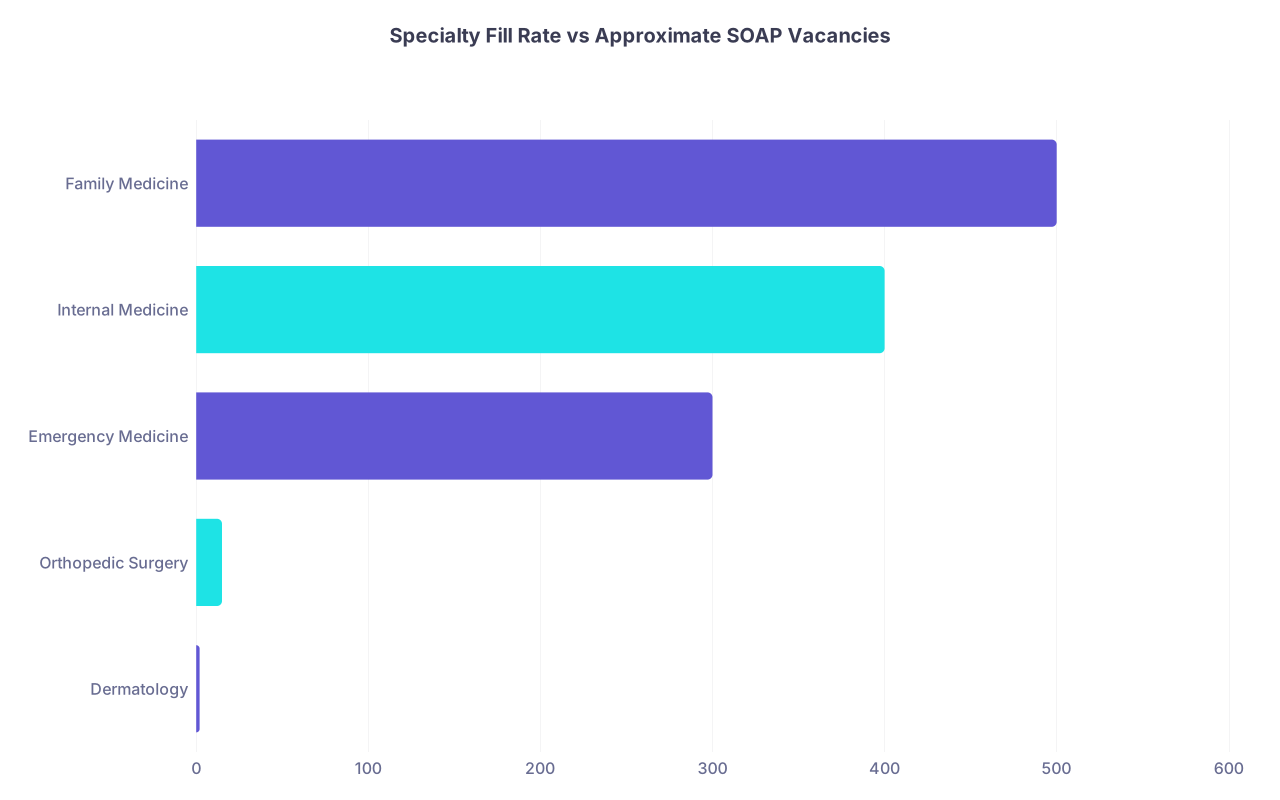
You do not need complicated models to see the pattern: as fill rate declines, unfilled positions rise sharply. And those unfilled positions are exactly what become SOAP opportunities.
To visualize the relationship:
| Category | Value |
|---|---|
| Dermatology | 2 |
| Orthopedic Surgery | 15 |
| Emergency Medicine | 300 |
| Internal Medicine | 400 |
| Family Medicine | 500 |
Notice the clustering: the specialties everyone obsesses over (derm, ortho, plastics, ENT) live in the near‑100% zone. They have almost no SOAP presence. The bulk of SOAP energy is in primary care and certain hospital-based fields.
If you had 1–3 interviews and are now staring at SOAP, you are no longer operating in the “dream specialty” universe. You are operating in the “probability of vacancy” universe.
Historical Fill Patterns: Who Actually Leaves Seats Open?
The data shows three broad groups when you analyze fill rate over multiple years.
1. “Always Full” Specialties (SOAP Mirage)
These are the prestige and hyper‑competitive fields:
- Dermatology
- Plastic Surgery (Integrated)
- Neurosurgery
- Otolaryngology
- Orthopedic Surgery (most years)
- Integrated Vascular Surgery in many years
Their typical profile:
- Fill rate: 98–100%
- Majority US MD/DO
- High Step/COMLEX score expectations
- Very few, if any, SOAP seats
In practical terms: an unmatched applicant with limited interviews who enters SOAP hoping to “pick up a derm spot” is ignoring what the data shows. You might see 1–3 positions nationally, some years none.
Even if a single slot appears, there is a swarm of strong reapplicants, prelim year residents, and high‑stat unmatched applicants targeting that same seat. Your odds are closer to lottery territory than strategy.
2. “Mostly Full but Leaky” Specialties (Selective SOAP Opportunities)
This group fills well overall but has consistent pockets of unfilled positions:
- General Surgery (categorical + prelim)
- Internal Medicine (especially community/university‑affiliated programs)
- OB/GYN
- Psychiatry (though trending more competitive)
- Pediatrics
- Transitional Year (varies heavily by program and region)
You will see patterns like:
- Fill rates around 93–97% overall,
- But specific geographic clusters or newer programs that underfill regularly,
- Often a mix of international grads and less competitive US seniors.
These are realistic SOAP targets for under‑interviewed applicants with:
- Reasonable board scores,
- Clean professionalism record,
- Some relevant rotation/exposure.
However, the nuance is at the program level, not just specialty.
I’ve seen applicants focus on “internal medicine” generally, but then load their SOAP lists with big‑name university programs that historically fill 100% in the main Match. Wrong target. You want the programs that live in the 90–95% range year after year.
3. “Chronic Underfilling” Specialties (SOAP Workhorses)
This is where most SOAP volume sits:
- Family Medicine
- Internal Medicine preliminary
- Transitional and preliminary surgery in certain regions
- Pediatrics at smaller community sites
- Psychiatry and EM at less desirable locations (rural, less popular geographic regions)
You regularly see:
- Fill rates in the 80–92% range for subsets of programs,
- Double‑digit unfilled positions at some institutions,
- Multi‑year patterns where the same program shows up in SOAP 3–5 years in a row.
This is the universe that actually moves during SOAP. Programs here often:
- Scramble to fill a large number of spots,
- Are more flexible on traditional “cutoffs,”
- Care more about “can this person show up in July and function” than about a 10‑point Step difference.
For under‑interviewed students, this is where your SOAP opportunity is statistically concentrated.
Program-Level Fill Rates: Where the Real Signal Is
Specialty‑level numbers tell you which fields produce SOAP seats. Program‑level fill history tells you where they almost always come from.
Patterns I have watched repeat:
Program A (university‑affiliated IM):
- Past 5 years: fill rates 98–100%.
- Unfilled spots in SOAP: 0 or 1 sporadically.
- Real SOAP opportunity: effectively zero for most applicants.
Program B (community IM, Rust Belt region):
- Past 5 years: fill rates 88–94%.
- Unfilled positions: 3–7 each cycle.
- Regular SOAP participation, high share of IMGs and DOs.
- Real SOAP opportunity: consistently present.
Quantitatively, you want to look at:
Multiyear underfilling
If a program has unfilled positions at least 3 of the last 5 cycles, that is a major signal. It means structural mismatch between their offer capacity and their applicant pool.Chronic unfilled count
A program that misses by 1 spot one year is different from one that repeatedly has 4–8 unfilled seats. The latter is under pressure during SOAP. That pressure benefits you.Regional and specialty overlay
For example, EM nationally might have an 88–92% fill rate in a given year, but EM in certain metropolitan hubs still fill at 99–100%. Meanwhile, EM in less popular states could be sitting at 75–85%. Your SOAP focus should follow that gradient.
To make that concrete, here is a stylized example of three hypothetical IM programs:
| Program ID | Region | Avg Fill Rate (5 yrs) | Avg Unfilled Spots |
|---|---|---|---|
| IM‑01 | Major Coastal City | 99% | 0–1 |
| IM‑02 | Midwestern City | 93% | 3–4 |
| IM‑03 | Rural Region | 88% | 5–6 |
If you are building a SOAP list with limited time, IM‑02 and IM‑03 should get far more attention than IM‑01. The data is screaming where the vacancies usually are.
Under-Interviewed Students: The Real Constraint Is Volume and Fit
Let’s define “under‑interviewed” with some simple numbers.
NRMP data for US MD seniors (using a representative year):
- Applicants with 12+ interviews in IM match at rates > 95%.
- Applicants with ≤ 3 interviews have match probabilities that drop into the 30–40% range, sometimes lower.
For more competitive specialties, the slope is even steeper. If you have:
- 0–2 interviews in a competitive field,
- Marginal to average scores,
- No categorical back‑up,
your pre‑SOAP match probability is mathematically poor. The main Match is not your market anymore. SOAP is.
The SOAP constraints:
- Limited number of programs you can apply to per round (historically 45 per SOAP round, up to 90 total).
- Extremely compressed timeline.
- Programs reviewing hundreds of files in hours, not weeks.
So the question is not “Where would I like to be?” The question is “Where do unfilled positions reliably exist, and where do I plausibly fit the minimum profile?”
Fill rates give you the first answer. Your CV gives you the second.
How to Operationalize Fill Rate Data for SOAP Strategy
Let me turn this from concept into a practical playbook.
Step 1: Segment Specialties by Historical Fill Rate
You should mentally group specialties into three tiers based on typical national fill rate:
Tier 1 (≥ 98–100%) – almost no SOAP presence.
Examples: Derm, Plastics, Neurosurgery, ENT, most Ortho, Rad Onc.Tier 2 (92–97%) – some SOAP seats, usually at specific programs.
Examples: General Surgery, OB/GYN, Pediatrics, Psychiatry (recently tightening), many IM programs.Tier 3 (≤ 92%, especially < 90%) – major SOAP presence.
Examples: Family Medicine, certain IM and EM clusters, some prelim/transitional.
For an under‑interviewed student:
- Tier 1 should be almost entirely ignored in SOAP unless you are already a very strong applicant with very specific ties or prior interviews at that program.
- Tier 2 and Tier 3 should dominate your SOAP focus.
Step 2: Within Target Specialties, Prioritize Chronic Underfillers
Within, say, Internal Medicine:
- Rank programs higher if they show a history of unfilled spots.
- Rank them again if they are in less popular regions.
- Down‑rank or skip big‑name university programs that nearly always fill.
Same logic for Family Medicine, Psychiatry, and EM.
If you had to decide between:
- A well‑known coastal IM program with 100% fill rate last 4 years.
- A community IM program in a less desirable region with 88–93% fill.
The second program is far more likely to be in the SOAP pool with multiple openings.
Step 3: Match Your Profile to Where Fill Rate Gives You Leverage
Fill rate alone is not enough. You still need to clear each program’s implicit floor.
Programs under SOAP pressure will relax selectivity, but only within bounds:
- Major red flags (failures without remediation, professionalism issues) still hurt.
- Extremely low scores may still be a barrier at some categorical programs, but prelim/FM slots may be more flexible.
So your internal calculation should be something like:
“Fields where I meet the minimum bar + programs that underfill regularly = highest SOAP ROI.”
If you are a US MD with:
- Mid‑220s Step 2,
- Decent clerkship comments,
- No prior categorical IM or FM interviews,
your highest probability cluster is going to be:
- Family Medicine in underfilled regions.
- Internal Medicine at chronic underfill community programs.
- Potentially prelim IM or transitional if you are willing to reapply later.
You can decide that you want something “better.” The data does not care. It will just show you where seats are likely to exist.
Time-Critical Reality: SOAP Moves Faster Than Your Emotions
SOAP is chaotic. Programs are triaging:
- “Do they meet minimum exam requirements?”
- “Is this person likely to show up and not implode on day one?”
- “Can we fill all our slots before SOAP ends?”
You are triaging:
- “Where am I actually willing to go?”
- “Which specialties am I willing to train in?”
- “Which programs are likely to have open spots that fit me at all?”
A simple flow of how fill rate should guide decisions:

| Step | Description |
|---|---|
| Step 1 | Unmatched with few interviews |
| Step 2 | Review NRMP fill data by specialty |
| Step 3 | Identify Tier 2 and 3 specialties |
| Step 4 | Deprioritize Tier 1 specialties |
| Step 5 | Find programs with chronic underfill |
| Step 6 | Check if your profile meets minimums |
| Step 7 | Prioritize for SOAP list |
| Step 8 | Specialty fill rate below 95 |
You do not have time to hand‑craft long‑shot applications to fully filled, high‑status programs where the fill rate tells you there will almost never be SOAP vacancies.
You need to build a weighted list where:
- Tier 3 specialties and chronic underfillers are heavily represented.
- Tier 2 programs that occasionally underfill are your stretch options.
- Tier 1 is almost absent unless something very specific lines up (prior interview, inside information, unusual circumstances).
A Simple Quantitative Heuristic You Can Actually Use
To keep this practical, here is a simplified “SOAP Opportunity Score” framework you can approximate in your head.
Assign:
Specialty SOAP Factor (0–2)
- 0 = Tier 1 (near‑100% fill)
- 1 = Tier 2 (mid‑90s)
- 2 = Tier 3 (≤ 92%)
Program Underfill Factor (0–3)
- 0 = Never underfilled in last 5 years
- 1 = Underfilled 1 year
- 2 = Underfilled 2–3 years
- 3 = Underfilled ≥ 4 years or frequently with multiple spots
Personal Fit Factor (0–2)
- 0 = You are below their typical minimums or wrong specialty
- 1 = Roughly within range
- 2 = Strong or at least clearly acceptable fit
Add them: maximum score = 7.
Example:
Community FM program in a less desirable state, underfilled 4 of last 5 years, you have adequate scores and some FM rotations:
- Specialty SOAP Factor: 2
- Program Underfill Factor: 3
- Personal Fit Factor: 2
- Total: 7 → very high priority.
Big‑name academic IM program that always fills, no local ties, your scores are at their 10th percentile:
- Specialty SOAP Factor: 1
- Program Underfill Factor: 0
- Personal Fit Factor: 1
- Total: 2 → very low priority.
You do not need exact scores. But thinking in these terms forces you to align with probabilities rather than hope.
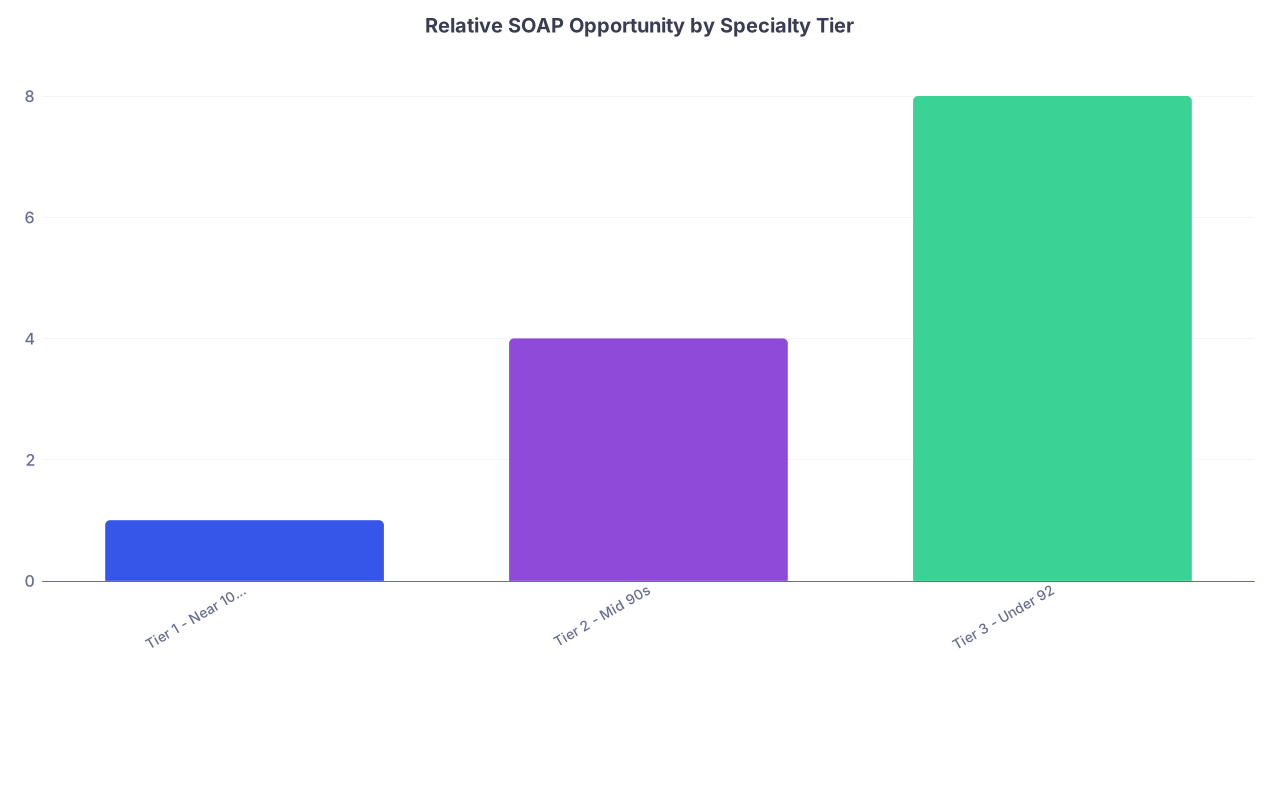
To visualize where the opportunity tends to cluster, imagine aggregate SOAP opportunity scores by specialty tier:
| Category | Value |
|---|---|
| Tier 1 - Near 100% fill | 1 |
| Tier 2 - Mid 90s | 4 |
| Tier 3 - Under 92 | 8 |
The pattern is obvious. Tier 3 dominates. Tier 2 can matter. Tier 1 is background noise for most SOAP applicants.
The Hard Truth: SOAP Is a Numbers Game, Not a Redemption Arc
I have watched under‑interviewed students try to use SOAP as a last‑minute rescue for an unrealistic primary strategy:
- They applied heavily to high‑prestige specialties with minimal backup.
- They secured very few interviews.
- They enter SOAP still thinking primarily in “dream specialty” terms.
The data is blunt: SOAP does not reverse the competitiveness hierarchy of the main Match. It amplifies it. The specialties and programs that were overflowing with applicants on Sunday are not magically barren on Monday.
What does change in SOAP is:
- The supply of seats in historically underfilled fields/programs,
- The urgency on the program side to fill them,
- The flexibility in choosing acceptable candidates.
Program fill rates are your high‑level map of where that supply consistently appears.
If you fight that, you are picking emotion over probability. And in a process where you might have one week to decide the next several years of your life, that is an expensive mistake.
Key Takeaways
Program and specialty fill rates are one of the clearest quantitative predictors of SOAP opportunity. High fill fields (near 100%) almost never offer real SOAP chances; underfilled fields and chronic underfill programs do.
Under‑interviewed students should shift from prestige targeting to vacancy targeting in SOAP. Focus your limited applications on Tier 2–3 specialties and programs with multi‑year histories of unfilled spots where you at least meet minimum thresholds.
Treat SOAP as a constrained optimization problem, not a Hail Mary. Use fill‑rate data, underfill patterns, and your own profile to construct a weighted list that follows probability, not hope.