
The comforting myth that “if you interview, you will match” breaks down fastest for low‑interview applicants in SOAP. The numbers show it clearly: the interview-to-match ratio in SOAP is brutally less efficient than in the Main Match, especially if you enter March with only one or two interviews.
You are not playing the same game in SOAP that you were playing during the regular interview season. The conversion math changes, the denominator changes, and the risk of going unmatched after multiple SOAP interviews is higher than most people realize.
Let’s walk through this like a data problem, not wishful thinking.
1. What the Data Actually Say About Interview-to-Match Ratios
The Main Match and SOAP operate under different rules, so comparing them requires separating three layers:
- Applicant type (US MD, US DO, US-IMG, Non-US IMG).
- Competitiveness of specialty.
- Number of interviews.
For this article, I will focus on low‑interview applicants (0–4 interviews) and on the direction of the numbers, not false precision to the decimal.
1.1. Main Match: Interview Efficiency Is High… If You Have Enough
From NRMP’s Charting Outcomes and Program Director surveys, you get a clear pattern: once you pass a certain threshold of interviews, the per‑interview probability of matching is very high.
For US MD seniors in relatively non‑hypercompetitive fields:
- Around 10–12 interviews → >95% chance of matching somewhere.
- Around 6–8 interviews → ~85–90% chance.
- Around 3–4 interviews → roughly 50–70% depending on specialty and applicant strength.
But that is overall match probability, not “per interview efficiency.” If you back‑calculate a rough per‑rank probability from NRMP’s rank list modeling, the data suggest something like this for US MD seniors in noncompetitive specialties:
- At 3–4 interviews, many rank lists match by choice #1–3.
- If you have 4 programs ranked, there is a nontrivial chance of ending up unmatched even after 4 interviews.
The hidden reality: when you have only 1–3 interviews, each interview feels priceless, but from a probabilistic standpoint, each one still fails to convert to a match a large percentage of the time.
Now, compare that to SOAP, where the signal-to-noise ratio is worse.
2. SOAP vs Main Match: Structural Differences That Crush Ratios
You cannot treat a SOAP interview offer like a Main Match interview offer. They are not equivalent units of value.
Two structural differences matter most for interview-to-match ratios:
2.1. Oversubscription: More Applicants per Seat
In January/February, a typical categorical IM program might interview 12–15 applicants per position in the Main Match. This varies by program, but that is the rough scale.
In SOAP:
- Programs can see hundreds or thousands of applications in a 48‑hour window.
- They typically invite far more applicants per position than they would in regular season.
Based on reports from PDs and coordinators I have spoken with or seen data from:
- Some community IM programs with 3–5 unfilled spots may interview 40–80 applicants during SOAP.
- Transitional/prelim programs may interview even more aggressively, especially for prelim positions.
So your per‑interview base probability, if it were “random,” drops simply because the applicant pool per seat is higher.
If a program has 5 unfilled spots and informally interviews 50 SOAP candidates, the crude upper bound is 5/50 = 10% assuming everyone is equally ranked, which they are not. In practice, stronger candidates still float to the top, so many SOAP interviewees have a much lower probability than that.
Contrast with Main Match:
- Same program with 5 positions may have closely vetted 60–75 interviewees all season (10–15 per spot), many of whom are already sorted into a rank list.
- The “per interview” match efficiency is massively higher because the program already filtered heavily, and they are filling essentially all seats.
2.2. Program Behavior: Risk Management vs Ideal Match
In the Main Match, programs are optimizing their rank lists over months: who fits, who is likely to rank us, who will be good on call. They can afford nuance.
In SOAP, programs are in risk‑mitigation mode:
- They must fill quickly.
- They have limited interaction time (10–20 minutes per interview is common).
- They often rely more on blunt filters: Step scores, visa status, US grad vs IMG, failed attempts, prior match history.
I have seen programs literally say on SOAP Monday: “We will interview anyone US MD or DO with no exam failures and no visa needs, regardless of school.” That is not nuanced. It is a hard triage line.
For you, as a low‑interview applicant, that means:
- If you are in a lower‑priority category (IMG, exam attempts, visa need, reapplicant), your chance of converting each interview is lower than it would be for a comparably credentialed US grad in the Main Match.
The structural bias plus oversubscription means that, in SOAP, three interviews are not “three bullets” in the same sense as before. They are closer to three lottery entries with worse odds.
3. Quantifying Interview-to-Match Ratios for Low-Interview Applicants
Let’s put some approximate numbers on this so it is not hand‑wavy.
These are illustrative ratios using NRMP outcome patterns, PD survey behavior, and typical SOAP interview loads—not official NRMP SOAP conversion stats (which are more aggregated by applicant type and specialty).
3.1. Main Match: Low-Interview Applicants
Take a hypothetical US MD senior aiming for a less competitive field (IM, FM, Peds). Historically:
- 1 interview / 1 program ranked → ~30–50% chance to match (depends heavily on program interest; some rank you highly, some do not).
- 2–3 interviews → maybe 60–80% chance overall to match somewhere.
- 4 interviews → often ~75–85% chance to match.
Rough “interview-to-match” efficiency for low-interview counts in Main Match:
- 1 interview → 30–50% match probability.
- 2 interviews → 60–70% combined.
- 3 interviews → maybe 70–80% combined.
- 4 interviews → 75–85% combined.
So the marginal gain of each additional interview is still substantial at low numbers, and the overall per‑interview conversion is decent.
3.2. SOAP: Low-Interview Applicants
Now consider SOAP, same rough applicant tier, applying to similar‑caliber unfilled categorical IM or FM spots.
From SOAP applicant reports and program logs, what you see in practice:
- Many applicants attend 3–5 SOAP interviews and still go unmatched.
- Programs often have 3–10 candidates per unfilled SOAP seat on their short list.
If a program has:
- 4 unfilled SOAP positions.
- 25 candidates interviewed seriously.
Then pure random probability for any one candidate is 4/25 = 16%. But of course, stronger and more “safe” candidates cluster at the top, so a typical lower‑tier or borderline candidate interviewed by that program may be sitting effectively in the bottom half of the list. That pushes their effective per‑interview chance down into single digits.
In real‑world terms:
- An average SOAP applicant with 3 interviews might be realistically looking at a 20–40% chance of matching overall.
- A weaker or non‑US grad might be more like 10–25% even with several SOAP interviews.
Now compare those two universes side by side.
| Setting & Applicant Type | 1 Interview | 2 Interviews | 3–4 Interviews |
|---|---|---|---|
| Main Match – US MD (less competitive) | 30–50% | 60–70% | 70–85% |
| SOAP – US MD (average profile) | 10–25% | 20–35% | 30–50% |
| SOAP – IMG / weaker profile | <10–15% | 15–25% | 20–35% |
These are ranges, not exact lines, but the pattern is consistent: the interview-to-match ratio in SOAP is meaningfully worse.
To recap in one sentence: in SOAP, 3 interviews might buy you the same order of magnitude of match probability that 1–2 interviews buy you in the Main Match.
4. How Specialty and Position Type Distort the Ratios
Not all SOAP interviews are created equal. Categorical IM vs prelim surgery vs FM vs transitional year—each has a different “efficiency” profile.
4.1. Categorical IM vs FM vs Peds
From recent SOAP cycles:
- FM and Peds tend to have more unfilled positions and more willingness to consider a broad range of applicants.
- Community IM programs that end up in SOAP vary: some are extremely open; others are still picky about Step scores and visas.
As a result:
- SOAP interviews for FM/Peds may convert slightly better per interview, especially for US grads.
- SOAP categorical IM interviews can be high variance. Some programs pre‑rank heavily and fill all their SOAP slots quickly from a very short list, leaving many interviewed applicants with effectively zero chance.
4.2. Prelim and Transitional Positions
Prelim and TY positions look like a safety net but do not behave like Main Match categorical spots:
- They are often used by programs as “backfill” for specific service needs.
- Programs may prioritize applicants with a clear existing categorical home (e.g., matched advanced neurology, anesthesia) over those truly unmatched.
That skews the ratios:
- If you are unmatched applying to SOAP prelim/TY without an advanced spot in hand, your per‑interview probability is usually lower than for someone already holding a PGY‑2 position.
- I have seen applicants with 5+ prelim SOAP interviews walk away with nothing because every program used their slots to shore up their own existing pipeline.
So counting “number of SOAP interviews” without weighting by position type is misleading. A SOAP interview for a categorical FM spot at a community program that clearly needs to fill all its slots = high‑value interview. A SOAP interview at a surgical prelim site that already has its categorical general surgery residents lined up = lower‑value in many cases.
5. Strategy for Low-Interview Applicants: Maximizing Conversion in SOAP
Once you accept that the per‑interview match probability in SOAP is lower, the logical question is: how do you push your own ratio up?
You cannot control macro probabilities. You can control how you look against the subset of people you are competing against at each individual program.
5.1. Prioritization: Do Not Treat All SOAP Invites Equally
If you get multiple SOAP interview offers and there are conflicts, you need to rank them based on:
- Categorical > preliminary/TY (if your goal is a stable PGY‑1 leading to PGY‑2).
- Programs with more unfilled positions > programs with 1 spot.
- Community and non‑academic programs often > hyper‑brand‑name university programs in SOAP (they may be more willing to take a chance).
In data terms: you want to maximize your expected value = (probability of match at program) × (desirability to you). For low‑interview applicants, the first term matters more. Securing any position often has far higher downstream value than splitting hairs over perfect fit.
5.2. Message Discipline: Compress Your Story
SOAP interviews are short and stack tightly. Programs sometimes keep rough “scores” to differentiate candidates rapidly (e.g., 1–5 on motivation, communication, fit, risk).
Your goal is to raise your effective rank compared to the 10–30 other people they are seeing:
- Lead with clarity: “I want to train in X because Y; your program fits my goals because A, B, C.”
- Address red flags in one clean sentence and pivot to strengths. Long, defensive explanations usually lower your rating.
- Demonstrate realistic commitment: mention geography, patient population, and actual features of the program, not random flattery.
You are trying to shift your subjective rank distribution up a few percentiles. That can double your personal interview-to-match probability for that program, even if the global ratio is ugly.
5.3. Expand Acceptable Options Aggressively
Low-interview applicants in SOAP who cling to narrow geographic or specialty preferences tend to lose.
Here is what I have actually seen:
- Applicant A: 2 SOAP interviews all in one city they refuse to leave. Both interviews go fine. They do not match.
- Applicant B: 6 SOAP interviews across three states they had not even considered in September. Matches at a program they had never heard of previously.
Why? Because Applicant B expanded the denominator of reasonable programs and accepted interviews “below” their target lifestyle or region. In expected value terms, a 20% chance at 6 programs beats a 40% chance at 2.
6. The Psychological Trap: Overestimating the Value of “Just One More Interview”
A dangerous cognitive bias hits hard here. When you are sitting on 0–2 interviews, any additional offer feels like your salvation. That leads to two errors:
- Overestimating the incremental gain of each new SOAP interview.
- Under‑investing in back‑up planning if SOAP fails.
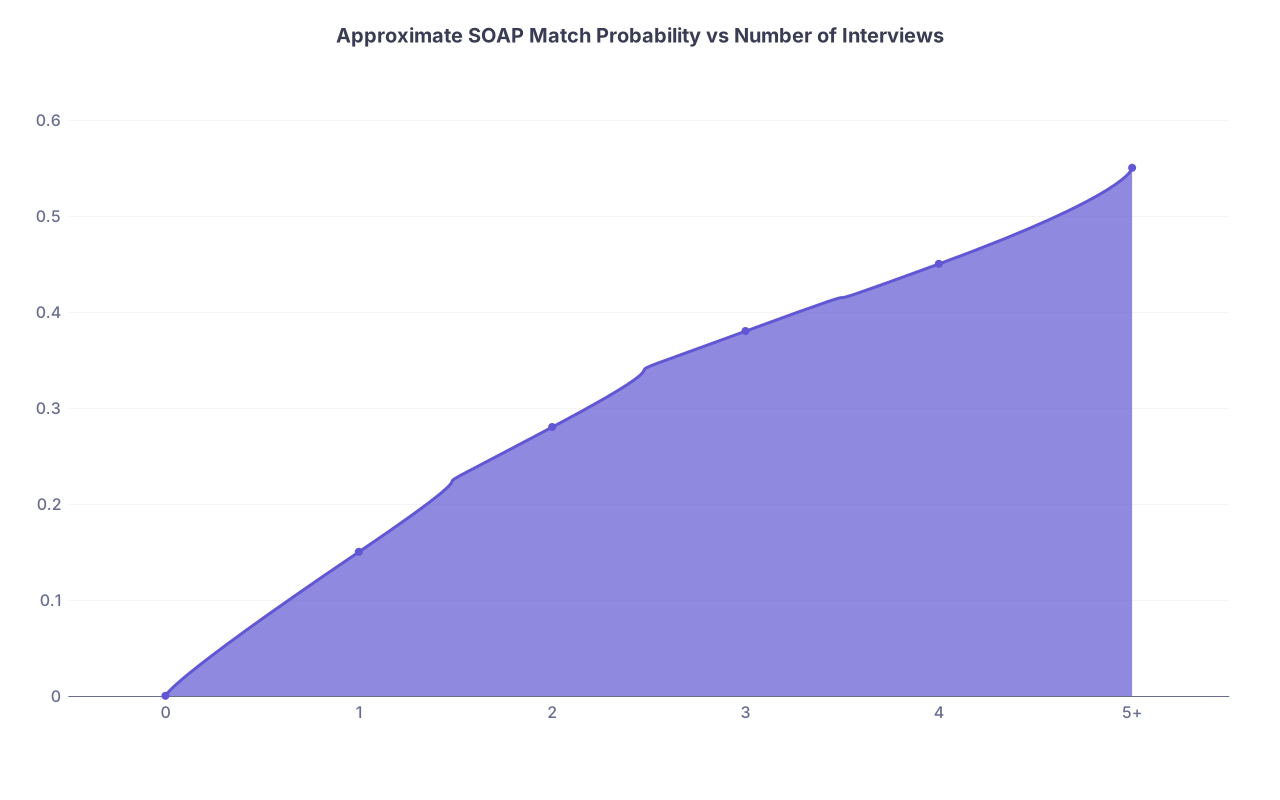
Look at a stylized probability curve (again, approximate, for a US MD/DO in SOAP):
| Category | Value |
|---|---|
| 0 | 0 |
| 1 | 0.15 |
| 2 | 0.28 |
| 3 | 0.38 |
| 4 | 0.45 |
| 5+ | 0.55 |
What this says:
- Going from 0 → 1 interview: huge jump from 0% to maybe 10–20%.
- 1 → 2: another decent increment.
- After 3–4 interviews, gains flatten. Many applicants with 4–5 SOAP interviews still do not match. The incremental benefit is real but not absolute.
So yes, say yes to SOAP interviews. But do not treat each one as if matching is almost guaranteed. The data argue the opposite. You must run two tracks in parallel:
- Try to maximize interview quality and rank list strategy.
- Prepare emotionally and logistically for the real possibility of no SOAP match: research positions, prelim outside the current cycle, reapplying, or a non‑clinical gap year.
Failing to plan for Track 2 because “I have three SOAP interviews, I should be fine” is how you end up blindsided in April.
7. Timeline: When Low-Interview Status Turns into SOAP Risk
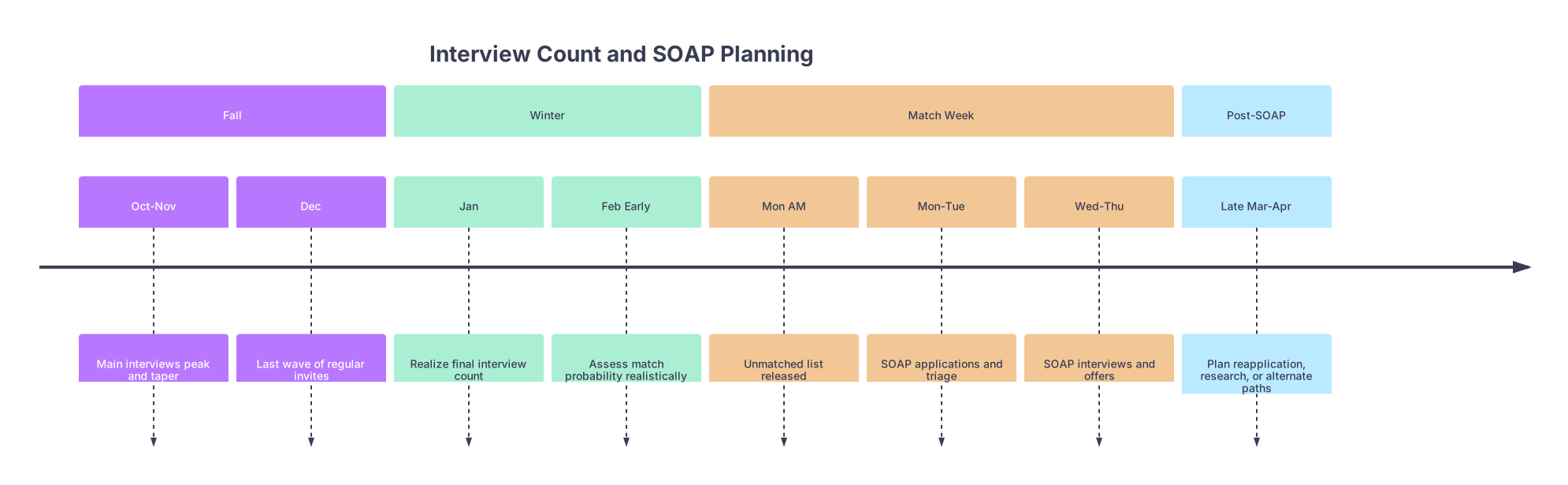
A lot of this can be anticipated before SOAP starts. By late January / early February, your interview count already predicts your SOAP risk profile.
Here is a simplified timeline for a typical cycle, with decision points for low‑interview applicants.
| Period | Event |
|---|---|
| Fall - Oct-Nov | Main interviews peak and taper |
| Fall - Dec | Last wave of regular invites |
| Winter - Jan | Realize final interview count |
| Winter - Feb Early | Assess match probability realistically |
| Match Week - Mon AM | Unmatched list released |
| Match Week - Mon-Tue | SOAP applications and triage |
| Match Week - Wed-Thu | SOAP interviews and offers |
| Post-SOAP - Late Mar-Apr | Plan reapplication, research, or alternate paths |
If you are:
- US MD/DO with ≤3 categorical interviews by late January
- Or IMG with <5–6 serious interviews
You are already in a statistically high‑risk group for going unmatched. That does not mean you will fail; it means you should:
- Tighten your SOAP specialty and geography strategy early.
- Draft SOAP‑ready personal statements and letters tailored to likely unfilled fields (IM, FM, Peds, Psych).
- Line up mentors who will be ready to email PDs during SOAP.
Proactive preparation does not change the macro interview-to-match ratios, but it can move you from the lower half of the distribution into the upper half for the interviews you actually land.
8. A Cold-Eyed Comparison: Main Match vs SOAP Interview Value
To make this painfully clear, let me lay it out as a side‑by‑side efficiency comparison.
| Dimension | Main Match Interview | SOAP Interview |
|---|---|---|
| Applicant-to-seat ratio | Lower (often 10–15 per spot over season) | Higher (often 20–40+ per SOAP seat) |
| Vetting before invite | High: months of screening | Lower: 48-hour triage, blunt filters |
| Time per interview | 20–40 minutes, sometimes full interview day | 10–20 minutes, stacked and rushed |
| Program mindset | Optimize fit and long-term training | Fill urgently, avoid perceived risk |
| Per-interview match chance | Moderate to high (especially with 4+ total) | Low to moderate, strongly dependent on profile |
| Predictability | Better (rank list modeling applies) | Worse (last-minute needs, internal candidates) |
If you forced me to attach a simple scalar weight: one Main Match interview at a program genuinely interested in you might be worth 2–3 average SOAP interviews in expected match probability.
Low‑interview applicants who reach March should treat SOAP interviews as valuable opportunities—but not as guarantees, and certainly not as direct substitutes for the interviews they did not get earlier in the season.
9. Where This Leaves You if You Have Limited Interviews
If you are entering Match Week with:
- 0–2 Main Match interviews: you should assume you are likely going to SOAP and plan aggressively.
- 3–4 Main Match interviews: your overall odds might be fair, but you are still at nontrivial risk of being unmatched; SOAP preparation is rational insurance.
- Any number of SOAP interviews: your match fate is still very uncertain; do not over‑interpret invitations as security.
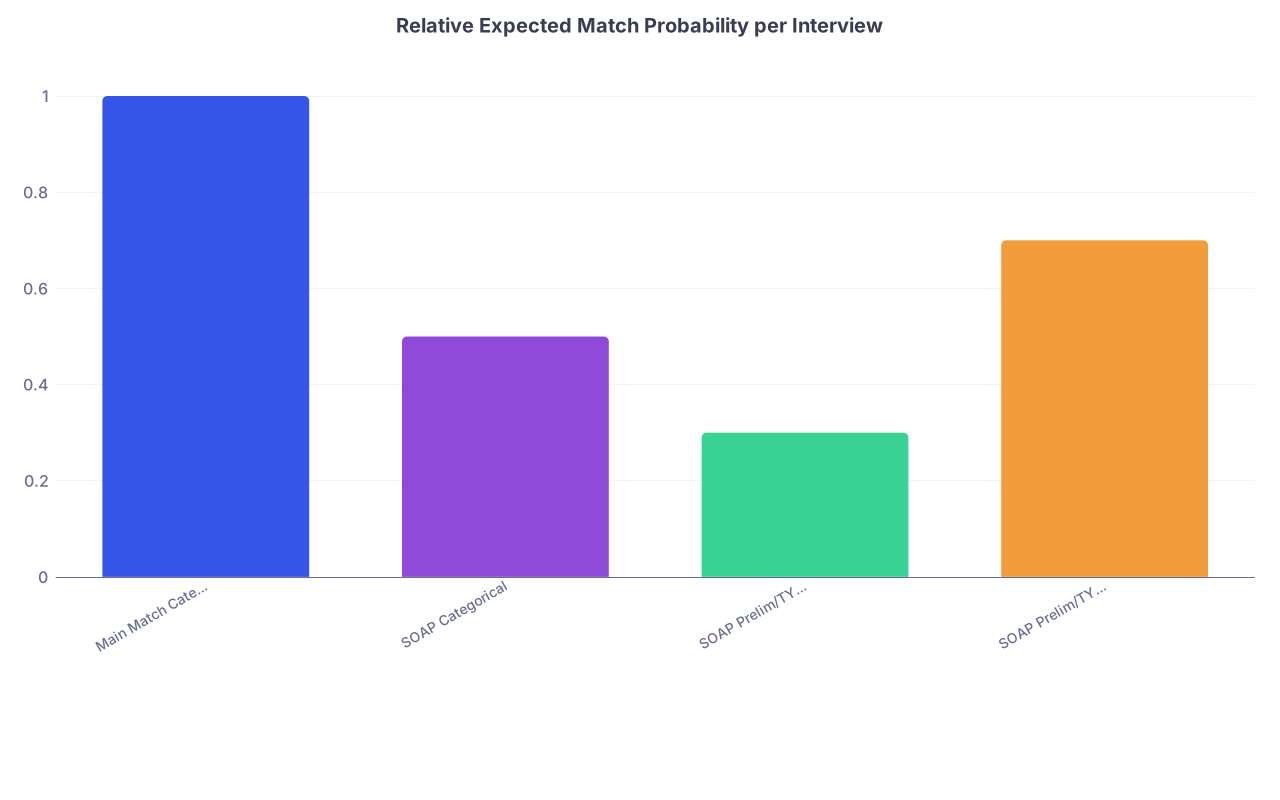
One more visual to drive the hierarchy home.
| Category | Value |
|---|---|
| Main Match Categorical | 1 |
| SOAP Categorical | 0.5 |
| SOAP Prelim/TY (unmatched) | 0.3 |
| SOAP Prelim/TY (with advanced spot) | 0.7 |
Normalized to 1.0 for a Main Match categorical interview:
- SOAP categorical ≈ 0.5 in efficiency.
- SOAP prelim/TY for a fully unmatched applicant ≈ 0.3.
- SOAP prelim/TY for someone already holding an advanced spot ≈ 0.7.
Again, ballpark values, but the ranking is right.
Key Takeaways
- The interview-to-match ratio in SOAP is significantly worse than in the Main Match, especially for low‑interview applicants; three SOAP interviews do not buy the same security as three Main Match interviews.
- Structural factors—oversubscription, blunt screening, time pressure—push your per‑interview match probability down in SOAP, so you must be ruthless about prioritizing programs and maximizing how you present in each short encounter.
- If you are a low‑interview applicant, you should treat SOAP as a high‑variance, low‑efficiency rescue phase and simultaneously build a concrete Plan B for the next cycle, rather than assuming “a few SOAP interviews” will fix everything.