
The biggest mistake undersubscribed applicants make in SOAP is emotional, not strategic: they chase categorical prestige and ignore the math that clearly favors certain prelim pathways.
You are not competing with an idealized version of yourself. You are competing with your actual numbers, in a brutally quantified market. SOAP only amplifies that.
Let’s walk through what the data show about prelim vs categorical positions in SOAP, how they differ in risk and upside, and how a low‑interview applicant should actually build a SOAP list if the goal is “secure a job and a license” rather than “roll the dice on a fantasy”.
1. The hard reality: SOAP is a numbers game, not a vibes game
Start with some macro context. The NRMP and AAMC publish detailed statistics every year. The trend is straightforward: more applicants, tighter margins, and SOAP functioning as a secondary, more compressed market.
A few key patterns from recent match cycles (aggregated / rounded to illustrate the scale):
- Roughly 5–7% of US MD seniors and 10–15% of US DO seniors do not match initially.
- International medical graduates (IMGs) are hit harder, with non‑match rates often >40% in some cohorts.
- SOAP typically has several thousand unfilled positions, but the mix is heavily skewed:
- Fewer categorical IM / FM / Peds slots than people imagine.
- A big chunk of preliminary internal medicine and preliminary surgery positions.
Think of SOAP as a constrained optimization problem:
- Objective: Maximize probability of landing any accredited position that preserves future options (licensure, PGY‑2+ transitions).
- Constraints:
- Limited application slots in SOAP rounds.
- Your existing profile (scores, attempts, gaps, citizenship) which you are not fixing in 4 days.
- Program needs: many just need bodies for one year, not future partners.
Prelim vs categorical is not a philosophical distinction here. It is a structural one:
- Categorical = you are slotted into a full training pathway in that specialty at that program (or system).
- Preliminary = you are there for a fixed 1‑year (internal medicine, surgery, transitional, etc.) without a guaranteed advanced spot.
And crucially in SOAP: categorical slots are fewer and more selective; prelim spots are more numerous and more flexible.
2. Inventory: what actually goes unfilled and shows up in SOAP?
You cannot choose a strategy without knowing the supply.
The data show a consistent pattern:
- Categorical IM, FM, Peds, Psych – some unfilled, but not enough to absorb all unmatched applicants.
- Categorical competitive specialties (Derm, Ortho, ENT, Rad Onc, etc.) – almost no SOAP‑relevant categorical positions.
- Preliminary IM and Prelim Surgery – a large portion of the SOAP inventory, year after year.
Here is a simplified, representative snapshot of how unfilled positions might cluster on SOAP Monday (numbers are illustrative but directionally accurate relative to NRMP reports):
| Position Type | Approx Share of Unfilled | Competitiveness in SOAP |
|---|---|---|
| Categorical IM | 10–15% | Moderate |
| Categorical FM | 10–20% | Low–Moderate |
| Categorical Peds/Psych | 5–10% | Moderate–High |
| Prelim Internal Med | 25–35% | Low–Moderate |
| Prelim Surgery | 20–30% | Moderate–High |
| Transitional Year | 5–10% | High |
Notice the distribution: prelim IM and prelim surgery together often account for nearly half of unfilled slots. That is your sandbox if you are undersubscribed.
Programs use prelim slots as service workhorses. The bar, statistically, is lower than for categorical. That is not speculation; it is straightforward market behavior:
- More slots relative to applicant interest.
- Programs know most people in SOAP are there with some red flags or weaker metrics.
- The job to be done is coverage, not long‑term faculty pipeline.
So if you are entering SOAP with:
- ≤3–4 total interview invites, or
- prior failed match attempt, or
- Step 1 or Step 2 scores near/below national means, or
- IMG status with no strong US letters,
then the prelim market is where the odds look materially better.
3. Risk and payoff: categorical vs prelim as different portfolios
Think like a portfolio manager for a minute. You are allocating SOAP applications across assets with different risk/return profiles.
- Categorical positions:
- Payoff: direct path to board eligibility in that specialty.
- Risk: significantly higher competition per slot; fewer total slots. Greater chance of ending SOAP empty‑handed.
- Prelim positions (IM, surgery, transitional):
- Payoff: one year of ACGME‑accredited training, salary, US clinical experience, and often eligibility to apply to PGY‑2 or re‑enter Match as a stronger candidate.
- Risk: no guaranteed continuation, need to re‑apply or secure PGY‑2.
If you reduce it to outcomes and probabilities, it looks more like this for an undersubscribed applicant:
| Strategy | Chance of Any Offer | Chance of Full Categorical Pathway | Risk of No Position |
|---|---|---|---|
| Categorical‑only SOAP list | Low–Moderate | Low–Moderate | High |
| Mixed list (cat + many prelim) | Moderate–High | Moderate (via cat or later PGY‑2) | Moderate |
| Prelim‑heavy (IM/Surg/TY focused) | High | Moderate (via PGY‑2 / re‑match) | Lower |
These are not precise numbers – they are directional. The point is relative, not absolute: as an undersubscribed applicant, your chance of leaving SOAP with zero position goes up sharply if you insist on categorical‑only applications, especially in more competitive specialties or desirable locations.
4. What prelim actually buys you (quantified, not romanticized)
People undersell prelim years because they think in binary terms: “matched categorical” vs “failed.” That is lazy thinking.
From a data standpoint, a prelim year provides:
- One year of US, ACGME‑accredited training.
- A full year of concrete attending and senior resident evaluations.
- Program‑level credibility: “We trusted this person enough to put them on our wards / in our ORs.”
This does three measurable things to your profile when you re‑enter the market:
It dilutes the impact of weaker metrics.
Program directors do not care nearly as much about a 210 vs 230 once they have a stack of solid evaluations, evidence of reliability, and no professionalism issues. I have seen IMGs with marginal scores go from 0 interviews to 10+ after a strong prelim year plus coherent letters.It shifts your narrative from “unproven” to “known quantity.”
Many PDs are more comfortable taking a PGY‑2 transfer whose current PD says, “I would keep them if I had a spot,” than an unknown fresh graduate with a 10‑point higher Step score.It preserves momentum.
Licensing boards and programs increasingly view prolonged gaps post‑grad skeptically. One or two years out with no training is a statistical red flag. A prelim year effectively resets that clock.
If you want to visualize value, think in terms of “likelihood of any PGY‑2+ future” conditional on your current risk profile.
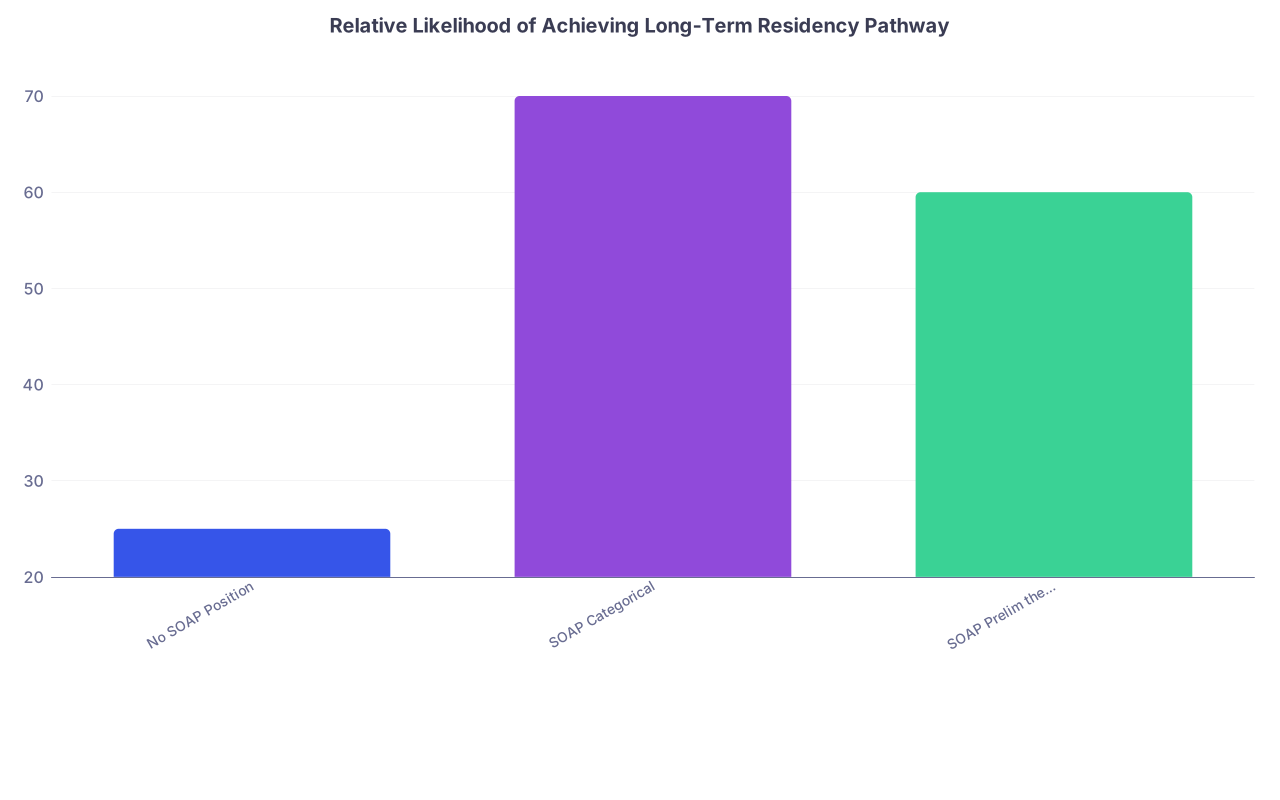
| Category | Value |
|---|---|
| No SOAP Position | 25 |
| SOAP Categorical | 70 |
| SOAP Prelim then Reapply | 60 |
Here I am assuming a high‑risk applicant:
- If you end SOAP with no position, long‑term probability of ever completing residency may be ~20–30%.
- If you somehow get categorical in SOAP, your path completion odds might be ~60–80% (there is always attrition).
- If you do a prelim year and then reapply/transfer, real‑world completion odds are not that far off categorical from the start, often in the 50–70% range for those who actively pursue PGY‑2 spots.
So the commonly repeated “prelim is a dead end” line is statistically wrong. The dead end is no position and a growing timeline gap.
5. Different prelim flavors: IM vs Surgery vs Transitional
Not all prelim slots are created equal. The choice changes your downstream probability tree.
Preliminary Internal Medicine
Prelim IM is the most versatile:
- It can lead to:
- Categorical IM at same or different program (PGY‑2 entry).
- Categorical neurology, PM&R, some anesthesiology paths, and other IM‑linked specialties.
- It offers robust inpatient experience, ward medicine, call structure, and plenty of contact with faculty who write influential letters.
It is also often the least competitive among prelim types in SOAP. Many community hospitals and lower‑tier academic centers underfill these year after year.
From a data‑driven standpoint, prelim IM is usually the best risk‑adjusted pick for an undersubscribed applicant whose main goal is “stay in the system and create options.”
Preliminary Surgery
Prelim surgery is a double‑edged sword:
Pros:
- Can convert into categorical surgery in rare cases.
- Can lead to PGY‑2 in surgery or switch to other specialties (IM, anesthesia, etc.) with the right networking.
- Strong clinical experience, procedures, high intensity.
Cons:
- Historically higher burnout, higher attrition.
- Many programs view non‑categorical surgery applicants as expendable labor.
- Fewer categorical conversion opportunities relative to the number of prelims.
For someone already struggling on metrics or resilience, a hard‑driving prelim surgery year can backfire. The risk of poor evaluations or exhaustion is real.
Transitional Year (TY)
Transitional years are the unicorns:
- Broad, often cushy mix of IM, outpatient, electives.
- Highly sought by those already holding advanced positions (radiology, anesthesia, derm, etc.).
- Result: they are often more competitive than categorical IM in SOAP. You will rarely out‑compete an advanced‑position‑holder for a TY if you are unmatched and undersubscribed.
If you are in SOAP without an advanced spot already in hand, TY is rarely your highest‑yield target. Chase them only if you see clear, realistic alignment (e.g., strong academic record, but just mis‑matched specialty).
Here is the relative competition gradient in SOAP:
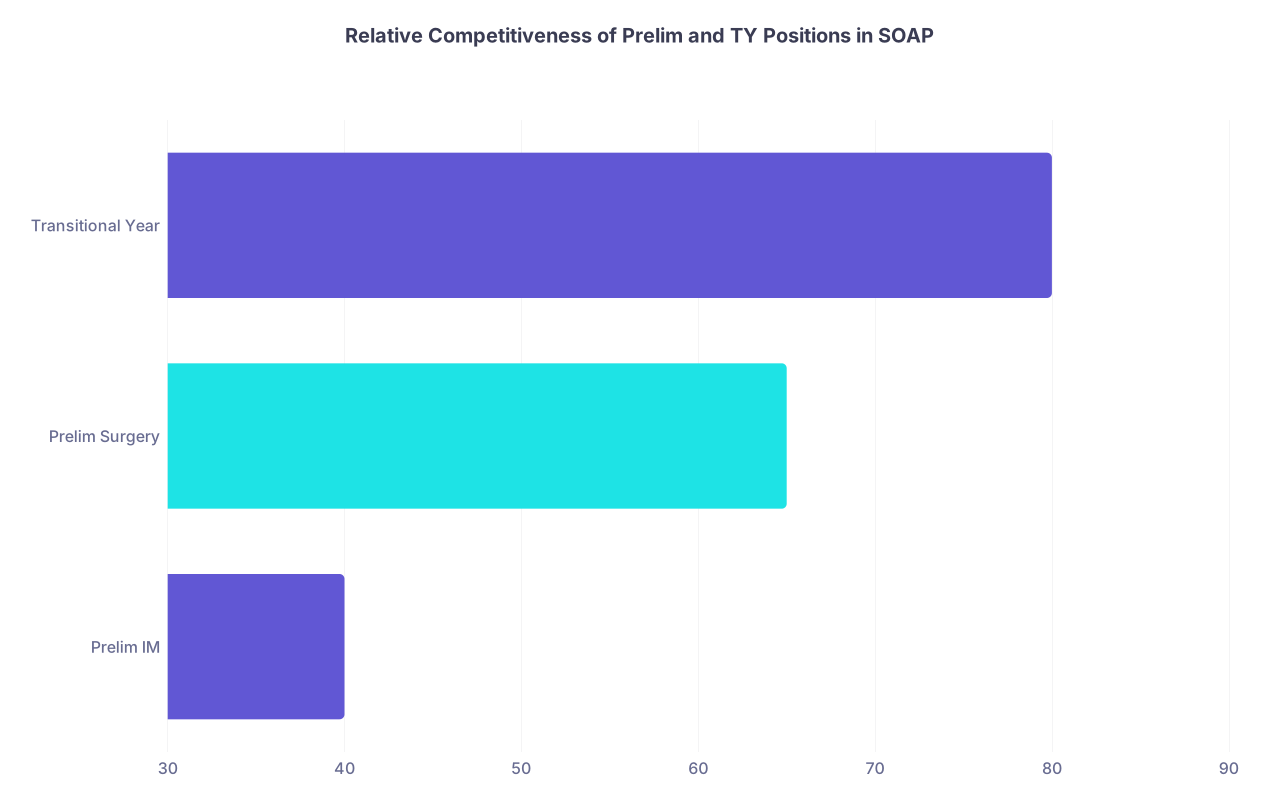
| Category | Value |
|---|---|
| Prelim IM | 40 |
| Prelim Surgery | 65 |
| Transitional Year | 80 |
Scale 0–100 here is a rough “competitiveness index” (lower = easier to get). Prelim IM is generally the most accessible entry point.
6. How undersubscribed applicants should actually build SOAP lists
Let’s get specific. “Limited interviews” is a vague phrase. You need to quantify your risk tier.
Assume you are:
- US MD with ≤3 interviews, or
- US DO with ≤4–5 interviews, or
- IMG (US or non‑US citizen) with any interview count <7–8,
and you are entering SOAP unmatched. You are by definition high risk for ending the cycle without a position.
The goal in SOAP is not to “shoot your shot” at dream programs. The goal is to maximize your probability of leaving that week with an ACGME contract.
A rational SOAP list for this profile usually looks like this:
- Majority (50–70%) prelim internal medicine positions at a range of community and lower‑tier academic hospitals, with broad geographic flexibility.
- A smaller tranche (10–20%) prelim surgery or mixed prelim slots if you can realistically handle the workload and are open to surgical or anesthesia pathways later.
- A focused remainder (20–30%) of categorical FM, IM, Psych, or Peds at programs with historically lower fill rates (rural, community, less desirable locations).
Here is a template allocation that I have seen work for high‑risk applicants:
| Position Type | Share of SOAP Applications | Rationale |
|---|---|---|
| Prelim Internal Med | 50–60% | Highest volume, broadest utility |
| Prelim Surgery | 10–15% | For those open to surgery path |
| Categorical FM/IM | 20–30% | Moderate chance at full pathway |
| Other (Psych/Peds/TY) | 5–10% | Selective, where profile fits |
Could you skew more toward categorical if you are US MD with decent scores and just bad interview luck? Yes. But if you are undersubscribed and unmatched, the data do not support a categorical‑only SOAP strategy as rational risk management.
7. Prelim vs categorical for IMGs and repeat applicants
The calculus tightens for IMGs and for those in their second or third Match attempt.
The numbers here are harsh:
- IMGs in SOAP disproportionately land in prelim positions rather than categorical.
- Repeat applicants without new credentials (no new scores, no new clinical experiences, no research) see declining interview numbers each year.
For this group, prelim is not a consolation prize. It is often the only plausible entry point into U.S. GME.
I have watched cycles where:
- IMG applicant A, with two prior unmatched cycles, refused to apply to prelims, targeted only categorical IM/Peds in SOAP, and ended with nothing. Third gap year, CV effectively toxified.
- IMG applicant B, same metrics, same graduation year, aggressively targeted prelim IM in SOAP, matched to a midsized community hospital, worked hard, secured stellar letters, then slid into a PGY‑2 IM spot via transfer at a different program.
Five years later, B is a board‑certified internist. A is still trying to patch together observerships and explain a 5+ year gap.
Those are not isolated anecdotes; they are patterns that correlate strongly with who was willing to treat prelim as a viable strategic asset rather than a mark of failure.
8. Decision tree: when you should prioritize prelim vs categorical
If you like visual logic, here is a simple mental model:

| Step | Description |
|---|---|
| Step 1 | Unmatched after main Match |
| Step 2 | Prioritize categorical FM/IM/Peds in SOAP |
| Step 3 | Prelim-heavy SOAP list with broad geography |
| Step 4 | Mixed list - categorical plus substantial prelim IM |
| Step 5 | Focus on Prelim IM, some Surg, limited categorical |
| Step 6 | 50-50 mix of categorical and prelim at realistic programs |
| Step 7 | Total interviews >= 8 and mostly in primary care? |
| Step 8 | Any strong red flags - low scores, gaps, prior failures, IMG? |
This is obviously simplified, but the structure is right: the more risk flags you have, the more your optimal strategy slides toward prelim‑heavy.
9. A realistic view of “prelim to categorical” transitions
People love to ask: “What are my odds of turning a prelim year into a categorical spot?” They want a clean percentage. The real answer is conditional and messy, but there are patterns.
Several levers matter:
- Size of your prelim program and its categorical complement.
- Existing attrition rates – programs that historically lose PGY‑2s/3s are more likely to upgrade prelims.
- Your performance: punctuality, call coverage, no drama, willingness to take undesirable shifts.
From combined multi‑year experiences at multiple programs, a rough, believable range:
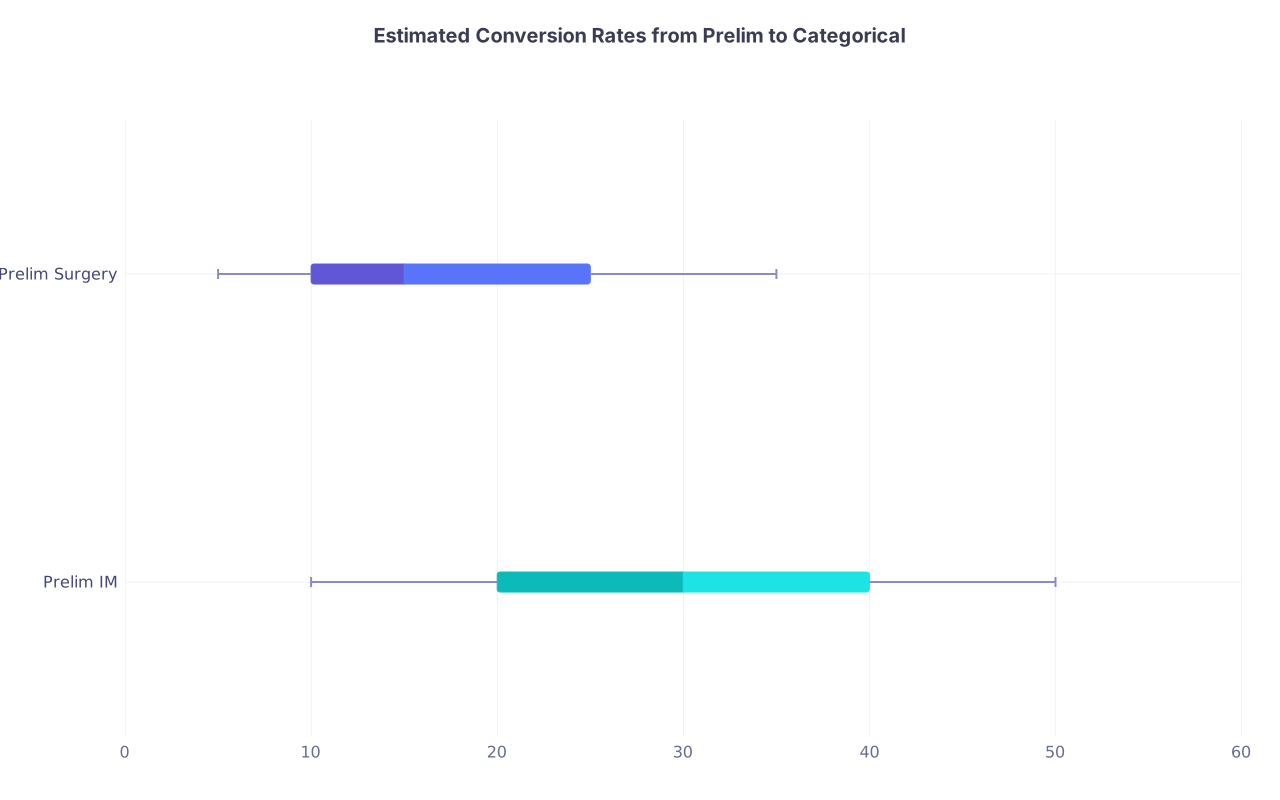
| Category | Min | Q1 | Median | Q3 | Max |
|---|---|---|---|---|---|
| Prelim IM | 10 | 20 | 30 | 40 | 50 |
| Prelim Surgery | 5 | 10 | 15 | 25 | 35 |
Interpretation:
- For prelim IM, conversion to some categorical PGY‑2 (at same or different program) in a couple of years might realistically sit somewhere in the 20–40% band for motivated residents.
- For prelim surgery, the median is lower, variability higher, and a lot of prelims eventually pivot out of surgery entirely.
But here is the key: even if your personal chance of eventual categorical conversion is only 30–40%, it still dominates the 0% chance you have if you never enter training in the first place.
10. Putting it all together: what undersubscribed applicants should actually do
Strip away emotion. This is about maximizing your probability of staying in the physician pipeline.
For undersubscribed SOAP applicants, the data and real‑world outcomes point to three hard conclusions:
Categorical‑only SOAP strategies are high‑risk gambles.
If you are coming into SOAP with limited interviews or obvious red flags, a categorical‑only SOAP list is effectively a bet that the same programs that did not interview you in the main cycle will now rescue you with their few remaining categorical seats. That happens, but not often. The risk of ending with no position is unacceptably high for most.Prelim, especially internal medicine, is a rational, data‑supported pathway.
Prelim IM slots are numerous, relatively less competitive, and function as a statistically proven bridge to PGY‑2 categorical positions and licensable careers. The short‑term ego hit is real, but the long‑term outcome curves favor those who take the prelim door over those who spend years on the outside rationalizing why they “deserve” categorical.Your SOAP list is an optimization problem, not a manifesto.
You do not have to abandon categorical aspirations. You simply have to stop pretending that your current risk profile justifies ignoring prelim inventory. A mixed strategy – especially prelim‑heavy for high‑risk applicants – gives you the best combined probability of:- getting any supervised, paid, accredited clinical post now, and
- preserving realistic access to categorical training within the next 1–2 years.
If you are undersubscribed and walking into SOAP hoping for a miracle categorical rescue, you are playing the wrong game. The smarter move is simple: respect the numbers, use prelim IM and selected prelim surgery positions as your statistical safety net, and treat categorical offers as upside, not baseline expectation.