
The moment you realize you’re SOAP-eligible with 0–1 interviews is brutal.
But you do not have time to spiral. You have a week to execute.
I’m going to walk you through the first six moves you need to make in the next 24–48 hours. Not abstract “stay positive” stuff. Actual “open this tab, email this person, rank this specialty lower” level guidance.
You’re in a bad spot, yes. But you are not done. Plenty of people in this exact situation have matched through SOAP. The ones who do not? They usually waste the first 48 hours panicking, hiding, or pretending next year will magically be different without changing a single thing.
Let’s not do that.
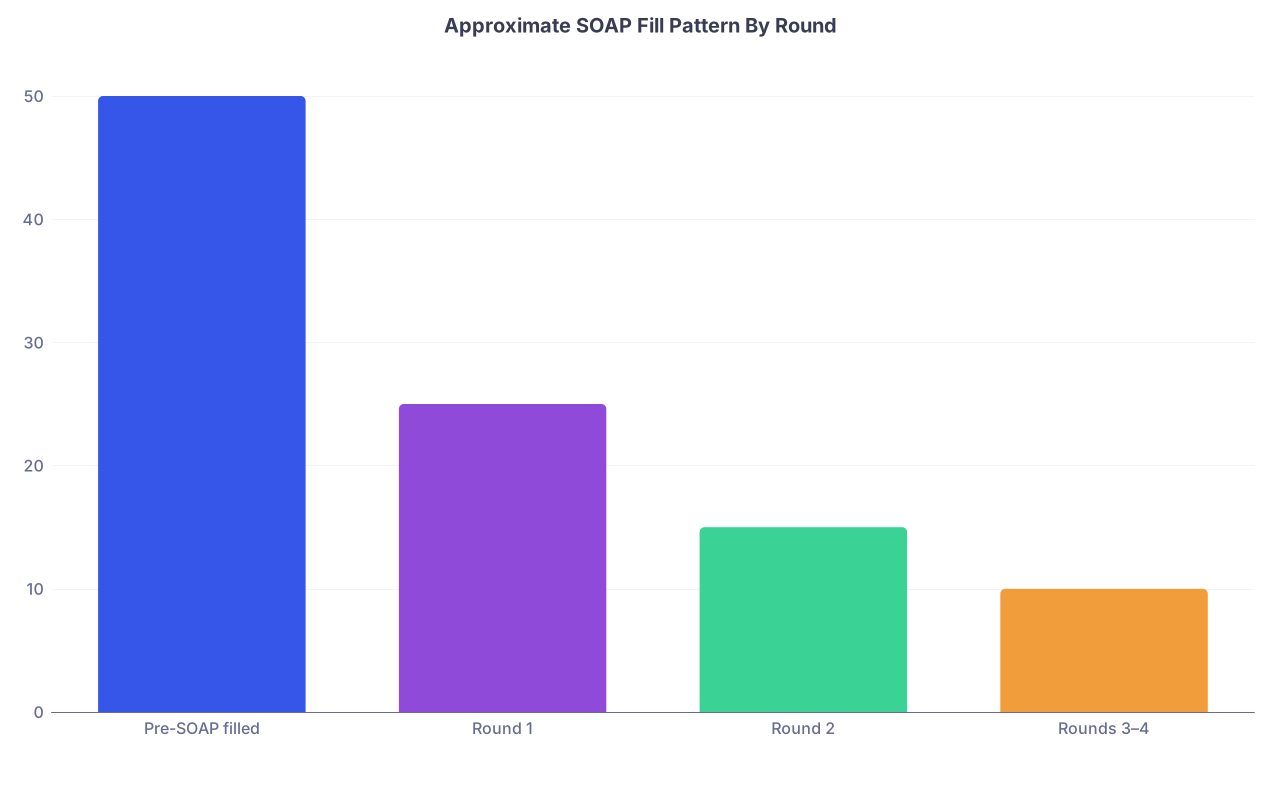
| Category | Value |
|---|---|
| Pre-SOAP filled | 50 |
| Round 1 | 25 |
| Round 2 | 15 |
| Rounds 3–4 | 10 |
Step 1: Stabilize Your Mindset for 48 Hours (Yes, This Is a Step)
You cannot plan or write coherent emails if you’re mentally on fire. And SOAP week will eat you alive if you go in scattered.
Here’s your 2–3 hour “mental triage” protocol:
Give yourself one contained meltdown.
Go for a 30–45 minute walk. Cry. Call one trusted person (not someone who will make it about them). Say the ugly stuff out loud: “I feel like a failure.” “I’m embarrassed.” Then stop. Put a hard time limit on it.Name the actual situation, not the catastrophe in your head.
Your current facts:- You’re SOAP-eligible.
- You have 0–1 interviews.
- There is a formal process, hard deadlines, and real rules. That’s it. Not “my career is over.” The story your brain wants to tell is optional.
Decide your posture: shame or strategy.
You have two choices:- Hide, downplay, and hope for a miracle.
- Treat this like an ICU code: focused, systematic, emotionally uncomfortable but technically straightforward.
Pick strategy. Every time your brain spins out, remind yourself: “I’m in the code. What is the next step?”
Then sit down, open your calendar and email, and move.
Step 2: Get Clear on Your Exact Status and Constraints
SOAP is rule-driven and time-bound. You cannot “wing it.” You need to know what you’re allowed to do and when.
2.1 Confirm your eligibility and status
Do this in the next 1–2 hours:
Log into NRMP:
- Confirm you are listed as SOAP-eligible.
- Check any NRMP messages. Do not assume you “know how it works” from rumors.
Log into ERAS:
- Confirm your documents are uploaded and released:
- MSPE
- LoRs
- USMLE/COMLEX scores
- Personal statement(s)
- Transcript
- Confirm your documents are uploaded and released:
Contact your Dean’s Office / Student Affairs / GME office:
- Ask directly: “Who is our SOAP point person?”
- Get their email + phone.
- Ask when they are available for a brief call today or tomorrow.
If your school or program director has a SOAP guide from last year, ask for it. Often they do, but no one bothers to look.
2.2 Understand the hard constraints
You don’t get infinite shots in SOAP. That fantasy has sunk a lot of people.
Typical constraints (verify for your year):
- Max programs you can apply to through SOAP: usually 45 total.
- Application rounds: 4 rounds typically (Mon–Thu of Match Week).
- Communication rules:
- You may NOT contact programs first during SOAP.
- Programs contact you. You respond.
- Outside advocates (dean, PD, faculty) can email programs on your behalf, depending on institutional rules.
You need these numbers in front of you while you plan. Write them down on paper. Old-school. It changes how real it feels.

| Step | Description |
|---|---|
| Step 1 | No Match Email |
| Step 2 | SOAP Eligibility Confirmed |
| Step 3 | Programs List Posted |
| Step 4 | Submit Up To 45 Applications |
| Step 5 | Programs Review and Contact |
| Step 6 | Round 1 Offers |
| Step 7 | Accept or Reject |
| Step 8 | Unfilled List Updates |
| Step 9 | Next Rounds Until Filled or End |
Step 3: Build a Ruthless, Reality-Based SOAP Target List
If you went into ERAS with starry eyes, SOAP is where you become pragmatic. Your goal is not “dream program.” Your goal is “any accredited training spot that moves my career forward.”
3.1 Know where you actually have leverage
Look at yourself the way a program director would:
- US vs IMG / DO vs MD
- Step 1 / Level 1: Pass/fail now, but failures still matter.
- Step 2 CK / Level 2: Exact score. Any fails or late attempts?
- Red flags: Gaps, repeats, professionalism issues, late graduation, visa needs.
Now look at the specialties:
| Specialty Type | SOAP Friendliness | Typical Reality in SOAP |
|---|---|---|
| Internal Medicine | Higher | Most spots, but still competitive in some areas |
| Family Medicine | Higher | Strong option, especially community programs |
| Pediatrics | Moderate | Some SOAP spots, regional variation |
| Psychiatry | Low–Moderate | Fewer spots, high demand |
| Surgery (categorical) | Very Low | Almost never in SOAP |
| Transitional/Prelim | Variable | Options, but be clear on long-term plan |
If you’re SOAP-eligible with zero or one interview, then yes, you should assume your initial strategy did not match your competitiveness. SOAP is not the time to double down on bad assumptions.
3.2 Decide your “floor” specialty
You need a minimum acceptable specialty list. Something like:
- Tier A: What you truly want but are realistic about (e.g., IM, FM, Peds).
- Tier B: Acceptable but not your dream (e.g., prelim IM, prelim surgery if you have a plan).
- Tier C: Absolutely not, even if it means reapplying next year.
The mistake people make: they pretend Tier C doesn’t exist, then panic-apply to everything. And match somewhere they hate. Do the thinking now.
3.3 When the unfilled list drops
When the SOAP unfilled list appears, here’s what you do that same hour:
- Filter by:
- Specialty
- State/region you can realistically attend (visa, family, financial)
- Mark ALL programs in your Tier A + B specialties.
- Ignore prestige. Ignore location glamour. You do not have that luxury this week.
Your goal: build a balanced list of up to 45 programs that:
- Are likely to consider applicants like you.
- Are not all in the most competitive metro areas.
- Include some places “no one at your school talks about” (these often actually have space).
Step 4: Fix What You Can in 24 Hours: Documents and Narrative
You can’t rewrite your whole application, but there are 3 levers you can still pull: personal statement, program signaling via ERAS, and how others talk about you.
4.1 Rapid SOAP-focused personal statement
If you applied to 4 different specialties and your current PS screams “Plastic Surgery or bust,” that will tank you in SOAP.
You need:
- 1–2 focused personal statements, max:
- One for your main SOAP target (e.g., Internal Medicine).
- One for a closely related backup if needed (e.g., prelim IM or FM).
What to emphasize:
You understand what the specialty actually is.
Not “I like people.” Show you’ve lived in that environment: specific patients, rotations, or responsibilities.You are safe, reliable, and low-drama.
SOAP programs aren’t only looking for brilliance. They want someone who will show up, not collapse under pressure, and not create problems.You’re committed to finishing training.
Especially if you’re going into a non-dream specialty, you must not sound like you’re “just parking here until something better comes along.”
Be direct about redirection if needed:
“I entered this application cycle focused on X, but through my subinternship in Y and close mentorship from Dr. Z, I’ve realized my skills and long-term goals align better with [SOAP target specialty].”
4.2 Check what programs will actually see
In ERAS, review:
- Experiences: Are important clinical roles buried under fluff research?
- Gaps: Are unexplained gaps clearly addressed anywhere? If not, your PS may need one clean, non-dramatic sentence to anchor it.
- LoRs: For SOAP, prioritize strong, recent, clinical letters in your target field over famous but generic research letters.
You do not have to be perfect. You just have to be clear and consistent.
4.3 Get 1–2 faculty advocates ready
Today, not “later this week”:
- Identify 1–2 people who actually know your work:
- Clerkship director
- Sub-I attending
- Program director at your home institution (or affiliate)
- Ask them for very specific help:
“SOAP is likely for me. If there are unfilled programs in [specialty], would you be willing to send a brief note of support if I identify them?”
Do not send them a vague, 3-page essay. Draft a 3–4 sentence email template they can adapt later:
- Who you are
- How they know you
- Two specific strengths
- One line of recommendation
Make it easy for them to say yes and act fast.
Step 5: Prepare for SOAP Contact Like It Will Happen
A lot of SOAP-eligible applicants secretly assume no one will call, so they don’t prep. Then they do get a call, ramble, and blow it.
You prepare as if you will get multiple contacts, even if you don’t.
5.1 Have a 30-second and 2-minute pitch ready
You need something you can say when a program calls out of nowhere and asks, “So, tell me about yourself and why you’re interested in our program?”
Your 30-second version:
- Who you are: “I’m a 2024 US MD graduate from X, with strong clinical performance in Y.”
- Target specialty + why: One clear reason grounded in experience.
- Two strengths: “My attendings consistently note A and B.”
- Close: “I’m looking for a program where I can contribute from day one and grow into a dependable [specialty] physician.”
Your 2-minute version: same structure, with one short patient story and one concrete example of reliability / work ethic.
5.2 Script answers to ugly questions
Do not improvise answers to predictable uncomfortable questions.
Common SOAP questions:
“Why do you think you didn’t match?”
Answer like this:- Own 1–2 specific factors (late scores, overly competitive list, visa issues).
- Show you learned from it and adjusted.
- Do not trash other programs or your school.
“If offered a spot here, would you come?”
Don’t hedge. If it’s true, say: “Yes, I would be fully committed to training here.”
If you’re unsure, don’t lie, but remember: wishy-washy answers kill offers.“Why this specialty now if you applied to others?”
Anchor it in experiences and mentorship, not “I couldn’t match X so now I’ll do Y.”
Write bullet responses now. Not on the spot in a phone call.
5.3 Logistics: phone, email, environment
Stupid things that cost people offers every year:
- Voicemail not set up or full.
- Unprofessional voicemail message.
- Not checking email every 10–15 minutes during offer windows.
- Missing calls because phone’s on silent.
Fix it:
Record a short, neutral voicemail today:
“Hi, this is [Name]. Sorry I missed your call. Please leave your name and number and I’ll return your call as soon as possible. Thank you.”Clear your schedule for SOAP rounds.
Do not plan flights, long drives, or procedures. If you’re on a rotation, tell your attending:
“I am SOAP-eligible and may receive time-sensitive calls this week. Is it okay if I quickly step out for those if they come?”
You are not being dramatic. This is actually time-sensitive.
Step 6: Decide Now What You’ll Do If You Don’t Match Through SOAP
This is the part almost no one wants to think about. Which is exactly why you need to.
Deciding your backup path before SOAP rounds start changes your behavior. It prevents panic-accepting something truly misaligned out of fear, and it also prevents the opposite: rejecting reasonable offers because you’re clinging to a fantasy.
Here’s the honest layout.
6.1 Your real options if SOAP fails
Broadly, you’ll be choosing among:
- Reapply next year, improved.
- Take a gap year with something related to medicine or research.
- Pursue a non-residency clinical role or another degree.
- Target prelim-only positions and plan a second application cycle strategically.
None of these are perfect. But pretending “I’ll figure it out later” is how you end up doing nothing useful for a year.
6.2 Decide your “line you won’t cross” now
Consider:
- Are there specialties or locations you truly will not accept, even in SOAP?
- Would you rather:
- Take a solid FM/IM spot in a less-desirable location now,
OR - Risk reapplying later aiming for something closer to your original goal?
- Take a solid FM/IM spot in a less-desirable location now,
No one can answer this for you. But if you do not answer it for yourself, fear will answer it in the worst possible way during Round 3.
Write down on a piece of paper:
- “I will accept any offer that meets: [X, Y, Z basics].”
- “I will decline offers that do not meet: [absolute dealbreakers].”
You can change it later, but having a starting point matters.
What To Actually Do Today (Condensed Checklist)
If you’re reading this the day you discovered you’re SOAP-eligible with 0–1 interviews, here’s your next 24-hour plan:
Morning:
- Confirm SOAP eligibility on NRMP.
- Check all documents on ERAS.
- Email or call your dean’s office / student affairs for SOAP support contact.
Midday:
- Draft or revise 1–2 SOAP-focused personal statements.
- Identify SOAP target specialties and your absolute floor.
- Build a rough list of “likely” programs from prior unfilled lists (if you have access to past data).
Afternoon:
- Contact 1–2 faculty advocates, send them a clear, short template they can use later.
- Script your 30-second and 2-minute pitch.
- Write bullet responses for:
- “Why did you not match?”
- “Why this specialty?”
- “Why our program?”
Evening:
- Fix voicemail, email alerts, and phone settings.
- Clear your calendar for SOAP week as much as realistically possible.
- Decide your “line you won’t cross” on programs/specialties.
Then sleep. This will be a long week.
FAQ (Exactly 3 Questions)
1. Should I apply to all 45 programs in the first SOAP round no matter what?
No. That’s how people waste their entire shot on places that were never going to interview them. You still need strategy. Fill the majority of your 45 with realistic programs in your main target specialty and similar ones. Keep a few slots flexible if you’re very unsure and want to adjust after seeing early interest (or lack of it). But waiting until Round 3–4 to “finally apply widely” is also a mistake—most decent opportunities are gone by then. Aim for aggressive but rational targeting in Rounds 1–2.
2. If a program calls or emails me, can I tell them they’re my top choice even if I’m not sure?
You can tell them you’d be “fully committed” to training there if you mean it. Do not play games with “rank” language in SOAP—it’s not the same as the main Match. Offers are real-time yes/no decisions with very short deadlines. If you say, “You’re my absolute top choice” to multiple places and then awkwardly reject them, it can backfire. Better: “If I’m fortunate enough to receive an offer from you, I would be fully committed to your program.”
3. How do I handle the shame with classmates and family asking what happened?
You keep the explanation boring and short. “I didn’t match this cycle; I’m going through the SOAP process now, and if that doesn’t work out I already have a plan for next year.” Most people don’t understand the Match enough to ask good follow-ups. You don’t owe anyone a detailed postmortem while you’re still in the middle of it. Save emotional processing for a small inner circle and for after SOAP is over. Right now, you need your bandwidth for execution.
Open your ERAS personal statement section right now and create a new document titled “SOAP – [Your Target Specialty] PS.” Draft the first three sentences before you close your laptop. That single action will shift you from panic to strategy.