
You’re pre‑rounding on four new admits, your resident just texted you to come help with a discharge, and your pager will not shut up. You duck into an empty room to update your note and see it: the email. You did not match. And you are on a crazy busy sub‑I this month.
If that’s you—or it might be you in a few weeks—this is the playbook. How to survive SOAP without tanking your acting internship, and how to protect your future even while you’re stuck on the wards from 5:30 a.m. to 7 p.m.
Step 1: Stabilize Yourself and Your Schedule in the First 2–3 Hours
The first few hours after you see “You did not match” are brutal. You still have patients. You still have a team. But SOAP is time‑sensitive and bureaucratic and does not care that you’re on a sub‑I.
Here’s the immediate sequence.
1. Tell the right people early. Not later. Early.
You need coverage and understanding. They will not magically intuit what’s happening. You do this:
Page or text your senior resident with something like:
“Hey [Name], just got my NRMP email—I did not match. I’ll need to participate in SOAP this week (calls, emails, ERAS updates). Can we talk for 5 minutes about how to work this around the team schedule?”Tell the attending (quickly, professionally, no drama), ideally after you’ve notified the senior:
“Dr. X, I wanted to let you know I did not match and I’ll be in the Supplemental Offer and Acceptance Program this week. It involves some time‑sensitive steps and phone calls during business hours. My priority is still patient care—I just may need brief protected time at a few key points.”
Most attendings and seniors have seen this before. They know SOAP is hectic. The mature ones will immediately say, “Okay, we’ll figure it out.” If they seem clueless, you push (nicely but firmly): “There are strict NRMP deadlines; if I miss them I lose my chance at a position this year.”
2. Loop in your student affairs / dean’s office the same morning
Do not wait until afternoon. Call or email your dean’s office:
- “I did not match. I’m currently on an acting internship on [service]. I need help planning SOAP logistics around this schedule and updating my ERAS.”
Ask for:
- A specific advisor or dean assigned to you for SOAP
- Their direct phone number
- Any institutional expectations (e.g., do they want you off‑service on SOAP days? Do they have institutional lists of programs with prior SOAP success?)
If your school is decent, they’ll have a SOAP playbook. Use it. If they don’t, you just identified that you’re on your own logistically and need to be more aggressive about carving out time.
Step 2: Get the Logistics Right: Know the SOAP Timeline and Carve Protected Windows
SOAP is not “check in whenever you feel like it.” There are strict windows.

| Step | Description |
|---|---|
| Step 1 | Did not match email |
| Step 2 | Notify senior and attending |
| Step 3 | Contact dean or advisor |
| Step 4 | Review SOAP timeline |
| Step 5 | Block critical times in schedule |
| Step 6 | Update ERAS and documents |
| Step 7 | Submit program list with advisor |
| Step 8 | Prepare for calls and mini interviews |
| Step 9 | Respond to offers and track status |
1. Understand the basic SOAP structure (every year the exact times shift, but the pattern holds)
- Monday morning: Unmatched notification, access to list of unfilled programs (through ERAS, not for sharing)
- Monday–Tuesday: Applications to SOAP programs (limited number, usually 45)
- Wednesday–Thursday: Offer rounds every few hours
You must be reachable. You must respond quickly.
Now overlay that on a busy sub‑I schedule. You need defined windows when you can:
- Review unfilled positions
- Talk to your advisor
- Choose programs strategically
- Answer unexpected program calls
- Commit to offers.
2. Build a “SOAP schedule overlay” on day one
Sit down with your senior and attending and do something like this:
“SOAP has critical windows Monday–Thursday, mostly 9 a.m.–5 p.m. Can we plan that during X and Y times, I step out for 20–30 minutes if needed for calls or offers? I’ll front‑load my notes and pre‑rounding to minimize impact.”
Then you do the following:
- Arrive earlier on SOAP days. If you usually come at 6, come at 5:15. Pre‑round, data‑gather, and start notes so your absence later hits less.
- Give your team your phone number/email and tell them: “If I suddenly disappear for 10–15 minutes, I’m probably on a SOAP call. I’ll let someone know each time.”
- Ask for backup coverage for pages during discrete windows: “From 10–10:30 can someone else grab the student pager? I need to be on standby for SOAP calls.”
Is this fun? No. Does it make you feel like you’re failing both SOAP and the rotation? Yes. But the alternative is missing offers completely and repeating a whole year.
Step 3: Triage Your Tasks: What Actually Matters This Week
When you’re on a sub‑I, everything feels urgent. Admit notes, discharge summaries, rounding presentations, discharge teaching. But during SOAP week, priorities shift brutally.
Here’s your real hierarchy (like it or not):
- SOAP deadlines and offers
- Patient safety / critical tasks
- Adequate participation in the rotation
- Excellence on the rotation
You’re not gunning for “star of the month” this week. You’re gunning for “safe, reliable, and not absent without explanation.”
What you can safely dial down
- Spending 2 hours perfecting a SOAP note format
- Volunteering to write consult notes on every new arrival
- Staying late just to show “dedication” when your work is essentially done and you need to prep for SOAP applications and calls
You still:
- Know your patients cold
- Show up on time
- Communicate clearly when you step away
- Close the loop on what you started (if you ordered something, you follow it up or hand it off properly)
But the glossy extra stuff? It can wait.
Step 4: Tactical SOAP Strategy When You Have Very Limited Time
You don’t get the luxury of spending ten hours combing through every program. You’re filling out SOAP choices in bursts between pages and admissions.
You need a simple, ruthless framework.
1. Clarify your target category within 24 hours
Where are you SOAPing?
- Same specialty you didn’t match in?
- A backup specialty?
- Preliminary year (medicine/surgery/transitional)?
- Categorical vs prelim mix?
This is where the dean/advisor matters. Do not sit there debating 25 different career paths in the middle of rounds. Get advice fast:
- “Given my Step scores, evals, and the current unfilled list, is my highest probability bucket:
– Med prelim?
– Transitional year?
– Categorical IM at community programs?
– Categorical FM/Peds/etc.?”
Commit. Adjust later only if the landscape forces you to.
2. Build a priority list of programs in 1–2 quick passes
You have the unfilled list. You don’t have time to deeply research 100 places. Here’s the fast triage:
First pass: Eliminate obvious no‑gos
- Wrong state/license constraints
- Programs with clear deal‑breakers (e.g., advanced only when you need PGY‑1, wrong visa, etc.)
Second pass: Sort by probability, not prestige
I’d look at:
- Historically IMG‑friendly or DO‑friendly if that’s you
- Community programs rather than super‑brand academic centers
- Places where your school has prior residents or known connections
Have your advisor or dean quickly gut‑check your choices. Ten minutes on a call can save you from wasting applications on programs where you have zero chance.
| Priority Level | Program Type |
|---|---|
| High | Community IM categorical |
| High | Community med prelim |
| Medium | Academic affiliate IM categorical |
| Low | Big‑name academic categorical |
| Low | Unfamiliar specialty switch options |
3. Don’t over‑customize; do avoid obvious mismatches
You do not have time to write 45 bespoke love letters. But you can:
- Fix your personal statement if needed (one strong, concise version for SOAP)
- Update ERAS experiences briefly if there’s a major change
- Make sure red flags are addressed in one clear place (a brief, honest explanation, not a novel)
What kills SOAP apps from busy students is not lack of poetry; it’s:
- Wrong specialty mentioned in personal statement
- Sloppy ERAS that contradicts itself
- Missing key exam scores or unupdated attempts
Spend 60–90 minutes one evening tightening those essentials. That’s it.
Step 5: Handling Calls and Mini‑Interviews While You’re Actively on Service
Programs may call you out of nowhere. Zoom. Phone. A quick “can you talk for 10 minutes?” while you’re in the middle of writing orders.
You need a clear plan with your team and with yourself.
1. Set expectations with your senior: “If I get a SOAP call…”
Tell them:
“If a program calls, I’ll step away for 10–15 minutes. I’ll text you before I go and after I’m done. I won’t do it in the middle of something unsafe—if we’re on a code or critical situation I’ll let the program know I’ll call right back.”
Then actually follow that script.
Do not disappear. The worst is your senior looking for you during rounds while you’re secretly on a Zoom interview.
2. Keep a SOAP “go bag” in your white coat
You should always have:
- A small folded sheet with:
– List of applied programs (names, cities, specialties)
– 2–3 bullet points per program if you did any research - 3–4 talking points about yourself:
– Why this specialty/position
– Strengths as an intern (work ethic, teamwork, communication, reliability)
– Quick explanation of why you think you didn’t match and what you’ve done about it (keep this calm, non‑defensive) - A pen and a small notebook for names, next steps
You will not have time to log in and Google the hospital while on the phone. You need enough info that you don’t sound totally lost.

3. A simple, durable answer set you can use 20 times
You don’t need 50 perfect answers. You need a few clean, repeatable ones.
Why are you interested in our program/this specialty now?
- “I’ve been committed to internal medicine from the start—most of my sub‑Is and electives are in IM. During my acting internship I’ve really enjoyed longitudinal care and managing complex patients. I’m looking for a program where I can work hard, take ownership of my patients, and grow under close supervision. Your program’s [teaching emphasis/community focus/specific attribute] fits that.”
Why do you think you didn’t match?
- “I think it was a combination of a competitive cycle and [specific, contained issue—late Step 2 score, limited interviews, geographic restriction]. I’ve reflected a lot on this; my evaluations and Step 2 show I can perform at the level expected, and I’m determined to prove that as an intern.”
What strengths will you bring as a PGY‑1?
- “I’m comfortable with high workload environments from my acting internship. I’m reliable—I close the loop on tasks, communicate clearly with the team, and I’m proactive about asking for help. I don’t disappear when things get busy.”
You’re not giving a TED talk. You’re giving a confident, steady, consistent story.
Step 6: Protecting Your Acting Internship Evaluation Without Burning Yourself Out
You’re balancing two high‑stakes things at once: the sub‑I (which may be a major letter source) and SOAP (your immediate job hunt). Here’s how to not let the sub‑I completely implode.
1. Have one honest 10–15 minute sit‑down with your attending midweek
Ask for a quick check‑in:
“Dr. X, can we talk for a few minutes about how things are going from your perspective? This week has been unusual with SOAP, but I still want to make sure I’m meeting expectations on the rotation.”
Key aims:
- Show you care about the rotation
- Surface any concerns early
- Give yourself a chance to adjust before evals get written
If they say: “You’ve been a bit distracted,” you respond:
“You’re right, this week has been a lot emotionally and logistically. My plan for the rest of the rotation is to [specific adjustments—arrive earlier, take ownership of X patients, communicate better when I step away]. I want you to feel comfortable relying on me.”
You do not argue. You fix it.
2. Be deliberate about one or two “anchor patients”
If you can’t be perfect at everything this week, be rock‑solid on a subset:
- Take ownership of 2–3 patients
- Know every lab, imaging, consultant conversation
- Anticipate next steps in their care
- Be the person the team looks to when updates are needed
That can save your eval even if you had to step out for multiple SOAP calls. Attendings remember: “She was the one who always knew what was going on with Mr. Smith.”
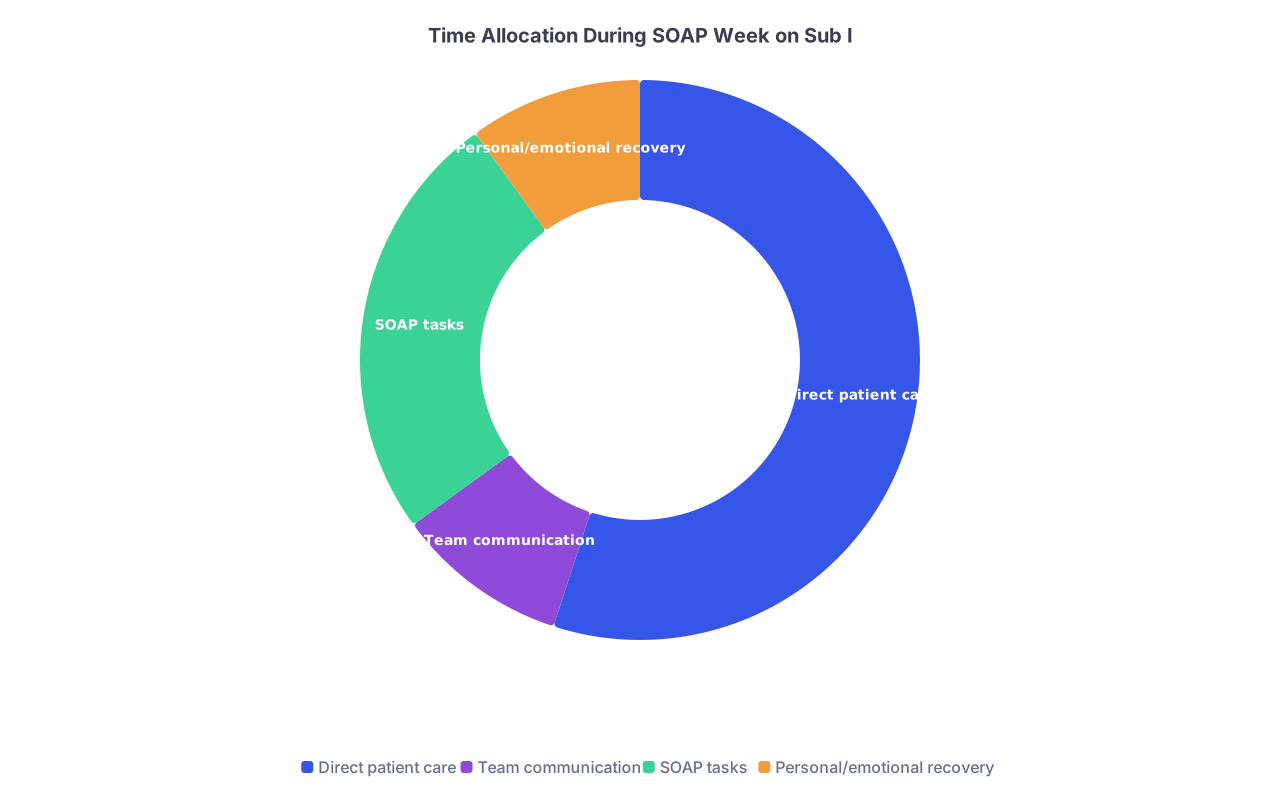
| Category | Value |
|---|---|
| Direct patient care | 55 |
| Team communication | 10 |
| SOAP tasks | 25 |
| Personal/emotional recovery | 10 |
Step 7: Emotional Survival While You’re Still Physically on the Wards
The emotional whiplash is intense. You’re writing orders one minute and wondering if you have a career the next. People around you might be celebrating their matches. You’re trying to function.
You need deliberate coping, not “I’ll power through.”
1. Choose 1–2 people who know the full situation
Tell:
- One trusted co‑student or resident
- One person outside medicine (family, partner, friend)
Ask very specifically:
- “This week, can I text you when I feel like I’m about to lose it, and can you just remind me this is not the end?”
- “Please don’t flood me with advice right now; I mostly need a place to vent.”
Trying to pretend everything’s normal in front of everyone is exhausting. Having one person who knows the full chaos helps.
2. Set one tiny daily rule to protect your brain
This isn’t a “self‑care” Instagram post. This is tactical.
Examples:
- No checking ERAS or email between 10 p.m. and 5 a.m.
- 5 minutes of walking outside the hospital before you go home, without your phone
- Writing down 3 things you actually did competently that day (so your brain doesn’t rewrite the week as “I failed at everything”)
You cannot control the outcome of SOAP. You can control not spiraling into complete collapse in the middle of your acting internship.

Step 8: If SOAP Fails or You Land a Prelim – Planning While Still on Service
You might be reading this worried SOAP will not go your way. Or you may end up with a prelim when you wanted categorical. Your acting internship is still running while you make contingency plans.
If you don’t get a SOAP position
You still have patients the next day. You still have an attending expecting you at 6:30 a.m. That next morning is awful. Here’s what you do:
Tell your senior/attending:
“I wanted to update you—I did not secure a SOAP position. I’ll be working with my dean’s office on a plan for the coming year, but for now I’m committed to finishing this rotation strong.”Schedule a longer meeting with your dean/advisor ASAP (zoom/phone after hours) to outline:
- Research year vs additional degree vs non‑clinical gap
- Strategy for reapplication
- Who will write new letters (that acting internship attending might be one—so your performance still matters)
Ask your attending for candid feedback before the rotation ends: “Given this outcome, I want to use this year to improve. Are there specific skills or habits you think I need to develop to be a strong intern next cycle?”
That feedback may sting. You still want it.
If you end up with a prelim rather than categorical
While finishing your sub‑I, quietly shift gears:
- Build relationships with residents and attendings who could be future letter writers
- Ask them about their program’s track record of prelims landing categorical spots later
- Start a running list (simple spreadsheet) of:
– Programs with open PGY‑2 spots historically
– Mentors who could advocate for you next cycle
You’re playing a two‑year game now, not a one‑week one.
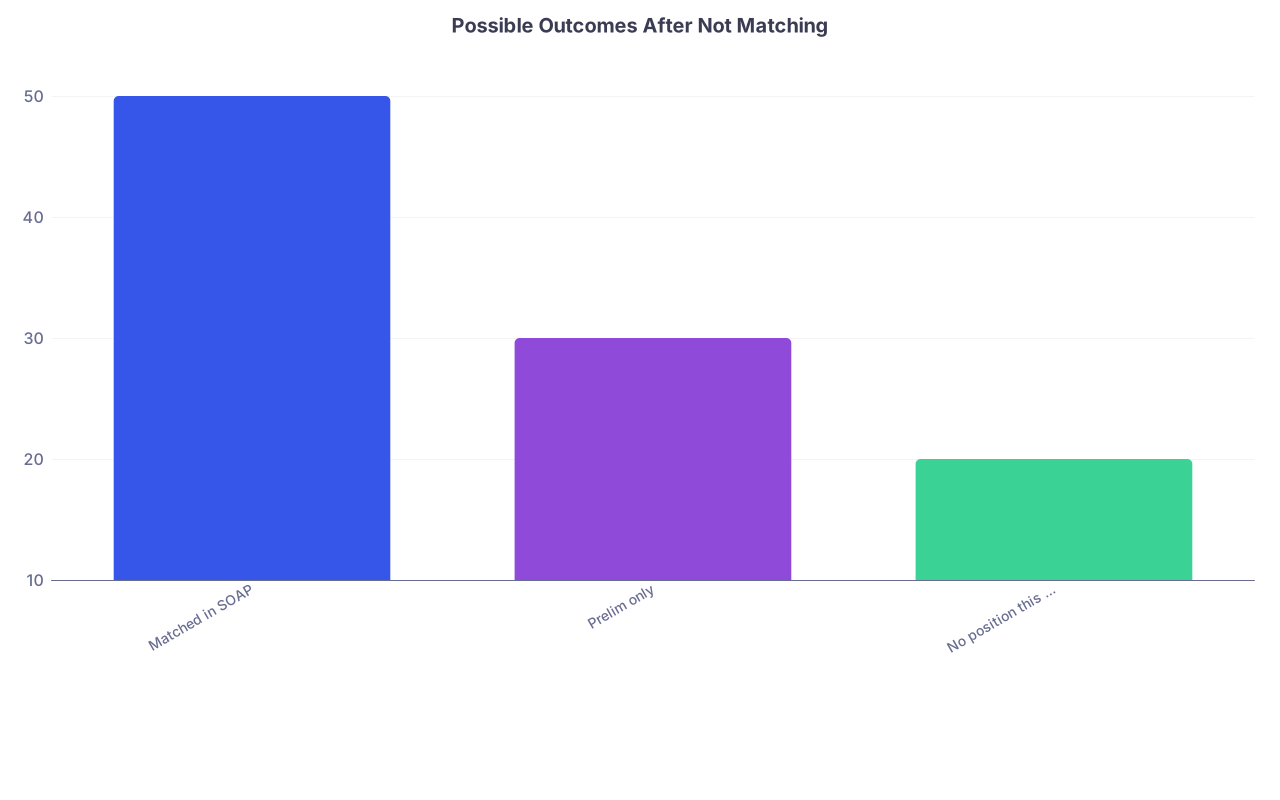
| Category | Value |
|---|---|
| Matched in SOAP | 50 |
| Prelim only | 30 |
| No position this year | 20 |
Step 9: Common Mistakes I See Students Make in This Exact Situation
I’ve seen versions of this play out multiple times. Same patterns.
Hiding SOAP from the team
They find out when you keep disappearing or seem distracted. This breeds frustration and bad evaluations. Tell them early.Over‑investing in the rotation at the expense of SOAP logistics
“I didn’t check my email for four hours because I didn’t want to step away from rounds” → missed offer, lost spot, repeat year.Over‑sharing with everyone
Telling every nurse, every resident, every classmate the blow‑by‑blow of your unmatched status. You end up emotionally drained and get 50 conflicting pieces of advice.Trying to present as if nothing is wrong
You look brittle. People can tell something’s off. Controlled honesty usually earns you more respect than fake normal.Neglecting basic professionalism because you’re upset
Snapping at staff, disappearing without explanation, charting sloppily. Being unmatched explains emotional distress. It does not excuse unprofessional behavior.
Avoid those, and you’ve already done better than a lot of people caught in this situation.

Your Next Move: Prepare Before You Need This
You might be reading this before Match Week. That’s actually ideal.
Here’s what you can do today:
- Open your calendar and block out Match Week and SOAP dates (look them up for this cycle).
- Draft a one‑paragraph email you’d send your senior/attending if you didn’t match: clear, calm, professional. Save it.
- Make a short list of 2–3 faculty or deans you’d contact immediately if SOAP became your reality.
Do that now, not later. Then, if that “You did not match” email ever hits while you’re buried in orders and cross‑cover pages, you won’t be starting from zero. You’ll be following a plan.