
The biggest myth about SOAP is that programs thoughtfully “review all applicants” before sending offers. They don’t. They can’t. On offer day, decisions are made in minutes, sometimes seconds, and if you do not understand that reality, you get steamrolled.
Let me pull back the curtain on what actually happens on the PD side when the clock starts.
What the Room Really Looks Like on Offer Day
Most applicants picture some civilized committee meeting. Printed CVs. Thoughtful debate. That’s fantasy.
Here’s the real scene I’ve sat in more than once.
Program director at the head of a table. Two or three core faculty. Maybe the chief resident. Program coordinator with two phones, ERAS open, and a spreadsheet up. Some places have the GME office patched in by Zoom, especially if they have to coordinate multiple programs. Everyone looks like they already did a 24-hour call.
There’s a running list of:
- How many categorical spots are open
- How many prelim spots are open
- A short “priority list” of SOAP candidates they already flagged during the application window
And then there’s the clock. Because everyone in that room knows: when offer rounds open, every extra minute you hesitate is a candidate accepting someone else’s offer.
No one is “starting fresh” on offer day. If you are still a random name in a list at that point, you’re almost certainly not getting that program’s first wave of offers.
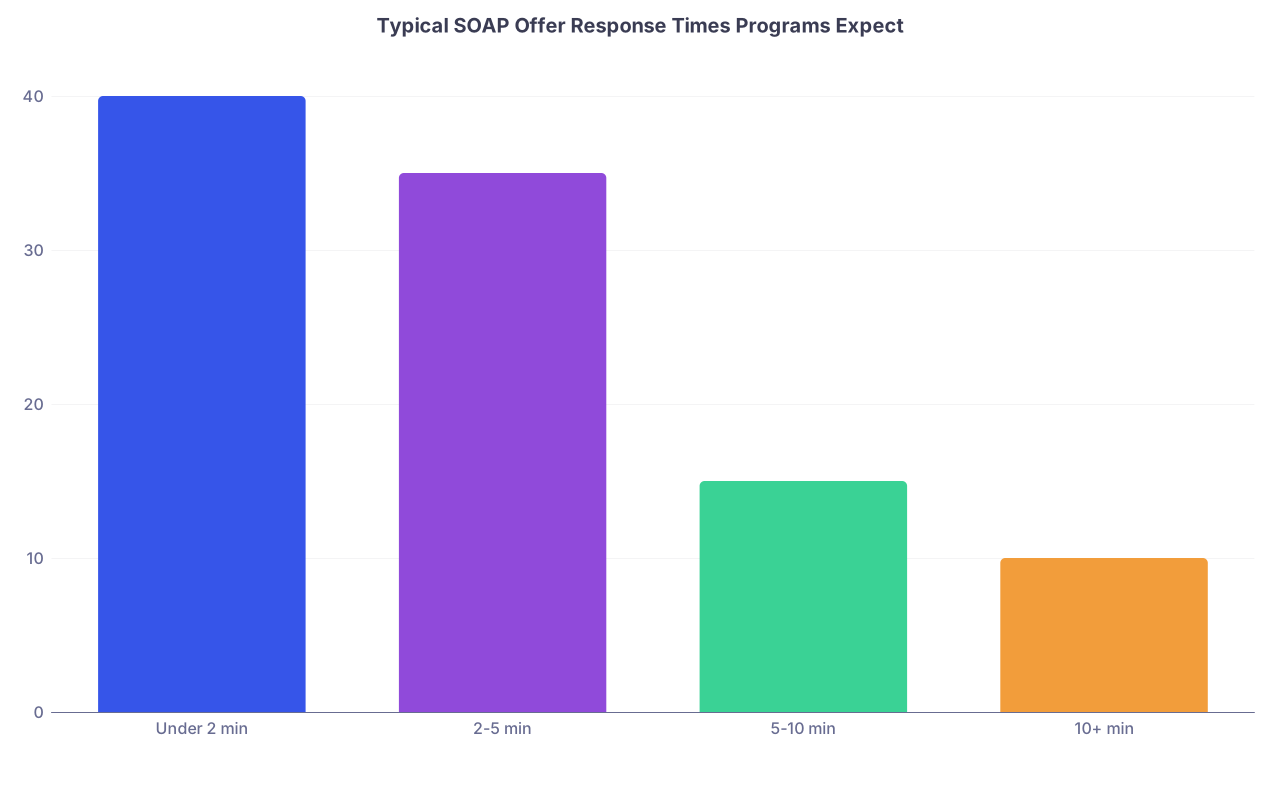
| Category | Value |
|---|---|
| Under 2 min | 40 |
| 2-5 min | 35 |
| 5-10 min | 15 |
| 10+ min | 10 |
That’s the expectation. Programs assume strong candidates will accept in under 5 minutes if they’re serious. Plenty accept in under 60 seconds.
What Programs Actually Prepare Before Offer Day
The “speed” of SOAP offers is all about prep. The fastest decisions on offer day are actually made days before.
Here’s what’s already done before you ever see an offer:
Shortlist creation
During the SOAP application window, the PD or associate PD does a brutal, high-speed sort:- Filters for US grads vs IMGs (yes, this matters, especially for prelim vs categorical)
- Looks at Step 1 (if numeric), Step 2, fails, exam gaps
- Looks for “hard filters”: professionalism issues, failures, big time gaps without explanation
- Skims personal statement only if something is borderline
Most places will create tiers: Tier 1 (will offer if we can), Tier 2 (if Tier 1 declines or disappears), Tier 3 (true backup)
Mini-rank list
SOAP is basically a free-agency sprint. Programs sketch a rough internal rank list:- “Top 5 for our categorical spots”
- “Top 10 for prelims”
- “Fine if desperate” list They will not advertise this, but it absolutely exists. If you had a phone/virtual conversation with them and it went well, you’re probably on Tier 1 or 2.
Pre-cleared candidates
This is the part nobody tells you: PDs often pre-clear their top few names with the DIO/GME before offer day. Conversation sounds like:“We want to move on these four if we get them. Any contract issues? Visa okay? Licensure okay?”
Why? Because on offer day, they cannot chase down legal/visa details for every candidate. So they pre-identify “safe” people they’re comfortable locking in.Communication strategy
Some programs will call or email candidates before offer day:- “We’re very interested in you if we have a spot.”
Or slightly more vague: - “You are ranked highly on our list.”
Are they promising? Usually no. But if you’ve had zero contact, and other people have had calls and quick Zoom chats, understand this: you’re not at the top of their board.
- “We’re very interested in you if we have a spot.”
The Moment Offers Go Live: What Actually Happens
When that first SOAP offer round opens, the PD side turns into controlled chaos. Let me walk you through it minute by minute, the way it actually plays out.
Minute 0–1: Fire off the first wave
The PD has their list ready. They rarely send just one offer per spot. Instead they overshoot slightly, expecting some declines.
Example: 3 categorical spots open. They might send 4 or 5 offers in the first round, depending on how confident they are that some candidates have better options.
Decision per candidate? 5–15 seconds. Tops.
- Name
- Board scores already known
- Short impression from call/Zoom if they had one
- Quick glance to confirm “nothing crazy” in the file
Then: “Send.”
Nobody is reading your personal statement carefully at this point. That ship sailed the minute SOAP applications closed.
Minute 1–5: Watching the accept/decline feed like hawks
ERAS/GME interface starts showing:
- Offer accepted
- Offer expired (candidate accepted elsewhere)
- Offer declined
Coordinator is refreshing like a day trader watching a stock crash.
PD’s mental calculations go like this:
- “We just lost Candidate #1 to another program. Go to #2 on the backup list.”
- “We filled one prelim, two left. Next wave from Tier 2.”
Each new offer decision is usually under 30 seconds. If they know your name and like you, it’s basically automatic.
If you’re unknown to them and they’re scrolling: that’s dangerous for you. You are not a prioritized name. You’re a “we need a warm body” candidate.
Minute 5–20: The pivot phase
This is where a lot of applicants either get lucky or disappear completely.
What happens here:
- PD realizes: “We’re not getting our top three; they already matched elsewhere.”
- They quickly move to Tier 2 and Tier 3.
- Faculty might say:
“What about that IMG from XYZ? Great scores, had strong letters. Let’s look fast.”
They open your ERAS, scroll for maybe 20–30 seconds:- Exams
- School
- Red flags
- Any prior communication or faculty connection
If nothing alarming jumps out, they say: “Send an offer.”
This is where being clean on paper is everything. SOAP is not a time for nuanced storytelling. It’s a time for “No obvious risk.”
If they have to think too hard about you, someone simpler gets the slot.
How Long They Actually Spend on You
Let me put real numbers on the thing everyone dances around.
| Candidate Type | Typical Review Time |
|---|---|
| Pre-identified Tier 1 candidate | 5–15 seconds |
| Tier 2 candidate with known name | 15–30 seconds |
| Completely cold candidate | 30–60 seconds |
| Candidate with obvious red flags | 5–10 seconds (to reject) |
If you’re imagining they’ll sit down and read your whole personal statement, analyze all your clerkship comments, and then debate your potential: no. They’re barely reading full paragraphs. They are scanning.
The PD brain on offer day is wired for questions like:
- “Can this person safely function as an intern?”
- “Will GME or the hospital credentialing office scream about this file?”
- “Is there any obvious disaster (multiple fails, professionalism write-up, huge unexplained gaps)?”
If the answer to those questions looks okay in 20–30 seconds, you can get an offer. That’s the speed we’re talking about.
How They Decide Between Two Similar Candidates
You and someone else look almost identical on paper. 1–2 point Step difference, similar school tier, no major red flags. How do they choose in 10 seconds?
Here are the tiebreakers I’ve watched PDs use when time is short:
- Prior connection: Did you rotate there? Did you email them with a concise, professional message earlier in the week? Did someone at their institution mention your name? That’s often enough to nudge you above another stranger.
- Communication style: If they talked to you on the phone/Zoom and you sounded mature, clear, and not desperate, that memory is driving the choice more than your exact score.
- Visa/eligibility simplicity: Hard truth. If time is tight and they’re choosing between two similar candidates, the one who doesn’t require a complicated visa often wins. Not always. But often.
- Perceived stability: No LOAs, no suspensions, no professionalism notes, no multi-year unexplained gaps. Clean and boring wins during SOAP.
Remember: on offer day, “low risk and predictable” beats “possibly great but complicated.”
Why Some Programs Move Slower (and Why That Can Save You)
Not every program blasts offers in the first second. A few are more cautious. Sometimes that’s bureaucracy; sometimes that’s a PD who’s been burned before.
What slower programs do:
- They might re-open a couple of full files between rounds and take 2–3 minutes on a candidate they’re on the fence about.
- They sometimes call you between rounds or send a quick “are you still interested?” ping through whatever communication they can legally use.
- They’re more likely to look at things like clerkship comments and letters if they’re stuck.
This slower pace can save candidates who are not obvious slam-dunks but who are clearly competent and thoughtful. The trade-off: those programs often lose their very top Tier 1s to more aggressive programs in earlier rounds.
From your side, this is why you sometimes see offers pop up not in round 1, but in round 2 or 3, from programs you thought were dead. They were just… slower. Or arguing. Or both.
What Happens When You Do Not Respond Fast Enough
This part is brutal and it happens every year.
You get an offer. You panic. You want to “think about it.” You text five people. Ten minutes pass.
On the PD side? They’re refreshing.
- At 2–3 minutes, they start to wonder: “This person probably has other offers.”
- At 5–10 minutes, they’re muttering: “They’re keeping us warm while they decide. We’re their backup.”
- If your offer window expires because you were indecisive, some PDs will not send you another one even if they still have open spots. They’d rather move to someone who looks eager.
During SOAP, silence or delay reads as disinterest.
This is why serious applicants go into offer day with a clearly ranked list of where they’re willing to say “yes” instantly, where they’d say “yes” after brief thought, and where they’d rather stay unmatched.
If you’re trying to build that list during the offer window, you’re doing it backwards.
How “Desperate” PDs Actually Are (Less Than You Think)
From the applicant side, SOAP can feel like programs are scrambling to fill with anyone they can get. That’s not how PDs see it. The good ones are very clear: they would rather leave a spot unfilled than bring in someone who will be a year-long disaster.
I’ve seen this happen. Program with two open prelim spots. After the first two SOAP rounds, they had only very high-risk files left in their realistic range. PD looked around the room and said:
“I’d rather do more work next year than spend every week in remediation meetings. We leave it open if these are the only options.”
They are under pressure. But not enough to ignore every red flag. Massive professionalism issues, repeated Step failures, dishonesty — those do not magically become acceptable in SOAP.
So yes, they move fast. But no, they’re not blind.
How You Can Position Yourself Before Offer Day (Given This Reality)
Since you’re reading this under “Navigating SOAP With Limited Interviews,” I’ll be blunt. You don’t have the luxury of fantasy.
Here’s what actually helps before offer day, aligned with how PDs really work:
Be easy to accept in 30 seconds.
Your ERAS should scream: “Clean, competent, safe.” That means your experiences and summary are organized, no weird contradictions, no unexplained disappearances. Any necessary explanations for gaps or fails are short, clear, and in one place.Communicate once, well.
A concise, specific email to programs you’re genuinely interested in: stating your interest, that you’re in SOAP, what you bring, and that you’d enthusiastically accept an offer if extended. No three-page life stories. PDs remember clear, simple messages.Answer your phone. Immediately.
On offer day, your phone is your lifeline. Unknown number? You answer. Weird area code? You answer. Your voicemail is professional and not full. If they can’t reach you quickly and they’re worried you won’t respond fast enough, some will move on.Have your own internal rank list ready.
You should know before the first offer window opens:- Which programs you will accept instantly
- Which programs you’d need 2–3 minutes to think about
- Which you will decline, even if desperate
That mental clarity lets you respond at the speed programs expect.

| Step | Description |
|---|---|
| Step 1 | Offer received |
| Step 2 | Accept immediately |
| Step 3 | Take 2-3 min max to decide |
| Step 4 | Decline and wait |
| Step 5 | Accept or decline |
| Step 6 | Prepare for next round |
| Step 7 | On pre-made yes list |
| Step 8 | On maybe list |
What PDs Talk About After It’s Over
After the dust settles, there’s always a debrief. You hear the same comments every year:
- “We lost three people in the first two minutes; they clearly had better options.”
- “That one candidate who took 15 minutes to accept? I don’t want to go through that again.”
- “We should have moved faster on [name], they got scooped up.”
- “I’m glad we did not go for that one file. GME would’ve killed us.”
Notice the theme. Speed. Clarity. Risk.
They remember candidates who:
- Responded fast
- Were straightforward to accept
- Had already left a good impression from a previous interaction or rotation
They also remember the ones who made them feel like a backup option. And they do not forget that next year if you reapply.
SOAP is short, but PD memories are long.
FAQs
1. Do programs ever fully read my personal statement during SOAP?
Rarely on offer day. During the SOAP application window, a few faculty might read it if you’re borderline and they’re trying to decide whether to put you on the Tier 1 or Tier 2 list. But during the actual offer rounds, they’re moving far too fast to absorb long narratives. What matters more is that your application is clean, coherent, and free of landmines.
2. If I get a call from a program before offer day saying they’re “very interested,” is that basically a promise?
No. It means you’re on their shortlist. You’re probably in their Tier 1 or high Tier 2 group. But they might lose you to other programs, or decide in the moment to pivot if someone else picks up faster or seems like a lower-risk bet. Take it as a good sign, not a guarantee.
3. How long is too long to wait before accepting an offer?
Anything beyond a few minutes starts to look bad. Under 2–3 minutes is ideal if you knew you liked that program. Over 10 minutes and you’re sending a clear signal that they’re a backup, or that you’re indecisive. In SOAP, indecisive reads as risk. That can hurt you not just this round, but if you ever show up in their applicant pool again.
4. If I don’t match in SOAP, does this fast decision-making hurt me for next year?
It can, but not always. Programs mostly remember extremes: the candidate who accepted quickly and gratefully, the one who strung them along, the one with a terrible interaction. If you were never on their radar at all, they probably won’t remember you. Your job after an unmatched SOAP is to clean up your application, get solid clinical experience or research, and become someone who looks like a clear “yes” in 30 seconds the next time they see your file.
Key points: Programs make SOAP decisions in seconds, not hours. They act on prebuilt shortlists and instinct about risk, not deep holistic reviews. Your advantage comes from being simple to accept, fast to respond, and already on their mental map before offer day even starts.