
What do you do when your only SOAP offer is prelim medicine at a non-visa-sponsoring program in the middle of nowhere, and your dream is categorical IM at a university hospital that might not even pick up the phone?
If you’re an international MD/DO grad in SOAP, you’re not choosing “what’s best.” You’re choosing “what’s least likely to blow up my life and my visa status.”
Let’s walk through that.
1. Know Exactly What You’re Optimizing For (Visa vs. Training vs. Future Match)
If you trained outside the US and you’re in SOAP, you’re usually juggling three competing priorities:
- Keep or get US visa status
- Get any ACGME-accredited spot so you’re not repeating this nightmare next year
- Set yourself up for a realistic second match (if you land prelim/transitional only)
You can’t maximize all three. You’ll have to rank them.
If your visa clock is ticking (OPT ending, J-1 waiver window looming, H-1B prospects unclear), visa security usually wins, even over prestige or “fit.”
Here’s the hard reality I’ve seen multiple times:
People who “held out” in SOAP for:
- “only categorical”
- “only H-1B sponsors”
- “only big city/university programs”
and passed on prelim or community offers often ended up:
- unmatched again the following year
- with worse application “age”
- with tighter visa timelines
- and less leverage
So before Monday of SOAP week, answer for yourself:
If the only offer I get is:
- Prelim medicine, J-1 only, small community hospital.
Would I take it?
If you don’t answer this before you’re under the gun, you’re going to make a panicked, emotional decision when the offer clock is ticking.
2. Understand What Each Visa Option Means in SOAP
Let’s get concrete. You’ll see the same keywords over and over:
- J-1 only
- H-1B eligible
- No visa sponsorship
- “Must be US citizen or permanent resident”
These aren’t semantics. They’re hard boundaries.
| Scenario | Practical Reality |
|---|---|
| J-1 only | You can match now, but future waiver planning is essential |
| H-1B eligible | Strong option but harder to secure during SOAP |
| No visa sponsorship | Effectively impossible as a non-US citizen/GC |
| US citizen/GC only | Do not waste time here if you need sponsorship |
J-1 Visa Programs
Most IMGs in SOAP will be dealing with J-1 programs. The key questions:
- Does the program actually sponsor J-1 for your specialty?
- Do they have a history of getting ECFMG forms done on time?
- Are they used to dealing with IMGs, or are you going to be their experiment?
Quick rule:
If it’s a community IM program in New York, New Jersey, Michigan, or Texas that already has a lot of IMGs, they know the J-1 drill. Good sign.
If it’s a tiny program with almost all US grads and no visible international faculty or residents, be cautious. They may “sponsor J-1” in theory and still be chaotic in practice.
H-1B Eligible Programs
Here’s the blunt truth: H-1B through SOAP is rare and logistically messy.
You usually need:
- Step 3 already passed
- Fast credential verification
- A program with a solid GME/legal team that’s done H-1Bs before
- Program willing to pay multiple thousand dollars for you, sight-unseen, mid-March
So if you’re sitting in SOAP expecting a first-time H-1B sponsorship from a small hospital that never had an IMG before? That’s fantasy.
Use H-1B eligibility as a bonus, not a requirement, unless you’re in a very specific situation (e.g., already in the US on another status with a lawyer lined up and Step 3 passed).
Programs With No Visa Sponsorship
Do not waste energy here.
You are not going to “convince them” in SOAP week to bend policy and start sponsoring you. They won’t.
If ERAS or FREIDA says “Cannot sponsor visas” or “US citizens / permanent residents only” → remove from your mental pool completely. Do not send a single message.
3. Categorical vs Prelim/Transitional: What Actually Matters for You
You’re an IMG in SOAP. Here’s your hierarchy, if you need visa sponsorship:
- Categorical spot at a visa-sponsoring program
- Transitional Year at a visa-sponsoring program (if your long-term plan can work from TY)
- Prelim Internal Medicine at a visa-sponsoring program
- Prelim Surgery at a visa-sponsoring program (only if you have a solid plan)
- Anything non-ACGME or non-visa-sponsoring = almost always “no”
Why this order?
Because you’re not just fighting to train. You’re fighting to stay legally in the country and still be competitive for future matching if you don’t land categorical now.
Categorical Offer with J-1 vs Prelim Offer with H-1B Potential
People get stuck on this tradeoff.
Here’s my take when I’ve seen this exact situation:
- Categorical J-1 offer at a solid (not famous) community program vs.
- Prelim medicine with possible H-1B, no guarantee of PGY-2
I’d take categorical J-1 almost every time.
Why?
- Residency completion is everything.
- A completed residency (even on J-1) → you’re a board-eligible physician.
- A prelim year with no PGY-2? You’re back in the match as “incomplete training” and your visa situation is shaky.
The rare exception: you already have a strong pipeline to a categorical spot the next year (e.g., guaranteed PGY-2 in writing, or you’re a re-applicant to a specialty that truly values prelim + research and you’re willing to roll the dice).
4. Targeting Programs in SOAP When You Need a Visa
During SOAP, time is your enemy. So you have to filter fast and hard.
Here’s how I’d structure a 2–3 hour block on Monday:
Pull your list of unfilled programs.
Filter by specialty. Then by state you’re actually willing to go to. Be honest.Separate into 3 buckets quickly:
- Clear visa sponsors (historically known, many IMGs on roster)
- “Maybe” sponsors (say they sponsor J-1 but haven’t had many IMGs)
- No-sponsors / US-only (delete from your life)
Check these specific things program by program:
- Do they have current international residents?
- Do their current or former residents mention J-1/H-1B on LinkedIn?
- Is there a GME office webpage clearly outlining visa info?
Prioritize applications:
- First wave: visa-sponsoring categorical spots
- Second wave: visa-sponsoring prelim/TY at stable IM-heavy hospitals
- Last: “maybe” sponsors you’re willing to risk
5. Handling Actual SOAP Offers When Visa Is the Constraint
This is where people panic.
You get an offer email or call. Let’s walk through the common nightmare scenarios.
Scenario 1: Only offer so far – prelim medicine, J-1, small community hospital
You want categorical IM, maybe subspecialty later. No other interviews. No categorical SOAP interest yet.
My advice:
Take the prelim.
Why?
- One year of US ACGME training is massively better than zero
- You lock in a legal status (J-1)
- You build US LORs from attendings who know you well
- You can reapply next cycle as “US-trained, strong prelim resident”
Is it ideal? No.
Is it way better than going unmatched completely with expiring visa? Yes.
What you do during that prelim year matters:
- Crush the job: show up early, be reliable, do not be difficult
- Get at least 2 very strong letters by mid-year
- Network with PDs at nearby categoricals
- Apply early and broadly, even to community categorical programs
Scenario 2: Two offers – categorical FM with J-1 vs prelim IM with potential H-1B later
You want IM, maybe cardiology. You dislike FM.
Still, I’ve seen this decision wreck people when they over-optimize for specialty.
Most likely better move: categorical FM with visa sponsorship.
Reasons:
- Completed ACGME residency in anything beats uncompleted IM
- Future immigration options with a completed FM residency + J-1 waiver job exist
- You can still subspecialize in some ways from FM (sports, geriatrics, palliative, pain, etc.), or pivot into hospitalist medicine
Choosing a prelim IM spot with vague “maybe H-1B next year” is gambling your entire future on hope.
Scenario 3: Categorical surgical prelim vs medicine prelim, both J-1
You dream of surgery, but you have no dedicated research, no big-name mentors, and your scores are average.
In SOAP, and especially as an IMG needing a visa, surgery is exceptionally unforgiving.
If you have:
- No previous surgical research
- No strong surgery letters from US attendings
- No advanced PGY-2/PGY-3 positions in pipeline
Then a prelim surgery year is often a dead end.
Prelim IM gives you broader doors later:
- Switch to IM categorical
- Pivot to FM
- Possibly transition to neurology or other fields
- And still maintain your visa through ACGME training
So yes, the “smart but painful” call is usually prelim IM.
6. Immigration Reality Checks You Cannot Ignore
Talk to an actual immigration lawyer if you’re close to losing status. Not a friend-of-a-friend on Telegram. A real one.
But here are some practical truths that show up every year:
- A gap year on no recognized status in the US is poison for your visa story.
- Multiple unmatched years look bad to both programs and immigration.
- Securing any ACGME position with J-1 sponsorship now is often safer than holding out for a hypothetical H-1B dream.
If you’re on OPT or some temporary status ending soon, your job is survival:
- Lock in something that keeps you in the system
- Prefer J-1 sponsored ACGME residency to trying to piece together observerships and unpaid research after your status ends
Don’t assume, “I’ll just stay and do unpaid research, it will be fine.” It often isn’t.
7. Scripts for Communicating With Programs About Visa During SOAP
You need to be direct, not apologetic. Also not needy.
Example email for a program that might sponsor J-1:
Subject: SOAP Applicant – Visa Eligibility Clarification
Dear Dr. [PD Last Name],
My name is [Name], AAMC ID [ID]. I’m an international [MD/DO] graduate who applied to your [Specialty] program this cycle. I’m very interested in your program and noticed it on the SOAP list.
I’m eligible for ECFMG-sponsored J-1 visa. Could you confirm whether your program sponsors J-1 visas for incoming PGY-1 residents this year?
Thank you for your time and consideration.
Best regards,
[Name]
Do not:
- Ask them to create new visa policies
- Get into long stories about your immigration struggles
- Write 800-word emails
For H-1B eligible places, if you truly have Step 3 and strong test scores:
I have already passed USMLE Step 3 and am available for H-1B sponsorship where offered; however, I’m fully comfortable with a J-1 if that is the only visa your institution supports.
You want to present as low-friction, not demanding.
8. Planning for the Next Match if You Take a SOAP Prelim Offer
Let’s say you accept a prelim/TY offer because of visa reasons. How do you not get stuck in limbo?
You need a concrete 12-month plan.

| Step | Description |
|---|---|
| Step 1 | Start PGY1 July |
| Step 2 | First 3 months - Prove reliability |
| Step 3 | Month 4-6 - Secure strong letters |
| Step 4 | Aug-Sep - Prepare and submit ERAS |
| Step 5 | Oct-Jan - Interview while on electives |
| Step 6 | Feb - Update PDs and mentors |
| Step 7 | March - Match outcome and plan |
Key moves:
- Request at least 1–2 elective or lighter months during Oct–Jan so you can interview
- Get explicit support from your PD early: “I plan to apply for categorical PGY-1/PGY-2 positions next year. Is this something you’ve supported residents with before?”
- Document everything. You’ll need LORs, evals, proof you performed well
If your prelim/TY program is hostile to your reapplication plans? You still do what you must, but you document your work and build alliances with individual attendings.
9. Emotional Side: Making a Decision You Don’t Love but Can Live With
Here’s the part people underestimate: grief.
You might have to take:
- A specialty you never originally wanted
- A location you hate
- A visa route that limits your future options
And it feels like failure.
It isn’t.
What kills careers in this space is not “taking an imperfect option.” It’s letting pride push you into no option.
I’ve watched:
- FMGs who took categorical FM in small towns → now hospitalists making good money with solid immigration status
- IMGs who refused prelim spots because “I’m better than that” → still unmatched 3 years later, visa gone, back home, bitter
You’re allowed to be upset. Just don’t let that emotion make the decision.
Build a decision matrix on paper. Literally write:
- Option A: [Program, specialty, visa type] – pros/cons
- Option B: [Alternative, including going unmatched] – pros/cons
- Worst-case scenario in 5 years for each
- Best-case scenario in 5 years for each
Then choose the option where the worst-case is still survivable.
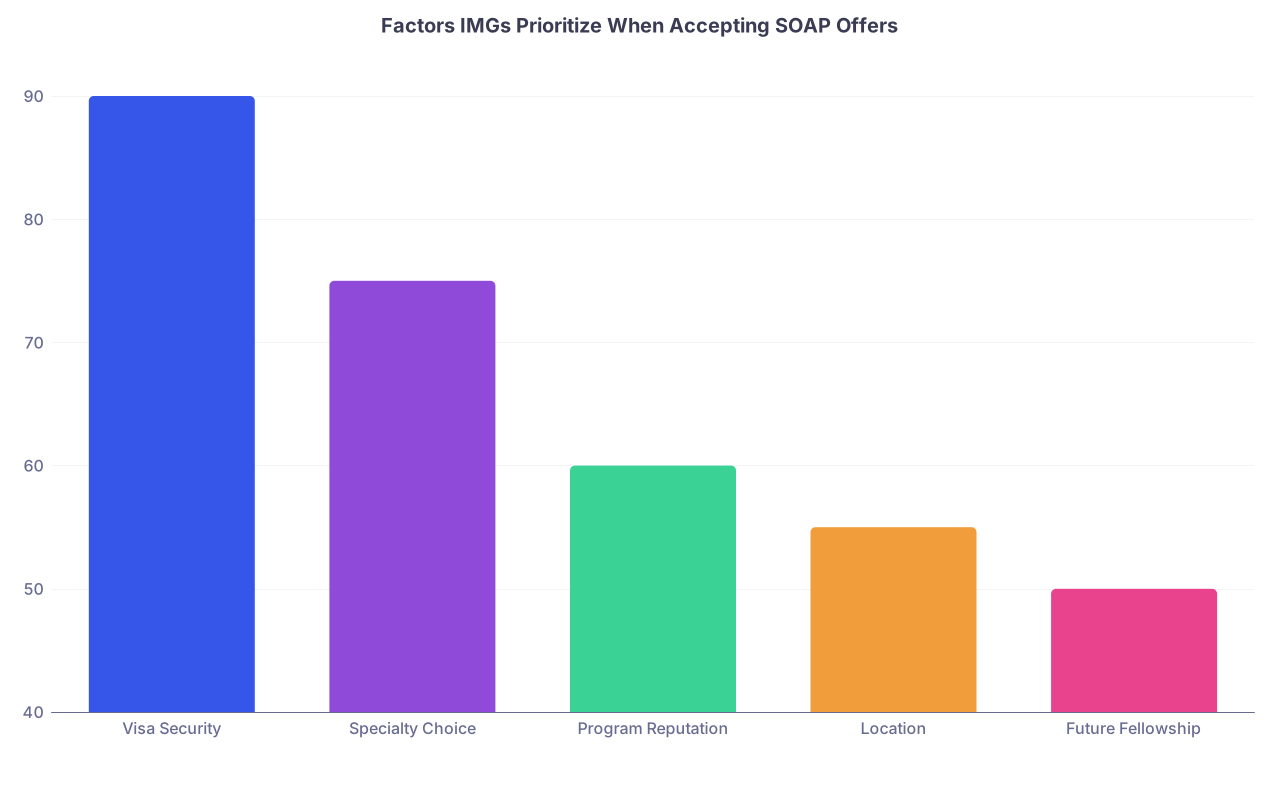
| Category | Value |
|---|---|
| Visa Security | 90 |
| Specialty Choice | 75 |
| Program Reputation | 60 |
| Location | 55 |
| Future Fellowship | 50 |
FAQ (Exactly 4 Questions)
1. Should I ever decline a SOAP offer if it’s my only one?
Yes, but rarely. You consider declining only if the program cannot sponsor your required visa at all, or if the position is non-ACGME and will not help your future match or immigration situation. Declining a legitimate ACGME, visa-sponsoring prelim or categorical spot because you “don’t like the specialty” or “wanted a bigger name program” is almost always a mistake for an IMG with visa constraints.
2. Is J-1 really that bad compared to H-1B?
J-1 isn’t “bad”; it’s constrained. You’ll need a waiver job after training and likely commit several years to underserved or rural areas. But it gets you trained, board-eligible, and employable. H-1B is cleaner for immigration long term, but harder to secure and more expensive for programs. In SOAP, chasing H-1B at the expense of losing a sure J-1 categorical spot is usually the wrong play.
3. Can a prelim year actually help me match better next cycle?
Yes—if you use it correctly. Strong evaluations, real US LORs, PD support, and evidence you performed well as a resident can significantly upgrade your application. Many PDs value someone who has already survived intern year. But if you coast, burn bridges, or fail exams during that prelim year, it will hurt you, not help you.
4. What if my dream specialty basically doesn’t exist in SOAP for visa-sponsoring programs?
Then you choose between your dream and your reality. You can:
- Take a visa-sponsoring spot in a different specialty (FM, IM, TY) and later find crossover paths, or
- Go unmatched, stay or leave the US depending on visa, and reapply hoping next year is better. For most IMGs who need a visa, locking in some ACGME position now is the more rational, survivable choice.
Key points to remember:
- Do not sacrifice visa security and ACGME training for prestige or ideal specialty in SOAP.
- Categorical J-1 almost always beats speculative prelim H-1B.
- A solid, imperfect offer today is almost always better than a theoretical perfect offer that may never come.