
You are in a call room, it is Monday of Match Week, and your phone just showed you the message you hoped you would never see: “We are sorry, you did not match to any position.”
Your dean’s office is buzzing, group texts are exploding, and someone has already said: “Just apply to everything in your specialty in SOAP and see what happens.” Another person says: “If a program calls, say yes immediately before they move on.”
This is exactly where people blow up their own chances. Not with one giant, dramatic mistake. With a series of quiet, panicked moves that feel logical in the moment and end up boxing them into bad options or no options at all.
Let me walk through the ones I see every year—and how to avoid becoming another cautionary story.
1. Treating SOAP Like ERAS 2.0 Instead of a Different Game
SOAP is not just “a late ERAS.” The rules, timelines, and psychology are completely different. If you act like it is the same game, you will lose.
Common self-sabotage moves here:
- Recycling your original personal statement without edits
- Leaving your application generic when SOAP needs targeted clarity
- Not rewriting your specialty story when you pivot
Here is the key difference: In regular Match season, programs are sifting through hundreds of applications, searching for the “best” fit. During SOAP, they are triaging. Fast. “Can this person safely fill this spot and not be a disaster for my service?”
If your application still reads like a hopeful, idealistic main-cycle application that assumes time and attention, you look tone-deaf.
You must adjust three things quickly:
- Your personal statement
- Your program signaling (if applicable / via emails)
- Your specialty narrative (especially if you pivot)
Bad move: You leave a Dermatology-aimed PS as-is while applying to Internal Medicine SOAP positions, hoping no one reads that closely.
Better move: Write a blunt, one-page, SOAP-focused statement: what you want now, why you are a safe bet, what you bring to this specialty / setting.
If you have 20–30 minutes, you have time to create specialty-specific variants.
| Scenario | Action |
|---|---|
| Same specialty as main cycle | Lightly trim and refocus on reliability, readiness |
| Close specialty pivot (FM ↔ IM) | Rewrite intro, emphasize overlapping skills |
| Major pivot (Surgery → Psych) | New PS, direct explanation and risk control |
| Applying to prelim only | Emphasize work ethic, adaptability, team reliability |
Do not cling to the fantasy that programs will “understand” what you really wanted. In SOAP, unclear or contradictory messaging is a red flag, and red flags do not get a call.
2. Blindly Clicking “Apply All” Like You’re Buying Clearance Socks
By Tuesday morning, the SOAP list is up. Your heart rate spikes. There are actually spots in your specialty. And spots in others. And prelims. And you have 45 minutes between meetings with your dean and the advisor who sort-of knows your name.
This is where students torch their chances with one click: “Apply to all in [specialty].”
I have watched this mistake cost people both interviews and reputation.
Here is why “apply to everything” quietly sabotages you:
- Programs see an applicant list that clearly contains many people who have no real desire to be there. They become more suspicious, not less.
- You risk ending up at a program you actively hate because you never even read the description.
- You burn your limited number of applications on places that will not rank you, while better fits never see you.
SOAP applications are usually capped (for example, 45 programs total across rounds). Treat that cap like oxygen, not confetti.
You should filter:
- Geography you can realistically commit to
- Community vs university environment
- Visa / citizen status needs
- Programs with reputations so toxic even desperate residents warn you away
No, you do not need to be “picky.” But you absolutely should avoid being random.
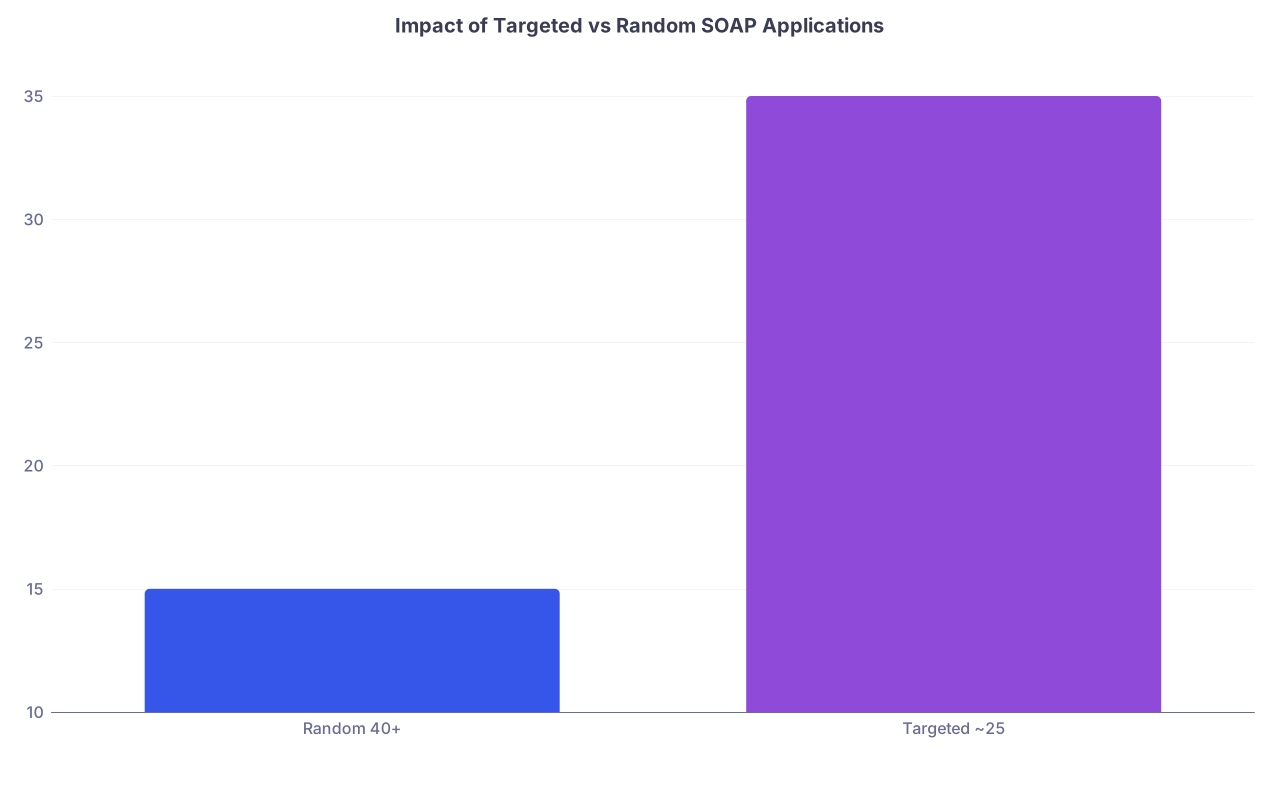
| Category | Value |
|---|---|
| Random 40+ | 15 |
| Targeted ~25 | 35 |
Interpretation: I routinely see targeted SOAP strategies roughly double the rate of interview calls compared to pure “spray and pray.” Programs can smell desperation. They respect discernment.
Do not make the lazy move of skipping the program websites “because there’s no time.” Even a 60–90 second skim is better than pretending every open spot is interchangeable.
3. Panicked, Sloppy Communication With Programs
SOAP has an odd tension: you are not supposed to cold-call programs and harass them, but there are times when strategic, respectful contact is appropriate (especially when they reach out to you).
Where people self-destruct:
- Answering SOAP calls unprepared and rambling
- Sounding either overly desperate or weirdly entitled
- Sending generic, mass emails that scream copy-paste
You will not have time to craft Shakespearean emails. You do have time to avoid sounding chaotic.
Build three micro-templates before calls start:
- Short interest statement for programs that contact you
- Clarifying email for major specialty pivots
- Update email if anything material changed (Step 2 CK, new LOR, remediation completion)
Ugly versions I see in SOAP:
“Hi, I would love to be considered for your program, I did not match but think I would be a great fit and really hope to get an interview.”
Better version:
“Thank you for considering my application through SOAP. I am especially interested in your [community / academic / rural] training environment and the opportunity for strong inpatient experience early in residency. I am ready to start July 1 and can commit fully to your program if offered a position.”
Short. Clear. Not groveling. Not vague.
On the phone:
Programs may call with what is essentially a five-minute interview pretending not to be one. The mistake is thinking, “It’s just logistics, I’ll wing it,” and then you word-vomit your anxieties.
Script three things ahead:
- 1–2 sentence “who you are”
- Why this specialty / program type now
- One solid example that shows you can work hard, safely
If you insist on “being natural,” you will sound scattered. And scattered in SOAP reads as unsafe.
4. Lying, Spinning, or Dodging the “Why Didn’t You Match?” Question
They will ask. Maybe not everyone, but enough that you must have an answer that is honest, contained, and not self-destructive.
The catastrophic mistake is one of these:
- Blaming everyone and everything (“My dean’s office screwed me, the system is unfair, Step going pass/fail ruined it”)
- Offering a vague, evasive non-answer (“It just did not work out, I am not really sure why”)
- Minimizing clear issues they can already see (like multiple fails, professionalism marks, failed rotations)
Programs are not looking for a flawless story in SOAP. They are looking for: “Is this person self-aware, accountable, and coachable, or will they blow up my service?”
Your answer must:
- Acknowledge reality
- Identify 1–2 focused factors (not 10)
- Show what you corrected or learned
- End with why you are now ready
Example (low interviews, average application):
“I had a relatively average Step score and my application leaned heavily academic for a competitive specialty. I received only a few interviews and did not match. Since then I have broadened my geographic preferences and am focusing on Internal Medicine, which aligns with my strengths in longitudinal patient care. My evaluations consistently highlight reliability and work ethic, and I am ready to bring that to your program.”
Example (academic issue):
“During my second year I failed one course related to a health issue that is now fully treated. I remediated successfully and have since completed all clerkships on time with strong clinical evaluations. I understand programs need residents they can depend on, and my performance over the last two years reflects that stability.”
Do not try to “outsmart” them with spin. They see hundreds of these. The bug is not that you had a problem. The bug is if you act like you did not.
5. Refusing to Pivot When the Market Has Already Spoken
Here is a bitter truth: some people end up in SOAP because they overshot their specialty competitiveness by a mile and refused to hear it all year.
On Monday, they still refuse.
They insist: “I will only SOAP into Ortho / Derm / ENT / Plastic Surgery / Neurosurgery / etc.” The unspoken part: “Or I would rather be unmatched.”
Sometimes that is a conscious, informed choice. But often it is pride and denial.
Self-sabotage pattern:
- You had very few or no interviews in a hyper-competitive field
- Your Step / clinical / research profile was already borderline
- SOAP shows a handful of spots in that same field
- You dump most of your applications into those few spots, “taking your shot,” and barely consider more realistic options
Here is what actually happens. The SOAP spots in those specialties often go to:
- Internal transfer agreements
- Extremely strong applicants who over-applied or had bad luck
- People with powerful, specialty-specific support
Not “I had zero interviews and I really like surgery.”
For many unmatched applicants, the right move is:
- Pivot to Internal Medicine, Family Medicine, Pediatrics, Psychiatry, or preliminary years
- Apply smartly, not shamefully
- Build a path to later transition or carve a satisfying career where you land
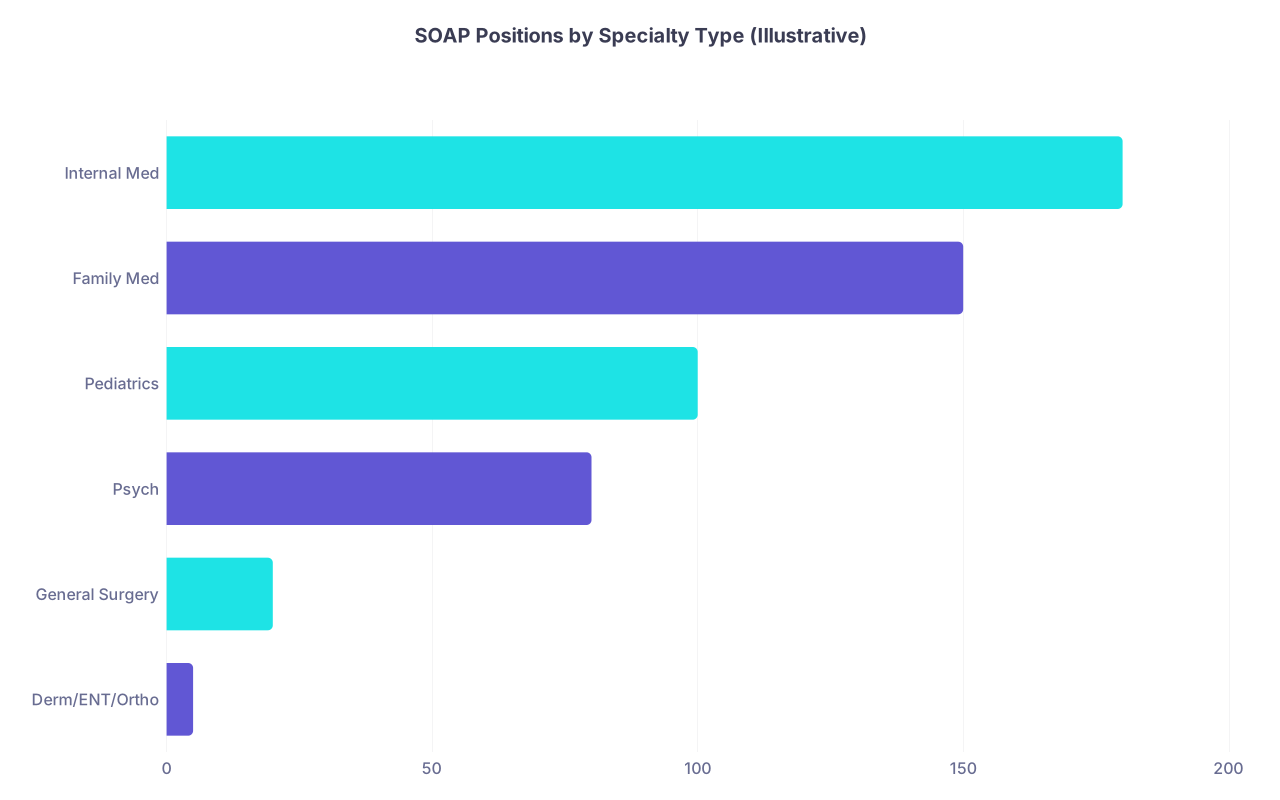
| Category | Value |
|---|---|
| Derm/ENT/Ortho | 5 |
| General Surgery | 20 |
| Psych | 80 |
| Pediatrics | 100 |
| Family Med | 150 |
| Internal Med | 180 |
Do not make the ego-driven mistake of burning 30+ SOAP applications on five spots in a field that already told you “no” loudly and clearly.
6. Accepting the First Offer Without Thinking Two Moves Ahead
By the time Thursday rounds come around, your nerves are shredded. Someone gets a call. Your classmate whispers, “Take anything, you can always transfer later.”
No. That mindset has wrecked more careers than it has rescued.
Here is the quiet sabotage: you treat any SOAP offer as a scratch-off ticket you can discard later. Programs do not see it that way. They expect a resident, not a 1-year temp who is already halfway out the door.
Transferring after a prelim or PGY-1 is possible, but it is not guaranteed and it is not easy. You will need:
- Strong program support and a positive letter
- Available PGY-2 positions
- No major red flags during PGY-1
- A story that makes sense and does not scream “flight risk”
If you accept a prelim Surgery spot in a program with a horrific reputation, minimal teaching, and high attrition, purely because it is the first call you got, you might be locking yourself into a miserable year that does not even set you up well for IM or another field.
It is not glamorous to ask during the call:
- Is this a categorical or prelim position?
- What is the call schedule like?
- Do your prelims historically move into categorical positions or other specialties?
But you need to. In SOAP, you do not have the luxury of ten second-look visits. You do have the right to basic transparency.
I have seen people say “yes” so fast they did not realize they accepted:
- A non-ACGME position
- A visa situation they could not meet
- A track that did not exist the way they thought
Pause. Ask 2–3 targeted questions. It is still fast. It is still SOAP. But it is not blind.
7. Wasting Emotional Energy on Shame Instead of Execution
This one is quieter but lethal.
Instead of spending Monday–Wednesday making a precise list, rewriting statements, calling your advisor three times, and confirming documents, you spend it:
- Doom-scrolling Reddit and SDN
- Obsessively reading “I matched!” posts
- Spiraling into “I am a failure, it’s over” territory
The mistake is not feeling awful. That is human. The mistake is letting that emotion paralyze your actual logistics.
Your mental model for SOAP should be: emergency protocol.
When a code is called, nobody stands in the hallway processing their feelings for 20 minutes. They go through the algorithm. Then they decompress later.
You need a SOAP algorithm:
- 1–2 hours to grieve on Monday morning
- Then a hard switch to task mode
- Short, specific breaks to cry, vent, walk, then back
You are not a robot. But if you let shame soak up your working memory all week, you will miss details, misclick, send the wrong PS, or ignore a voicemail for 6 hours.
I have seen that last one happen more than once.

| Step | Description |
|---|---|
| Step 1 | Monday - No Match Notice |
| Step 2 | 1-2 hr emotional decompression |
| Step 3 | Meet dean/advisor |
| Step 4 | Review SOAP list |
| Step 5 | Prioritize and filter programs |
| Step 6 | Rewrite focused PS versions |
| Step 7 | Submit applications |
| Step 8 | Prepare brief phone scripts |
| Step 9 | Monitor calls/emails closely |
| Step 10 | Evaluate offers, ask key questions |
Do not let the story “I am behind, I am ruined” become a self-fulfilling prophecy. You are behind. That is true. You are not ruined. Unless you act like you are and stop executing.
8. Ignoring Your Own Red Flags When Planning Post-SOAP
Last one. Not everyone matches in SOAP. Someone will read this after Thursday with no spot.
The destructive move here is to pretend that “just trying the Match again exactly the same way next year” is a plan.
If you had:
- Step failures
- Multiple low clerkship grades
- Professionalism / conduct issues
- Major gaps in your CV
- Almost no interviews in two consecutive cycles
You cannot just “reapply harder.” You need remediation, extra training, or a real pivot.
What people do instead:
- Slap together a research year with no mentorship
- Work as an unstructured “observer” with no path to a strong letter
- Avoid hard conversations with their dean’s office about true viability
You have to ask: what is realistically fixable in 6–12 months, and what might never change?
Sometimes the right move is:
- Reframing which specialties are truly within reach
- Considering different geographic markets more seriously
- Exploring non-residency clinical careers you would not hate
SOAP is not just about this week. Your decisions in and after SOAP set the trajectory of the next 5–10 years. Do not compound a bad year with a stubborn, fantasy-based plan that will fail again.

FAQ (Exactly 3 Questions)
1. Should I ever say “I will definitely come if you offer me a SOAP position”?
You should only say this if you truly mean it. Overcommitting is a silent reputation killer. Programs talk. If you verbally commit to multiple places and then disappear, that behavior will follow you. A more honest version is: “Your program is my top choice among the places I have applied to, and if offered a position I would be very likely to accept.” Reserve absolute statements for cases where you are genuinely prepared to follow through.
2. Is it a mistake to apply outside my original specialty in SOAP?
It is a mistake not to strongly consider it if your original specialty was highly competitive and you had poor traction. Pivoting to Internal Medicine, Family Medicine, Psychiatry, or Pediatrics in SOAP is not a sign of failure. It is a sign you understand the market. The bigger mistake is clinging to a closed door while ignoring an open one that could still lead to a good career—sometimes even circling back toward your first choice later, but now from a stronger base.
3. If I do not match in SOAP, does that mean I should give up on residency altogether?
No. It means you must stop pretending your current strategy will magically work next time. You need brutally honest feedback from someone who will not sugarcoat your chances. For some, a structured research year, improved Step 2 CK, and better geographic flexibility lead to a successful reapplication. For others, repeated failure and entrenched red flags mean it is smarter to pursue alternative clinical or non-clinical paths. The mistake is not “failing SOAP.” The mistake is refusing to adjust afterward.
Core takeaways:
- Do not let panic make your SOAP strategy random, sloppy, or dishonest.
- Be realistic about your competitiveness and pivots; do not waste applications on fantasy.
- Any offer or plan you accept in SOAP should make sense not just for this week, but for the next several years of your life.