
The worst SOAP mistakes happen in the first 30 minutes—when people panic and click “accept” without a plan.
You’re not asking a casual question. Geography vs specialty vs program reputation during SOAP is a real tradeoff with lifelong consequences. I’ve watched students end up in the wrong place (and miserable) because they treated SOAP like a lottery instead of a strategy.
Here’s the answer you’re looking for: you prioritize specialty first, then program stability/reputation, then geography—but only after you’re brutally honest about your long‑term goals and your actual risk tolerance.
Let’s break it down in a way you can actually use during those 2–hour decision windows.
Step 1: Get Clear On Your Primary Goal (Before SOAP Opens)
If you don’t know your real priority before SOAP starts, the offers will decide for you.
There are only four honest “main goals” I see in SOAP:
- “I just need to match this year into anything.”
- “I strongly prefer a specific specialty, but I’m willing to do a prelim year.”
- “I care about geography because of family/visa/health reasons.”
- “I’m playing a longer game for a competitive field and willing to reapply.”
Pick one. You’ll use it as your tiebreaker when things get hectic.
If you’re in category 1 (and many are), your priority stack is:
Program stability & accreditation > any categorical spot > geographic preference.
If you’re category 2 or 4 (very specialty‑driven), your priority stack is:
Specialty access & future opportunities > program stability > geography.
If you’re category 3 (geography is non‑negotiable for serious reasons), then:
Geography band (must-have region) > program stability > specialty within realistic bounds.
But here’s the blunt truth: most people think they’re in category 3. They’re not. “I like my partner and my apartment” is not the same as “I can’t safely leave this city.”
Step 2: Understand What Each Dimension Really Buys You
You’re not ranking buzzwords. You’re choosing concrete future constraints.
1. Specialty: What Door Are You Locking In (or Locking Out)?
Specialty choice in SOAP is about future flexibility.
Categorical positions:
- Lock you into that field on day one.
- Are usually the safest route to a completed residency.
- Make switching later possible but not guaranteed (and often hard).
Preliminary / transitional positions:
- Give you one year of training with no guarantee after.
- Are useful if you’ll reapply to something more competitive (e.g., radiology, anesthesia, derm, EM).
- Can be dangerous if you have no viable reapplication plan.
Common specialty questions I see during SOAP:
- “IM categorical in a small community hospital vs prelim surgery at a big academic name?”
If you’re not dead‑set on surgery long‑term, take the IM categorical nine times out of ten. A guaranteed residency beats a brand name prelim. - “Psych categorical in a less desirable city vs IM categorical near home?”
If you truly want psych, the psych spot is usually the better long‑term bet—even if the city is miserable for three years.
2. Program Reputation: Survival, Training, and Future Options
Forget hype. In SOAP, “reputation” is mostly about three things:
Stability
- ACGME accreditation intact
- Not on probation
- No recent mass exodus of residents or faculty
Training quality
- Enough volume to actually learn
- Reasonable board pass rates
- Graduates getting jobs/fellowships in what you want
Toxic vs functional culture
- Chronic duty hour violations
- Constant “warning” stories from multiple residents
- Leadership turnover every 1–2 years
| Aspect | Red Flag Example | Green Flag Example |
|---|---|---|
| Accreditation | On probation or new with gaps | Full ACGME, no warnings |
| Culture | Multiple residents left midyear | Stable classes, good retention |
| Education | No board data, residents fail | Consistent pass rates reported |
| Volume | Very low census, few cases | Solid, steady clinical volume |
| Leadership | New PD every 1–2 years | PD 3+ years, stable leadership |
A “weaker” program that graduates functioning physicians is better than a “well‑known” name with chaos and no support.
3. Geography: Lifestyle, Support, and Logistics
Geography matters. But you have to be honest about how it matters:
Good reasons to prioritize geography highly:
- Primary caregiver duties (kids, sick parents)
- Own health issues that require local specialty care
- Spouse/partner job or visa constraints that can’t move
- You’re on a visa and have limited J‑1/H‑1B options in some states
Bad reasons to let geography override everything:
- You like your current gym and coffee shop
- You “hate snow”
- You’ve never lived far from home and that feels scary
The question is not “Do I like this city?” It’s “Will being here vs there make or break my ability to function during residency?”
Step 3: A Simple Priority Framework You Can Use in Real Time
You’ve got offers. The clock is running. Here’s the framework I give my own mentees.
Step 3A: Categorize Each Offer on Three Axes
Give each program a quick rating (High / Medium / Low):
Specialty fit:
- High: categorical in a specialty you actually want
- Medium: prelim that is a logical stepping stone for what you want
- Low: specialty you strongly do not want long‑term
Program stability/quality:
- High: no obvious red flags; stable leadership; residents recommend it
- Medium: some unknowns; nothing obviously awful
- Low: probation, notorious toxicity, or residents tell you to stay away
Geography:
- High: in your preferred or acceptable region, workable for support system
- Medium: not great, but you can live with it for 3–4 years
- Low: would cause serious hardship or isolation
Step 3B: Use This Priority Rule
If your main goal is to match this year:
- Eliminate obviously unstable/toxic programs (very low stability). Do not ignore massive red flags just to say you matched.
- Among the rest:
- Prefer categorical > prelim.
- Prefer better stability/quality > perfect geography.
- Once stability and type are similar, then use geography as your tie breaker.
If your main goal is specialty‑driven (you’d rather risk another cycle than give up the field):
- Among stable programs:
- Prefer specialty fit > geography > reputation “shine”.
- A categorical spot in your target specialty almost always beats:
- A prelim in a famous place
- A categorical in a completely different specialty in your hometown
If your main goal is geography‑driven for serious reasons:
- Define a “must‑have” zone (e.g., within 2 hours of X city).
- Within that zone:
- Stability > type of position (categorical > prelim) > exact specialty (within what’s realistic for you).
- Only go outside the zone if the inside‑zone options are dangerous (e.g., probation, known terrible culture).
Step 4: Specific Common SOAP Dilemmas (And How I’d Decide)
Dilemma 1: Categorical IM in Unpopular Location vs Prelim Surgery at Big‑Name Hospital
Facts:
- You’re not a lock for categorical surgery next year.
- IM categorical = full residency, board eligibility, fellowship options later.
What I’d tell you:
Unless you are absolutely unwilling to ever practice IM, you take the categorical IM. A guaranteed path to being a board‑certified physician is safer than a name‑brand prelim that could leave you unmatched again.
Dilemma 2: Categorical FM Near Family vs Categorical Psych Far Away
Let’s say you like both fields but “love” psych more.
Questions I’d ask you:
- Do you understand primary care lifestyle and job market in your states of interest?
- Are you willing to be far from family support for 4 years?
- Any serious family health or caregiving obligations?
How I’d lean:
- If no major family obligations and you’re genuinely more drawn to psych → Psych categorical, even if the geography stings.
- If you are a critical caregiver or you’re at high risk of burning out without family help → FM near family is reasonable and not a “settle,” it’s just a different but still solid career.
Dilemma 3: Transitional Year in Dream City vs Categorical IM in Decent But Boring City
If you’re not gunning for a highly competitive specialty, taking a transitional year just to stay in a fun city is a mistake. You’re signing up to re‑enter the match stressed and possibly with weaker options next year.
I’ve watched people do this and regret it. A categorical IM in a boring place still gives you a complete residency, job security, and options to move later. Boring city for three years beats job insecurity for ten.
Step 5: How To Research Fast During SOAP (Hours, Not Weeks)
You don’t have time for deep dives. You need quick, targeted checks.
Do this for each serious offer:
- Google: “[Program name] ACGME”
- Look for accreditation status and any warning/probation language.
- Search Reddit/SDN/old forums:
- You’re not looking for perfection. You’re looking for repeated, consistent horror stories vs mild grumbling.
- Hospital and program website:
- Check leadership stability, class size, where grads go after residency.
- If possible, message:
- Any alum from your school who rotated there
- A resident whose info is on the program website
Keep it simple: “I was offered a SOAP position and would appreciate your honest take on training and culture.”
Set a 10–15 minute timer per program. You don’t have time to write a thesis.
Step 6: A Visual Priority Flow You Can Keep Next To You

| Step | Description |
|---|---|
| Step 1 | Have SOAP Offers |
| Step 2 | Deprioritize or avoid |
| Step 3 | Rate each on specialty fit, stability, geography |
| Step 4 | Prioritize stable categorical > location |
| Step 5 | Prioritize specialty categorical > geography |
| Step 6 | Prioritize region then stability |
| Step 7 | Create final preference list |
| Step 8 | Enter preferences quickly and stick to plan |
| Step 9 | Any clear red flag programs? |
| Step 10 | Main goal this year? |
Keep that logic in your head when the SOAP offer emails hit and your cortisol spikes.
Quick Reality Check: What Actually Matters 5 Years From Now
People overestimate:
- The exact city they trained in
- The “brand name” of their prelim year
- Being perfectly aligned with their M3 dream specialty
People underestimate:
- The cost of being in a truly toxic program
- How valuable any solid categorical spot is when you need stability
- How mobile most physicians are after training (you can usually move states, change practice type, often even pivot fields somewhat)
SOAP is triage, not fantasy football. You’re not building your ideal career; you’re securing a safe and workable starting point.
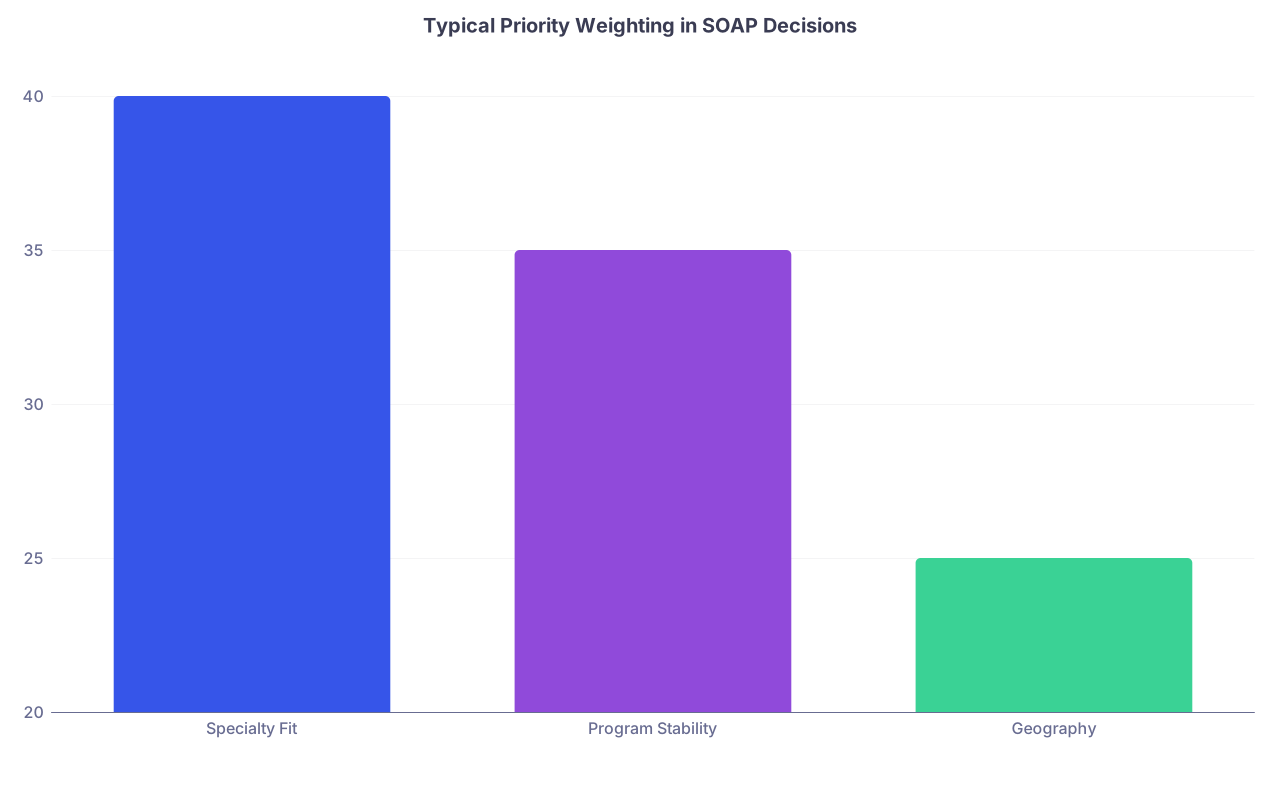
| Category | Value |
|---|---|
| Specialty Fit | 40 |
| Program Stability | 35 |
| Geography | 25 |
That rough 40–35–25 split is how I’d advise most unmatched applicants who do not have extreme personal constraints.
FAQ: SOAP Offers, Priorities, and Tradeoffs
Should I ever turn down a categorical offer in a less desired specialty to chase a prelim in my dream specialty?
Rarely. If you have a categorical in a core specialty (IM, FM, peds, psych) at a reasonably stable program, that’s usually a safer and smarter path than a prelim year that might lead nowhere. The exception: you’re a legitimately strong candidate for a very competitive specialty with clear mentor support and a concrete, realistic reapplication plan.Is it better to SOAP into a weaker program this year or go unmatched and reapply next cycle?
For most people, matching into a weaker but stable categorical program beats gambling on next year. Reapplicants do not magically become more competitive without major changes (scores, research, networking), and many do worse the second time. Going unmatched another year can permanently damage your chances.How much should I care about fellowship match rates when picking a SOAP program?
It matters only if you are dead‑set on a competitive fellowship (cards, GI, heme/onc, etc.). But even then, a place that trains you well and supports you can overcome weaker “brand.” If a SOAP program produces board‑certified, employed grads in your field consistently, that’s usually enough. Fellowship rates shouldn’t outweigh basic stability and your mental health.What if my only offers are in a specialty I’m not excited about?
Be brutally honest: is it “I do not like this at all,” or “this wasn’t my first choice”? Plenty of happy internists and family docs started as failed derm or ortho applicants. If you can see yourself tolerating (or maybe even liking) the day‑to‑day of that specialty, a categorical spot is very often worth taking. If you truly cannot stand the work, then you may need to risk reapplying—but do it with a clear plan and open eyes.Should I rank a program with known toxicity if it’s in my ideal city and specialty?
I’d be very cautious. A truly toxic environment can wreck your health, your confidence, and in bad cases your career. If “known toxicity” is coming from multiple independent sources (residents, faculty, online reports all saying the same thing), I’d drop that program down your list—even if the city and specialty are perfect. Three years in an unsafe environment is not worth the zip code.How do I factor in my partner or family when prioritizing SOAP offers?
Have the hard conversation early. Decide together whether the goal is “stay together at all costs” or “optimize your career now so we have flexibility later.” If you’re the primary income in the near term, matching into a stable program—even in a tough location—may actually be better for both of you long‑term. But if your partner’s job/visa/health is tightly tied to a region, geography may legitimately move up your priority stack.What if I freeze when offers come in and feel pressured to answer instantly?
Prepare your hierarchy before SOAP: know your main goal, your no‑go red flags, and your rough priority order (e.g., “any stable categorical > prelim > unstable categorical”). Keep notes on each program you applied to. When an offer hits, use your pre‑made framework instead of your panic. The biggest disasters I’ve seen in SOAP came from people making completely new value judgments in 5 minutes under stress.
Key takeaways:
- Decide your primary goal before SOAP starts—match security, specialty, or geography—and let that drive your choices.
- Prioritize stable categorical positions over glamour, geography, or prelim “stepping stones” unless you have a very strong, realistic reapplication plan.
- Geography matters, but for most people it’s a tiebreaker, not the main driver—your future flexibility comes more from specialty choice and program stability than your residency zip code.