
The instinct to “never go prelim” ruins more careers than a bad Step score.
If you went through SOAP with limited interviews and you’re staring at a prelim-only offer, you’re really asking one question: Do I take this now, or do I gamble my entire future on doing better next year?
Here’s the answer you’re looking for, broken down without the usual sugar-coating.
The Real Question: Career vs. Ideal Path
You’re not choosing between “prelim vs categorical.” You’re choosing between:
- A guaranteed spot in residency (even if only prelim) this year
vs. - A one-year or multi-year gamble with no guaranteed outcome
For most people, taking a solid prelim spot is safer and smarter than unemploying yourself to reapply with almost the same application.
But there are exceptions. Big ones. You need to know which camp you fall into.
Step 1: Understand What a Prelim Year Actually Buys You
People talk about prelim like it’s a dead end. It’s not. But it’s not magic either.
What a prelim year can realistically do for you
If you match or SOAP into a prelim medicine or surgery year, you can:
- Get US clinical experience, evaluations, and letters as a doctor
- Prove you can function in a real hospital, not just on paper
- Fix “professionalism” or “red flag” narratives with a clean year of performance
- Sometimes slide into an advanced or categorical spot that opens unexpectedly (rare, but it happens)
- Keep your CV from having a blank year that screams “I did not match”
Here’s the part programs care about after a prelim year:
- Did you show up, work hard, and not cause trouble?
- Did attendings say, “We’d hire this person”?
- Did you pass Step 3, if you took it?
- Did your PD write you a genuine, specific, positive letter?
If yes, you’re in a much stronger position than the same applicant who went home, did research, and reapplied with no new clinical evidence they can function as a resident.
Where prelim helps the most
Prelim helps a lot more in some scenarios than others:
- You’re going for IM, FM, psych, neuro, peds, or less competitive specialties
- Your main issues were:
- Limited interviews
- US clinical experience gaps
- Mild Step or COMLEX underperformance (not catastrophic)
- You’re an IMG or DO needing U.S. residency performance to “prove it”
It helps less if:
- You’re dead set on a hyper-competitive specialty (derm, plastics, ortho, ENT, urology, neurosurgery)
- You already have big red flags that a single year won’t erase (multiple failures, professionalism violations, etc.)
Step 2: Know When Reapplying Without a Spot is a Terrible Idea
This is the part people like to ignore.
If you failed to match and landed only SOAP scraps, your current application has problems. Reapplying next year with tiny tweaks (a new personal statement, one more abstract, one extra letter) is not a strategy. It’s denial.
You are a bad candidate for sitting out and reapplying if:
You do not have a clear, concrete way to address your weaknesses.
Example: “I’ll do a research year” when you’re trying to go IM or FM. That’s not fixing anything the market actually cares about.Your metrics are significantly below average for your target specialty and you refused to broaden your list this year.
- Step 1 fail or very low Step 2 relative to peers
- Weak clinical grades
- Minimal or no U.S. clinical experience if IMG
Your application strategy was flawed and you haven’t fixed it.
- Applied to 30 IM programs with a 210 Step 2 and no USCE
- Applied to one region only
- Chased competitive fields with no backup
Reapplying only makes sense if you can measurably change the story next cycle, not just “try again and hope.”
Step 3: When a Prelim Spot Is Clearly the Right Move
Let me be blunt. In these situations, you should almost always take the prelim spot:
You want IM, FM, neuro, anesthesia, EM, psych, or peds long-term
A prelim year (medicine or transitional) can be a very reasonable bridge. Especially IM or transitional.You’re an IMG or DO with limited U.S. clinical experience
A strong prelim year with good letters often matters more than another research year.You have borderline scores but no professionalism disasters
Programs will care more about your actual residency performance than your old NBME test trauma.You’re financially or visa-constrained
No income + no visa + a vague plan to “do research” is not a plan. A prelim spot is real income, real supervision, and real immigration stability (where applicable).You already cast a wide net this year and still didn’t get a categorical
That tells you how the market sees your current application. A prelim year is one of the few ways to substantially change that perception.
Step 4: When It Might Actually Be Better to Decline and Reapply
There are situations where it’s reasonable to walk away from a prelim SOAP offer.
You might consider reapplying instead of accepting the prelim if:
The prelim is in a toxic or extremely malignant program
- Chronic resident attrition
- Known for punishing or unsupportive culture
- Miserable work hours without teaching
If current residents quietly tell you, “Do not come here,” listen.
You’re 100% committed to a highly specialized, advanced field
Example: You want radiology, anesthesia, or neuro and you:- Already have strong scores and good letters
- Had a small number of interviews but just unlucky
- Can line up a targeted, well-supported research or clinical fellowship year directly in that specialty with mentors ready to advocate for you
In that narrow case, a very strong research/clinical year in your specialty may help more than a random prelim year.
You truly under-applied this year and can clearly fix it
- You applied late (October and later), and that alone killed you
- You limited applications to 10–20 programs in a competitive specialty despite being an average applicant
- You didn’t apply to community or “safety” programs at all
If your actual profile is solid and your strategy was just bad, reapplying early and broadly could make sense.
You have a concrete, guaranteed plan for the year
Not “I’ll try to find research.”
But: You already have a signed research fellowship, chief year, or structured clinical position with clear deliverables and strong mentorship.
Without that kind of plan, declining a prelim is usually self-sabotage.
Step 5: Key Factors You Must Weigh Before Deciding
Here’s the decision framework I’d use with any student sitting in my office.
| Factor | Favors Taking Prelim | Favors Reapplying |
|---|---|---|
| Specialty goal | IM/FM/psych/peds/neuro/EM | Derm/ortho/ENT/urology/IR |
| Scores | Borderline/low | Solid/strong |
| This year's application strategy | Broad, early | Narrow, late, unrealistic |
| Financial/visa situation | Need income/stability | Can afford 1 year no salary |
| Year-off plan quality | Vague/uncertain | Concrete, secured position |
And to visualize how people usually end up improving their chances:
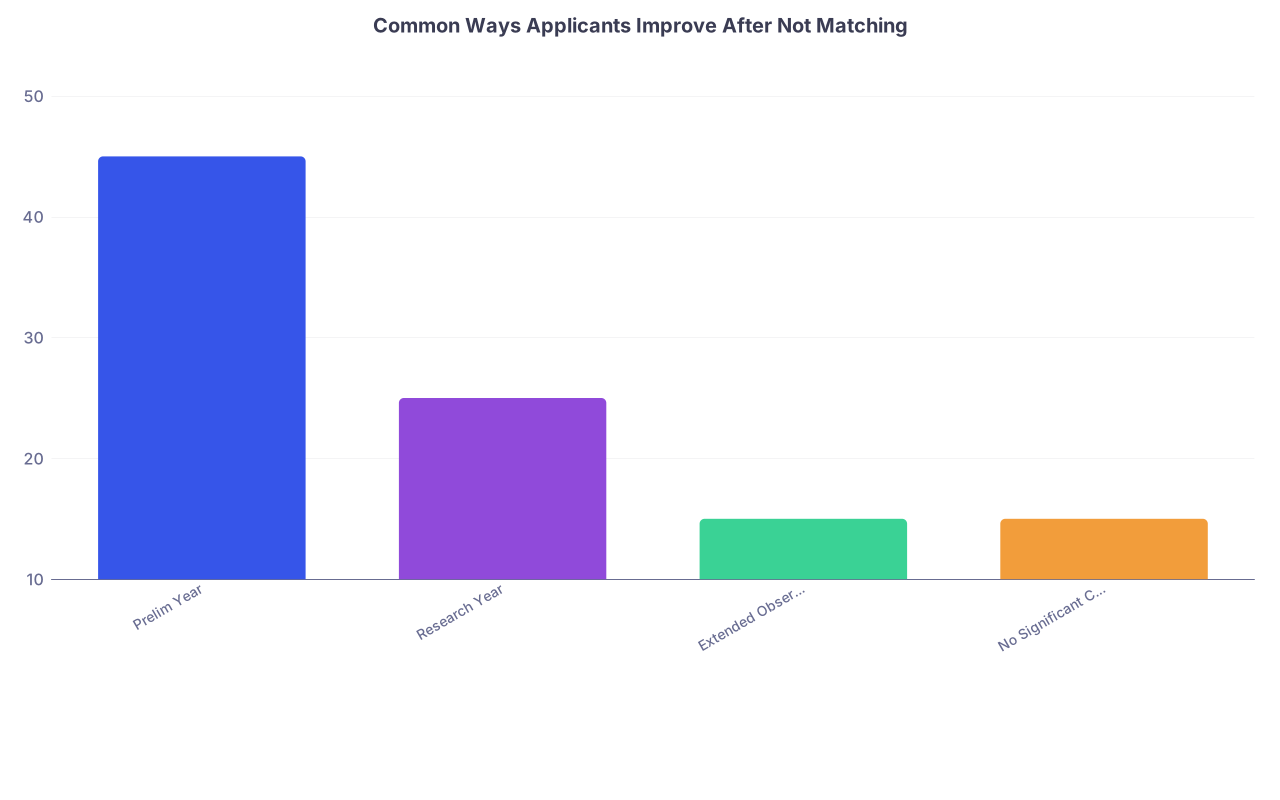
| Category | Value |
|---|---|
| Prelim Year | 45 |
| Research Year | 25 |
| Extended Observerships | 15 |
| No Significant Change | 15 |
Those numbers aren’t from a single study; they’re a rough reality check: most successful “second chance” stories involve real clinical work, not just more posters.
Step 6: How a Prelim Year Plays Out in Real Life
Let me walk you through what actually happens once you start a prelim.
Best-case trajectory
- You start prelim IM in July
- By October: your seniors and attendings like working with you
- December–January: your PD is willing to support your reapplication
- You apply widely again:
- Categorical IM/FM/psych/neuro, depending on your path
- Use new PD letter + strong attending letters
- You get significantly more interviews because:
- You’re already “battle-tested”
- Programs trust PDs more than med school deans
Sometimes, a categorical spot in your own hospital opens. You get first look. That’s the quiet benefit no one talks about.
Middle-case trajectory
You don’t immediately land your dream specialty. But:
- You match categorical in IM at a community program next year
- You angle toward a subspecialty (cards, GI, pulm) or hospitalist career
- You’re in a stable training path and not applying from scratch again
Worst-case trajectory
- You’re overwhelmed, undersupported, or burned out
- Performance suffers
- Your PD letter is lukewarm or negative
- Your next application is actually weaker
This is why the program’s culture and support truly matter. If you’re taking a prelim, you must be prepared to perform from day one and need at least a minimally functional training environment.
Step 7: What To Do In the Next 72 Hours If You Have a Prelim Offer
SOAP moves fast. So should you. Here’s the immediate playbook.

| Step | Description |
|---|---|
| Step 1 | Prelim SOAP Offer |
| Step 2 | Strongly consider accepting prelim |
| Step 3 | Speak with mentors and consider reapply |
| Step 4 | Long term goal competitive specialty |
| Step 5 | Have strong scores and solid apps |
| Step 6 | Guaranteed strong gap year plan |
Concretely, do this:
Contact current residents at the prelim program
Ask direct questions:- Are you supported or constantly drowning?
- Do prelims from here successfully match elsewhere?
- Would you choose this program again?
Speak to at least 2 mentors who know your file cold
- One from your med school or home institution
- One from your target specialty (if applicable)
Assess your realistic reapplication leverage
- Can you raise Step 2? (If not taken yet.)
- Can you get concrete research/clinical commitments this week?
- Are you truly willing to reapply more broadly and earlier?
Be honest about money, family, and visa
If you cannot easily afford a year without salary, this weighs heavily toward taking the prelim.
Visual: Typical Outcomes from a Prelim Year vs Sitting Out
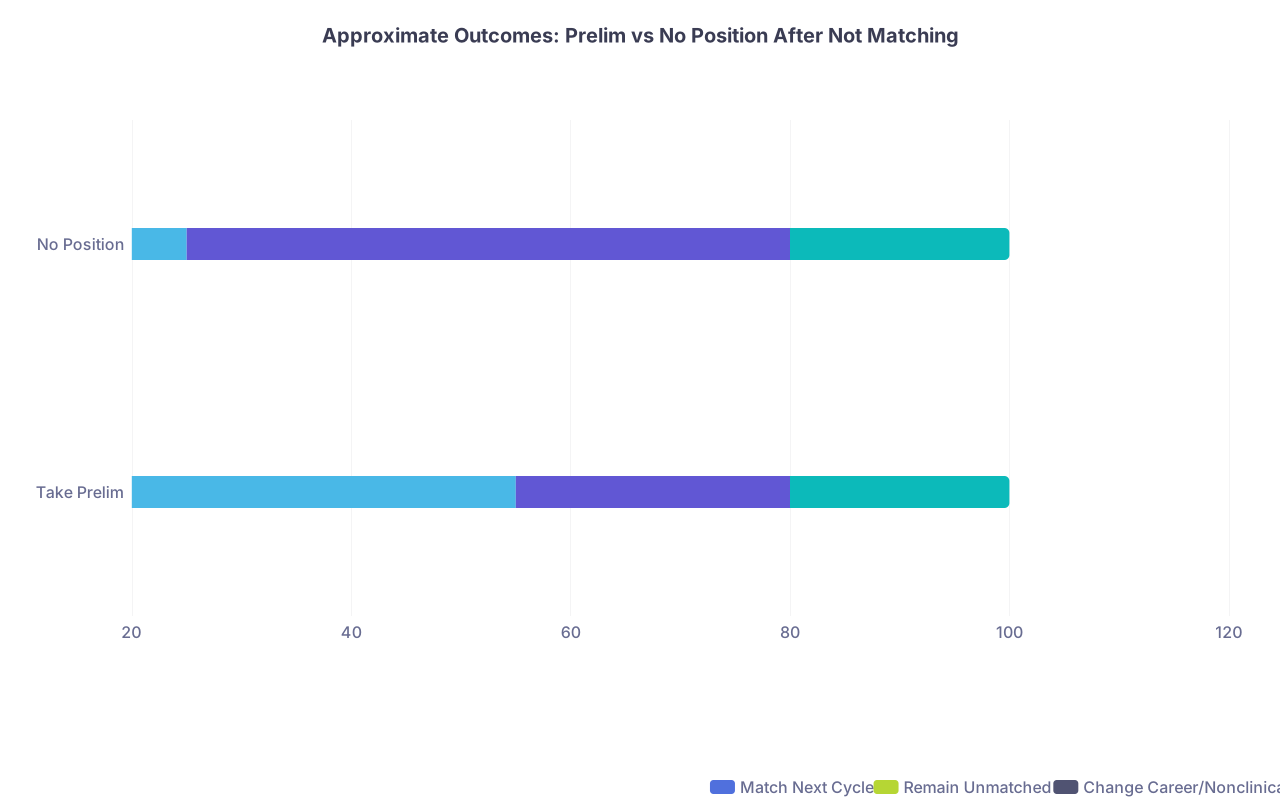
| Category | Match Next Cycle | Remain Unmatched | Change Career/Nonclinical |
|---|---|---|---|
| Take Prelim | 55 | 25 | 20 |
| No Position | 25 | 55 | 20 |
Again, these are directional, not a single study. But they track with what I’ve seen: doing real clinical work usually beats sitting out.
Step 8: Special Cases Worth Calling Out
If you’re an IMG
I’m going to be blunt: take the prelim spot unless it is clearly malignant or unsafe.
Why:
- U.S. residency experience is gold for IMGs
- It can turn you from “unknown risk” into “known quantity”
- Visa issues make year-off gaps and unpaid research especially risky
If you’re USMD with average scores, going for IM/FM/psych/peds
It’s usually a mistake to decline a decent prelim with the plan of “just reapply stronger.” Your file isn’t likely to transform in 12 months without real clinical work.
If you’re chasing derm/ortho/ENT/plastics with no built-in prelim path
Then you’re in a different world. Often:
- A dedicated research fellowship at a top program in your field
- Deep, hands-on work with faculty who sit on selection committees
- Multiple papers + strong advocacy
…can sometimes outperform a prelim IM year. But that only works if you actually secure that fellowship, not dream about it.
A Quick Reality Check Table
| Profile | Better Move (Usually) |
|---|---|
| IMG, low interviews, SOAP prelim IM | Take prelim |
| DO aiming for IM/FM, few interviews | Take prelim |
| USMD, average scores, wants psych, prelim IM available | Take prelim |
| Strong USMD, near-miss in anesthesia, secured top research fellowship | Consider reapplying |
| Applicant with major professionalism red flag | Either path is hard; prelim only if SUPPORTIVE PD |
| Applicant who applied late and too narrow but profile is strong | Consider reapplying strategically |
FAQ: Prelim vs Reapplying
If I take a prelim year, will programs hold it against me that I did not match categorically the first time?
They will see it, but they will care more about how you performed as a resident. A strong PD letter, solid evaluations, and evidence that you handled real responsibility usually outweigh the “didn’t match first time” concern. Many programs actively like prelims because they’re already acclimated to residency.Is a prelim medicine year better than a transitional year for future applications?
For IM, cards, pulm, heme-onc, and many hospitalist careers, a solid prelim IM year is often more directly useful because your letters will come from exactly the people who train and hire those specialties. Transitional years can be great if they’re well-structured and respected locally, but a good prelim IM at a solid program is generally more obviously applicable.Can I switch into a categorical spot at the same institution during my prelim year?
Sometimes. It depends on whether categorical residents leave, whether the PD likes you, and whether GME and the specialty are willing to convert a spot. I’ve seen prelims slide into open categorical IM, neuro, and anesthesia spots this way. You absolutely cannot count on it, but being on the inside gives you chances you would not have from the outside.What if I absolutely hate the specialty the prelim is in?
If you’re actively opposed to the field and know you’ll be miserable, that’s a serious red flag. Misery leads to poor performance, which leads to bad letters, which wrecks future applications. In that case, declining and pursuing a structured, specialty-aligned gap year might make more sense—but only if you have a real plan lined up, not vague intentions.How much does a research year help compared to a prelim year?
For most core specialties (IM, FM, psych, peds, neuro), a prelim year with strong performance typically helps more than a generic research year. For ultra-competitive, research-heavy fields (derm, ortho, ENT, plastics), a prestigious, deeply integrated research fellowship in the field may beat a random prelim year. The key is alignment: research only helps if it’s in the right place, with the right people, and leads to real advocacy.What should I prioritize during a prelim year if I plan to reapply?
Three things: professional reliability, relationships, and documentation. Show up, work hard, and be easy to work with. Cultivate relationships with attendings and chief residents who can speak in detail about your work ethic and judgment. And get concrete: ask for specific letters, keep track of positive feedback, and, if possible, take and pass Step 3. You want to leave zero doubt that you function well as a resident.
Open a document right now and write down two columns: “What a prelim year would actually change in my application” and “What a year off would actually change.” If the prelim column is longer and more concrete—as it is for most people—you have your answer.