
You’re a few weeks from Rank Order List certification. You had one interview. Just one.
Now you’re staring at your options:
“Do I submit a rank list and hope I match? Do I plan for SOAP? Do I enter SOAP now or wait and see?”
This is where people start asking Reddit. And get 50 different answers. Let’s cut that noise.
Here’s the direct version: with a single interview, you must assume a real chance of not matching and plan proactively for SOAP. The real question isn’t “Should I enter SOAP?” It’s:
- How do I realistically assess my match chances with one interview?
- When should I commit mentally and logistically to SOAP backup?
- If I do not match, what’s my play on Monday of Match Week?
I’ll walk you through a structured way to decide and prepare.
1. The Brutal Math: What Does “One Interview” Actually Mean?
Let me be blunt. One interview is not “I’m definitely doomed,” but it’s very far from safe.
Programs do not treat all interviewees equally. But we can set some basic context.
Typical situation across specialties:
- Programs interview far more people than they have spots for.
- Rank lists go deep, but not that deep for competitive fields.
- Your chance depends heavily on:
- Specialty competitiveness
- Your Step scores / class rank / red flags
- How strong that single program fit actually is
There’s no perfect data for “1 interview” odds, but here’s a realistic way to think about it:
| Interview Count | Very Competitive (e.g., Derm, Ortho) | Moderately Competitive (e.g., EM, Anesth) | Less Competitive (e.g., FM, Psych) |
|---|---|---|---|
| 1 | Extremely high risk of not matching | Very high risk | High risk |
| 2–3 | Very high risk | High risk | Moderate to high risk |
| 4–6 | High risk | Moderate risk | Non-trivial risk |
The key: with one interview, you must plan as if you might not match. That doesn’t mean give up. It means you prepare both paths:
- Path A: You match at that one program
- Path B: You don’t and need to hit SOAP hard
You don’t get to choose on Monday morning. The algorithm will choose. Your responsibility is to be ready for both outcomes.
2. Core Question: Should You Intend To Enter SOAP?
Let’s answer the headline question directly:
If you had only one interview, should you plan to enter SOAP if you do not match?
My answer: Yes, almost always.
Exceptions exist, but they’re rare. Let’s talk through the decision framework.
Step 1: What specialty and what program?
Ask yourself:
- Is this a niche/highly competitive specialty (Derm, Ortho, Plastics, ENT, Rad Onc, IR, integrated programs)?
- With one interview: your odds are poor. You absolutely should plan to SOAP into something if you do not match.
- Is this a moderately competitive specialty (EM, Anesthesia, Radiology, Gen Surg at solid academic places)?
- One interview is still very high risk. Plan for SOAP.
- Is this a traditionally less competitive specialty (FM, IM, Peds, Psych, Neurology) AND is the program:
- A community program
- Not in a hyper-competitive city
- Not a brand-name academic giant
Then your odds are better than the above categories, but not safe. I’ve seen people match off a single realistic IM or FM interview. I’ve also seen plenty not match.
Rule: If your specialty tends to have SOAP spots most years, you’re a SOAP candidate if you do not match.
Step 2: Are you willing to do a different specialty?
SOAP is not just “more chances at the same dream.” It’s mostly:
- Community programs
- Less competitive specialties
- Preliminary and transitional years
- Sometimes categorical IM/FM/Peds/Psych in less desired locations
You have to decide now:
- Would you SOAP into IM, FM, Peds, Psych, or Prelim if your chosen specialty is not available?
- Are you okay with doing a prelim year then reapplying?
- Are you willing to move anywhere?
If your answer is:
“I only want my original specialty and I’d rather reapply next year than switch,”
then: you might still enter SOAP, but only into that specialty or prelim. Limited options.“I just want to train, get licensed, and build my career. I’m flexible specialty-wise,”
then: yes, you should absolutely plan to enter SOAP aggressively.
Step 3: What’s the alternative if you skip SOAP?
If you do not match and also skip SOAP, you’re basically choosing a gap year, where you:
- Do research, a prelim year outside the Match (if you can find one), or some non-training job
- Reapply next cycle, now as an unmatched applicant
That’s not automatically a bad path. Sometimes it’s the right one. But don’t romanticize it. Being unmatched hits hard emotionally, financially, and logistically.
So ask:
- Do I have a clear, realistic gap-year plan (research position lined up, strong mentorship, clear path to a stronger application)?
- Or am I just avoiding SOAP because it feels chaotic and scary?
If you do not have a strong, concrete backup year plan, skipping SOAP is usually a mistake.
3. A Structured Decision Guide: Should You Prepare to Enter SOAP?
Let’s formalize this so you’re not just going on vibes.
Step A: Quick self-risk assessment
Answer these honestly:
Specialty:
- Highly competitive → +2 risk points
- Moderately competitive → +1
- Less competitive → 0
Program type:
- Top-tier academic or big-name institution → +1
- Average academic or solid community → 0
- Small community / rural / less sought-after → -1 (slightly safer)
Application strength red flags:
- Failure/remediation, Step failure, major professionalism issue → +2
- Below-average scores or no home/away rotation in specialty → +1
- Clean record with average metrics → 0
Number of interviews:
- 1 interview → +3
- 2–3 interviews → +2
- 4–5 interviews → +1
Now total:
- 5+ points: You must plan for SOAP. No discussion.
- 3–4 points: Strongly plan for SOAP.
- 0–2 points: Still plan for SOAP, just with more optimism about matching.
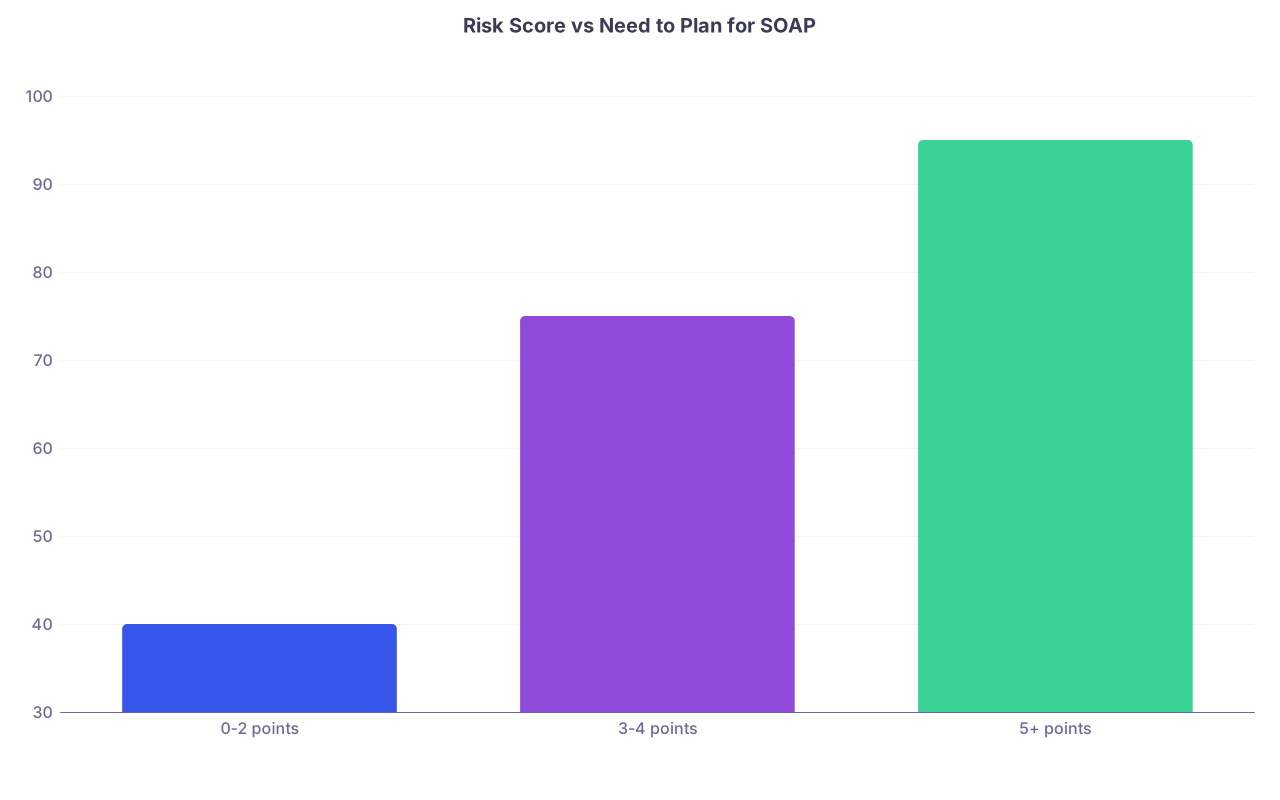
| Category | Value |
|---|---|
| 0-2 points | 40 |
| 3-4 points | 75 |
| 5+ points | 95 |
The numbers here are illustrative, not exact science, but you get the idea: one interview heavily tilts you into “be SOAP-ready.”
4. How SOAP Actually Works (And Why You Must Decide Early)
You can’t decide about SOAP at 10:59 am Monday of Match Week. NRMP and ERAS logistics don’t care about your anxiety timeline.
Quick timeline refresher:
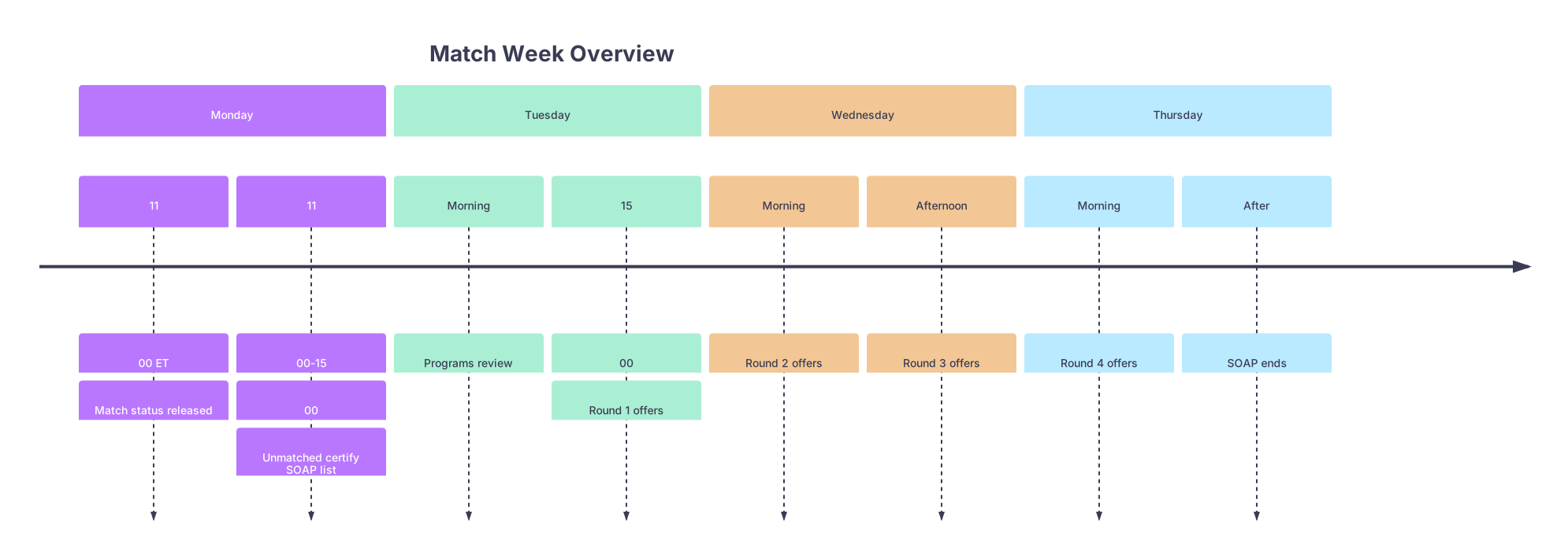
| Period | Event |
|---|---|
| Monday - 11 | 00 ET |
| Monday - 11 | 00-15 |
| Tuesday - Morning | Programs review |
| Tuesday - 15 | 00 |
| Wednesday - Morning | Round 2 offers |
| Wednesday - Afternoon | Round 3 offers |
| Thursday - Morning | Round 4 offers |
| Thursday - After | SOAP ends |
Key constraints:
- You must have your SOAP application materials (personal statement variants, letters assigned, CV updated) ready before Match Week.
- Unmatched and partially matched applicants can enter SOAP for unfilled programs in the NRMP system.
- You’re limited in the number of programs you can apply to in SOAP rounds (usually up to 45 total).
So the decision you’re really making now is:
“Do I prepare myself and my application so that if I see ‘You did not match’ on Monday at 11:00, I can immediately be in SOAP with a coherent strategy?”
If you wait to decide until after you see “Unmatched,” you’re already behind.
5. Practical SOAP Strategy If You Had Only One Interview
Assume you don’t match. Here’s what I’d have lined up.
1. Clarify your target tiers ahead of time
Before Match Week, write out:
- Tier 1: Same specialty, any unfilled categorical spots, regardless of location
- Tier 2: Closely related specialties you’d actually do (e.g., EM → IM prelim, Anesthesia → prelim/IM/FM)
- Tier 3: Prelim-only spots you’d accept as a stepping stone

Don’t wait until the unfilled list drops to start thinking through what you’re willing to do.
2. Have multiple personal statement versions ready
At minimum:
- One PS for your original specialty
- One generic PS for IM/FM/Peds/Psych (whichever you’d actually consider)
- One short paragraph you can quickly adapt for a prelim year pitch
Programs in SOAP care about:
- “Will you show up?”
- “Are you a risk?”
- “Do you understand what this job is?”
You need language that shows you’re not just using them as a throwaway gap-year landing pad.
3. Shore up letters now
You likely can’t get new letters between Monday and Tuesday of Match Week. So:
- Assign at least one broad/IM-friendly letter in ERAS now if there’s any chance you’d SOAP into IM/FM/Peds/Psych.
- If you have a strong mentor, tell them now:
“I only had one interview. I’m preparing for the possibility of SOAP. If I need a quick email advocacy push that week, could I reach out?”
Mentor advocacy sometimes helps in SOAP. Not always, but sometimes that 10-minute phone call from a known faculty member helps move you up a list.
6. When Not To Enter SOAP (The Few Exceptions)
There are a few cases where intentionally skipping SOAP can be reasonable.
Exception 1: You’re dead-set on one specific specialty
If you’re determined: “I will only be a neurosurgeon, and I’d rather not match than do something else,” then SOAP may not offer you anything meaningful.
But here’s the rub:
- Some people still choose a prelim year in Gen Surg/IM through SOAP, then reapply stronger.
- That path has risks (being labeled as “prelim only” or burning out), but it can work.
If you truly will not accept any other path, you may choose to:
- Skip SOAP
- Immediately pursue a structured research year or additional training that directly strengthens your reapplication
I still think many people overestimate how rigid their future needs to be.
Exception 2: You have a guaranteed, strong gap-year opportunity
Example: You already have a paid research fellowship locked in at a top department where the chair has explicitly said:
“If you do not match, we’ll take you for a year and strongly support your reapplication here.”
Then SOAP into a random prelim program in a different city may not be better.
But that scenario is uncommon. Don’t make it up in your head.
Exception 3: Serious personal constraints
If you know you cannot move states this year for family, medical, or visa reasons, and SOAP options are unlikely to meet those constraints, entering SOAP might just waste effort.
Even then, you might still want to see the unfilled list and decide case-by-case.
7. Mental Prep: Handling the Emotional Side Without Sabotaging Yourself
Here’s the trap I see: students with one interview mentally give up on matching and emotionally live in SOAP-land for months. Then Match Day hits and they’re shocked they matched.
Or the opposite: they’re 100% convinced this single program “loved them” and don’t prepare SOAP at all, then they’re crushed and scrambling.
You need a split mindset:
- 51% of your emotional energy: assume and hope you’ll match at that program
- 49% of your logistical energy: quietly and efficiently prepare as if you won’t
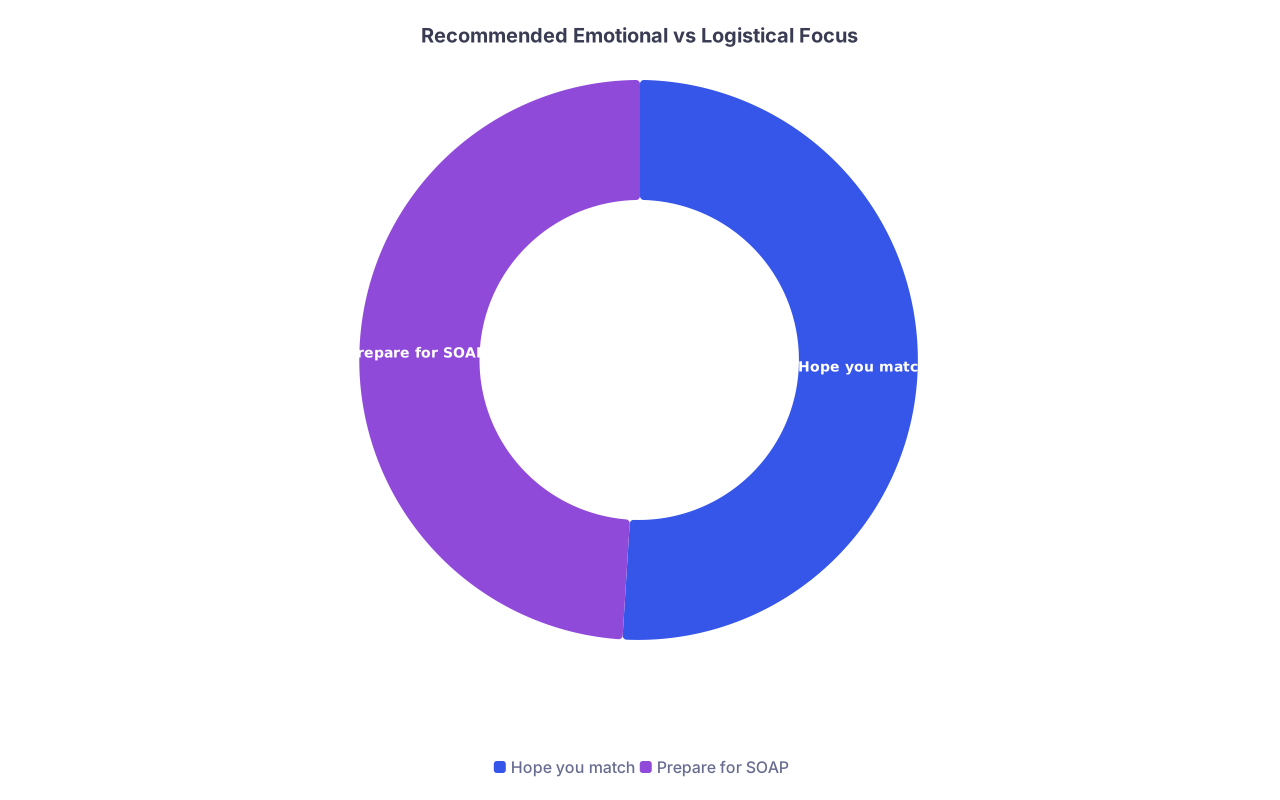
| Category | Value |
|---|---|
| Hope you match | 51 |
| Prepare for SOAP | 49 |
You don’t tell everyone about your SOAP plans. You just quietly get your files, PSs, and targets ready.
8. Quick Scenario Walkthroughs
A few concrete examples will help.
Scenario 1: One FM interview at a mid-tier community program
- US grad, no failures, average scores, some FM exposure.
- Risk score:
- Specialty less competitive: 0
- Community program: -1
- No major red flags: 0
- One interview: +3 → Total 2
Call: Reasonable shot to match, but still plan for SOAP. You should:
- Prepare SOAP materials aimed at FM, IM, Peds, Psych
- On SOAP Monday, if unmatched, hit FM and IM categorical spots hard
Scenario 2: One Gen Surg interview at a solid academic center
- US grad, Step 1 pass/Step 2 225, one minor professionalism hiccup.
- Specialty moderately competitive (+1), academic (+1), red flag (+1), one interview (+3) → Total 6.
Call: Very high risk of not matching. Must plan for SOAP. You should:
- Prepare for prelim surgery and IM spots
- Consider whether you’d SOAP into categorical IM/FM/Peds as plan B
Scenario 3: One Derm interview at a mid-tier academic program
- Strong research but no other interviews.
- Highly competitive specialty (+2), academic (+1), no red flags (0), one interview (+3) → Total 6.
Call: Odds are low. You absolutely plan SOAP. Realistically you:
- SOAP into prelim IM or transitional year if available
- Plan Derm reapplication with serious research and mentorship
9. The Bottom Line: What You Should Do Today
If you had only one interview, your default stance should be:
“Yes, if I do not match, I am going to enter SOAP, and I am going to be ready for it.”
Enter SOAP is not the question. Being prepared is.
FAQ (Exactly 6 Questions)
1. If I only had one interview, what’s my actual chance of matching?
There’s no exact percentage because it depends on specialty, program, and your file. But it’s nowhere near “likely” and nowhere near “impossible.” For primary care at a non-elite community program, it might be reasonably decent. For competitive specialties, it’s low. The important part: one interview is never a safe number. That alone justifies a full SOAP backup plan.
2. Will programs in SOAP judge me harshly for being unmatched?
They already know you’re unmatched; everyone in SOAP is. What they care about is: are you safe to hire, do you understand the specialty, and are you likely to stay? If you have big red flags (Step failures, professionalism issues), that’s a problem anywhere, not just SOAP. A clean applicant with limited interviews can still look totally acceptable in SOAP with a focused, humble application and clear explanation of interest.
3. Should I tell my single interview program I’m preparing for SOAP?
No. That’s not a helpful conversation. You should tell them you’re very interested, maybe even that they’re your top choice if that’s true and ethical to say. You do not need to share your backup planning. Programs assume all borderline applicants are considering SOAP or a backup plan. Keep that discussion to your dean or trusted mentors, not to the PD.
4. If I really want to reapply to my specialty, is a SOAP prelim year better than a research year?
Depends on the specialty and your weaknesses. Surgical fields often value a strong prelim surgery year if you excel clinically and get strong advocacy from that department. Some highly academic fields (Derm, Rad Onc) may value a strong, productive research year more. If your biggest gap is clinical performance or letters, prelim helps. If it’s research/academic profile, a research year might be stronger. This is where a specialty-specific mentor’s opinion matters more than generic advice.
5. Can I change my mind during Match Week and decide not to enter SOAP after seeing the unfilled list?
Yes. Seeing the SOAP unfilled positions list sometimes changes people’s minds. But you only have that flexibility if your materials and strategy are already prepared. If the list has reasonable options, you apply. If it’s all things you’d never accept, you can sit it out and pursue a gap year. Preparing for SOAP does not force you to use it; it just gives you the option.
6. What’s the biggest mistake students with one interview make about SOAP?
Two big ones: pretending SOAP “won’t be necessary” and then scrambling unprepared, or emotionally collapsing and assuming they’re doomed before the Match results even come out. Both are bad. The right move is quiet, methodical preparation—multiple PS versions, letters assigned, target tiers listed—while still genuinely hoping and planning as if you’ll match at your one program.
Open a blank document right now and title it: “SOAP Plan – [Your Name].”
Write down: your specialty, your risk score from Section 3, and three tiers of programs you’d consider in SOAP. Once that’s on paper, you’re no longer just anxious—you’re actually prepared.