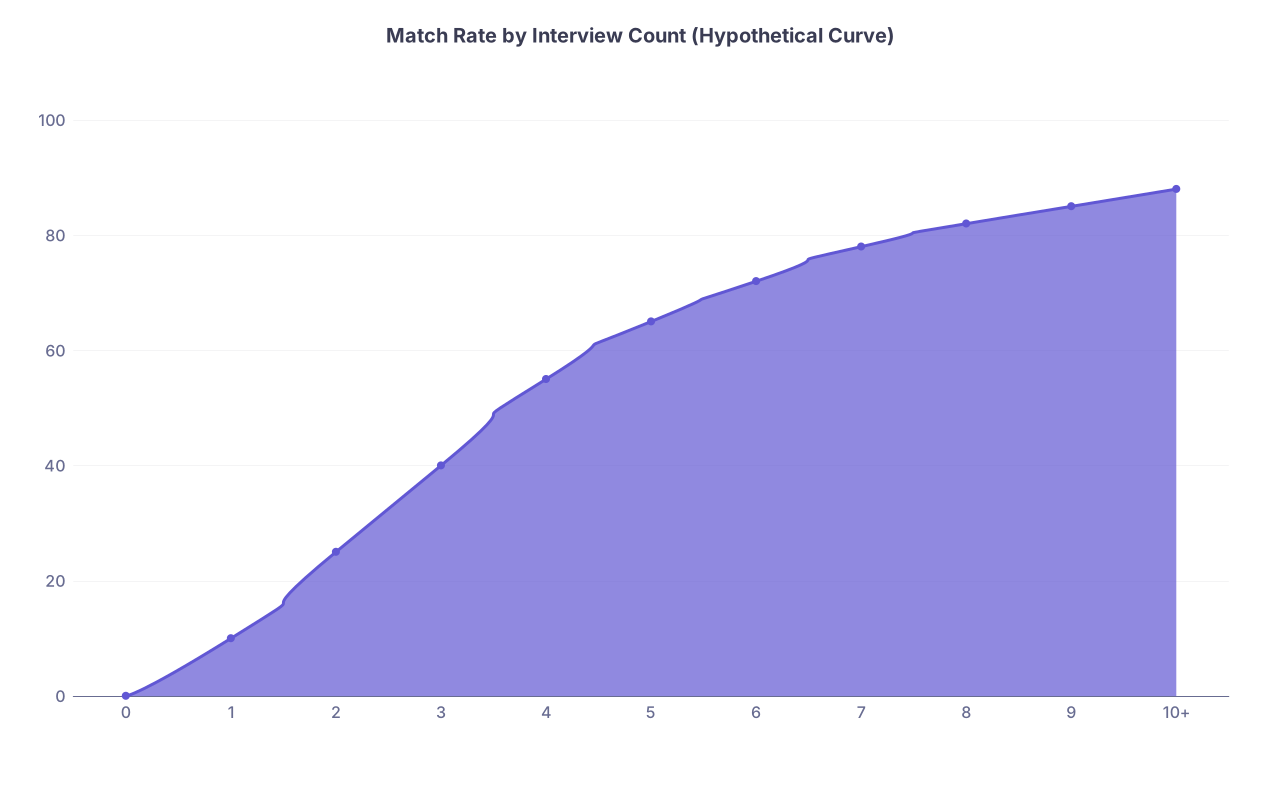
You can absolutely match through SOAP with 0–2 interviews. The idea that you’re “dead in the water” is lazy folklore, not data.
Every March I see the same cycle: someone with one interview, or an early December ghosting, walks into January convinced their fate is sealed. Classmates say, “You’re going to SOAP, and if you didn’t get interviews you have no chance there either.” A resident on nights mutters, “No one really matches from SOAP anyway.” People repeat this like it’s carved into stone.
It is not. The Supplemental Offer and Acceptance Program (SOAP) is not a lottery for leftovers. It’s a structured, data-driven second match that fills thousands of residency positions every year. And a huge chunk of those spots go to people who looked “doomed” by interview numbers.
Let’s tear apart the biggest myths poisoning limited‑interview applicants, and replace panic with a realistic, aggressive playbook.
Myth #1: “If you only had 0–2 interviews, SOAP is basically hopeless”
This is the big one. The fatalism myth.
Here’s what’s true: low interview numbers put you at higher risk of going unmatched. But that’s about the initial Match, not SOAP. Once you’re in SOAP, your pre-SOAP interview count matters far less than you think.
Look at what actually happens.
Each year, NRMP data show:
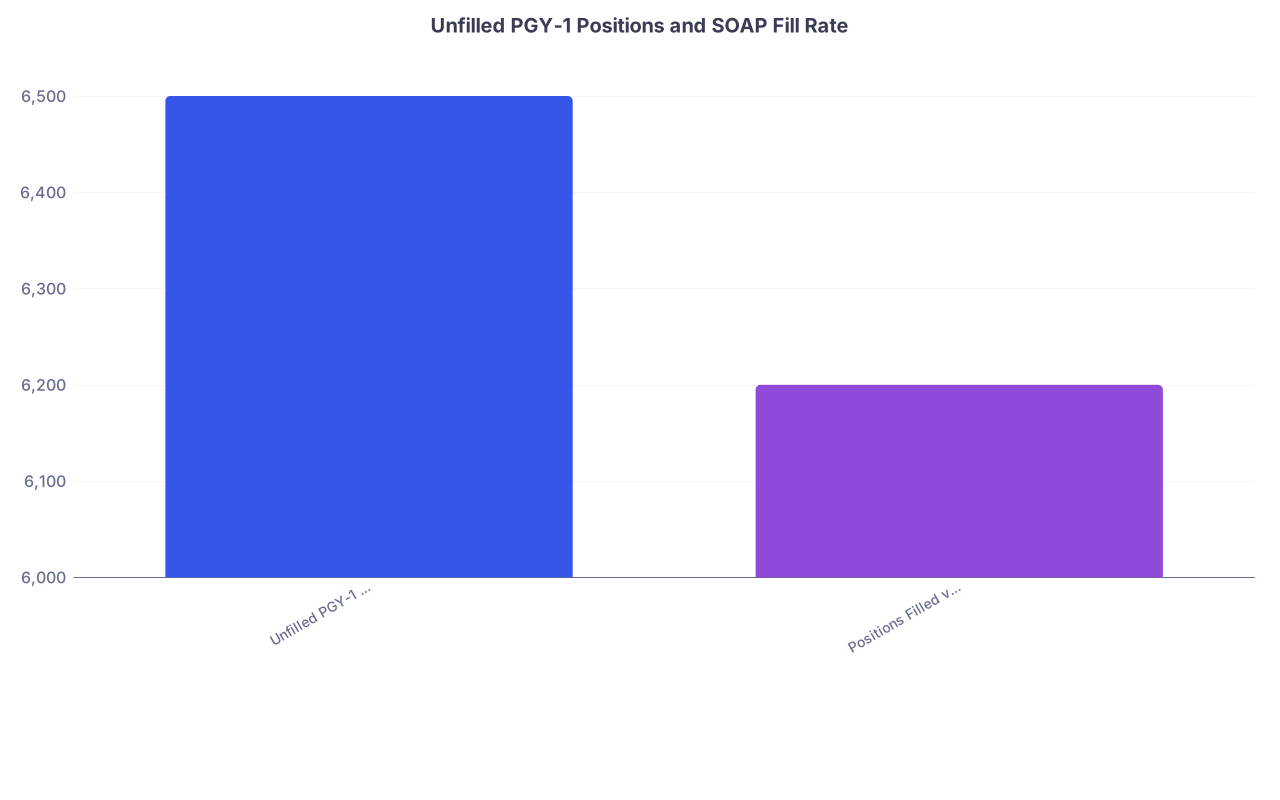
- Roughly 5,000–7,000 PGY-1 positions go unfilled after the main match.
- Historically, SOAP fills the vast majority of those positions by Thursday. In many cycles, >95% of unfilled spots are gone by the end of SOAP.
Those positions go somewhere. They are not vaporizing. They are going to people who, by definition, did not match in the main round—which very often includes the “1–2 interviews” crowd, the “I got only community programs,” the “I applied late,” and the “I had Step failures” group.
| Category | Value |
|---|---|
| Unfilled PGY-1 Spots | 6500 |
| Positions Filled via SOAP | 6200 |
If SOAP were “hopeless,” those bars would not be nearly equal. But they are.
Here’s the other reality I’ve seen over and over: programs use SOAP to fill solid, real jobs they need covered on July 1. They need a body on nights. A junior on wards. Someone to run crosscover. They don’t care that you had only one main-season interview. They care that you’re licensed-eligible, not a behavior problem, and available.
Do some applicants with few interviews also strike out in SOAP? Absolutely. But that’s not because low-interview applicants cannot match. It’s because:
- They only apply to their “dream” specialty again.
- They send 40 weak, generic applications instead of 45–50 laser-targeted ones.
- Their dean’s office or mentor gives them vague, “see what happens” guidance instead of a hard, data-based plan.
Low interview numbers are a warning, not a sentence. What you do in the 4–6 weeks before SOAP and during SOAP week matters more than how many places you visited in October.
Myth #2: “SOAP is just for super weak applicants and garbage programs”
Bluntly: this is snobbery, not reality.
Look at the NRMP’s own Program Director Survey. A huge number of PDs in:
- Internal medicine
- Family medicine
- Pediatrics
- Psychiatry
- Transitional year
- Preliminary medicine
report that they do rank SOAP applicants as part of their strategy and have used SOAP to fill positions with acceptable residents.
The programs that appear in SOAP aren’t a monolith. You absolutely will see:
- Underfunded community hospitals with chronic unfilled slots
- Programs in locations many people avoid (rural Midwest, inner-city safety nets, very high cost-of-living metros)
But you’ll also see:
- Solid community IM programs that expanded quickly and overshot
- New psychiatry programs still building reputations
- Transitional years attached to big-name university hospitals
- Categorical gaps created because someone matched into two programs and dropped one late, or because a visa process fell apart
I’ve watched graduates SOAP into:
- A well-known IM community program in the Southeast
- A psychiatry program at a state university that’s now fully accredited and respected
- A transitional year at a large academic flagship that later opened doors for radiology and anesthesia
Could they have matched there in the main round? Maybe. But they didn’t. They matched there in SOAP, because the program still needed warm, competent hands in March.
The idea that SOAP is “beneath you” is how you end up completely unmatched while someone with worse scores signs a contract on Thursday.
Myth #3: “If I SOAP, I should just re-apply next year to my dream specialty”
This is the sunk-cost fallacy dressed up as career planning.
If you’re entering SOAP with 0–2 interviews and your dream specialty is ultra-competitive—derm, plastics, ENT, ortho, neurosurgery, IR, rad onc—you’re not in a “bad break” situation. You’re in a numbers situation.
SOAP rarely, if ever, has open categorical spots in those fields. When they do, they’re often:
- Linked to very specific visa or funding issues
- Snapped up by applicants who already have strong surgical or research backgrounds and just had some paperwork or timing failure
Let me be very direct: for 90+% of limited-interview applicants, SOAP is about broadening the target. Not stubbornly re-aiming the same arrow at the same tiny bullseye.
| Dream Specialty | Realistic SOAP Options |
|---|---|
| Dermatology | TY, prelim med, FM |
| Orthopedics | TY, prelim surg, IM |
| Radiology | TY, prelim med, IM |
| Anesthesia | TY, prelim med, IM |
| EM | IM, FM, prelim/TY |
I’ve seen the smartest path look like:
- SOAP into internal medicine or family medicine at a solid program.
- Prove you’re a great resident.
- Pivot within that ecosystem or beyond once you’ve built actual performance data and network.
That’s not fantasy. Residents do transfer. People do pivot into anesthesia, radiology, EM, even some surgical fields after starting in IM or a prelim. It’s not guaranteed—but it’s much more realistic than spending a year doing nothing clinically and hoping the same application magically yields a different result.
Does that mean everyone must settle? No. If you’re a near-miss for a moderately competitive specialty (say EM) with strong scores and a few interviews, there might be room to be a bit more targeted. But going into SOAP intending only to pursue your original ultra-competitive field is almost always a way of saying, “I don’t really want a residency this year.”
SOAP is primarily a rescue mission for getting into a residency, not a precision tool for hitting your original dream.
Myth #4: “SOAP is random; there’s no strategy, just spam applications”
No. This is where lazy thinking kills people’s chances.
SOAP is structured and ruthlessly constrained, which actually makes strategy more important:
- You get up to 45 applications (not 300).
- You send them in four rounds of offers over a few days.
- Programs screen fast based on a few key filters and impression.

| Step | Description |
|---|---|
| Step 1 | Go Unmatched |
| Step 2 | Monday - SOAP Eligibility |
| Step 3 | Submit up to 45 Applications |
| Step 4 | Program Review |
| Step 5 | Offer Rounds 1 to 4 |
| Step 6 | Accept One Offer |
| Step 7 | Lock Position |
The idea that you “just click all” and hope is exactly how you waste 45 chances.
Here’s what programs actually do in SOAP when I talk to PDs and chiefs:
They apply quick, harsh filters:
- US vs. non-US grad (depending on their funding and accreditation)
- Step 1 pass/fail and any failures
- Step 2 CK score cutoffs (yes, they still use this)
- Grad year (many quietly prefer recent grads)
- Visa needs
Then they skim:
- Your personal statement: are you coherent, appropriate, and actually interested in the specialty or this kind of program?
- Your MSPE for professionalism concerns
- Your experiences for any sign of clinical readiness
They do not read your entire application like a main-season interview file. They triage.
So the SOAP strategy that works looks like this:
- Target programs where your profile meets obvious cutoffs.
- Tailor personal statements by category, not by individual program, but avoid sounding generic to the point of “I will do any specialty anywhere for any reason.”
- Avoid sheer delusion. If you failed Step 1 and barely passed Step 2, the brand-new university IM program with 0 unfilled spots for the last 5 years is not your SOAP target.
| Category | Value |
|---|---|
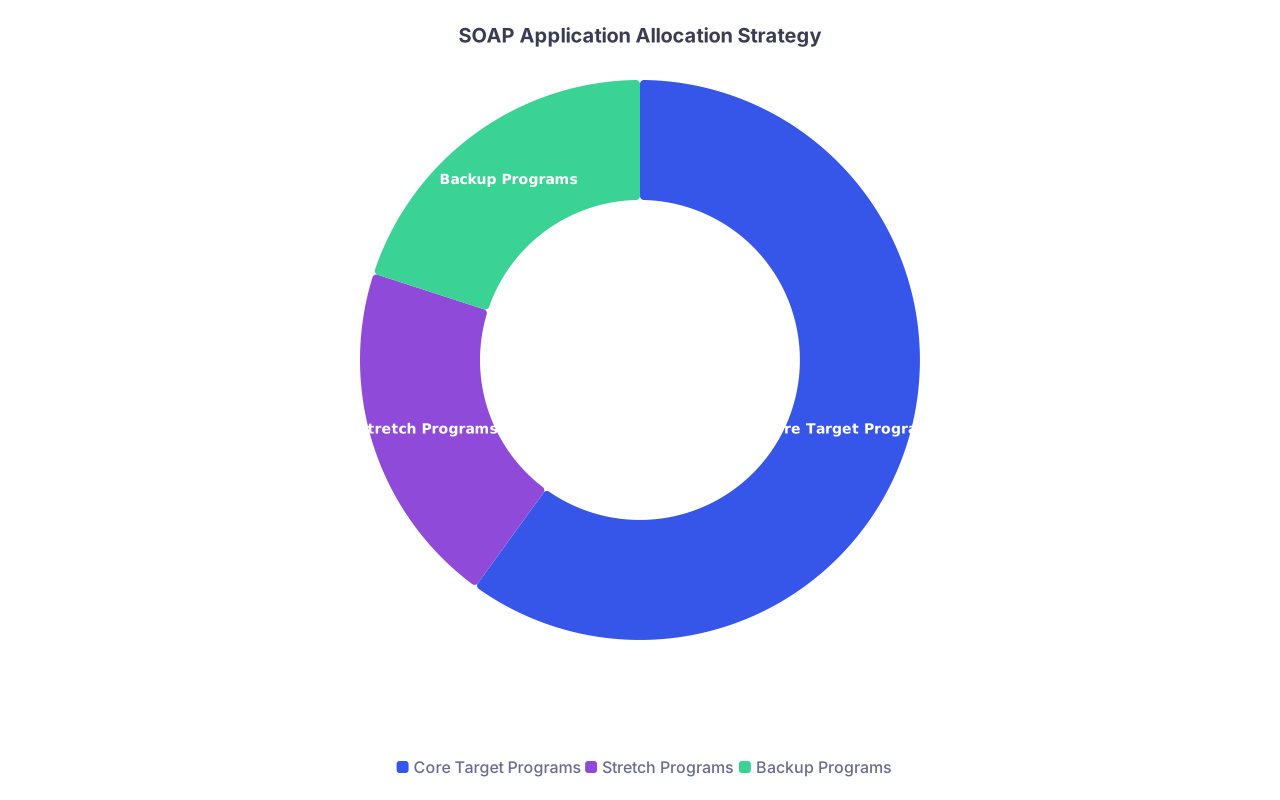
| Core Target Programs | 60 |
| Stretch Programs | 20 |
| Backup Programs | 20 |
SOAP isn’t random. It rewards the people who:
- Know where they’re realistically competitive.
- Can put together a focused, coherent narrative quickly.
- Don’t waste time chasing names instead of openings.
Myth #5: “I should wait for SOAP to think about backup specialties”
If you’re reading this before rank list certification: you’re already on the clock.
The worst SOAP outcomes I’ve seen weren’t from bad scores—they were from people who started planning on Monday of Match Week. That’s like starting for Step 2 the morning of your exam.
Here’s what actually moves the needle before SOAP:
- You and your dean’s office agree on clear thresholds: “If I have <3 interviews in X by January, we will plan SOAP for Y and Z specialties.”
- You draft backup personal statements for IM, FM, TY/prelim at least.
- You quietly research:
- Historically unfilled programs
- Regions you’d truly be willing to move to
- Visa-friendly programs, if applicable
And during the weeks before SOAP, you refine:
- A realistic list of strengths and weaknesses (US grad vs. IMG, attempts on exams, time since graduation).
- Which specialties can actually absorb your profile.

Waiting until SOAP week means:
- You’re writing personal statements in pure panic.
- You’re picking programs based on location names you recognize instead of realistic opportunity.
- You’re letting shame (“I don’t want my classmates to know I’m planning for SOAP”) cost you an entire year of your life.
Pre-SOAP planning doesn’t “jinx” anything. It just means you’re not gambling your future on vibes.
Myth #6: “Programs won’t touch me because I failed an exam / had to repeat a year”
This one is half-myth, half-truth.
Yes, some programs will auto-screen out for any failure, any repeat, any LOA not labeled “medical hardship.” Those programs weren’t going to take you in the main match either. Fine. Forget them.
But SOAP is full of programs that live in real-world medicine:
- Safety-net hospitals that know life is messy.
- Community programs that care more about work ethic and teachability than Step 1 perfection.
- Services that have seen plenty of residents with nontraditional paths turn into strong clinicians.
I’ve seen SOAP successes with:
- Step 1 failure, Step 2 > 230, good letters, strong MSPE → matched into FM.
- Year off for mental health, explained professionally, with solid later clerkship performance → matched into IM.
- Older grad with international background but strong US clinical experience → matched into prelim + later categorical.
You will not get to be picky. You will get judged. Some doors will stay shut.
But “red flags” are not universal death sentences. In SOAP, where programs are under time pressure to fill real jobs, a coherent story plus clear improvement can absolutely trump a clean but mediocre file.
What does not work is pretending the issue isn’t there, or writing three vague sentences about “personal challenges” and hoping PDs read your mind.
If you have a failure, repeat, or nontraditional timeline, you need:
- A direct, non-defensive one- to two-paragraph explanation in your personal statement.
- Obvious proof of recovery: better scores, better clerkship comments, consistent performance.
- At least one letter that clearly backs up your growth and reliability.
Programs are not allergic to imperfection. They are allergic to risk they don’t understand.
Myth #7: “If I go through SOAP, my career is permanently damaged”
This is the post-hoc shame myth.
I’ve sat in cafeterias and heard interns say, “Yeah, I had to SOAP here,” like it’s a confession. Then watched them match GI, cards, heme/onc out of that same “backup” IM spot.
Program directors don’t sit around in fellowship committees saying, “We only want applicants who never SOAPed.” They care about:
- Your residency performance (evaluations, 360s, how your name comes up in rooms).
- Your in-training exam performance.
- Your research or scholarly activity, if relevant.
- How you interview as a PGY-3 or PGY-4.
If SOAP lands you in a weaker or more demanding environment, it might actually make you better. You’ll see more pathology. You’ll be forced to function under pressure. You’ll have to navigate complex, under-resourced systems. Fellowship PDs know that.

The real career damage comes from:
- Being completely unmatched, doing nothing clinically for a year, and trying to re-enter with stale letters.
- Letting pride stop you from taking an available SOAP spot in IM/FM/Psych because it’s “beneath” your original goals.
SOAP is a bruise, not a fracture. It feels terrible in March. Three years later, most people barely mention it. Ten years later, nobody cares.
What Actually Gives You a Shot in SOAP with Limited Interviews
So if “no chance” is wrong, what does “a real chance” look like?
Not guarantees. Just probabilities stacked in your favor.
It looks like this:
You accept reality early. By January you stop pretending the interview trickle is a fluke. You talk frankly with your dean or advisor and identify realistic SOAP specialties—usually IM, FM, Psych, Peds, TY/Prelim.
You do boring, unglamorous prep. Backup personal statements ready. Program list templates half-built. A clear record of programs and regions you’d actually attend.
You aim wide but not blind. You use all 45 SOAP applications, but you don’t waste them on vanity picks. You prioritize places:
- Historically unfilled
- In less popular regions
- Where your metrics at least meet published or known cutoffs
You tell a clean story. Your documents say, in effect: “Here is where I am, here is what happened, and here is why I’ll be a reliable, hardworking resident in your program starting July 1.” That’s it. No melodrama. No vague “personal hardship” paragraphs with zero details.
You drop the ego. If IM in a small state hospital is realistic and anesthesia at a coastal academic center is not, you move toward the option that actually gets you training, not prestige.
| Category | Value |
|---|---|
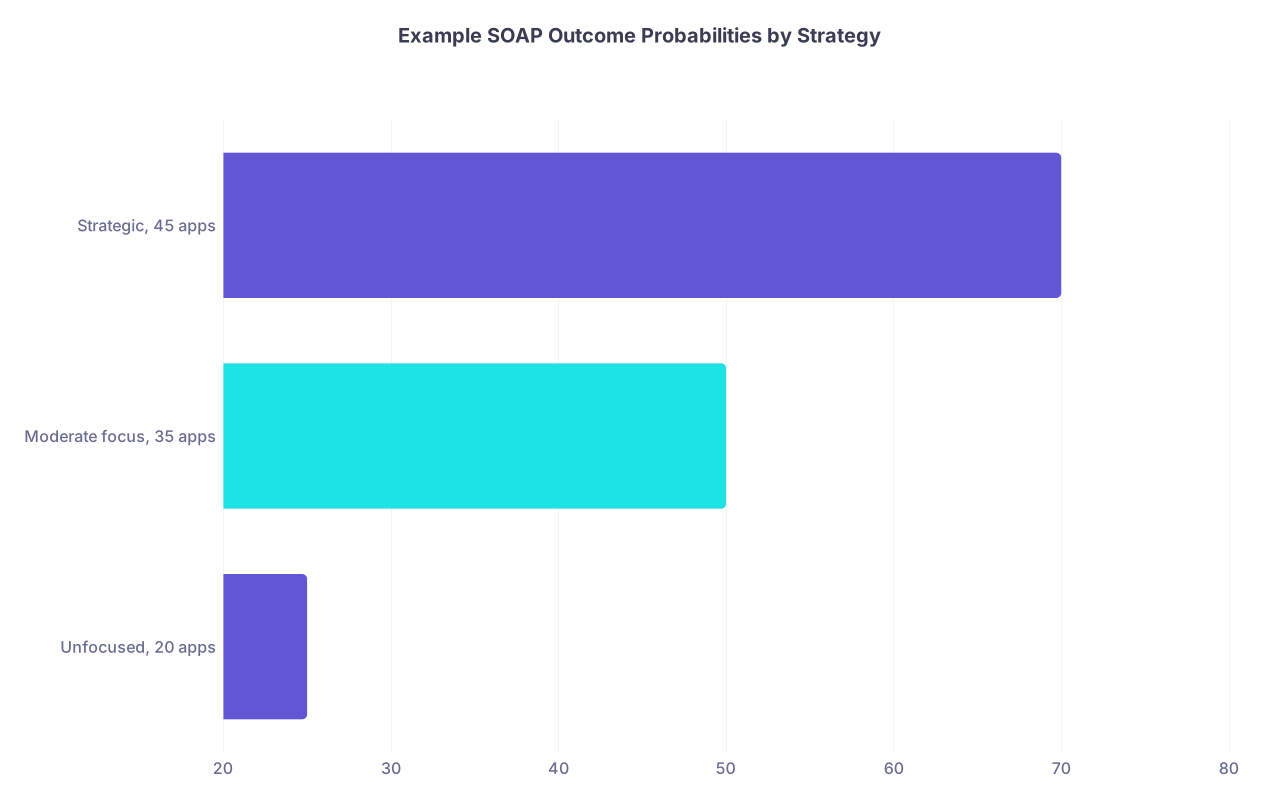
| Unfocused, 20 apps | 25 |
| Moderate focus, 35 apps | 50 |
| Strategic, 45 apps | 70 |
Those numbers aren’t official NRMP stats; they’re the pattern you see on the ground. Students who go into SOAP prepared, humble, and targeted land positions at far higher rates than the ones who treat it as an afterthought.
Final Reality Check
Three things to walk away with:
- Low interview numbers mean risk, not impossibility. SOAP fills thousands of positions every year, many with people who looked “doomed” in December.
- Strategy beats fatalism. Clear-eyed specialty choices, targeted programs, and prepared documents give you a shot; panic and pride destroy it.
- SOAP is a detour, not a dead end. Matching through SOAP doesn’t cap your career; refusing to engage with it honestly might.
You don’t have “no chance.” You have a narrow, demanding, very real chance—if you treat SOAP like a serious second match, not a consolation prize.