
27% of US MD seniors in SOAP-eligible specialties receive zero interviews at at least one program they applied to—yet most of them are not “failures” by any rational metric.
Let me be direct: the idea that “SOAP is for people who failed” is lazy, outdated, and mathematically impossible in the current Match ecosystem. You are not living in 1998. You’re in an era where thousands of applicants are perfectly competent, reasonably credentialed, and still wind up in SOAP because of bottlenecks, preferences, and gamesmanship—not because they “blew it.”
Let’s dismantle this myth properly.
What SOAP Actually Is (And What It Is Not)
SOAP = Supplemental Offer and Acceptance Program. It is not:
- a separate, shame-tier match
- a public pillory for “bad” applicants
- a random scramble free-for-all like the old days
It is literally a regulated, structured, time-boxed extension of the Match for unfilled positions and unmatched applicants.

| Step | Description |
|---|---|
| Step 1 | Submit ERAS |
| Step 2 | Interview Season |
| Step 3 | Submit Rank List |
| Step 4 | Start Residency |
| Step 5 | SOAP Eligible |
| Step 6 | Apply to Unfilled Programs |
| Step 7 | SOAP Rounds Offers |
| Step 8 | Unmatched After SOAP |
| Step 9 | Matched? |
| Step 10 | Accepted Offer? |
SOAP is just the process that kicks in after the algorithm runs and:
- Some programs fail to fill their spots
- Some applicants fail to get a spot
- NRMP tries to match the leftover supply and demand in a controlled way
Notice what none of that implies: “You are incompetent.”
The Numbers: Why SOAP Exists (And Why It’s Not Going Away)
If SOAP were truly “only for failing applicants,” then we’d expect SOAP to be rare. A fluke. An edge case.
It’s not.
Each Match cycle, you see three brutal realities:
- More applicants; relatively fewer positions in certain specialties
- Geographic and prestige preferences that don’t line up with reality
- Programs’ interview hoarding and yield protection games
Look at this simplified reality snapshot (numbers approximate, but directionally accurate based on recent NRMP data):
| Metric | Approximate Recent Value |
|---|---|
| Total residency applicants | 47,000+ |
| Total PGY-1 positions | 40,000+ |
| Applicants who go unmatched | ~7,000–8,000 |
| Positions unfilled after Match | 1,500–2,000+ |
| Positions filled through SOAP | Majority of unfilled |
So you’ve got:
- Thousands of applicants with nowhere to go
- Thousands of positions with no one in them
That mismatch isn’t a “you” problem. It’s a system design problem.
SOAP is the patch that keeps the system from collapsing entirely. You are operating inside that system. Not outside of it.
Who Actually Ends Up in SOAP? (Not Just “Bottom of the Barrel”)
Let’s kill the biggest myth first: that SOAP is where the “rejects” go.
Here’s who I’ve seen in SOAP in recent cycles:
- US MD with Step 1 pass, Step 2 in the 230s–240s, solid letters, applied IM/FM, but over-weighted “reach” programs.
- US DO with decent scores, applied to a competitive IM or EM-heavy list with not enough backup.
- Dual-physician couples who only ranked a narrow region and didn’t match as a pair.
- IMG with multiple US rotations, letters from US attendings, applied realistically—but got caught in a brutal year for IMGs.
Those people are not “failing applicants.” They’re victims of one or more of these:
- Overly narrow rank lists
- Overconfidence in big-name or coastal programs
- Late Step 2 scores
- The “I’ll be fine with 8–10 interviews” delusion in competitive specialties
- Program-side chaos: new PDs, sudden funding changes, program closures
Here’s the important part: SOAP is full of people who were viable enough to be on multiple rank lists. They simply didn’t land in the first pass.
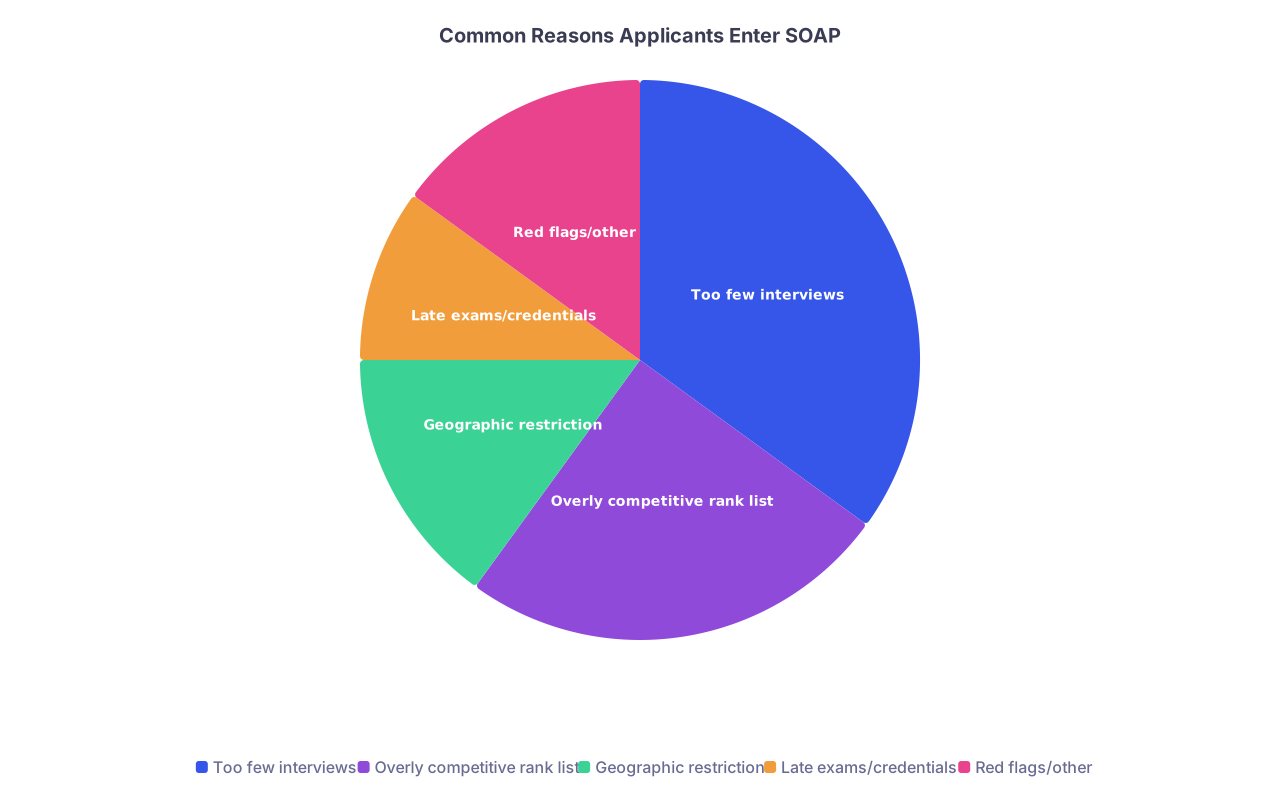
| Category | Value |
|---|---|
| Too few interviews | 35 |
| Overly competitive rank list | 25 |
| Geographic restriction | 15 |
| Late exams/credentials | 10 |
| Red flags/other | 15 |
Notice that only a fraction of that pie is “red flags/major issues.” The rest? Strategy, numbers, and preference mismatch.
The Stigma: Mostly Emotional, Rarely Logical
Where does the “SOAP = failure” mindset come from?
- Upperclassmen horror stories from the old Scramble days
- Attending physicians who trained 15–20 years ago and still think SOAP = chaos
- Class gossip: “Did you hear X went into SOAP?” whispered like a scandal
- Personal shame: you built your whole identity around “first round Match or bust”
But look at the cold reality:
- NRMP does not mark your record as SOAP vs. Main Match in any public-facing way
- Your future colleagues don’t get a tag over your head that says “matched in SOAP”
- Many PDs honestly stop caring how you arrived as long as you’re competent, reliable, and show up on July 1 ready to work
You are assigning way more meaning to the word “SOAP” than the system actually does.
The Market Reality: SOAP Is Where a Ton of Jobs Are
You know what’s actually true?
SOAP is often the most rational moment in the entire process. Why? Because finally, everyone drops the illusions and deals with what is actually available.
Programs in SOAP include:
- New programs that didn’t have brand recognition yet
- Solid community programs in less popular locations
- Academic programs that under-invited or overestimated their attractiveness
- Programs that had late funding approval or new positions added
Are there also problematic, chronically unfilled programs? Definitely. Some spots are unfilled for a reason: malignant culture, bad leadership, terrible work hours. You don’t blindly rank everything.
But equating “in SOAP” with “trash program” is lazy thinking. You’ll see very respectable IM, FM, psych, peds, prelim internal medicine and surgery, transitional year programs in there every single year.
SOAP vs. Main Match: Career Outcomes Are Less Different Than You Think
Let’s draw out the nightmare scenario people imagine:
“You SOAP into some random community program, your career is over, you’ll never subspecialize, you’ll never get a fellowship, no one will respect you, etc.”
A lot of that is fantasy.
Here’s the more honest comparison:
| Dimension | Main Match | SOAP |
|---|---|---|
| Timing | Results on Match Day | Results during Match Week |
| Program Type | Full spectrum | Slightly more community-heavy |
| Transparency | Long courtship via interviews | Compressed, document-heavy assessment |
| Stigma | None socially | Perceived stigma among peers |
| Future Prospects | Depends on program and performance | Same: depends on program and performance |
Program directors and fellowship directors care about:
- Your performance as a resident
- Your evaluations and letters
- Your research or scholarly work (depending on specialty)
- Your board pass rates and in-training scores
- Your reputation as someone people want on their team
They do not care that in March of your M4 year, a computer algorithm placed you on Monday instead of Friday.
I’ve seen SOAP residents end up:
- Chief residents
- Matched into cardiology, GI, heme/onc, pulm/crit fellowships
- Hired as academic hospitalists at big-name centers
Why? Because once you’re in training, how you do matters far more than how you got there.
The Real Failure: Not Having a SOAP Strategy
You want to talk about failure? Here’s actual failure in this context:
- Pretending you’ll definitely match “somewhere” with 5–6 interviews in EM, Ortho, Derm, or another high-competition field
- Refusing to think about SOAP because “I don’t want to jinx it”
- Wasting SOAP week spiraling instead of executing
You don’t prepare for SOAP because you’re planning to fail.
You prepare for SOAP because you’re not naïve.
SOAP week is insanely compressed. If you walk into it without a plan, you’ll make panic decisions that truly might damage your career. Not because SOAP is bad. Because you were unprepared.
If You Have Limited Interviews, Here’s the Truth
Let’s say you’re entering late interview season, and here’s your count:
- Competitive specialty (Derm, Ortho, ENT, Plastics, Uro, etc.): 0–3 interviews
- Moderately competitive (EM, anesth, rads, OB/GYN, neuro, gen surg): <7–8 interviews
- Less competitive (FM, IM, psych, peds, path, neuro, PM&R): <6 total, most at weaker programs
You are in risk territory. That’s not a value judgment. That’s statistics.
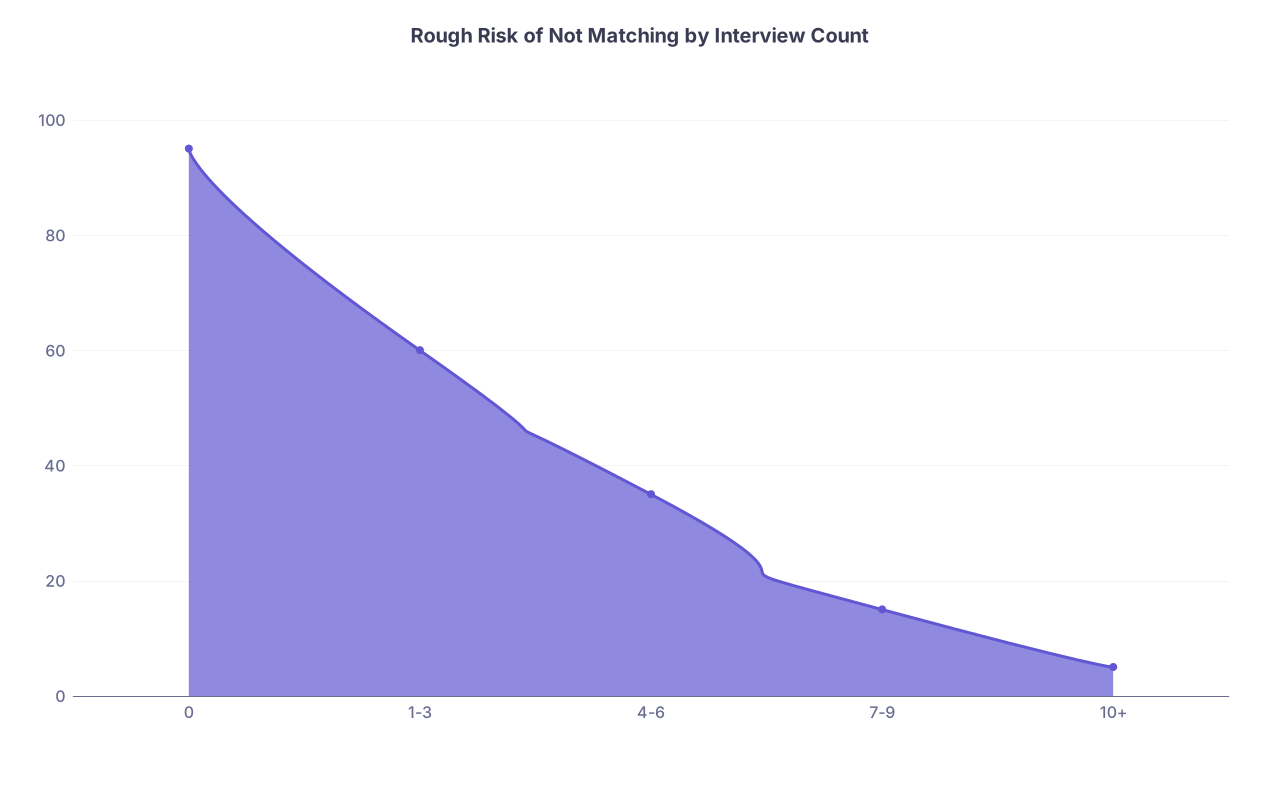
| Category | Value |
|---|---|
| 0 | 95 |
| 1-3 | 60 |
| 4-6 | 35 |
| 7-9 | 15 |
| 10+ | 5 |
(Those percentages vary by specialty, but the shape of that curve is real: risk drops with more interviews.)
If you’re in that risk zone and still clinging to “SOAP is for failures,” you’re setting yourself up for a brutal crash.
The grown-up move is this:
- Accept that SOAP is a tool, not a verdict.
- Decide ahead of time how you’ll use it if you need it.
- Drop the ego that says “I’d rather not match than SOAP.” That’s not noble. That’s self-sabotage.
How Smart Applicants Treat SOAP
The strongest applicants I’ve watched handle SOAP well all do the same things:
They game-plan early.
In January or February, they sit down and say: “If I do not match, what are my priorities in SOAP? Geography? Specialty flexibility? Transitional vs. categorical?”They know their acceptable ranges.
They draw a line:- “I will SOAP into FM/IM/psych if my specialty doesn’t work out.”
- Or: “I will only SOAP into TY/prelim and re-apply next year.”
They pre-assemble their documents.
- Up-to-date CV
- Multiple versions of a short, clear, SOAP-appropriate personal statement (one for IM/FM, one for prelim/TY, etc.)
- A list of faculty who can quickly advocate or send updated letters if needed
They mentally detach identity from outcome.
They understand: matching on Monday vs. matching on Thursday doesn’t change their worth as a future physician.
The weak approach is the magical thinking approach: “I’ll just manifest matching.” The strong approach is: “I’ll fight for a spot, in all phases available to me.”
Program Perspective: They’re Not Sitting There Judging You
Inside programs during SOAP, what’s actually happening?
I’ve sat in those rooms. Let me translate:
- PDs are stressed because unfilled spots look bad to their leadership.
- They’re racing to review applications in insane time windows.
- They’re asking: “Can this person safely and reliably take care of patients here?”
- They’re not asking: “Did this person fail emotionally before being offered to us?”
They care about:
- Your exam passes/scores
- Any major professionalism concerns
- Your letters (especially from US clinical rotations)
- Whether you seem like someone who will show up, work hard, and not disappear PGY-2
SOAP is not a morality court. It’s triage. Programs are trying to staff their teams safely.
When SOAP Might Not Be the Right Move
Now, to be truly honest, there are cases where SOAP might not be your best path:
- You have a serious red flag (failure to remediate, professionalism issue) and the only programs showing up for you are clearly toxic.
- Your long-term goal absolutely requires a specific specialty, and SOAP options are only in a completely different one you’d hate.
- You’re financially and emotionally in a place where taking a non-ideal prelim year would harm you more than help.
In those scenarios, strategically not SOAPing into a bad-fit situation and instead strengthening your application for a re-application can be rational. But that’s about fit and strategy, not about avoiding some imagined stigma.
“Not SOAPing because SOAP is for losers” is dumb.
“Not SOAPing into a malignant prelim surgery position you know will break you” is rational.
Different things.
The Real Question You Should Be Asking Yourself
If you strip away the ego, the gossip, the old myths, you’re left with one core question:
“Do I want a residency position this year enough to use every legitimate tool available to get one?”
If the answer is yes, then SOAP is just part of the battlefield. Not a scarlet letter. You don’t have to love the process to use it. You just have to refuse to let pride make decisions that your future self will regret.
Years from now, you won’t be replaying Match Week minute by minute. You’ll be remembering the patients, the codes, the nights you barely made it through, and the colleagues beside you. Whether you got there on Monday or via SOAP on Thursday will be a footnote, if you remember it at all.