
The idea that you should “wait and see how the regular Match goes” when you only have a couple of interviews is fantasy. Not strategy. Fantasy.
If you’re entering January with a thin interview list and your plan is basically hope, you’re not being “optimistic.” You’re gambling with the most important bottleneck year of your career on worse odds than a slot machine.
Let’s walk through what the data actually shows, why “I’ll just see what happens in March” is a terrible plan, and how to treat SOAP as a parallel strategy, not a panic button.
The brutal math: few interviews = real risk, not “maybe”
I’ve heard the same line every year from at least one student:
“I’ve got 2 interviews. People match with 2 or 3 all the time. I’ll just rank them and hope I don’t need SOAP.”
Then March hits. And they’re in my inbox at 11:07 AM Eastern with the subject line:
“NRMP said I didn’t match. What do I do now??”
Here’s where the myth starts: people latch onto individual anecdotes.
“My friend’s cousin matched ortho with 3 interviews.”
“Someone in our group chat matched EM with just 2.”
And they ignore the population-level reality.
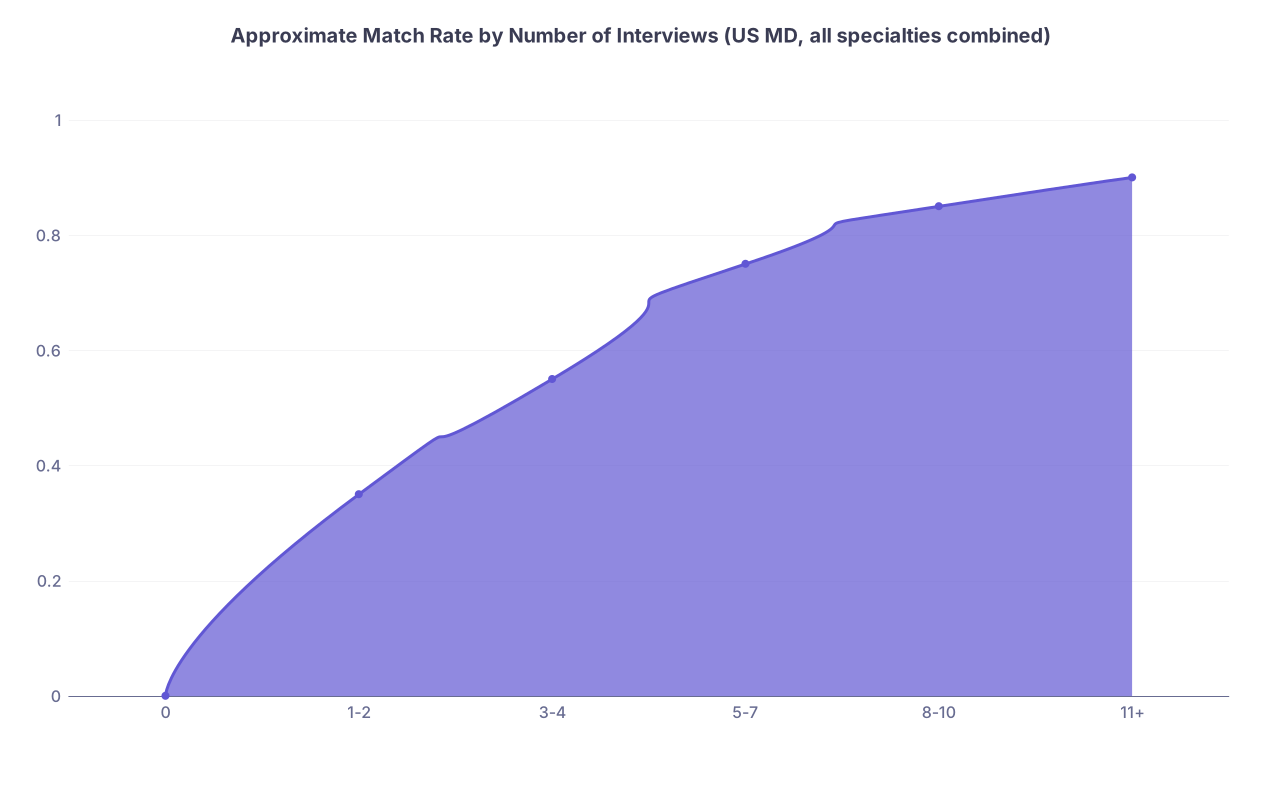
NRMP’s Charting Outcomes and Program Director Survey data paint a very consistent picture:
| Category | Value |
|---|---|
| 0 | 0 |
| 1-2 | 0.35 |
| 3-4 | 0.55 |
| 5-7 | 0.75 |
| 8-10 | 0.85 |
| 11+ | 0.9 |
These are rounded, but directionally accurate across multiple Match cycles:
- With 1–2 interviews, your odds are closer to a coin flip than a sure thing. And that’s for U.S. MDs. DOs and IMGs generally fare worse at the same interview count.
- You don’t have “a couple of good shots.” You have a real chance of not matching. Period.
The problem is that applicants treat “chance” like it’s a vibe, not a probability.
“I feel pretty good about my interviews.”
“I vibed with the PD.”
“They told me they liked me.”
Programs say that to many people. And they don’t control the algorithm.
The Match algorithm is applicant-favoring mathematically, not outcome-favoring emotionally. If your ranked list is two or three lines long, the algorithm can only help you so much.
Relying on “waiting for regular Match” with thin interviews is like saying:
“I know the fire is spreading, but I’d like to see if the wind changes before I think about exits.”
What SOAP actually is (and why you’re already behind if you wait)
SOAP is not a magical second Match. It’s not a “backup Match.” It’s an emergency redistribution of unfilled spots under time pressure and chaos.
Let me be blunt: the people who do well in SOAP aren’t the ones who panic better. They’re the ones who prepared like they knew this might happen and refused to be ashamed of planning for it.
Every year, the pattern repeats:
- Monday 11:00 AM ET: NRMP emails go out. Unmatched and partially matched find out.
- 11:00–11:55 AM: Shock, denial, crying in bathrooms, frantic texts.
- 12:00 PM: List of unfilled programs released, ERAS opens for new applications.
- Within minutes: some programs already flooded with applications, PDs triangulating with coordinators, faculty, and previous interview impressions.
If your thought process before Match was:
“I’ll see if I match first. If not, I’ll figure out SOAP,”
you’re starting this process at mile 10 of a 5K.
The students who do better in SOAP usually did three things before March:
- Accept the possibility of not matching as a scenario, not a moral failing.
- Build a SOAP-ready version of their application: updated personal statement(s), realistic program list by specialty, letter PDFs handy, CV polished.
- Have frank conversations with mentors about which specialties and locations they’d be willing to consider in SOAP—before emotions are high.
SOAP is fast. Emotional. Competitive. You don’t want to be writing a brand-new personal statement at 12:07 PM Monday while 200 other applicants have already applied to the same unfilled IM program you’re eyeing.
The myth of “If I plan for SOAP, I’m giving up on the Match”
This one annoys me because it’s pure magical thinking.
I hear versions of it every year:
“I don’t want to make SOAP plans because I want to stay positive.”
“If I start thinking about SOAP, it means I don’t believe in myself.”
No. It means you understand probability.
Airlines have oxygen masks. They don’t expect every flight to crash.
Hospitals have code carts. They’re not “manifesting” cardiac arrests.
You’re a future physician. You’re supposed to be comfortable with contingency planning.
There’s no causal link between:
- Writing a SOAP personal statement in February
and - You not matching in March.
You’re not jinxing anything. You’re protecting yourself against an outcome that happens to thousands of people every year, many of them “good applicants.”
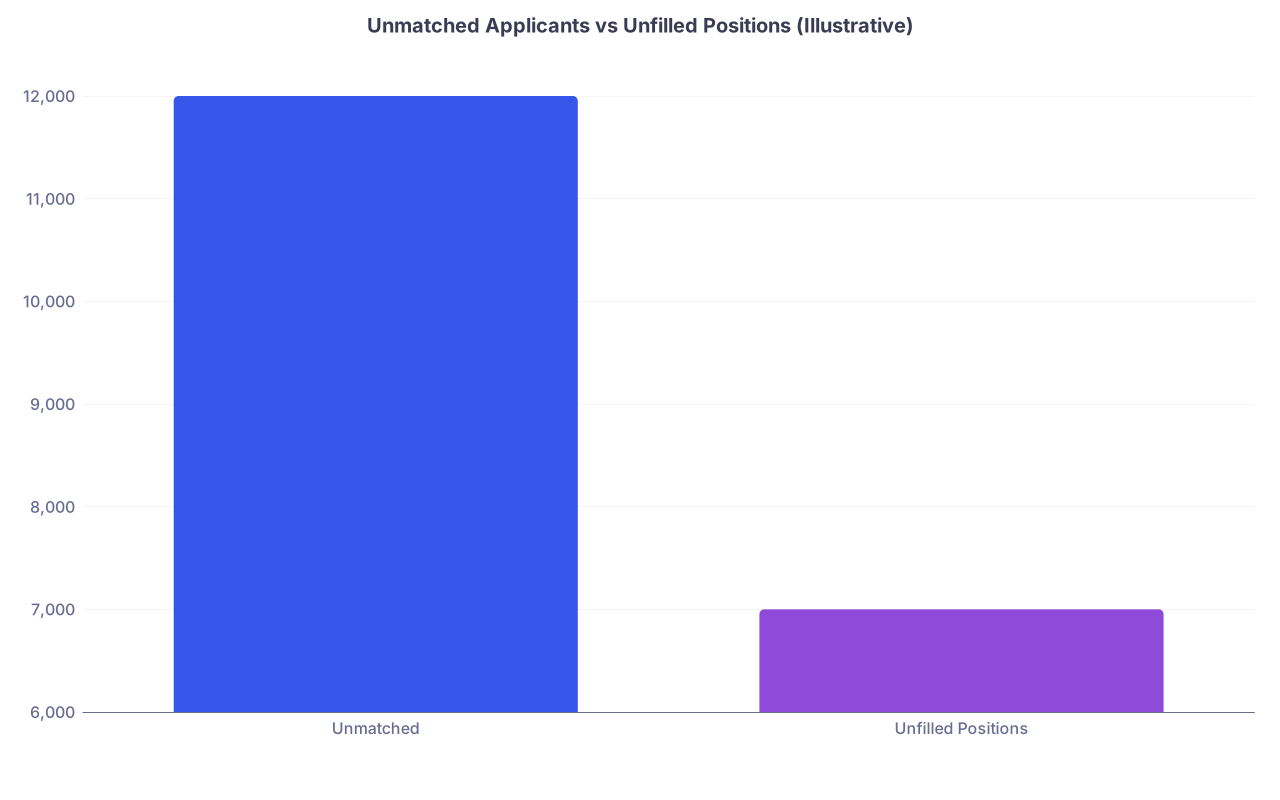
Let me remind you of one cold number: the NRMP publishes the total number of unmatched US seniors plus IMGs plus DOs every year. We’re talking tens of thousands of applicants vying for a few thousand unfilled positions.
| Category | Value |
|---|---|
| Unmatched | 12000 |
| Unfilled Positions | 7000 |
When the supply-demand curve looks like that, you don’t have the luxury of superstition.
Planning for SOAP doesn’t reduce your Match chances; it reduces your panic level if things go sideways. That’s it.
Why “I’ll just scramble into something” is outdated and wrong
Older attendings sometimes tell students, “Don’t worry, if you don’t match, you can just scramble into prelim surgery or something.”
They’re talking about a system that does not exist anymore.
The old “Scramble” was a semi-chaotic race to call programs and beg for spots. Ugly, but more free-form. SOAP is structured, regulated, and heavily time-boxed.
You cannot just:
- Start cold-calling programs on Monday.
- Email your way into unfilled positions outside the ERAS SOAP process.
- Randomly apply 60 times with one generic statement and see what sticks.
Programs in SOAP are looking at:
- Do you meet minimum requirements?
- Does your application actually show any interest or alignment with this specialty or type of program?
- Do you look like someone who is desperately applying anywhere, or someone who has a coherent story and is willing to commit?
If your entire ERAS is set up for Derm and you suddenly apply in SOAP to FM, IM, Psych, and Prelim Surgery with no tailored materials, you’ve told them exactly one thing: “I didn’t think about this earlier.”
“But my interviews went really well” – the illusion of safety
The most common rationalization I see for not prepping SOAP is:
“My interviews went great. I feel good about them.”
Let me tell you what program directors also say every year in their post-Match debriefs:
- “We loved a lot of our interviewees. We ranked them highly. Many of them ended up at other places.”
- “There were 5 people we would’ve been thrilled to match for that one PGY-1 slot.”
- “She was amazing, but she ranked us low. Or not at all.”
Your perception of how interviews “went” has almost no predictive value once the rank lists are in. You don’t know:
- How you ranked relative to others they liked.
- How they slotted couples, special cases, or internal candidates.
- Which more competitive applicants also decided to list them as a safety.
With 1–3 interviews, there’s another hard truth: any single factor can swing your Match result. A PD retires. A new chair pushes to favor home students. An applicant with stronger scores decides at the last minute to rank rural IM higher.
You’re not just betting that you did “well.” You’re betting that your success is robust to factors you’ll never see.
Again: believing you interviewed well is fine.
Using that belief as an excuse to pretend SOAP isn’t a serious possibility is not.
Concrete ways to prepare for SOAP now (without derailing your Match focus)
I’m not telling you to become obsessed with SOAP in January. I’m telling you to quietly lay the groundwork so that, if Monday morning in March goes badly, you’re in execution mode instead of existential-crisis mode.
A practical approach looks like this:
Have an honest specialty conversation with yourself and a mentor.
If you’re applying to a highly competitive field (Derm, Ortho, ENT, IR, etc.) with very few interviews, you should already be thinking about which less competitive fields you’d actually be willing to train in if you had to. Not “like,” not “dream of,” just “could live with, build a career from, and not be miserable.”
That list might include IM, FM, Psych, Peds, Path, or certain prelim/TY options.Build at least one SOAP-focused personal statement.
Not a thrown-together generic ramble. A focused, honest explanation of why you would be a good fit in that specialty—even if it wasn’t your original Plan A. This can sit in a Google Doc or Word file. You can adapt it quickly if needed.Identify and quietly line up backup recommenders.
A psych attending from your clerkship who liked you. An IM faculty member who said, “If you ever need a letter, ask me.”
You don’t necessarily need to ask them to write a letter right now, but you can at least re-open contact, show interest in their specialty, and be sure they’d be willing to help fast if needed.Know which programs and regions are realistic.
Look at historical fill rates. Community programs. Less desirable locations. Programs that traditionally take IMGs or DOs.
No, this isn’t glamorous. Yes, these are real training opportunities that produce real board-certified physicians.Clean up your ERAS, CV, and any “holes.”
That ambiguous 6-month gap? Clarify it now. That weird research entry? Make it coherent. Your ERAS is the file SOAP programs will see, not a second, magically better version.
None of this hurts you if you match in your preferred specialty at your top-choice program. You’ll just have some extra personal statements and notes sitting in your hard drive.
If you do not match, this work suddenly becomes pure gold.
When “waiting for regular Match” crosses the line into self-sabotage
Let me draw the distinction clearly.
Reasonable mindset:
“I’m going to give these interviews my full effort, rank sincerely, and I’m also going to assume I might need SOAP and prepare accordingly.”
Self-sabotage:
“I only have 2 interviews, but I’m sure it’ll work out. Thinking about SOAP makes me anxious, so I’ll just deal with it if it happens.”
The second mindset trades short-term comfort for long-term risk. Every time.
When I talk to people who went unmatched and then also botched SOAP, they almost always say some version of:
- “I just didn’t think this would happen to me.”
- “I thought my school’s match list meant I’d be fine.”
- “I didn’t want to seem like I didn’t believe in myself by planning for SOAP.”
And then a year of their life is gone. They’re scrambling for research positions, prelim spots, or reapplication strategies—many of which could have been avoided by 10–15 hours of unglamorous prep in January and February.
You’re not just choosing between “be positive” and “be negative.”
You’re choosing between:
- “Treat myself like I’m special and immune to statistics.”
vs. - “Treat myself like a real applicant functioning within real numbers.”
The numbers don’t care how confident you felt on interview day.
Quick reality check: When is it rational to be concerned?
There’s no universal cutoff, but if you want a rough feel:
| Interviews | Risk Level | SOAP Prep Priority |
|---|---|---|
| 0 | Extreme | Critical |
| 1–2 | Very High | Critical |
| 3–4 | High | Strongly advised |
| 5–7 | Moderate | Advisable |
| 8+ | Lower | Reasonable backup |
For DOs and IMGs, shift that whole table one row down in optimism. Three to four interviews in IM as an IMG is not “safe.” It’s “better, but still volatile.”
SOAP planning is not a punishment reserved for people with 0 interviews. It’s a rational step for anyone who would be devastated by an unmatched email. Which, for most of you, is… all of you.
The bottom line
“Waiting for regular Match” when you have few interviews is not a strategy. It’s denial wrapped in optimism.
Three core truths to walk away with:
- Few interviews = real statistical risk, no matter how “good” you felt about them. You can’t out-vibe probability.
- SOAP works best for people who prepared early, emotionally and practically, not for those who discovered it existed on Monday at 11:01 AM.
- Planning for SOAP doesn’t hurt your Match chances; it only protects you if the Match doesn’t go your way. You’re a scientist-in-training. Act like it. Plan for both outcomes.
If your interview list is short, stop treating SOAP as a dirty word. Treat it as what it really is: your contingency plan in a system where even strong applicants fall through the cracks.