
What do you put in a SOAP personal statement when you’ve already had a few interviews and you’re worried programs think you were “passed over”?
Here’s the answer: you write like someone who learned from the main Match, not like someone begging for scraps in SOAP.
Let’s break down exactly what your SOAP personal statement should focus on, and what to leave out.
First: Understand What SOAP PDs Are Actually Looking For
Program directors reading SOAP applications have a different mindset than during regular ERAS.
During SOAP they’re asking:
- Can this person show up in July and function safely?
- Are they stable, teachable, and low-drama?
- Do they actually want this kind of program, or are we just a backup?
- Are they going to stick around, or quit in October?
They’re not dissecting every comma in your research paragraph. They’re scanning for:
- Clear, consistent motivation for the specialty
- Evidence you can do the work (clinical readiness)
- Professionalism and insight (do you understand what went wrong, at least implicitly?)
- Fit for their setting (community vs academic, patient population, location)
Your SOAP personal statement should be laser-focused on that.
Not on explaining why you didn’t match.
Not on rehashing your entire life story.
The Core Focus: Three Things Your SOAP PS Must Do
If you remember nothing else, remember this: your SOAP personal statement should do three jobs, in this order.
- Reaffirm your commitment to the specialty
- Prove you’re clinically ready and coachable
- Show specific, believable fit for the type of programs you’re applying to
Let’s walk through each.
1. Reaffirm Commitment to the Specialty
SOAP PDs are nervous about applicants just “parking” in their program or switching specialties later. Especially if they know you had some interviews and still didn’t match.
Your job: make your continued commitment to the specialty unambiguous and current.
Focus on:
- Recent clinical experiences in that specialty or related fields
- Concrete patient encounters that solidified your choice
- How your experiences this year confirmed your interest
Bad:
“I have always dreamed of being an internal medicine physician…”
Better:
“Over this past year, my sub-internship in internal medicine reinforced that this is where I do my best work—managing complex, multi-problem patients over time and coordinating care across teams.”
You’re answering the silent question in the PD’s mind: “Are you still truly in for this specialty, after not matching?”
Your answer: yes, and here’s recent evidence.
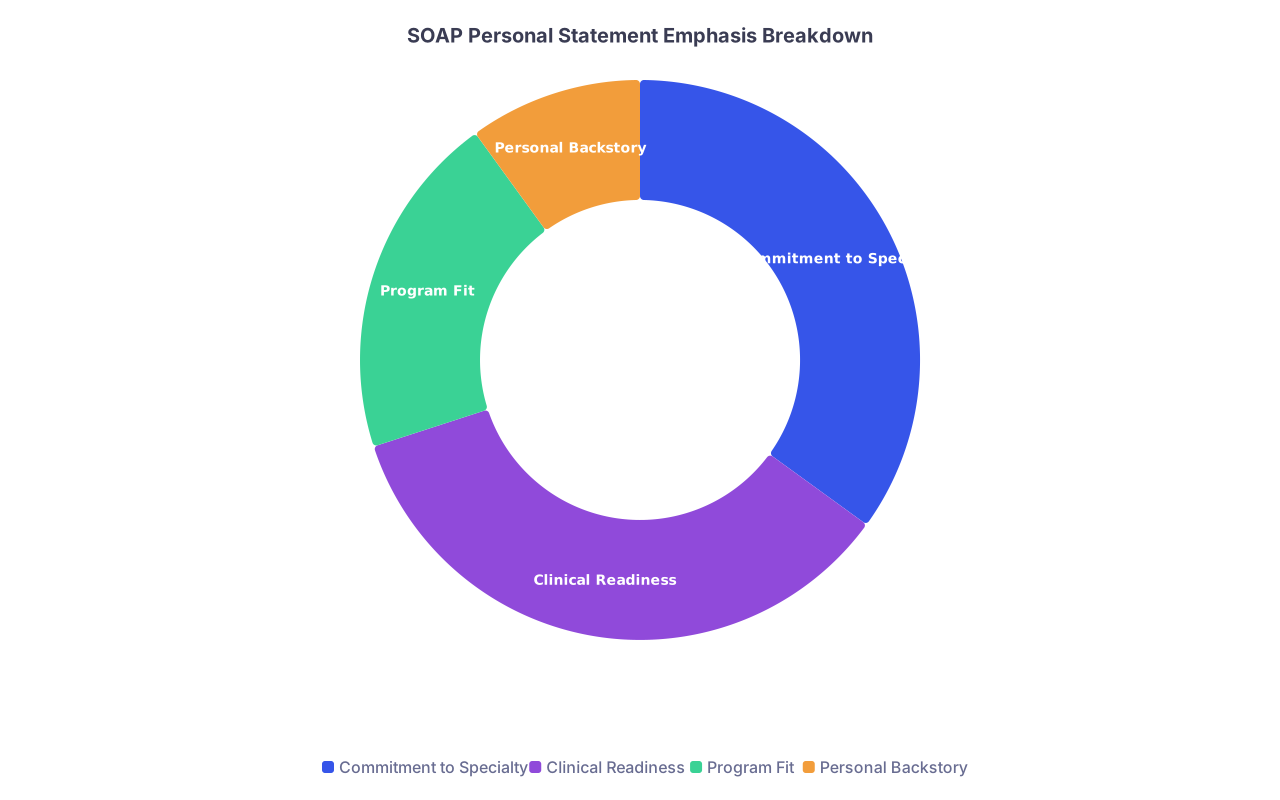
| Category | Value |
|---|---|
| Commitment to Specialty | 35 |
| Clinical Readiness | 35 |
| Program Fit | 20 |
| Personal Backstory | 10 |
2. Prove You’re Clinically Ready (Without Saying “I’m Clinically Ready”)
You’re not selling “potential” anymore. You’re selling “ready to start PGY-1 in four months.”
You need to show:
- You’ve handled intern-like responsibilities (sub-I, acting internship, ICU, nights, busy wards)
- You can manage a patient load, communicate with teams, and follow through
- You understand the grind: call, documentation, cross-coverage, sick patients at 3 a.m.
Use 1–2 tight, specific examples. Not fluffy general statements.
Weak:
“I work well in teams and communicate effectively with my colleagues.”
Stronger:
“On my medicine sub-internship, I took primary responsibility for 8–10 patients daily, presenting on rounds, following up test results before sign-out, and calling consults independently with attending supervision. The pace confirmed that I enjoy high-acuity, high-responsibility work.”
You want PDs to read it and think: “I could put this person on my night float team and they wouldn’t implode.”
Don’t say you’re “ready.” Show it through the details you choose.
3. Show Specific Fit for the Programs You’re Targeting
SOAP is fast and chaotic. Most applicants blast out a generic statement.
That’s a mistake.
You probably don’t have time to customize 30 different versions. But you can tailor by program type:
- Community IM vs academic IM
- Rural FM vs urban FM
- County EM vs suburban EM
- Transitional vs preliminary vs categorical
Focus your statement on the kind of environment you’re actually applying to in SOAP.
Examples of “type-fit” language:
- “I’m drawn to community programs where residents take early ownership of patient care and see a broad, undifferentiated population.”
- “I’m especially interested in training in a safety-net environment serving uninsured and underinsured patients.”
- “I value close-knit teams and strong bedside teaching over large institutional size.”
Don’t name specific programs in SOAP (you’re applying to many), but make it obvious you’ve thought about the training environment, not just the specialty label.
What to Do With the “I Had a Few Interviews and Didn’t Match” Reality
You do not need a paragraph explaining why you didn’t match.
SOAP personal statements that start with “Although I was unsuccessful in the Match this year…” almost always hurt more than they help.
Here’s how to handle it instead:
Don’t lead with your failure
Start with your current commitment and your recent experiences, not your non-match.If you address it at all, keep it one short, neutral line
Example:
“While I did not secure a position in the initial Match, this process has only strengthened my determination to begin residency training in internal medicine this July.”Do not:
- Blame schools, programs, or the system
- Over-explain (“I think my low Step 1 score…” “I applied late…”)
- Sound desperate (“I will take any position available…”)
Programs already know you didn’t match. SOAP exists for that reason. You don’t need to justify your presence there.
Your tone should be: “I’m ready, I’ve learned, I’m moving forward.”

| Step | Description |
|---|---|
| Step 1 | Opening paragraph |
| Step 2 | Commitment to specialty |
| Step 3 | Clinical readiness example |
| Step 4 | Program type fit |
| Step 5 | Brief nod to growth or reflection |
| Step 6 | Confident closing statement |
Concrete Structure You Can Follow
Here’s a simple 4–5 paragraph structure that works well in SOAP.
Paragraph 1: Present-Tense Commitment
Goal: Establish that you’re still firmly committed to this specialty now.
- Brief hook: a recent rotation or patient care moment
- 1–2 sentences clearly stating your commitment and why
Example start:
“During my sub-internship on the general medicine service this fall, I realized that internal medicine is where I feel most at home in the hospital: at the center of complex diagnostic questions and long-term patient relationships.”
Paragraph 2: Clinical Readiness and Skills
Goal: Show you can function as an intern.
- Describe concrete responsibilities you’ve handled
- Mention any feedback or strengths that are relevant: reliability, work ethic, communication
Example components:
- Managing a patient list
- Night call or cross-cover experiences
- Working with nurses, consultants, families
Paragraph 3: Fit for Program Type
Goal: Show you understand the kind of program you’re applying to.
- Emphasize what you value in training: patient population, community, teaching style, autonomy
- Tie in your background if relevant (rural upbringing, language skills, prior community work)
Example:
“Having trained in a setting where many patients lacked stable access to care, I want to continue working in a community hospital that serves a diverse, often underserved population. I value programs where residents are integral to the care team and develop early autonomy with appropriate supervision.”
Paragraph 4: Growth and Perspective
Goal: Address maturity without a long apology.
You can briefly acknowledge:
- What you’ve learned from this application year
- How you’ve grown in resilience, self-awareness, or professionalism
One tight sentence on the non-match is fine here if you want it.
Example:
“This application cycle has pushed me to reflect deeply on my strengths and areas for growth. Rather than discouraging me, it’s reinforced my commitment to show up as a reliable, hardworking intern who contributes positively to my team every day.”
Paragraph 5: Confident Closing
Goal: Leave a sense of stability and readiness.
Something like:
“I’m eager to bring my strong work ethic, clinical curiosity, and commitment to patient-centered care to your residency program this July. Thank you for your consideration.”
That’s enough. Clean, direct, adult.
| Aspect | Main Match PS Focus | SOAP PS Focus |
|---|---|---|
| Tone | Aspirational, long arc | Grounded, ready-to-work-now |
| Explanation of path | More background and narrative | Minimal; current commitment and readiness |
| Addressing failures | Sometimes detailed context | Very brief or implicit |
| Program specificity | Sometimes tailored to certain programs | Tailored to program *type* |
| Length | Full page often fine | Tighter, ~3/4 to 1 page max |
Things You Should Not Focus On in a SOAP PS
Let me be blunt. I’ve seen people sink themselves with this stuff.
- Long childhood origin stories (“ever since I was five…”)
- Detailed research projects unless directly relevant to the specialty and level of program
- Emotional oversharing about the pain of not matching
- Complaints about school, exams, or personal hardships as main content
- “I’ll do anything, anywhere” language (sounds desperate, not committed)
SOAP PDs are reading fast under pressure. You get credit for being clear, concise, and relevant. You lose points for drama and vagueness.

How to Handle If You’re Pivoting Specialty in SOAP
Different scenario: You applied to one specialty, had a few interviews, didn’t match, and now you’re SOAPing into a different specialty.
Your statement has to do three extra things:
- Give a clear, honest, brief reason for the pivot
- Show concrete experiences that support the new choice
- Reassure them you’re not using this as a temporary holding spot
Example approach:
One sentence acknowledging previous plans:
“While I initially applied to anesthesiology, my clinical experiences this year have made it clear that I’m better suited to internal medicine.”Then pivot hard into evidence for the new specialty:
- Rotations you loved
- Skills that match (communication, continuity, breadth)
- Mentors in that specialty who encouraged you
Avoid long justifications or self-flagellation. PDs care more about: “Will you stay and thrive in this field?” than about the exact path you took to get here.
Final Key Points
For your SOAP personal statement after a few interviews and a non-match:
- Focus on current commitment, recent clinical readiness, and clear program-type fit.
- Treat the non-match as background noise, not the headline—acknowledge briefly if at all, then move on.
- Write like someone ready to work in July, not someone begging for another chance at an application cycle.
That’s what gets you taken seriously in SOAP.
FAQ (Exactly 5 Questions)
1. Should I completely rewrite my personal statement for SOAP?
If your original PS is heavily narrative, long-winded, or focused on research and not clinical readiness, yes—rewrite a tighter, more immediate version. If your existing statement already emphasizes recent clinical work, commitment, and program fit, you can adapt it by trimming fluff and adjusting the tone to be more “ready now.”
2. How long should my SOAP personal statement be?
Aim for about 3/4 of a page to 1 page, single-spaced. SOAP PDs are reading under time pressure. Long, multi-page essays are a liability. You want a clean structure: 4–5 short paragraphs that can be absorbed in under 60–90 seconds.
3. Should I mention that I had a few interviews but didn’t match?
Don’t list or count interviews. Programs already know you didn’t match; they don’t need a recap. If you want to nod to it, one sentence like “Although I did not match this cycle, I remain fully committed to beginning residency in [specialty] this July” is enough. Then immediately pivot to strengths and readiness.
4. Can I reuse parts of my original ERAS personal statement?
You can reuse strong, specific clinical examples and your core “why this specialty” argument. You should cut: long background stories, excessive childhood narrative, and any “big picture” fluff that doesn’t directly help in SOAP. Also adjust any language that feels aspirational and replace it with grounded, concrete readiness.
5. Should I write different SOAP personal statements for different programs?
You probably don’t have time to customize by individual program, and that’s fine. But you should at least customize by specialty and program type. One version for community IM, one for FM, etc. If you’re SOAPing into multiple specialties (e.g., IM and prelim surgery), you must have separate, clearly specialty-appropriate statements—no generic “I just want to help people” copy-paste jobs.