
The brutal truth: yes, you can switch specialties during SOAP with a weak interview season—but doing it blindly is how people end up chronically unhappy or unmatched twice.
Let’s walk through how to make this decision like an adult, not a panicked applicant with ERAS PTSD.
1. Can You Switch Specialties During SOAP? Yes. But That’s Not The Real Question.
Mechanically, switching specialties in SOAP is easy. Emotionally and strategically, it’s not.
Here’s what’s actually true:
- You can apply to a completely different specialty during SOAP than what you applied to in the main Match.
- NRMP doesn’t care if you “switch” on paper. Programs won’t even necessarily know your original list unless they dig.
- You can reuse most of your ERAS materials with some tweaks (more on that later).
- Plenty of people do it every year—family med hopefuls jumping to psych, failed derm applicants jumping to IM prelims, etc.
The real question you should be asking is:
Given my weak interview season, is switching specialties during SOAP my best path to matching and being reasonably happy, or am I just panic-sprinting toward anything open?
That’s a very different decision.
2. First: Diagnose Why Your Interview Season Was Weak
If you skip this step, you’ll repeat your mistakes in SOAP and again in a reapplication cycle.
There are only a handful of common reasons:
| Issue | SOAP Impact |
|---|---|
| Low Step scores | Major |
| Late applications | Moderate |
| Poor letters | Major |
| Limited specialty fit | Moderate |
| Overly competitive list | Major |
Ask yourself bluntly:
Scores
- Were your Step 2 / COMLEX 2 scores below the typical range for your specialty?
- Did you fail anything? Shelf, Step, COMLEX?
Application Strategy
- Did you under-apply? (e.g., 20 EM programs with a 220 Step 2)
- Did you apply late? September/October submission?
- Were your programs mostly top-tier, big academic centers?
Specialty Fit
- Did you have weak or minimal home/audition rotations in that field?
- No specialty-specific letters? Generic “medical student worked hard” letters?
Red Flags
- Remediation, professionalism concern, leaves of absence, multiple withdrawals?
- Poor communication on interview trail? No-shows?
Here’s the key:
- If your problem was strategy (too few apps, late apps, bad list), then reapplying to the same specialty with a better plan next year may be smarter than a panicked SOAP switch.
- If your problem was objective stats (low Step, failed exams, multiple red flags) then more competitive specialties are effectively closed, and SOAP may be your best chance at any categorical spot.
Write down your actual issues on paper. Not in your head. You need to see them to be honest with yourself.
3. What Specialties Are Realistic To Switch Into During SOAP?
Switching to derm, ENT, or ortho during SOAP? Not happening.
SOAP tends to have unfilled positions in:
- Family Medicine
- Internal Medicine (categorical and prelim)
- Pediatrics
- Psychiatry
- Transitional Year (sometimes)
- Surgery prelims
- A few scattered OB/GYN, Pathology, Neurology, PM&R, etc.
To give you a realistic snapshot:
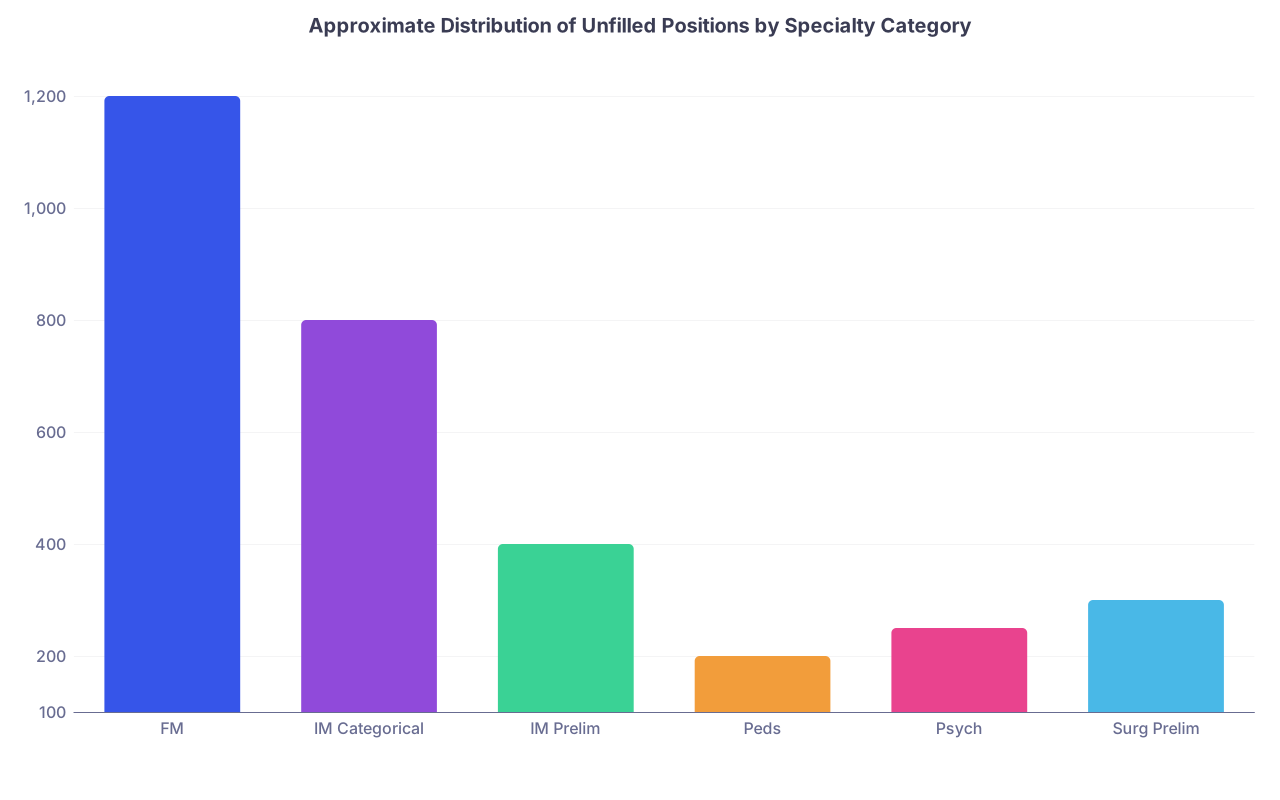
| Category | Value |
|---|---|
| FM | 1200 |
| IM Categorical | 800 |
| IM Prelim | 400 |
| Peds | 200 |
| Psych | 250 |
| Surg Prelim | 300 |
The exact numbers vary every year, but the pattern is stable: primary care, prelim IM, and prelim surgery dominate SOAP.
So if your original specialty was:
Highly competitive (Derm, Ortho, ENT, Plastics, Ophtho, Rad Onc, Urology):
Switching in SOAP to primary care, psych, or prelim IM/Surg is common and often necessary.Moderately competitive (EM, Anesthesia, Radiology, OB/GYN):
You might still match there in SOAP occasionally, but you shouldn’t bank on it. Having a backup SOAP specialty is wise.Less competitive (FM, Peds, IM categorical in many regions):
If you didn’t get many interviews here, the issue is likely your application itself. SOAP may still save you, but a specialty switch won’t magically fix fundamental problems like multiple failures.
So yes, you can switch. But the switch has to be downward in competitiveness and aligned with:
- Your scores and red flags
- Your geographic flexibility
- Your actual tolerance for different types of work (clinic-heavy vs hospital-heavy, nights, procedures, etc.)
4. Should You Switch Specialties in SOAP? A Simple Framework
Here’s the decision framework I use when advising students.
Step 1: Clarify Your Priorities
Be honest: what matters most this year?
Rank these 1–3:
- Match into any residency this year
- Match into a specialty I can plausibly tolerate long-term
- Preserve the chance to reapply to my dream specialty next year
- Stay in a certain geographic region
You can’t have all of them maximized. You just can’t.
If your #1 is “I must match this year,” then switching to a less competitive SOAP specialty or prelim spot is on the table.
If your #1 is “I care a lot more about my eventual specialty than matching this very second,” then a panicked SOAP switch may be a bad move. Especially if you’d be miserable in, say, clinic-heavy primary care.
Step 2: Look at Your Original Specialty
Ask:
- Is it structurally closed to me now? (e.g., 205 Step 2 trying to do Derm—yes, it’s closed.)
- Or was I just unrealistic and sloppy in how I applied?
If it’s structurally closed, then clinging to it for another year likely wastes time and money. Switching in SOAP (or planning a formal pivot next cycle) is rational.
Step 3: Reality-check the Backup Specialty
If you’re thinking “I’ll just SOAP into Psych or FM,” pressure-test that.
- Do you have any exposure? Rotations, elective, shadowing?
- Can you truthfully write a paragraph about why you’d be reasonably happy there?
- Are you okay with the job market, patient population, and typical practice style in that field?
If all your answers are vague or resentful, that’s a red flag.
5. How To Actually Execute a Specialty Switch During SOAP
Let’s say you’ve decided: yes, I’m going to switch. Here’s how to do it intelligently.
5.1 Prepare Before SOAP Week
SOAP week is chaos. You don’t want to be writing your first family med personal statement on Tuesday at 9:30 a.m. while the list is live.
Before Match Week:
Draft a second personal statement for your backup specialty.
It doesn’t need to be poetic. It needs to be:- Plausible
- Honest
- Focused on patient care, your strengths, and experiences that translate (e.g., for EM → IM: acuity, teamwork, critical thinking)
Identify letters you can reuse.
- Generic strong IM or FM letters can usually support a switch between primary care-ish fields.
- A great “sub-I in medicine” letter can be used for IM, FM, Psych, even prelim.
Clarify your target list by competitiveness:
| Priority | Category |
|---|---|
| 1 | IM categorical (any) |
| 2 | FM (any region) |
| 3 | Psych (community) |
| 4 | IM prelim / TY |
You don’t know which specific programs will be open, but you can decide which categories you’ll prioritize if they appear.
5.2 During SOAP: What To Change In ERAS
You cannot rewrite your whole application line by line. You don’t need to.
Focus on:
- Personal Statement: Upload and assign the specialty-specific one to your SOAP programs.
- Program Signaling / Geographic Signals: Not relevant in SOAP—ignore.
- Letters: Assign the ones that best support the new specialty (IM/Peds/FMH attendings over EM/Ortho letters, etc.).
- Experiences: You’re mostly stuck with what’s there, but:
- Reorder entries so that relevant experiences appear higher.
- Make sure descriptions highlight skills valued in the new specialty (continuity of care, communication, mental health exposure, etc.).
5.3 How Many SOAP Applications and To Whom?
You’re limited in SOAP. You can’t just blast 200 programs.
Strategy tips:
- Don’t chase prestige. This is not the time.
- Community programs and those in less desirable locations are more realistic.
- For many applicants switching to a less competitive field, you should use the full allotment of applications. The risk of under-applying here is massive.
6. What If You SOAP Into a Prelim But Not a Categorical Spot?
This is a common outcome for people who switch late or come from a competitive specialty.
You match into:
- Prelim surgery
- Prelim IM
- TY year
Now what?
Conceptually:

| Step | Description |
|---|---|
| Step 1 | Match to Prelim Only |
| Step 2 | Plan to reapply to advanced specialties |
| Step 3 | Consider switching to IM or FM next cycle |
| Step 4 | Use prelim faculty for letters |
| Step 5 | Apply broadly to categorical IM or FM |
| Step 6 | Happy in hospital based fields |
Prelim year gives you:
- A US residency position (you’re in the system)
- A chance to impress faculty and get letters
- Time to reapply more competitively to IM, FM, Psych, Anesthesia, Radiology, etc.
But here’s the trap:
If you hate inpatient work, a prelim surgery year can be miserable. I’ve watched people drag themselves through 80-hour weeks knowing they’ll never do surgery again.
So:
Prelim can be a valid bridge if:
- You’re okay with another Match cycle
- You can handle one tough, uncertain year
- You’re strategically picking prelim IM or TY, which keep doors more open
It’s a bad idea if:
- You’re using it just because “it was the only thing available” and you already know you dislike that environment
7. How To Talk About the Switch Without Sounding Desperate
Programs know SOAP is chaotic. They’re not expecting a lifelong, childhood-dream story.
They’re looking for:
- Coherence: your story should make sense
- Stability: you’re not impulsive or flaky
- Insight: you’ve thought this through
A simple, credible narrative sounds like this:
“I applied to [original specialty] because I genuinely enjoyed [specific aspects]. During my rotations, though, I consistently found myself most fulfilled by [aspect of new specialty—continuity, complex medical management, mental health conversations, etc.]. As I reflected on where I’d be happiest long term, [new specialty] became a better fit.
SOAP has given me the chance to align my training with that realization, and I’m especially interested in your program because of [concrete program feature].”
Notice:
- No melodrama.
- No “I always secretly wanted psych but applied to EM for prestige.”
- Just a rational pivot based on real experiences.
8. When Not To Switch During SOAP
Let me be blunt: sometimes the right move is not to scramble into something you don’t want.
Don’t switch during SOAP if:
- You’d rather take a research year and reapply to your original specialty with a stronger application, and that specialty is still realistically attainable.
- The only open slots are in specialties or locations you know would be a daily grind you’d resent.
- You’re so burned out you’re making decisions from a place of pure panic, not strategy.
You’re allowed to say:
“I’d rather wait one year than commit to 3+ years in a field I know I’ll hate.”
Just make sure that’s a deliberate decision, not avoidance.
9. A Quick Visual: Your Real Options
Here’s a simple way to visualize what you’re deciding between:
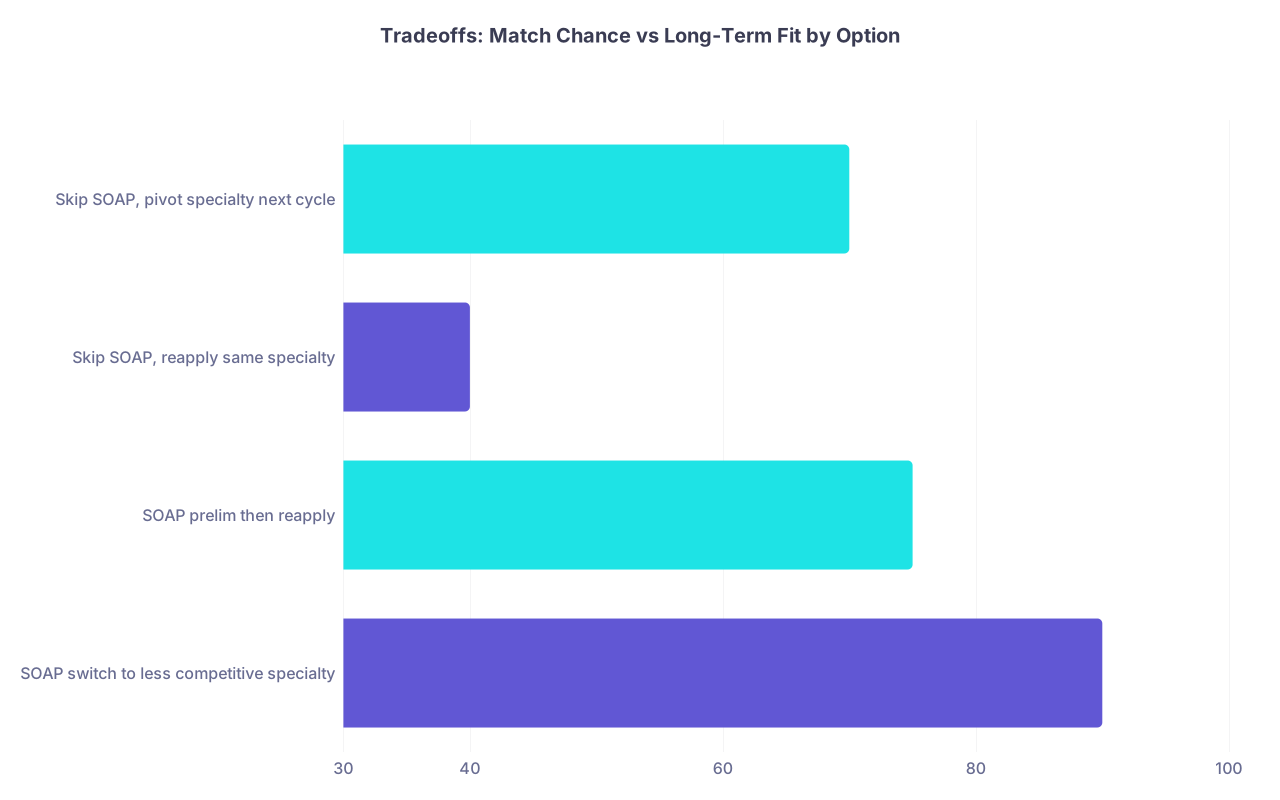
| Category | Value |
|---|---|
| SOAP switch to less competitive specialty | 90 |
| SOAP prelim then reapply | 75 |
| Skip SOAP, reapply same specialty | 40 |
| Skip SOAP, pivot specialty next cycle | 70 |
Interpretation (roughly):
- SOAP switch to a less competitive specialty → highest chance to match this year, uncertain long-term satisfaction.
- SOAP prelim → decent chance this year + second chance next year, but with a hard year.
- Skip SOAP, reapply same specialty → highest long-term fit if that specialty is truly attainable, but risk of never matching at all.
- Skip SOAP, pivot specialty next cycle → more controlled pivot, but costs you a year.
FAQ: Switching Specialties During SOAP With a Weak Interview Season
1. Do programs see which specialty I originally applied to before SOAP?
Not directly in some glaring flag, but they can infer from your experiences, letters, and any previous applications if they dig. In SOAP, they mostly care: are you a reasonable fit for them and are you serious about their specialty?
2. Is it better to SOAP into a prelim year or wait and reapply next cycle?
If you can tolerate a tough year and want to improve your candidacy from inside the system, prelim IM or TY can be powerful stepping stones. If the prelim is in something you despise (e.g., surgical prelim for someone who hates ORs), waiting and reapplying with a focused improvement plan may be better.
3. Will switching specialties during SOAP hurt me if I later try to go back to my original specialty?
It can complicate the story, but it’s not fatal. You’ll just need a clear explanation: what changed, what you learned, and why your original specialty still makes sense after more experience. Strong performance and letters in your new context matter more than the fact of the switch itself.
4. How much do I need to rewrite my personal statement for the new specialty?
Enough so it doesn’t sound like a clumsy “find and replace.” Two or three focused paragraphs about why the new specialty fits you, drawing on real experiences from rotations, is usually enough. You don’t need a brand-new origin story—just a coherent link between who you are and what that specialty values.
5. What’s one concrete thing I should do today if I’m even considering a SOAP specialty switch?
Open a blank document and draft a 1-page personal statement for your most likely backup specialty. If you can’t write a convincing page about why you could see yourself in that field, that’s a signal you either need more exposure—or that switching to that specialty in SOAP may not be the right call.
Today, don’t catastrophize the whole next decade. Just do one thing:
Write down your top two realistic backup specialties and sketch 3 reasons each could actually work for you long-term. If you can’t do that honestly, you’ve got your answer about whether you should really switch in SOAP—or fix your strategy and try again the right way.