
The way most applicants approach SOAP is a disaster. Random programs, blind panic, and zero strategy in the one moment when precision actually matters.
You can do better than that. In one focused hour.
This is a tactical, step‑by‑step guide to building a sharp, targeted SOAP program list in 60 minutes or less. No fluff. Just what to click, what to filter, and how to decide.
The 60‑Minute SOAP List Blueprint
You are under time pressure. So you need a clear structure.
Here is the high‑level 60‑minute plan:

| Step | Description |
|---|---|
| Step 1 | Start - 60 min |
| Step 2 | Collect your stats and constraints |
| Step 3 | Scan SOAP list & pre-filter by reality |
| Step 4 | Score programs with a simple rubric |
| Step 5 | Prioritize and tier your list |
| Step 6 | Sanity check and finalize |
| Step 7 | Export list into your SOAP workflow |
We will walk through each phase with specific actions, time boxes, and what “good enough” looks like.
To make this real, assume:
- You are an IMG with Step 1 Pass, Step 2 CK 226
- One prior US clinical rotation, no US residency attempts
- Interested in IM, FM, Psych, but open to anything non‑surgical
Adjust the details to your situation, but keep the process.
Step 1: Set Your Constraints (10 minutes max)
If you skip this, you will waste your entire hour chasing fantasy options.
1.1 Write down your non‑negotiables
On paper or in a simple text file, list:
- Scores and attempts
- Step 1: Pass / numeric, any failures?
- Step 2 CK: score + attempts
- CS/OTS: Pass/Fail if relevant for older grads
- Graduate year
- YOG (Year of Graduation) and gap years
- Citizenship / visa status
- US citizen/GC / needing J‑1 / requiring H‑1B
- Specialties you are realistically willing to do
- Be brutally honest. Would you actually go to FM in a rural area if that is your only option? Write yes/no for each.
- Geographic hard stops
- Only include true hard stops: spouse career limitations, immigration restrictions, childcare obligations. Not “I don’t like cold weather.”
You want a one‑page “constraints sheet” you can glance at without thinking.
1.2 Define your realistic competitiveness bands
You do not have time for philosophical debates about what is “competitive.” You need a quick self‑sorting.
Use something like this:
| Band | Typical Profile Snapshot |
|---|---|
| Strong | Step 2 CK ≥ 245, no fails, recent YOG |
| Moderate | Step 2 CK 230–244, no fails, ≤5 years YOG |
| Vulnerable | Step 2 CK 220–229 or older YOG or 1 fail |
| High-Risk | Step 2 CK <220 or multiple fails or ≥7 YOG |
Circle your band. Commit to it. This will guide your program filtering.
Step 2: Attack the SOAP Vacancy List Intelligently (15 minutes)
Once the SOAP list drops, you need to move from overwhelm to sorted reality fast.
2.1 Get the list into a workable format
You will usually have:
- NRMP SOAP vacancy list (web or PDF)
- Sometimes program contact details or links
Your first task: make the data sortable.
If allowed and technically feasible:
- Export to CSV or copy‑paste into Excel / Google Sheets
- At minimum, create your own sheet with columns:
- Program name
- Specialty
- State
- ACGME code
- Notes / filters
Do not overbuild. The sheet just needs to be functional and sortable.
2.2 Quick specialty pre‑filter (3–5 min)
You cannot evaluate 300+ programs one by one. You need to nuke half instantly.
Filter the vacancy list by specialty:
- Keep:
- Your target specialties
- Any “backup of last resort” specialties you would truly accept (e.g., prelim internal medicine or transitional year, if that is on your radar)
- Remove:
- Surgical prelims if you have zero surgical profile or interest
- Highly competitive fields where you had no interviews initially (Derm, Ortho, Plastics, etc.), unless you are a truly exceptional candidate
Be ruthless here. A bloated list does not help you. It paralyzes you.
2.3 Apply hard constraints (5–7 min)
Now pass your filtered list against your constraint sheet:
Instant exclusions:
- Programs requiring US citizenship if you only have an F‑1 and no EAD pathway
- Programs explicitly stating “No visas” if you need J‑1/H‑1B
- Programs that do not sponsor your specific visa type if they clearly state that
- YOG cutoffs that exclude you (e.g., “Graduation within 3 years” and you graduated 8 years ago)
You can usually get this via:
- Program website
- FREIDA
- Institutional GME page if their own site is vague
You do not have time to research every program in depth. Use a triage approach:
- If program clearly excludes you → delete
- If unclear but no obvious exclusion → keep for now
By the end of Step 2 you want:
- A cleaned list of vacancies that are at least plausibly open to your profile
- Typically 40–120 programs depending on specialty and the year
Step 3: Use a Simple Scoring Rubric (20 minutes)
This is where most applicants drown. They click endlessly, read full websites, then still cannot decide.
You are going to use a 5‑factor, 0–2 point rubric that takes ~30–60 seconds per program.
3.1 The 5‑factor SOAP feasibility rubric
Each program gets 0, 1, or 2 points per category:
Eligibility fit (0–2)
- 2 = Explicitly IMG‑friendly or clearly accepts your YOG/visa/score band
- 1 = Neutral / unclear but no obvious exclusion
- 0 = Red flags (recently stopped visas, states “strong US grad preference,” extreme YOG cutoff)
Score alignment (0–2)
- 2 = Historical or stated minimums comfortably below or near your scores
- 1 = Slightly above your score but still feasible in SOAP chaos
- 0 = Clearly out of range based on historical data or reputation
IMG / non‑traditional friendliness (0–2)
- 2 = Known high IMG proportion or explicitly lists IMGs on website/roster
- 1 = Mixed signals, some IMGs, not clear emphasis
- 0 = All US MD/DO on current roster, strong academic branding
Geographic feasibility (0–2)
- 2 = You can realistically relocate there without major life damage
- 1 = Not ideal, but you would go if this is the only option
- 0 = True hard stop (e.g., immigration/legal/family constraint, not just “I like big cities”)
Strategic value (0–2)
- 2 = Continuity with your background (e.g., you did an elective at that institution, same region, similar patient population)
- 1 = Neutral but solid training
- 0 = Program is known to be malignant or has ongoing accreditation issues you are not willing to risk
Maximum score: 10.
You are not building perfect science here. You are building relative ranking under time pressure.
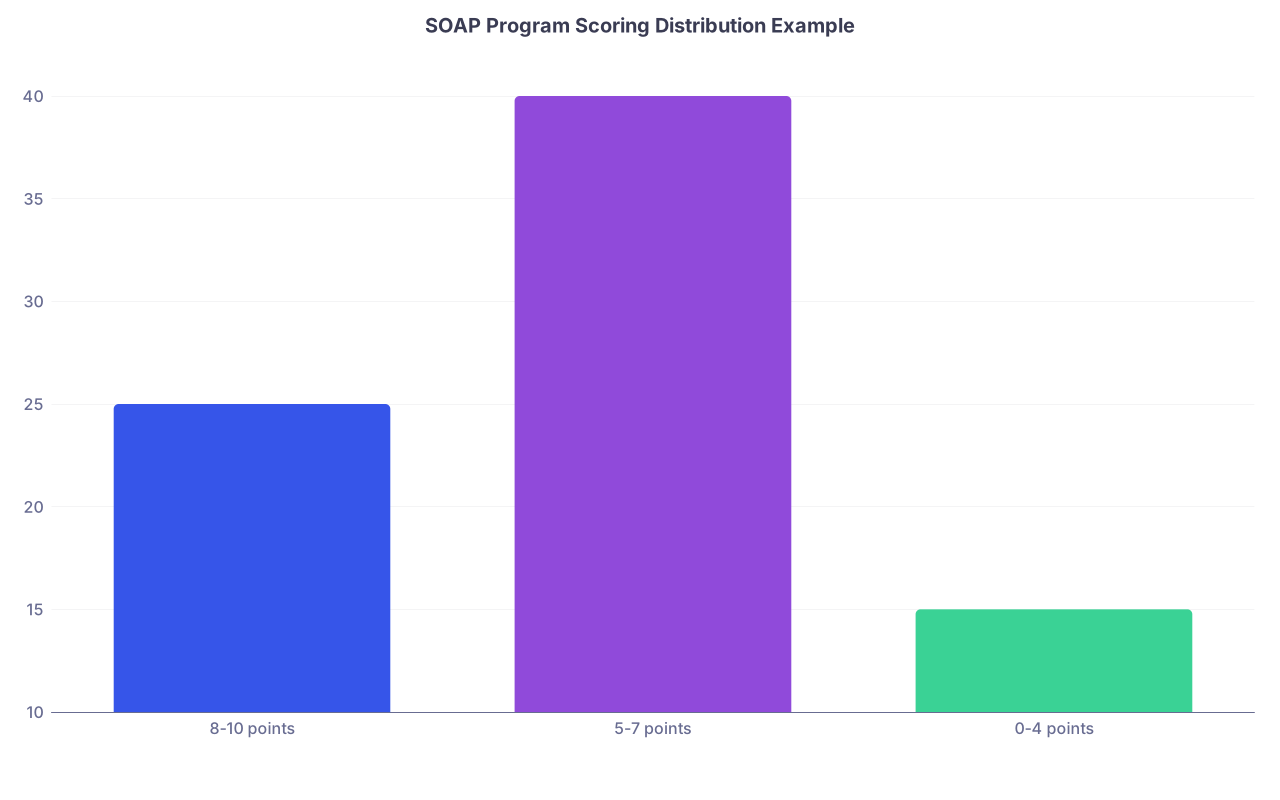
| Category | Value |
|---|---|
| 8-10 points | 25 |
| 5-7 points | 40 |
| 0-4 points | 15 |
3.2 How to move fast through programs
For each program, open:
- FREIDA profile
- Program website (residency page)
- If time: Residency roster / “Current residents” page
Then ask yourself, in this order:
- Any disqualifying criteria mentioned clearly?
- Do I see IMGs or older grads in the current residents?
- Is visa info clear one way or another?
- Do my scores feel in range?
You should be assigning scores in under 60 seconds per program on average. Some will be 20 seconds (obvious yes/no), some 90 seconds (unclear).
Do not agonize over a 6 vs 7. Just pick a number and move on.
3.3 Color‑coding for speed
In your sheet:
- Green = 8–10 total points
- Yellow = 5–7 points
- Red = 0–4 points (these should usually be cut unless SOAP list is tiny)
By the end of this step, you should have:
- A ranked, color‑coded list
- A rough sense of your “strongest bet” programs
Step 4: Build Your Tiered Application List (10 minutes)
Now you convert scores into an actual SOAP application strategy.
Most applicants scatter gun. Equal effort to every program. That is a mistake.
4.1 Create three clear tiers
Use your scores to define tiers:
Tier 1 (Primary targets)
- Score: 8–10
- Typically 15–30 programs
- These are your best statistical bets: good fit, IMG‑friendly, feasible location
Tier 2 (Secondary targets)
- Score: 5–7
- Typically 20–50 programs depending on supply
- Programs where you have a real but lower probability shot
Tier 3 (Stretch / last resort)
- Score: 0–4
- Add only if:
- The SOAP pool is small in your specialty
- Your profile is high‑risk and you truly need volume
You will not treat all tiers equally. Your time and customization go to Tier 1 first.
4.2 Balance depth vs breadth
This is the tension:
- Too few programs = high chance of going unmatched
- Too many with zero customization = you look like noise
In SOAP, there are hard application caps, so you must be efficient.
For most applicants:
- Aim to include as many Tier 1 + Tier 2 programs as your application cap allows
- Only dip into Tier 3 if your Tier 1 + 2 pool is small
If your cap is, say, 45 applications:
- 20–25 Tier 1
- 15–20 Tier 2
- Optional 0–10 Tier 3 if you truly have room and need
Step 5: Sanity Check and Reality Alignment (5 minutes)
This is where you avoid two classic SOAP errors:
- Applying only to aspirational programs
- Or applying only to “any spot anywhere” and ending up somewhere you will later regret or leave
Run through three quick checks.
5.1 Specialty mix check
Look at your final list and ask:
- Does this list reflect what I would actually accept?
If all your Tier 1 programs are in a specialty you are lukewarm about, and your true interest specialty is only Tier 2/3, fix that. You are locking in a path here.
Make sure:
- You would genuinely attend any specialty represented in Tier 1
- Your “would prefer” specialties are not entirely neglected
5.2 Geographic consequences check
Scan the “state” column:
- Any location where you absolutely cannot move for more than a month? Remove it.
- Any cluster that might be logistically helpful (family, friends, prior connections)? Consider bumping those programs up within their score band.
Do not lie to yourself here. If you know you will decline a position for geography alone, you should not apply there in SOAP.
5.3 Risk profile check
Match your competitiveness band to your list:
Strong candidates:
- You can afford a higher proportion of moderate‑reach programs
- But still keep a base of solid IMG‑friendly options
Vulnerable / High‑risk candidates:
- You should heavily favor highly IMG‑friendly, lower‑prestige programs
- A fantasy list of big‑name university programs is how people go unmatched twice
If your profile is vulnerable and half your programs are major university hospitals in large metro areas, you are not being realistic. Fix it now.
Step 6: Lock the List into Your SOAP Workflow (Remaining minutes)
Once the list is built, integrate it into how you will actually apply.
6.1 Create your action columns
In your spreadsheet, add:
- “Applied?” (Y/N)
- “Priority” (1, 2, 3)
- “Personalization notes”
Example personalization notes:
- “Did 4‑week IM elective at same system hospital”
- “Have strong letter from community attending in same state”
- “Fluent in Spanish, large Spanish‑speaking population here”
Those one‑line prompts will help you tweak your application language quickly.
6.2 Decide your sequence of attack
Have a clear sequence for application submission once SOAP opens:
- Submit to all Tier 1 programs first
- Then Tier 2
- Then Tier 3 (if needed)
You do not want to be improvising this while the clock is running and servers are lagging.
6.3 Build quick program‑specific hooks
You will need targeted language for messages, emails, or brief custom text.
For Tier 1 programs, prepare a few “plug‑and‑play” sentences you can adapt:
- One about why that region makes sense for you
- One about how your experience matches their patient population or mission
- One about your readiness to start immediately and commitment to the specialty
You are not writing novels here. Two to three targeted lines can distinguish you from generic applications.
Example: 60‑Minute SOAP List in Practice
Let me walk you through a compressed example so you see the flow.
You:
- IMG, Step 2 CK 224, 2019 grad, need J‑1
- No interviews in main Match
- Interested in IM and FM primarily
Minute 0–10
- Write your constraint sheet
- Needs J‑1
- YOG 2019
- Strong preference but not requirement: East Coast
- Open to IM, FM, prelim IM
You classify yourself as Vulnerable based on the band from earlier.
Minute 10–25
- SOAP list drops
- Filter to IM categorical, FM, prelim IM
- Sweep out obvious impossibilities:
- Programs that state “No visa sponsorship”
- Programs with YOG cutoff at 3 years and you are 5+ years out
- You copy ~90 viable‑looking programs into your sheet
Minute 25–45
- Go program by program, 30–60 seconds each:
- FREIDA: visas? IMGs? YOG language?
- Program site: current residents list?
- Assign 0–2 points for each of 5 factors
- End up with:
- 22 programs scoring 8–10 (Tier 1)
- 41 programs scoring 5–7 (Tier 2)
- 15 programs scoring 0–4 (Tier 3)
Minute 45–55
- Application cap: 45
- Build final target list:
- Take all 22 Tier 1
- Add 23 highest scoring Tier 2 (prefer East Coast and clear J‑1 programs first)
- Do a quick specialty mix check:
- 30 FM, 15 IM/prelim IM
- You are okay with that balance
Minute 55–60
- Add columns for “Applied?” and “Notes”
- Mark Tier 1 as Priority 1, Tier 2 as Priority 2
- Add 1‑line notes to ~10 programs where you have some regional or experiential link
By the end of the hour, you are not guessing. You have a rational, prioritized, reality‑checked list that fits your risk profile.
Common SOAP List Mistakes You Should Avoid
Let me be blunt. These are the traps that burn people every year.
-
- This is not main Match. Your priority is getting accredited training, not chasing brand names that already passed on dozens of stronger candidates.
-
- “We encourage IMGs to apply” on the main page, then in a tiny FAQ: “We do not sponsor visas.” Seen it too many times. Always verify.
Applying to programs you secretly would never attend
- This is how you end up scrambling again next year with a “left after PGY‑1” stigma. Be honest about your bottom line.
Spreading yourself across too many specialties
- IM, FM, Psych, Neuro, Path, TY, prelim Surg… I see people do this in panic. It dilutes your narrative and makes you look unfocused.
Relying on old reputation or gossip alone
- Programs change. New PD, new chair, or new funding can completely alter visa and IMG friendliness. Check current residents, not 2015 Reddit threads.
Quick Comparison: Random vs Targeted SOAP Strategy
| Feature | Random SOAP List | Targeted SOAP List |
|---|---|---|
| Program selection | Any vacancy in your specialty | Filtered by eligibility + fit |
| Time per program | 5–10 minutes aimlessly | 30–60 seconds with rubric |
| Visa/YOG screening | After applying | Before adding to list |
| Chance of true fit | Low | Moderately high |
| Stress level | High, constant second-guessing | High but controlled and focused |
The second column is how people panic themselves into another unmatched year. The third column is what you are aiming for.
FAQ (Exactly 3 Questions)
1. How many SOAP programs should I apply to if my profile is high‑risk?
If you are high‑risk (multiple fails, older YOG, low scores), you should maximize volume within realistic boundaries. That usually means:
- Apply to your full SOAP cap
- Prioritize IMG‑heavy community programs, less desirable locations, and specialties with historically higher fill rates like FM and IM prelims But do not apply to programs that obviously cannot rank you (no visas, hard YOG cutoffs). Those are wasted applications.
2. Should I completely avoid academic university programs in SOAP?
Not automatically. Some university programs are quietly IMG‑friendly, especially in FM and IM. Use your rubric:
- If the roster has several IMGs and visa support is clear, they might be solid Tier 1 or 2 targets
- If the roster is all US MDs, recent YOG, and zero mention of visas, they are probably Tier 3 or a skip for most IMGs
3. How much should geographic preference matter in SOAP?
Less than in main Match, but not zero. The honest rule:
- If you know you will refuse to move somewhere, do not apply there
- If it is merely uncomfortable or unfamiliar, but feasible, include it, especially if you are vulnerable or high‑risk
Residency is temporary. Being unmatched twice is not. Balance those facts when deciding how much geography to sacrifice.
Key takeaways:
- You can build a sharp SOAP program list in under 60 minutes by following a constraint‑driven, rubric‑based process.
- Screening hard for eligibility (visa, YOG, IMG history) and then tiering programs by fit is far more powerful than blind volume.
- Do not lie to yourself: only apply where you are both eligible and truly willing to train. That combination is what actually gets you matched and keeps you there.