
It is Monday of Match Week. You did not match.
You have 90 minutes before the first SOAP application window opens, ERAS is live in another tab, and now you are staring at an “Experiences” section that was written months ago for a completely different audience and a much more optimistic scenario.
Now you are not selling “best-fit future academic dermatologist.”
You are selling “safe, competent, ready-to-work intern who will not make my life harder on July 1.”
Let me break down exactly how to re-tool your ERAS Experiences section for SOAP review — fast, tactical, and specialty-aware.
1. What PDs Actually Look For In SOAP (That’s Different From Main Match)
SOAP is not the main match with worse programs. It is a different market.
Program directors in SOAP have three priorities:
Fill spots quickly with:
- People who will show up.
- People who will not melt down on call.
- People who can write a note, return a page, and not create drama.
Avoid risk:
- No professionalism nightmares.
- No clear inability to function clinically.
- No one who looks like they still think they are “too good” for the program or specialty.
Minimal cognitive load:
- They are scanning dozens to hundreds of applications in hours.
- They are not reading your whole ERAS like a novel.
- They skim top sections, pull out red flags and green flags, and move on.
In SOAP, your Experiences section is not about showing how “interesting” you are. It is about proving three things, over and over:
- You show up.
- You function on a team in a real clinical environment.
- You handle responsibility and follow through.
If an entry does not support one of those, it is either filler or fluff. You do not have the luxury of either.
2. Quick Structural Rules For SOAP-Optimized Experiences
You do not have time to rewrite your entire life story, but you can refactor selectively. Think in terms of triage.
2.1 Priority order for SOAP
For SOAP review, your Experiences should be ordered so the most “reassuring” content is front-loaded.
For almost any SOAP applicant, this order works better than your original “research-first” layout:
Key clinical experiences
- Sub-internships / acting internships
- ICU, ED, busy inpatient rotations
- Any U.S. clinical experience (esp. for IMGs)
Longitudinal roles
- Anything you did consistently for 1+ years
- Employment, longitudinal clinics, ongoing volunteer work
Teaching / leadership that involves responsibility
- Peer tutor, TA, chief of something, coordinator for actual programs
Research (only if it can be framed as work ethic, follow-through, team role — not just abstract science flex)
Other extracurriculars (only if they demonstrate grit, commitment, or something clearly useful to residency)
If you currently have “Research — 12 pubs” at the top and you are SOAPing into Internal Medicine or Family Medicine, that needs to move down. SOAP PDs want reassurance you can function clinically and reliably on day one. Lead with that.
3. How SOAP PDs Read An Individual Experience Entry
Here is what a PD actually sees when they click an experience in SOAP:
- Title
- Organization
- Dates
- Location
- Average hours per week
- The first 2–3 lines of description
They are not counting your verbs. They are asking:
- Does this look real or like resume-padding?
- Did you stick with it long enough to matter?
- Was there responsibility or just attendance?
- Does this fill any of my checkboxes? (clinical, US exposure, teamwork, reliability)
Your job is to make each entry answer those questions clearly, fast.
3.1 Concrete formatting changes (within ERAS limits)
You cannot change the structure of ERAS, but you can optimize how content hits the eye.
For SOAP, each description should:
Open with function, not fluff:
“Acted as primary student on 8–10 inpatient medicine patients daily, writing notes, presenting on rounds, and following up on labs and consults.”Include scope and context:
“Busy 600-bed safety-net hospital with high-acuity internal medicine service.”Show reliability and ownership:
“Consistently arrived early to pre-pre-round and updated sign-out for cross-cover.”Avoid vague words like “exposed to,” “observed,” “gained insight into.” Those are death in SOAP. They read as passive and unimpressive.
Think “what would my senior resident say about me on July 10 based on this experience?” and write that.
4. Rewriting Clinical Experiences For SOAP
This is the most crucial section. If you only have time to update one category, make it clinical / work experiences.
4.1 Anatomy of a SOAP-optimized clinical entry
Let us take a typical pre-SOAP description and fix it. Original:
Sub-Internship, Internal Medicine
- Observed patient care on the inpatient service
- Learned to manage multiple medical problems and coordinate care
- Presented patients on rounds and practiced clinical reasoning
This is what everyone writes. It is technically fine and functionally useless in SOAP.
SOAP rewrite:
Sub-Internship, Internal Medicine – 4th year
- Functioned as primary student for 6–10 general medicine inpatients daily in a 500-bed teaching hospital.
- Wrote full daily progress notes and admission H&Ps, presented on attending and resident rounds, and followed up on labs, imaging, and consult recommendations.
- Participated in cross-cover sign-out, updated problem lists and medication reconciliations, and communicated plan changes with nursing staff and patients.
Now the PD sees: workload, environment, responsibility, communication. All green flags.
4.2 Emphasize SOAP-critical elements explicitly
If you are rewriting for SOAP, prioritize sentences that show:
- Volume and pace:
- “3–4 new admissions per call night.”
- “Managed panel of 70+ clinic patients over the year.”
- Procedural or practical tasks:
- “Performed and documented focused physical exams.”
- “Entered orders under supervision in EMR (Epic/Cerner).”
- Interprofessional communication:
- “Regularly called consult services and discussed patient plans.”
- “Coordinated discharges with case management and social work.”
- Reliability and initiative:
- “Volunteered to stay late to finish admissions when the team was short-staffed.”
- “Frequently identified critical lab abnormalities and alerted the team promptly.”
You are painting a picture of someone who is already thinking and acting like a supervised intern.
5. Non-Clinical Experiences: How To Make Them SOAP-Relevant Or Cut Them
You probably have a mess of other experiences: tutoring, campus leadership, undergrad clubs, research, random volunteer hours.
In SOAP, that stuff is only helpful if you translate it into residency-relevant attributes. Otherwise it is just word-count.
5.1 Quick rule: keep, reframe, or delete
Use this triage rule for every non-clinical experience:
- KEEP if:
- It shows reliability, commitment, or responsibility (job, long-term role, consistent volunteering).
- It clearly aligns with the specialty you are SOAPing into (e.g., community outreach for FM, psych hotline for Psych).
- REFRAME if:
- It is currently written as “fun story” or “impact narrative” but actually shows persistence / organization / teaching.
- DELETE or minimize if:
- It is a one-off, 1–2 month thing with no clear responsibility.
- It looks like fluff to pad your CV.
You are no longer optimizing for “broadly impressive.” You are optimizing for “this person will be fine on nights in November.”
5.2 Example: turning a generic volunteer entry into a SOAP asset
Original:
Volunteer, Student-Run Free Clinic
- Volunteered at student-run clinic providing free care to underserved patients.
- Helped with intake and education.
- Developed strong interest in primary care.
SOAP rewrite:
Clinical Volunteer, Student-Run Free Clinic
- Completed weekly 4-hour shifts for 18 months at an urban student-run free clinic serving predominantly uninsured adults.
- Performed patient check-in, obtained focused histories and vitals, updated medication lists, and presented to supervising residents and attendings.
- Provided patient education on chronic disease management (diabetes, hypertension), and coordinated follow-up appointments and referrals.
Now it reads as continuity, clinical interaction, and responsibility.
6. Adjusting Experiences Based On SOAP Specialty Targets
You might be SOAPing into a specialty you did not originally prioritize. Your Experiences section should be clearly compatible with that specialty’s culture and concerns.
6.1 For Internal Medicine / Preliminary Medicine
They want to see:
- Inpatient experience, complexity, and volume.
- Comfort with sick patients and multi-morbidity.
- Longitudinal follow-through (research or longitudinal clinics OK if framed right).
Emphasize:
- ICU / CCU exposure.
- Sub-Is on medicine.
- Any QI, handoff, or documentation-heavy roles.
- Team communication with consultants and nursing.
Downplay:
- Purely niche procedural stuff unless it shows discipline and focus.
- Overly “academic” descriptions that sound like you are just passing through IM on the way to something more “elite.”
6.2 For Family Medicine
They want:
- Continuity, communication, patient relationships.
- Outpatient clinic work, preventive care, community involvement.
- Evidence you can handle broad, sometimes messy psychosocial situations.
Emphasize:
- Longitudinal clinics, free clinics, primary care electives.
- Community outreach, health fairs, education programs.
- Any mental health, addiction, or social medicine exposure.
Rewrite your basic science research to emphasize transferable skills: communication, team-based work, long-term project follow-through. Not “bench science all day, no people.”
6.3 For Psychiatry
They worry about:
- Your own stability and maturity.
- Communication, insight, professionalism.
- Experience with vulnerable populations and interdisciplinary teams.
Emphasize:
- Work with crisis lines, shelters, addiction programs.
- Case management-type roles, social work collaboration.
- Any formal or informal mentorship roles.
Cut or trim:
- Overemphasis on ultra-competitive surgical goals that scream “psych is backup.”
- Experiences that look chaotic or poorly explained (especially anything around leaves of absence or professionalism — those need tight, factual framing elsewhere, not here).
6.4 For Surgery / Prelim Surgery
In SOAP, surgical PDs are bluntly scanning for:
- Work ethic.
- Ability to live in the hospital for large chunks of time.
- Not being a liability in the OR or on call.
Emphasize:
- Early OR days, pre-rounding, long shifts.
- Call nights, cross-cover, managing multiple active issues at once.
- Procedural comfort and technical attention to detail.
The subtext you want: “This person can grind and not fall apart.”
7. Hours, Dates, And Continuity: Cleaning Up The Skeleton
SOAP PDs are hypersensitive to gaps, weirdly short roles, and inflated hours. They are not stupid; they have seen every trick.
7.1 Fix obviously inflated or inconsistent hours
If you logged “40 hours/week” for five different roles simultaneously as a full-time MS3, that looks fake. In SOAP, fake = risk.
You want your hours to:
- Be realistic compared to your phase of training.
- Match your transcripts and timeline roughly (no one is measuring, but glaring contradictions hurt you).
- Show some roles that are truly longitudinal, not just bursts.
If you must adjust hours during SOAP week:
- Decrease unrealistic numbers rather than increase small ones.
- Better to have “3–5 hours/week” over 2 years than “20 hours/week” over 1 month of “intense” involvement.
7.2 Fix scattered, short experiences
You cannot erase history, but you can make it coherent.
If you have multiple short roles in similar settings, consider:
- Making sure the descriptions explicitly show why each was distinct (not just “I flaked and left”).
- Highlighting the one you stayed with the longest and trimming descriptions for the short ones.
Continuity signals maturity and reliability. SOAP PDs want that more than breadth.
8. Red-Flag Management Inside Experiences
You might have problem areas:
- Failed Step(s) / delayed graduation.
- Leave of absence.
- Changed specialty interest late.
The Experiences section is not where you explain these in detail (that is for your SOAP-specific personal statement or the “Additional Info” box), but you must avoid making things worse.
8.1 Do not oversell to cover a weak area
The temptation: “If I make this research gig sound like I was running the lab, they will forget my Step 1 failure.”
They will not. Instead, you will look dishonest.
Better approach:
- Be concrete about what you actually did.
- Add one line that quietly shows growth or reliability.
Example:
- Joined project after repeating MS2; completed data collection, organized REDCap database, and coordinated weekly check-ins with PI and team.
You acknowledged a timeline subtly and emphasized follow-through. That is actually more reassuring than pretending the gap did not exist.
8.2 Align your experiences with your new “story”
If you SOAP into a different specialty than your original plan, your Experiences need to look at least compatible with this pivot.
No, you cannot pretend you never wanted ortho. But you can:
- Emphasize the medicine, teamwork, and continuity elements within those surgical experiences.
- Highlight earlier broad clinical experiences that show you were always interested in patient care, not just procedures.
Example: Orthopedic research entry rewritten for FM SOAP:
Original:
- Conducted outcomes research on ACL reconstruction techniques.
SOAP rewrite:
- Contributed to outcomes research on ACL reconstruction, focusing on functional recovery and long-term pain control, which reinforced my interest in longitudinal patient follow-up and rehabilitation.
You are not lying. You are reframing the emphasis.
9. Before-And-After Makeover: Full Entry Set Example
Let me show you a concrete transformation. A typical M4 going into SOAP for IM.
9.1 Pre-SOAP version (for a competitive IM match)
Clinical Experience – Sub-Internship, Internal Medicine
- Observed complex patient care and learned to manage multiple chronic conditions.
- Gained experience in presenting patients and formulating differential diagnoses.
Research – Cardiology Outcomes Research
- Conducted retrospective chart reviews and collected data.
- Presented poster at regional conference.
Volunteer – Student-Run Free Clinic
- Volunteered at weekly clinic providing care to underserved patients.
Leadership – Internal Medicine Interest Group President
- Organized events and talks to promote interest in internal medicine.
9.2 SOAP-optimized version for IM SOAP
Clinical Experience – Sub-Internship, Internal Medicine
- Functioned as primary student for 7–9 general medicine inpatients daily at a 550-bed teaching hospital.
- Wrote daily progress notes and admission H&Ps, presented on resident and attending rounds, and followed up on labs, imaging, and consult recommendations.
- Participated in cross-cover sign-out and updated problem lists, medication reconciliations, and discharge plans in coordination with nursing and case management.
Clinical Experience – Medicine Clerkship (Core Rotation)
- Completed 8-week core internal medicine rotation on general medicine and step-down units.
- Managed 4–6 patients per day under supervision, documenting notes in EMR, placing draft orders, and calling consult services with the resident.
- Regularly communicated plans with patients and families, including discussing new diagnoses and medication changes.
Volunteer – Student-Run Free Clinic (Longitudinal)
- Completed weekly 4-hour shifts for 18 months at an urban student-run free clinic serving predominantly uninsured adults.
- Performed initial intake (history, vitals, medication lists), presented to supervising residents/attendings, and documented in clinic EMR.
- Provided patient education on chronic disease management (diabetes, hypertension) and scheduled follow-up visits to ensure continuity.
Research – Cardiology Outcomes Research
- Collected and managed data for a retrospective study of readmission rates after heart failure hospitalizations, working closely with cardiology attendings and residents.
- Coordinated with nursing and case management to understand discharge planning factors included in the analysis.
- Presented a poster at a regional meeting, summarizing findings on transitions of care and their impact on 30-day readmissions.
Leadership – Internal Medicine Interest Group President
- Organized monthly residency panels and case-based teaching sessions attended by 20–40 students.
- Coordinated logistics with faculty, residents, and administrative staff, and managed scheduling and communication.
- Mentored junior students on clinical rotation preparation and expectations.
Same person. But the SOAP version screams: This applicant understands wards, follow-through, and team communication.
10. Tactically Using Time During SOAP Week To Edit Experiences
You do not have infinite time. The SOAP clock is brutal. Here is a realistic priority sequence for updates.

| Step | Description |
|---|---|
| Step 1 | Start - Did not match |
| Step 2 | Identify SOAP specialties |
| Step 3 | Reorder experiences - clinical first |
| Step 4 | Rewrite top 5 clinical entries |
| Step 5 | Fix hours and obvious red flags |
| Step 6 | Reframe 3-4 key nonclinical roles |
| Step 7 | Spot-check for specialty alignment |
| Step 8 | Stop - Submit applications |
10.1 If you have 2–3 hours total
Do this, in order:
- Reorder experiences so the first 5–7 are:
- Clinical rotations, sub-Is, meaningful clinical volunteering, employment.
- Rewrite descriptions for your top 3–5 clinical entries to hit:
- Volume, responsibility, communication, follow-through.
- Quickly adjust any obviously inflated or bizarre hours/week.
- Remove or downsize obviously fluff experiences.
10.2 If you have 1 day
Add:
- Reframe 3–4 nonclinical roles to show reliability and team skills.
- Specialty-tune phrases based on what you are SOAPing into (FM vs IM vs Psych, etc.).
- Make sure your Experiences content does not contradict your SOAP personal statements.
11. Quick Comparison: Pre-SOAP vs SOAP-Ready Experience Profiles
| Feature | Pre-SOAP Profile | SOAP-Optimized Profile |
|---|---|---|
| Order of entries | Research / leadership first | Clinical + longitudinal first |
| Description style | Vague, “learned” / “exposed” | Concrete, workload- and task-focused |
| Hours/week | Inflated or inconsistent | Realistic, defensible |
| Nonclinical activities | Many short, scattered entries | Fewer, clearly tied to reliability/skills |
| Specialty alignment | Tailored to stretch/competitive goals | Tailored to SOAP target specialties |
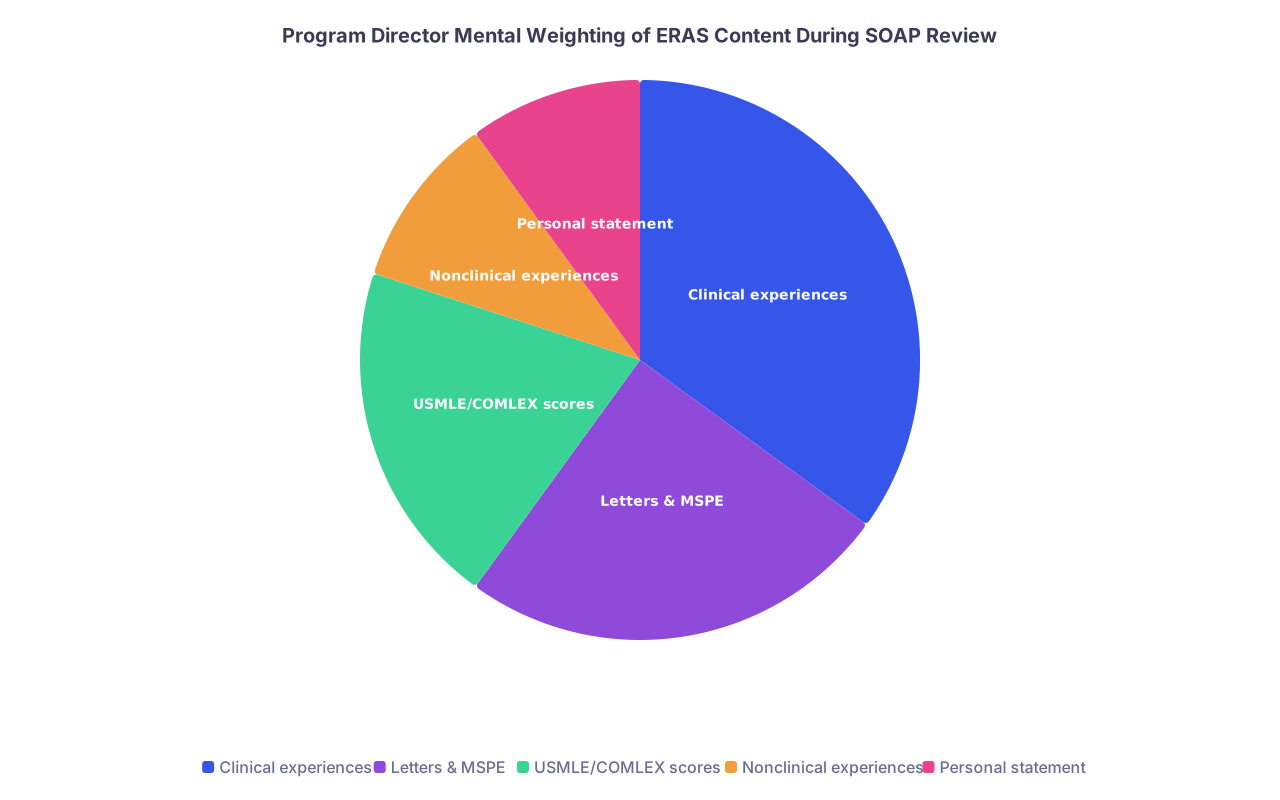
12. Visual: How PDs Mentally Score Your Experiences In SOAP
Not formal scoring. Just mental buckets.
| Category | Value |
|---|---|
| Clinical experiences | 35 |
| Letters & MSPE | 25 |
| USMLE/COMLEX scores | 20 |
| Nonclinical experiences | 10 |
| Personal statement | 10 |
Your clinical experiences are a big chunk of the fast decision. That is why this section is worth the time.
13. Do Not Forget Tone: You Are Applying For A Job, Not A Scholarship
SOAP is hiring season under pressure.
Your Experiences should make you read like:
- A future coworker.
- A stable worker in a high-stress environment.
- Someone who solves more problems than they create.
Not:
- A future star academic with minimal interest in bread-and-butter work.
- Someone still sulking about not getting Derm or Ortho.
- A person whose experiences are all about “me, my passion, my growth” with no evidence of responsibility.
You do not need to write “I am humble” anywhere. You just need to describe actual, unglamorous work you have done — clearly.
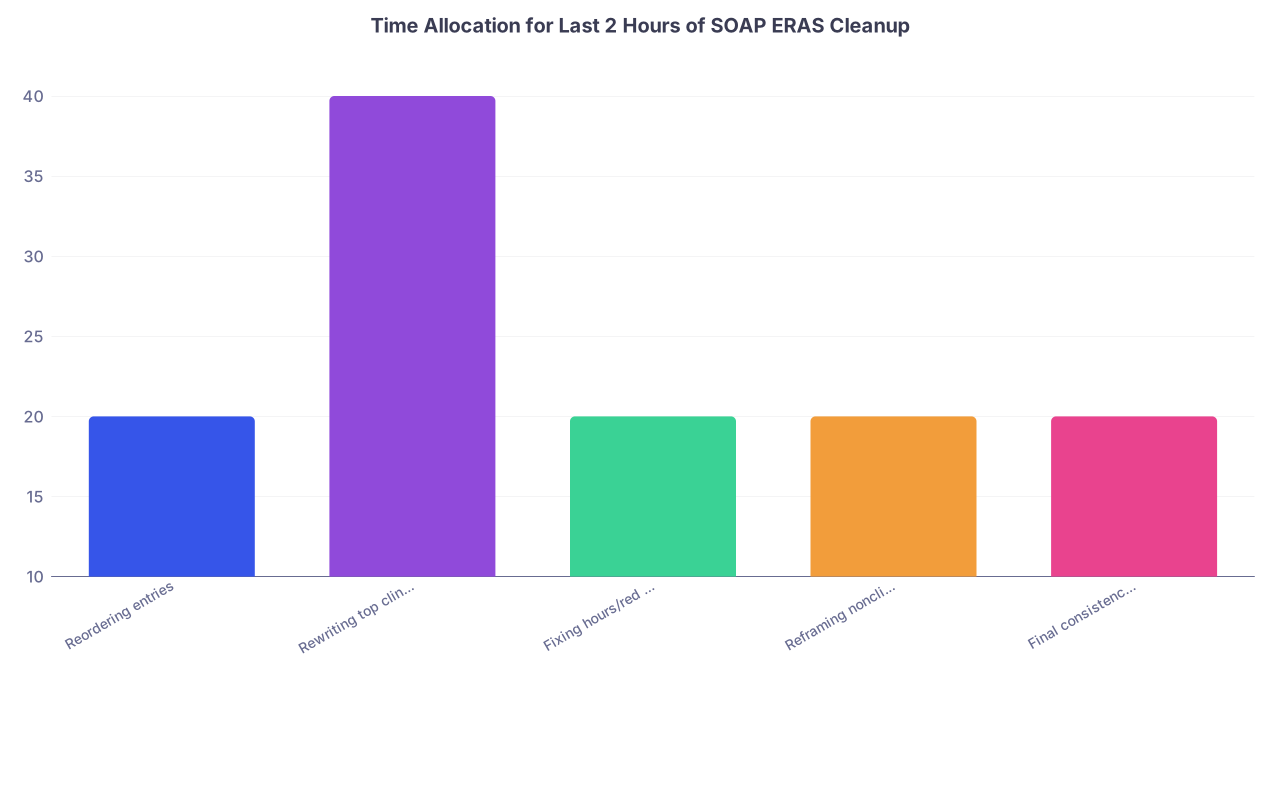
14. Final Pass Checklist Before You Hit Submit
Last 20–30 minutes, run through this checklist.
| Category | Value |
|---|---|
| Reordering entries | 20 |
| Rewriting top clinical experiences | 40 |
| Fixing hours/red flags | 20 |
| Reframing nonclinical roles | 20 |
| Final consistency check | 20 |
Ask yourself:
- Are my first 5–7 experiences clearly clinical or longitudinal and obviously real?
- Do my clinical descriptions show:
- Patient load?
- Notes / documentation?
- Communication with teams and patients?
- Do any experiences look like resume-padding? If yes, either cut or shrink them.
- Does the tone match the specialty I am SOAPing into?
- Do my hours and dates look plausible?
If you can honestly answer “yes” to most of that, you are in much better shape than when you started.
15. Key Takeaways
- In SOAP, your Experiences section must scream: “reliable, clinically functional, low-risk intern,” not “interesting future subspecialist.”
- Lead with concrete, high-responsibility clinical and longitudinal experiences; rewrite descriptions to emphasize workload, responsibility, and communication.
- Trim fluff, fix obviously inflated hours, and reframe nonclinical entries to highlight reliability and team skills, aligned with your SOAP specialty targets.