
You’re in the SOAP. It’s Monday afternoon. You didn’t match, your interview list was already thin, and now you’re staring at the unfilled positions list wondering:
“Do I cold-email program directors right now, or will that just annoy them and hurt me?”
Let me answer the core question first, then we’ll unpack nuance.
Short answer:
Emailing PDs during SOAP very rarely helps, and yes, it can backfire if you do it wrong.
Done strategically and sparingly, it can help in very specific scenarios. Mass-blasting PDs? Bad idea.
Let’s go step by step.
1. What PDs Are Actually Doing During SOAP (Not Your Fantasy Version)
Picture the PD side, because that’s the only perspective that matters here.
During SOAP, many PDs and coordinators are:
- Refreshing ERAS lists constantly
- Reviewing hundreds of applications in a compressed window
- Meeting with their team to identify “must interview / maybe / no”
- Calling candidates, scheduling rapid-fire interviews
- Updating GME, HR, hospital leadership on numbers
They are not sitting around waiting for heartfelt emails from applicants.
Most PDs I know filter their SOAP decision-making through one primary lens:
“Can this person safely and reliably function as an intern in July, with minimal drama?”
Anything that feels like noise, entitlement, neediness, or chaos goes straight to the mental trash bin.
So where does your email land? Usually as one of these:
- Noise they ignore
- A mild negative (annoyance)
- A small positive only if it’s sharp, relevant, and adds something they’d actually care about
Your baseline assumption should be: They will judge you more by your ERAS file and your interview than by your email.
2. When Emailing PDs During SOAP Actually Makes Sense
There are scenarios where emailing is reasonable and can help a little.
Use email only if you can honestly check one of these boxes:
You have a strong, specific connection to that program or region
Example: You grew up 20 minutes from the hospital, did a sub-I there, or have a spouse already working in that city.You already interacted with them earlier in the season
Example: You interviewed there in the main Match, were waitlisted, or had meaningful communication with the PD or APD.You have materially new information that changes your application strength
Example: Passed Step 2 CK after prior failure, new visa approval, important professionalism issue resolved, or a major red flag clarified.
If none of those apply, your email is mostly a generic “please notice me.” That’s weak leverage.
Here’s what I’ve actually seen work:
Applicant did a sub-I at a program, had strong written comments, didn’t match. During SOAP, they sent a short email to the PD and coordinator: “I’m very interested in your unfilled position, I’ve submitted via ERAS, and I’d be honored to interview.” That program interviewed them and ultimately offered a contract.
Applicant had a Step 2 CK pass come in during SOAP after a previous failure. They emailed 3–4 targeted programs where they’d already had some contact. That update moved them from “maybe” to “interview” at one program. That’s a win.
Notice the pattern: targeted, relevant, and additive. Not desperate spam.
3. When Emailing PDs Backfires
Yes, it can absolutely backfire. Not always dramatically, but enough to nudge you from “maybe” to “no.”
Here’s when I’ve seen it hurt:
Mass, obviously copy-paste emails to 40+ programs
PDs talk. Coordinators talk even more. If your email is generic and poorly tailored, it screams:
“I’m emailing everyone. You are not special. I am panicking.”
That’s not the energy you want associated with your name.Tone-deaf or entitled messaging
Examples that annoy PDs:- “I would be an asset to your program and deserve a chance.”
- “I was very surprised not to receive an interview earlier.”
- “Please reconsider my application urgently.”
You do not want to sound like extra work or a future complaint letter.
Overly emotional or oversharing
Long trauma narratives. Apologies paragraphs long. Blaming prior programs, schools, or systems.
SOAP is not your personal statement 2.0. It’s triage. PDs don’t have time for emotional essays.Multiple follow-up emails when they don’t respond
One email = fine.
Two emails = pushing it.
Three emails = “This person may be a problem.”
Remember, non-response is a response.Bypassing the official SOAP process
Some applicants try things like:- Asking for an offer outside ERAS
- Pushing for guarantees
- Hinting they’ll rank the program #1 if they get an unofficial promise
That’s not just unprofessional; it’s sometimes a violation of NRMP rules. Programs hate that.
So yes, done badly, emailing PDs can backfire. Most commonly as a subtle negative impression, not a dramatic blacklist—but in SOAP, subtle negatives can cost you a spot.
4. Decision Framework: Should You Email or Not?
Here’s the blunt framework I use with applicants.
Step 1: Identify only truly justifiable targets
If a program is on your SOAP list, ask yourself:
Would I be able to write three specific reasons this program makes sense for me, beyond “I want a job”?
- Real geographic tie (family, spouse, prior schooling there)
- Prior rotation / interview / meaningful interaction
- Strong fit with your background (e.g., FM with strong underserved focus, and your whole CV is community health)
If you can’t do that, skip the email. Let your ERAS file speak.
Step 2: Limit the number
A reasonable range during SOAP: 3–10 programs.
Beyond that, your messaging usually becomes generic.
If you feel the urge to email 30+ programs, that’s a reflection of anxiety, not strategy.
Step 3: Ask what your email adds that ERAS doesn’t already show
Good added value looks like:
- Clear statement of interest: “Your program is my top choice among SOAP options for X and Y reasons.”
- Clarification: “I had a prior Step 1 failure; I’ve since passed Step 2 and completed X months of rotations without concern.”
- Availability: “I’m available for interviews immediately and can start on time without visa or relocation barriers.”
If your email does not add anything concrete, you probably don’t need to send it.
5. How to Write an Email That Helps Instead of Hurts
Here’s the structure I recommend. Keep it short. Think 5–8 sentences.
Subject line options (keep it simple):
- “SOAP Applicant – [Your Name], [Specialty]”
- “Interest in Unfilled [IM/FM/etc] Position – [Your Name]”
Who to send it to:
- Program coordinator
- Program director (optional, CC, not BCC)
- Use the addresses from the program website or ERAS listing
Template you can adapt:
Dear Dr. [Last Name] and [Mr./Ms. Last Name],
My name is [Full Name], and I am a SOAP applicant who has applied to your [Specialty] residency position through ERAS. I am very interested in your program because of [1–2 specific reasons: geographic tie, prior rotation, underserved focus, etc.].
Briefly, my background includes [1–2 strengths: school, Step 2 pass, strong clinical evaluations, prior sub-I there if relevant]. I would be honored to be considered for an interview and am available immediately by phone or video.
Thank you for your time and consideration.
Sincerely,
[Full Name, AAMC ID, Phone]
Note what this doesn’t do:
- It doesn’t demand a response
- It doesn’t ask “why didn’t you interview me before”
- It doesn’t oversell
- It doesn’t write a second personal statement
You’re putting your name gently in the front of their brain, not banging on the door.
6. What Usually Helps You More Than Email During SOAP
This is where many applicants waste energy. They obsess over messaging PDs and ignore higher-yield actions.
Higher-yield than email, almost always:
- Expanding your SOAP list intelligently to more programs (especially community, less competitive regions, prelim spots if appropriate)
- Getting your advisors to reach out on your behalf to 1–3 places where you have a real shot
- Making sure your ERAS application is as clean as possible: updated Step scores, clear explanation of leaves or gaps, concise experiences
- Being glued to your phone and email during SOAP interview windows
- Practicing a tight, confident SOAP interview script: “Why did you not match?” and “Why this program?”
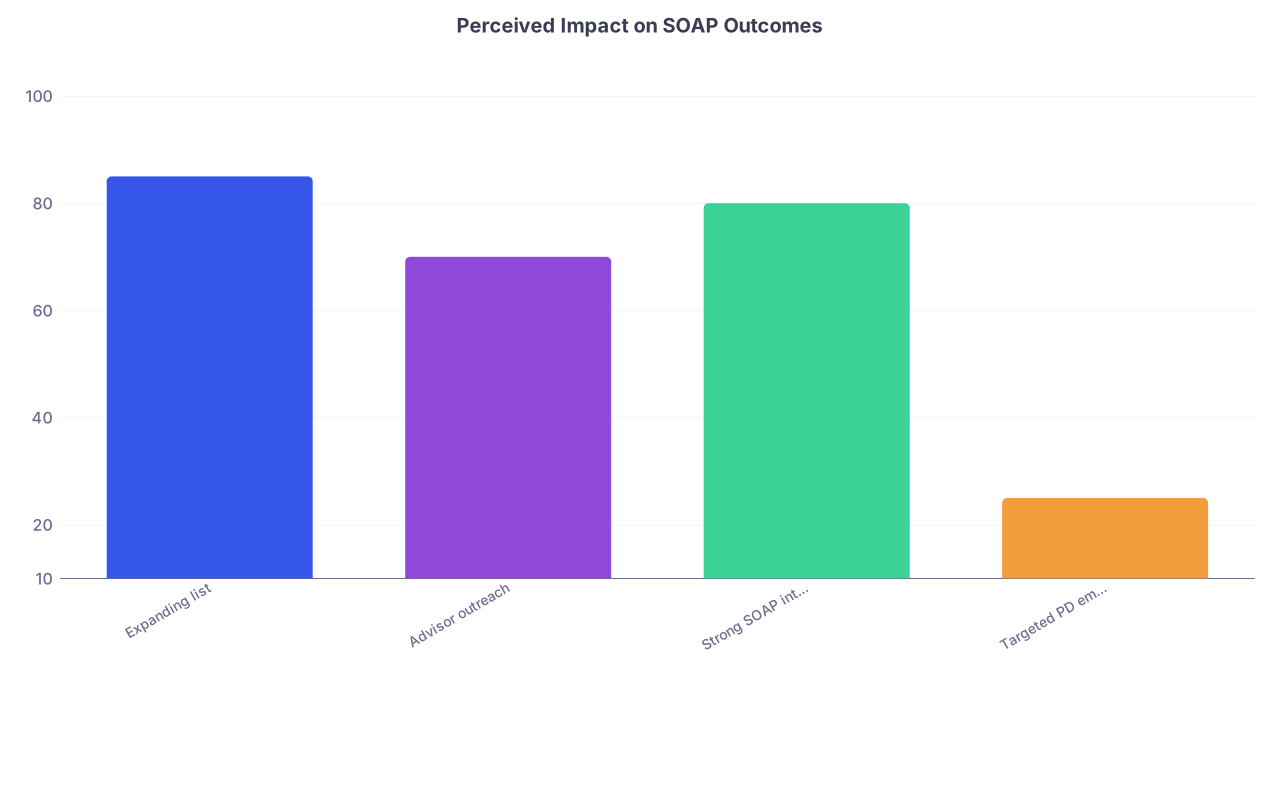
| Category | Value |
|---|---|
| Expanding list | 85 |
| Advisor outreach | 70 |
| Strong SOAP interview | 80 |
| Targeted PD emails | 25 |
You’ll notice I’m not saying “never email.” I’m saying: don’t confuse emailing with a primary strategy. It’s a side dish, not the main course.
7. Strategically Using Advisors and Faculty Instead of You Emailing
One more angle most students underuse.
A short email or call from:
- Your clerkship director
- Your home residency PD
- A faculty who knows you well
…often carries more weight than anything you send yourself.
Something like:
“We have an unmatched student, [Name], who is very interested in your program. I’ve worked with them directly in [rotation]. They are reliable and work hard, and I think they’d do well in your program.”
That’s it. No drama, no begging. Just a quiet nudge.
If you’re going to ask for this kind of help, give your faculty:
- Your updated ERAS
- Your short target list (3–5 programs, max)
- A 2–3 sentence summary of your story and strengths
Then step back and let them decide if and how to reach out.
8. Quick Comparison: When Email Helps vs Hurts
| Scenario | Likely Impact |
|---|---|
| Targeted email to prior rotation site | Small positive |
| Generic email to 40+ programs | Small negative |
| Short update with important new info | Neutral to small positive |
| Emotional, long narrative email | Negative |
| One polite, specific email | Usually neutral |
| Multiple follow-ups after silence | Negative |
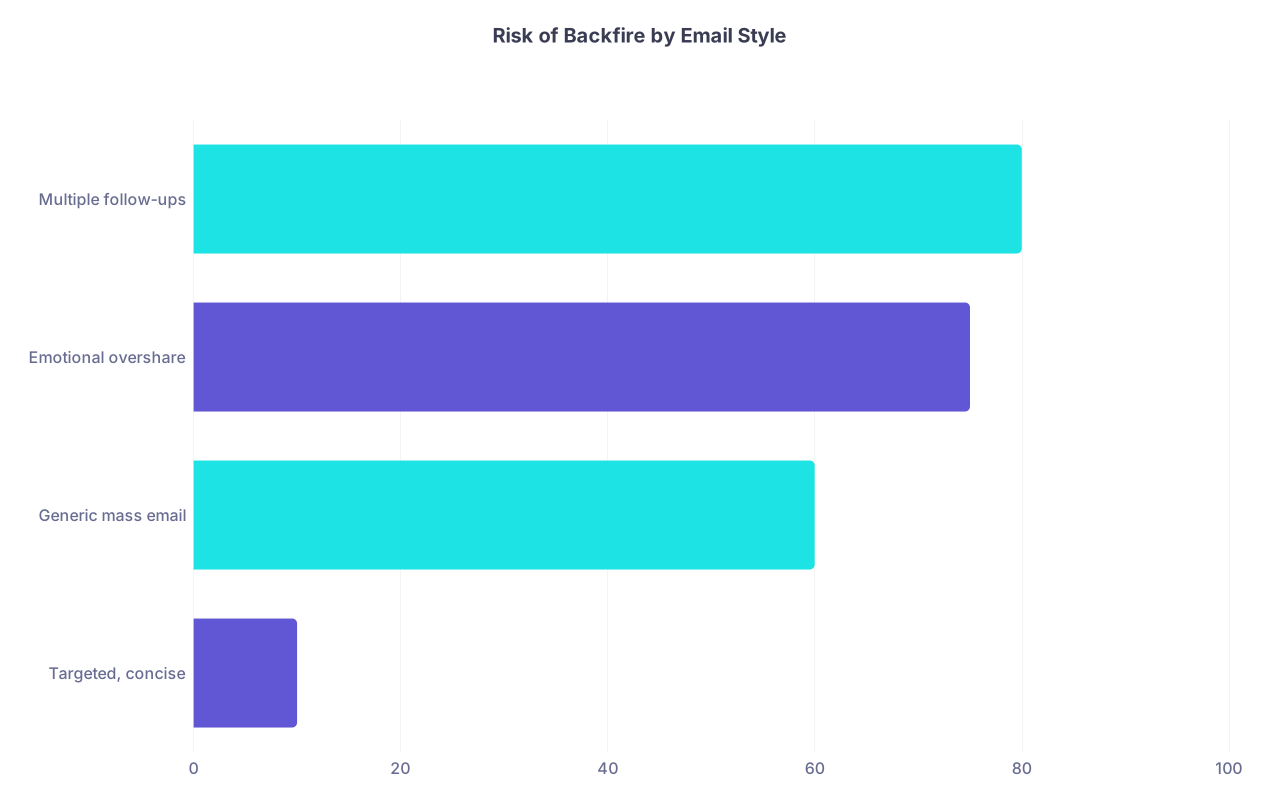
| Category | Value |
|---|---|
| Targeted, concise | 10 |
| Generic mass email | 60 |
| Emotional overshare | 75 |
| Multiple follow-ups | 80 |
9. Practical Playbook: What I’d Tell You to Do This Week
If you were my advisee, here’s the play:
- Build your SOAP list as broadly and intelligently as you can justify.
- Identify a small list (3–10) of programs where you legitimately have:
- A geographic tie,
- Prior relationship, or
- Clear mission fit.
- Draft one clean, concise email template and customize 2–3 lines per program.
- Send these once, during an appropriate SOAP window (early enough they might still be reviewing files, not mid-offer).
- Ask 1–3 faculty/advisors if they feel comfortable reaching out to 1–2 of your top realistic programs.
- Then stop fiddling. Focus on:
- Being reachable,
- Preparing for short-notice interviews,
- Having a clear, honest, non-defensive explanation of why you didn’t match and why you’re safe as an intern.
And remember: silence from programs is not a verdict on your worth as a physician. It’s a combination of numbers, timing, geography, and program risk tolerance. Don’t take it personally in the moment; use it as data later.


| Step | Description |
|---|---|
| Step 1 | Considering emailing PDs |
| Step 2 | Do not email |
| Step 3 | Limit to 3-10 programs |
| Step 4 | Write short targeted email |
| Step 5 | Send once |
| Step 6 | Prepare for interviews |
| Step 7 | Specific tie or new info? |

FAQs: Emailing PDs During SOAP
Does emailing PDs during SOAP improve my chances of getting an interview?
Sometimes, but only a little and only if it’s targeted. A short, specific email to a program where you have a real tie or update can nudge you from “unknown” to “maybe.” For most programs, your ERAS file and timing matter much more than your email.Can emailing PDs during SOAP hurt my chances?
Yes. Mass, generic, emotional, or persistent emails can make you look unprofessional, desperate, or difficult. That can move you from “maybe” to “no,” especially when programs are already drowning in applicants.How many PDs is reasonable to email during SOAP?
A reasonable range is 3–10 programs. Beyond that, your messaging gets generic and insincere. If you feel the need to email 30+ PDs, you likely need a better SOAP application strategy, not more emails.Should I email programs even if I have no connection to them?
Usually no. If you can’t name a real tie (location, prior rotation, mission fit) or share a meaningful update, your email is just noise. In those cases, rely on your ERAS application and spend your energy on interview prep instead.What should I absolutely avoid writing in a SOAP email?
Avoid blaming other programs, expressing entitlement, writing long emotional stories, or asking why you weren’t interviewed previously. Don’t hint at rule-breaking offers or push for special treatment. One concise, professional email is enough.Is it better for my advisor to email the PD instead of me?
Often yes, if they truly know you and are willing to vouch for you honestly. A brief note from a respected faculty member saying, “This student is solid; please take a look at their file,” can be more influential than anything you write yourself.What’s more important than emailing during SOAP?
Building a broad but realistic SOAP list, having a clean and updated ERAS, answering your phone and email immediately, and preparing tight, confident responses for SOAP interviews. Those factors move the needle far more than whether you emailed a PD.
Key points to walk away with:
- Emailing PDs during SOAP is a minor tool, not a main strategy. Use it sparingly, only where you have a real connection or update.
- Done badly—mass, emotional, or pushy—it can backfire and hurt you.
- Your time is better spent on a smart SOAP list, advisor outreach, and being absolutely ready when the phone finally rings.