
Your letter of recommendation problem is not “I need more letters.” Your problem is that you are playing a pre-SOAP game in a SOAP reality.
If SOAP is your only realistic path, the LOR strategy you used for the main Match is probably wrong for what you are about to face. SOAP is fast, brutal, and deeply constrained. You do not need “the best” letters in the abstract. You need the right letters configured the right way for a 72‑hour fire drill.
Let me walk you through this like I would with a borderline applicant sitting in my office the week before rank list certification. Because I have seen people salvage careers in SOAP purely because they understood how to weaponize their existing letters. And I have seen candidates with objectively stronger CVs fail because their LOR setup was rigid and naïve.
1. First, Be Honest: Are You Actually in SOAP Territory?
Before you touch a single letter, you need to admit where you stand.
Typical SOAP‑probable situations I see:
- 0–3 interviews total, mostly “courtesy” or prelim invites
- Failed or just‑passed Step 1/COMLEX 1 and a marginal Step 2, especially for IM, FM, peds, psych
- Prior failures, leaves of absence, or professionalism flags
- Caribbean/IMG with weak home support and no strong US clinical anchors
- Applied to highly competitive specialties with no realistic backup (e.g., 8 derm interviews and nothing else)
If you recognize yourself in those bullet points, you should assume SOAP is your main path, not some distant worst case.
That changes your LOR strategy in three concrete ways:
- You optimize flexibility and breadth, not perfection.
- You prioritize letters that can be repurposed across adjacent specialties.
- You prepare your letter bank and ERAS structure for rapid reconfiguration on Monday of SOAP.
You cannot fix your scores before SOAP. You can absolutely fix how your letters tell your story.
2. Understand SOAP’s Structural Constraints on LORs
SOAP is not just “more ERAS but faster.” It has real constraints you must build around.
Key realities:
- You cannot upload new LORs during SOAP week
- You can reassign existing letters to new programs and new specialties
- Programs can see which letters are assigned and from whom, just like in main Match
- Time pressure means programs often sort candidates crudely: US grad vs IMG, test history, presence of red flags, then quickly scan LOR headers and conclusion lines
So your goal is not “get 4 excellent letters.” Your goal is:
- Have 4–6 letters in your ERAS before SOAP that cover:
- Your original target specialty
- At least one adjacent specialty
- At least one “broadly usable” clinical letter
- Make sure your letter composition does not trap you in one specialty box
Think of your letters as a modular kit, not a single locked configuration.
3. Inventory What You Actually Have – Don’t Guess
I have watched people walk into SOAP with three letters they think are: “strong IM,” “general,” and “chair letter,” only to discover:
- “General” letter is full of “future orthopedic surgeon” sentences
- “Chair letter” is obviously generic, one paragraph, and dated early MS4
- “Strong IM” letter mostly describes punctuality and attendance
You cannot afford to be vague about your own letters.
Do this now:
List every LOR currently uploaded or realistically obtainable before rank list certification.
For each, write down:
- Writer (specialty, rank, institution)
- Intended specialty focus (IM, FM, surgery, “any field,” etc.)
- Specific phrases you know or suspect are in it (from what they told you, how you framed your ask, or if your school allows you to see content)
- Whether it comments on red flags (e.g., course failure, remediation, time off)
Classify each letter into:
- Specialty‑specific (e.g., “This student will be an excellent OB/GYN resident”)
- Specialty‑adjacent (e.g., IM letter that works fine for FM or neurology)
- Truly generic clinical (e.g., “outstanding clinician,” no specific specialty named)
If you do not know at all what is in the letter, that is a risk. Not automatically bad. But a risk.
4. What SOAP Programs Actually Want To See in LORs
SOAP programs are not hunting for the most dazzling prose. They are scanning for:
- “Safe to hire?”
- “Will this person show up, work hard, not implode, and not destroy the culture?”
- “Is there someone credible vouching for them in the United States system?”
In practice, that means:
- US clinical letters count more than any glowing letter from your home country (for IMGs) or preclinical faculty.
- Specific, behavior‑based comments beat generic fluff. Concrete examples of reliability, teachability, and work ethic.
- A single strong letter from someone high‑credibility in the target or adjacent field can offset 2–3 average ones.
The program director who has a stack of 80 SOAP applications to skim at 6 pm on Monday is not reading line by line. They glance at:
- Sender: “Program Director, Internal Medicine, University Hospital X” versus “Private Practice Pediatrician”
- Specialty match: internal medicine applying to IM, or at least not wildly mismatched
- Last lines: “I recommend without hesitation for a residency in…” or “Would be well suited for…”
If you are going into SOAP for a field like IM, FM, psych, peds, or prelim medicine/surgery, you want at least one LOR that reads like this to a tired PD at 6 pm: “safe, American clinical, clearly endorsing them for this type of work.”
5. Building a SOAP‑Optimized LOR Bank
You probably cannot conjure new superstar letter writers at this stage, but you often have more levers than you think.
You should aim for something like this structure:
| Letter # | Writer Role | Focus Type | Best Used For |
|---|---|---|---|
| 1 | IM core clerkship director | IM-specific | IM, prelim medicine, transitional |
| 2 | FM attending | FM/primary care | FM, psych, peds in SOAP |
| 3 | Surgery attending | Surgery/prelim | Prelim surgery, prelim medicine |
| 4 | General sub-I attending | Broad clinical | Any non-surgical SOAP field |
| 5 | Department chair (IM or FM) | Specialty-adjacent | Adds weight across IM/FM/psych |
You will not hit that exact grid, but you get the point: range plus at least one anchor relevant to your realistic SOAP field.
If You Can Still Get New Letters Before SOAP
Ask strategically:
Prioritize US clinical supervisors from your most recent rotations, especially core or sub‑I experiences.
Push for at least one letter that can be used across multiple primary care‑type fields. Tell them explicitly:
“I am likely to be active in SOAP for internal medicine, family medicine, and possibly pediatrics or psychiatry. Would you be comfortable writing a letter that focuses on my clinical performance and work ethic in a way that would support me for those types of positions, rather than naming a single specialty?”
If you had a remediation or low score, and there is a faculty member who witnessed your turnaround and believes in you, a “redemption arc” letter can be gold:
- Acknowledge the issue briefly
- Emphasize what changed and how you perform now
- Explicitly endorse you as ready for residency
Programs in SOAP know they are taking some risk. A letter that shows you already got knocked down, learned, and improved makes you look less risky, not more.
6. Specialty‑Specific vs Generic Letters: How To Use Each in SOAP
This is where most applicants mess it up. They are terrified of giving a psych program an IM letter or vice versa, so they lock themselves into one path.
Reality: In SOAP, perfectly specialty‑tailored letters are a luxury. Appropriateness and safety matter more.
Breakdown:
Internal Medicine / Family Medicine / Psychiatry / Pediatrics
You can cross‑use letters liberally here if they are framed correctly.
- IM letter → FM, psych, peds: usually fine if it focuses on inpatient work ethic, communication, and clinical reasoning.
- FM letter → IM, psych, peds: fine if it highlights outpatient continuity, patient relationships, overall clinical maturity.
- Psych letter → IM/FM/peds: workable if it emphasizes communication, insight, professionalism, and handling complexity.
- Peds letter → FM: very acceptable; to IM/psych, depends how pediatric‑specific the narrative is.
If the letter literally says “I can see her only as a future cardiologist,” that pigeonholes you. But most letters are not that extreme.
Surgery / Prelim Surgery / Prelim Medicine
Surgery letters are more specific in tone. But for SOAP:
- Strong surgery sub‑I letter → prelim surgery: perfect.
- Same letter → prelim medicine or transitional: still often fine if it emphasizes stamina, OR behavior, and team reliability.
- Do not use a very “proceduralist identity” letter (e.g., “future orthopedic surgeon”) for psych, peds, or pure IM unless you have no alternative.
Highly Competitive Specialties (derm, ortho, ENT, etc.)
If you applied only with hyper‑specialized letters (“future neurosurgeon,” “incredible orthopedics researcher”), they will look strange for primary care SOAP programs.
You have three options if that is your situation:
- Scramble for at least one general IM/FM/peds letter before SOAP begins. Even if brief.
- Use your competitive specialty letters only for prelim slots in surgery or medicine, where programs understand people are retooling.
- Accept some misalignment and let your personal statement and program signaling do the reframing (“pursuing a broad clinical foundation,” etc.).
7. Handling “Problem Letters” in SOAP
Some of you already know: one of your letters is weak, lukewarm, or subtly negative.
SOAP is not the time to be sentimental. If a letter:
- Uses faint praise over and over (“pleasant, punctual, did what was asked”)
- Emphasizes your weaknesses or remediation in a way that does not show clear recovery
- Comes from someone with very low credibility (e.g., non‑clinical, distant relative, very small community clinic with no teaching role)
…you should seriously consider not using it at all in SOAP, even if that means going in with only 2–3 letters.
A mediocre or mildly negative letter hurts more in SOAP because programs are deciding quickly and defaulting to “no” when they get an uneasy feeling.
Three‑letter file with 2 strong + 1 neutral is fine. Four‑letter file with 2 strong + 1 neutral + 1 subtly negative is not fine.
You are allowed to assign different subsets of letters to different programs. Use that power.
8. SOAP Week Mechanics: How To Deploy Your Letters Fast
You cannot re‑write letters, but you can absolutely re‑configure your assignment strategy to match where you are actually applying.
The timeline is tight. You need your plan before Monday noon.
Map Out Likely SOAP Targets
Most people in SOAP with limited interviews will end up hitting combinations of:
- Categorical IM at less competitive programs
- Categorical FM
- Categorical psych or peds
- Prelim medicine
- Prelim surgery
- Transitional year (if you are lucky and somewhat strong)
Now, decide beforehand which 3–4 letters you will assign as your “default pack” for each category.
Example mapping:
| SOAP Target | LOR 1 | LOR 2 | LOR 3 | LOR 4 (optional) |
|---|---|---|---|---|
| Categorical IM | IM clerkship director | General sub-I attending | Department chair (IM/FM) | FM attending |
| Categorical FM | FM attending | General sub-I attending | IM clerkship director | Chair (IM/FM) |
| Psych | FM or IM letter (behavior) | General sub-I attending | Any psych or primary care | Chair (IM/FM/psych) |
| Peds | Peds or FM letter | General sub-I attending | IM or FM letter | Chair |
| Prelim medicine | IM clerkship director | Surgery sub-I (if strong) | General sub-I | Chair |
| Prelim surgery | Surgery sub-I attending | IM clerkship director | General sub-I | Chair |
This is not about perfect alignment. It is about not looking incoherent.
On SOAP Monday, once positions are posted and you pick your targets, you already know which letter pack goes with which type of program. You adjust and submit, instead of panicking and clicking randomly.
9. Coordinating LOR Strategy With Your SOAP Personal Statements
Letters and personal statements talk to each other. Programs read them side by side.
Classic SOAP mistake: IM letter says “future outstanding general internist,” but your SOAP personal statement to FM spends three paragraphs explaining how you abandoned medicine dreams for primary care recently. It creates a disconnect.
How to avoid that:
Create a “broad clinical” narrative that works across IM, FM, psych, and peds with minor tweaks:
- Core themes: patient-centered care, complex problem‑solving, longitudinal relationships, multidisciplinary teamwork.
- No over‑the‑top “lifelong dream to be a child neurologist” lines if you are also applying to FM.
For prelim surgery / prelim medicine SOAP statements, lean into:
- Wanting strong foundational training
- Being open to multiple eventual paths
- Valuing high‑volume, high‑acuity exposure and building core clinical skills
Let your letters do the specialty‑specific heavy lifting and let your PS play the “I am serious, reflective, and grounded” role.
In other words: do not fight your own letters. If your IM type letter praises your thoroughness and methodical approach, echo that in your SOAP PS, even if you are redirecting into FM or psych.
10. Special Situations
Caribbean / Non‑US IMGs
For you, LOR hierarchy in SOAP is brutal but clear:
- US academic hospital letters from residency program faculty >
- US community attendings with formal teaching roles >
- US private attendings with no formal teaching roles >
- Home country academic letters >
- Home country community letters
If you have only home country letters right now and SOAP is likely, you should aggressively pursue any US clinical letter before SOAP: observership, externship, short‑term rotation, even if brief. A 2‑week but credible US letter can matter more than another glowing home letter in SOAP.
Major Red Flags (Fail, LOA, Probation)
If a letter specifically addresses the red flag in a constructive way and from a credible person, use it strategically. But do not assign that letter to every SOAP program.
- Peds or psych SOAP targets often value emotional maturity and growth stories. That redemption letter may help.
- Some prelim surgery or prelim medicine programs mainly want workhorses and do not have time for nuance in SOAP. Use simpler work‑ethic letters there.
Reapplicants
If you are going into SOAP after already failing a prior Match:
- Old letters that are >2 application cycles old look stale.
- You need at least one new letter that speaks to what you have done since (research, observerships, clinical work, improvements).
- If all your letters are from med school 3+ years ago, that screams stagnation. Programs in SOAP already fear taking someone who will struggle; an outdated LOR packet confirms that fear.
11. A Fast Pre‑SOAP Checklist For LOR Strategy
By the week before rank list certification, you should be able to say “yes” to these:
- I have at least 3 letters that show solid, specific clinical performance.
- At least 1 of my letters clearly supports me for IM/FM/primary‑care‑type roles.
- I know which letters I will assign for: IM, FM, psych, peds, prelim medicine, prelim surgery.
- I am not forced to use any letter I suspect is weak or subtly negative.
- My personal statements are not wildly contradicting the persona my letters create.
If you cannot check those boxes, that is where your energy goes now. Not to rewriting your CV font. Not to obsessively re‑ordering your program preferences that you probably will not even reach.
12. Realistic Expectations and Hard Truth
Letters alone will not rescue:
- A pattern of repeated exam failures with no improvement
- A glaring professionalism issue that is documented in MSPE and known locally
- Completely misaligned application choices (e.g., trying to SOAP into neurosurgery with a Step 1 fail)
But they absolutely can:
- Push you from “maybe” to “yes” at a small IM or FM program sorting 70 SOAP files.
- Reassure a PD you are not a “flight risk” even if your original specialty was more competitive.
- Counterbalance weak scores by showing you thrive clinically where it counts.
I have seen candidates with mediocre board scores but superb, targeted LORs convert SOAP into categorical offers. And I have seen higher‑scoring candidates, with vague letters and no plan, end up unmatched twice.
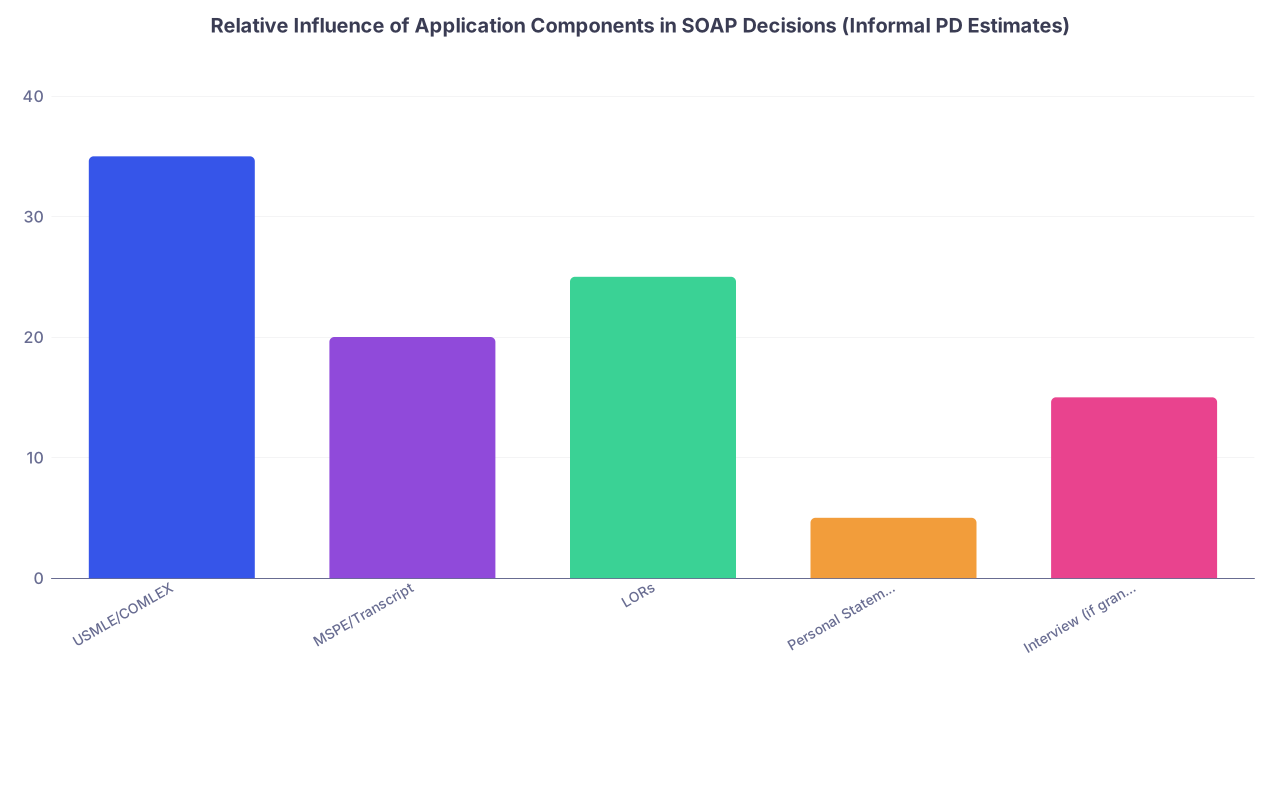
| Category | Value |
|---|---|
| USMLE/COMLEX | 35 |
| MSPE/Transcript | 20 |
| LORs | 25 |
| Personal Statement | 5 |
| Interview (if granted) | 15 |

| Step | Description |
|---|---|
| Step 1 | Realize SOAP Likely |
| Step 2 | Inventory Existing LORs |
| Step 3 | Request targeted new LORs |
| Step 4 | Map LORs to SOAP targets |
| Step 5 | Build default letter packs by specialty |
| Step 6 | Align SOAP personal statements |
| Step 7 | Pre-program ERAS assignments plan |
| Step 8 | Execute quickly on SOAP Monday |
| Step 9 | Have 3+ usable clinical LORs |
FAQs
1. Should I ever assign a non‑US letter over a weaker US letter in SOAP?
Sometimes, but only if the US letter is actively harmful. If your only US letter is obviously generic or lukewarm, and your home institution letter is detailed, specific, and strongly endorsing you, you can prioritize the home letter for categorical positions, especially in FM or peds. For IM and prelim medicine, most PDs still prefer some US perspective, even if brief. When in doubt, pair: one strong home letter + one acceptable US letter.
2. Is it better to use four letters for every SOAP application, or is three enough?
Three solid letters are absolutely enough. I would rather see three sharp, aligned letters than four where the extra one introduces doubt. Use four only when the fourth clearly adds value (different setting, seniority, or a unique angle such as addressing a past failure with a strong recovery narrative).
3. Can I reuse my original specialty‑specific letters for SOAP in a different field?
Yes, with judgment. A letter written for neurology that talks mostly about your careful reasoning, communication, and inpatient competence can work fine for IM or FM SOAP apps. A letter declaring you “destined for orthopedic surgery” looks odd for psych or peds. Focus on the content, not the heading: if the praise is about general clinical traits, you can cross‑use it. If it is identity‑locking (“future neurosurgeon”), reserve it for prelim slots or do not use it.
4. My school will not let me see my LORs. How do I know if one is weak?
You will not know for sure, but you can infer risk. Short turnaround after minimal contact, reluctance when you asked, or very generic language in the writer’s email (“happy to provide a standard letter”) are yellow flags. High‑trust signals: faculty who proactively offered, knew you well clinically, or invested time in your growth. In SOAP, favor letters from people who clearly believed in you and saw you work closely, even if they are not the most “famous” names.
Key takeaways:
You are not trying to win a beauty contest; you are trying to look like a safe, coherent, and supported hire in a compressed window. Build a flexible, SOAP‑ready LOR bank now, know exactly which letters you will deploy for which types of programs, and do not let one mediocre letter poison an otherwise salvageable application.