
The way most limited-interview applicants use SOAP program lists is dangerously wrong.
Not just suboptimal. Dangerous. I’ve watched people essentially re-fail Match Week because they treated SOAP like a chaotic re-roll instead of a targeted second chance. The tragedy? They often had enough options in SOAP to land something decent — and then blew it with bad list strategy.
If you got few or no interviews, you cannot afford ranking blunders here. SOAP is your second-chance triage, not a fantasy draft.
Let’s walk through the mistakes that quietly kill your odds — and how to avoid stepping on the same landmines.
1. Treating the SOAP List Like a Shopping Catalog

| Step | Description |
|---|---|
| Step 1 | See SOAP Vacancy List |
| Step 2 | Need strict filters |
| Step 3 | More flexibility |
| Step 4 | Add to target list |
| Step 5 | Skip and move on |
| Step 6 | Limited interviews? |
| Step 7 | Program realistic fit? |
The first big mistake: you open the vacancy list and start clicking “apply, apply, apply” to everything that looks remotely plausible.
That’s not strategy. That’s panic.
Here’s what goes wrong when you treat it like a shopping catalog:
- You blow your 45-application limit on programs that will never rank you.
- You waste time on specialties that were already unrealistic before SOAP.
- You spam “name brand” hospitals that only want stellar applicants who slipped through for weird reasons.
For limited-interview applicants, SOAP is not about maximum number of programs. It’s about maximum number of realistic yes’s.
Red flags you’re using the list like a catalog:
- You’re adding programs because you “recognize the name.”
- You’re applying to a specialty you never had on your ERAS list originally.
- You’re clicking into descriptions after you’ve already mentally committed.
Fix this:
- You need pre-defined filters before the list goes live:
- Geographic acceptability (where you’d truly go)
- Specialty tiers: primary (realistic), secondary (stretch), off-limits (fantasy)
- Hard limits on visa status, DO/IMG friendliness, Step requirements
If your approach is: “I’ll see what’s there and decide on the fly,” you’re already doing it wrong.
2. Ignoring Signal-to-Noise: Wasting Slots on Fantasy Programs
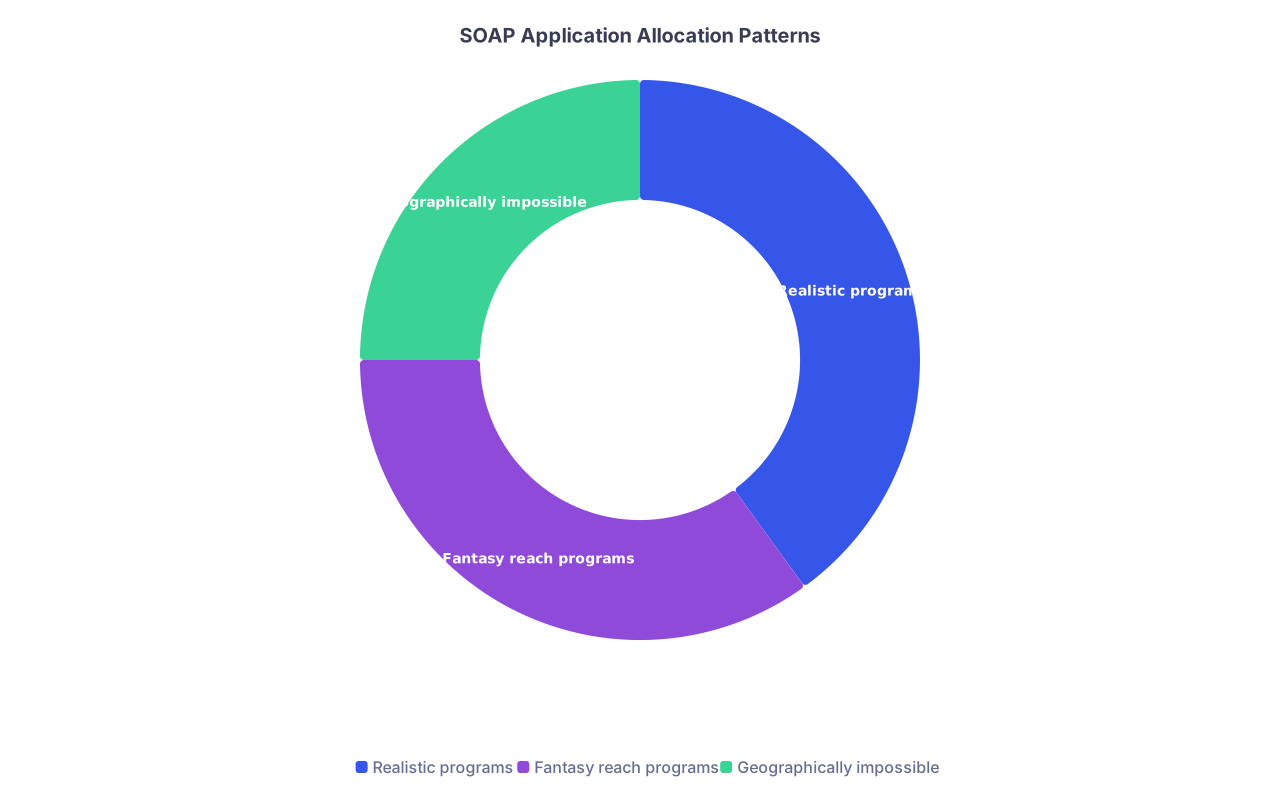
| Category | Value |
|---|---|
| Realistic programs | 40 |
| Fantasy reach programs | 35 |
| Geographically impossible | 25 |
One of the most lethal errors? Treating SOAP as your chance to “shoot your shot” at places you never had a chance at during the regular match.
You’re sitting there with:
- 0–3 interviews
- A Step failure or low score
- No home program in a competitive specialty
- Maybe IMG or DO status
And then you spend 10 of your 45 SOAP applications on:
- Unfilled spots in top 25 academic IM programs
- Highly competitive prelim surgery at name-brand hospitals
- EM, ortho, derm, urology unfilled positions “because what if”
No. That’s not ambition. That’s self-sabotage.
Programs in SOAP are not suddenly “less competitive.” Many simply under-ranked, had visa issues, or weird couple’s match fallout. A big-name program with 2 unfilled IM spots isn’t desperate — they’re sorting through a mountain of strong SOAP applicants.
You must brutally protect your 45 application slots.
Ask yourself, before every single program:
- “Would they have screened me out in October?”
- “If this program had posted on ERAS originally, would I have even gotten an interview?”
- “Does my application match their historical stats and applicant type?”
If the answer is no, skip it. I don’t care how nice the website looks.
3. Overvaluing Prestige and Underweighting Probability
I’ve seen this exact conversation more times than I’d like:
“But this is a university program, great research, big name hospital. I would love to go there.”
“Your Step 1 was 210, Step 2 was 219, and you failed Step 1 the first time. This program’s average Step is 240.”
“Yeah, but they have SOAP spots this year so maybe…”
That “maybe” is the hill people die on.
Here’s the harsh truth:
Your number one priority in SOAP is getting a position, not optimizing prestige. Especially if you had limited or zero interviews.
Making prestige your driver leads to:
- Ranking “big name” university programs over solid community ones where you’d actually be competitive
- Wasting slots on coastal metros while ignoring community programs in the Midwest/South where you’d be happy enough and actually get interviews
- Passing over FM/IM categorical positions because you’re clinging to EM/Anesthesia dreams that died three months ago
If you had limited interviews, the market already told you something about your competitiveness. SOAP doesn’t erase that. It amplifies it.
Reframe your priorities:
- Get a categorical spot in any core specialty you can live with.
- Prefer stable, training-focused community programs over name-chasing.
- Worry about fellowships and locations later. They’re easier problems than “no residency at all.”
4. Misunderstanding How SOAP Communication Works

| Step | Description |
|---|---|
| Step 1 | Submit SOAP applications |
| Step 2 | Programs review |
| Step 3 | Programs contact selected applicants |
| Step 4 | Interviews or phone calls |
| Step 5 | Programs create preference lists |
| Step 6 | NRMP offers released in rounds |
| Step 7 | Applicant accepts or rejects |
Another killer misunderstanding: thinking SOAP is like regular ERAS where you “cast a wide net and see who bites.”
Here’s what actually happens:
- Programs often don’t talk to most applicants they’re not serious about.
- Many will only call a short list of candidates they like before submitting preferences.
- Some don’t call at all — they pick based on paper, past school relationships, or internal candidates.
So how do applicants screw this up?
They:
- Apply to programs they’d never realistically rank highly, “just in case”
- Panic if they don’t hear back in the first 2–3 hours and start catastrophizing instead of preparing for possible late calls
- Misinterpret every missed call as “I just lost my only chance” instead of understanding multiple rounds and backup options
You can’t control who calls you. But you can control whether your list gives you enough plausible places that might call based on your stats and background.
What helps:
- Have your phone glued to you, ringer loud, voicemail set up and not full
- Pre-research your applied programs so if they call, you sound prepared, not clueless
- Accept that some solid community programs may never reach out formally and still rank you based on your file
The blunder is assuming that “get lots of calls” is the measure of a good SOAP strategy. The real metric is: did you pick programs where you’d actually be high enough on at least a few lists to land an offer?
5. Failing to Prioritize Categorical Over Prelim — Especially With Few Interviews
This one is brutal.
Many limited-interview applicants repeat the same mistake: overweighting preliminary positions because they’re scared to “close doors” on specific specialties.
Example pattern:
- You originally applied to IM and Anesthesia.
- Match Week: 1 Anesthesia interview, 0 IM interviews. You don’t match.
- SOAP opens: you apply to:
- 20 prelim Internal Medicine and Surgery spots
- 10 categorical IM spots
- 15 random transitional years “to keep options open”
Fast forward to Friday: You match into a prelim. No categorical. You’re now on the “find PGY-2 or reapply” hamster wheel.
If you had limited interviews, you cannot treat a prelim like a win unless:
- You are very competitive on paper (you’re not, by definition here), or
- You have a concrete plan and strong advocacy to get into a PGY-2
For most borderline or struggling applicants, a prelim without categorical is kicking the can down the road. Sometimes into a brick wall.
Your SOAP priority order if you’re limited-interview and not chasing Step 3-level competitive specialties should usually be:
- Categorical FM/IM/other core fields you can live with
- Transitional year or prelim at institutions with a strong track record of taking their own prelims into categorical
- Only then, generic prelims with no clear pipeline
Do not let “I really want Anesthesia eventually” blind you into sacrificing a stable categorical in FM/IM. I’ve seen too many people end up with nothing the second time.
6. Ignoring Program Type and Training Quality Red Flags

Another mistake: in a panic, people will apply to any program with open spots without doing even a 60-second sanity check.
Yes, your priority is to match. No, you don't have to throw yourself into a black hole.
Red flags you should at least pause over:
- Programs that chronically appear in SOAP year after year
- Vague or nonexistent curriculum details on their website
- Scattered or missing current resident lists
- No board pass rate data anywhere
- Multiple scathing reviews in resident forums from different years saying variations of “unsafe,” “toxic,” “no supervision,” “no education, only service”
For limited-interview applicants, the temptation is strong: “I can’t be picky.” I agree to a point. But there’s a difference between:
- Rough but functional community program where you’ll work hard and train decently
versus - Disorganized, malignant environment where you risk remediation, burnout, or getting pushed out
Minimal due diligence steps:
- Spend 30–60 seconds on each program’s website
- Scan resident forums or social media once your shortlist is formed
- Look at board pass rates if posted
- Check if they’ve had ACGME citations or warnings (often publicly available)
You don’t have the luxury of idealism in SOAP, but you also shouldn’t blindly walk into disaster if you can help it.
7. Bad Specialty Pivot Decisions Under Pressure
Here’s how people blow SOAP by mishandling specialty pivots:
Scenario:
- You applied to EM, got 0 interviews.
- SOAP opens, there are EM spots and there are FM/IM spots.
- You tell yourself: “This is my chance to prove I’m really committed to EM,” and you dump 30 of your 45 applications into EM programs that passed on you all season.
If you had zero interviews in that specialty:
- The market already gave you a pretty clear message.
- SOAP programs in that same specialty are usually not less selective; they’re just dealing with weird match math.
Pivoting mistakes:
- Refusing to add FM/IM categories because “I’ll be miserable”
- Trying to pivot into another competitive specialty you also never applied to originally (e.g., suddenly applying to Radiation Oncology in SOAP with no prior signal)
- Splitting too evenly (e.g., 50% EM, 50% FM/IM) when your odds in EM are essentially zero
This is where you need ruthless honesty, ideally with someone who’s not emotionally entangled — your dean, advisor, program director, someone who will tell you the truth.
For most limited-interview applicants, smart SOAP pivots look like:
- EM → FM/IM
- Anesthesia → IM/FM/Prelim + strong pipeline if you must
- Gen Surg → FM/IM, maybe prelim surg if you have strong backing
- OB/GYN → FM/IM
- Psych → FM/IM or keep some Psych if you had at least a few interviews
You’re not giving up on your dream. You’re giving yourself a career and the option to later shape it with fellowships, additional training, or even a second try through a backdoor. Hard to do any of that if you’re sitting unmatched a second year.
8. Mis-Ranking Their Own Internal Priorities
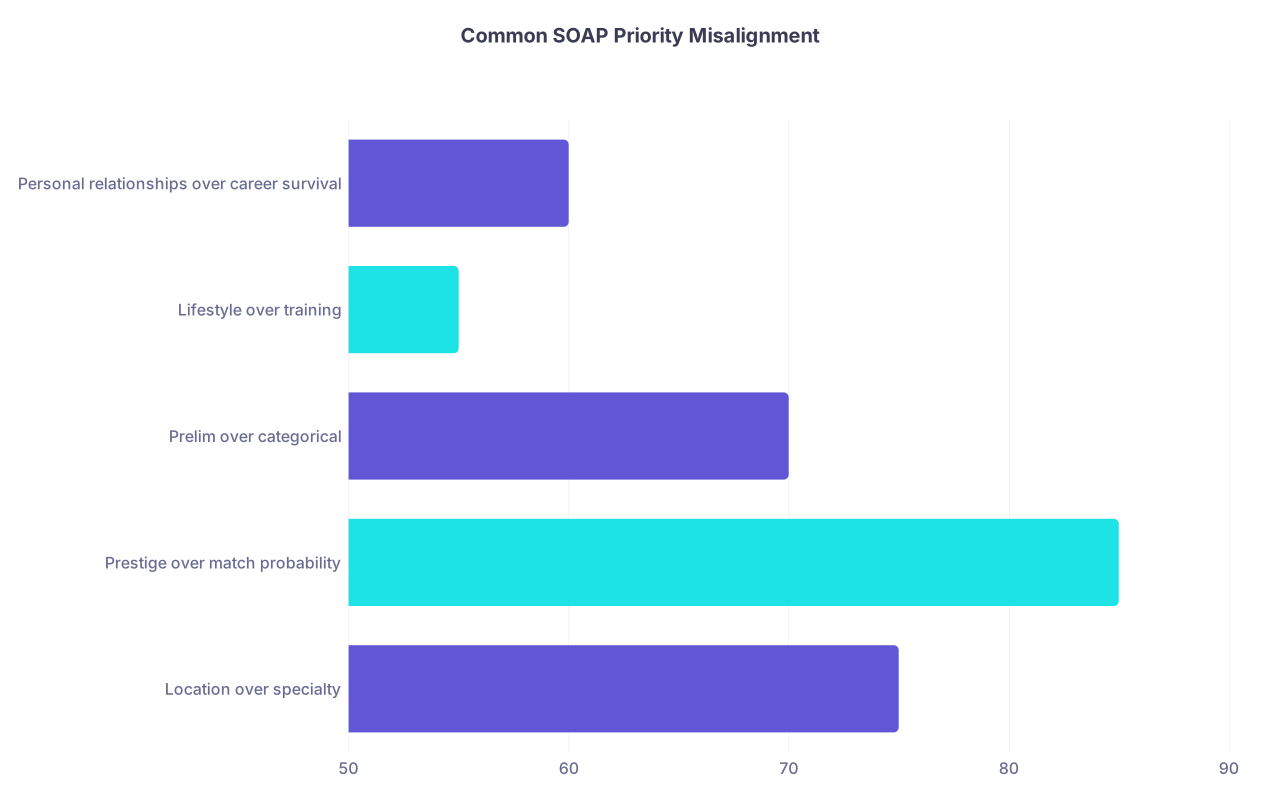
| Category | Value |
|---|---|
| Location over specialty | 75 |
| Prestige over match probability | 85 |
| Prelim over categorical | 70 |
| Lifestyle over training | 55 |
| Personal relationships over career survival | 60 |
Here’s an underappreciated pattern:
People say their #1 goal is “just to match,” but their SOAP list exposes their real priorities:
- Location > Specialty > Prestige > Probability instead of:
- Probability > Categorical Spot > Training Quality > Everything Else
Common self-sabotaging internal priorities:
- Refusing to apply outside a specific metro area or state, even after failing to match
- Prioritizing couples matching again in SOAP even though it already contributed to failure
- Letting a partner/family essentially veto entire regions — while you’re sitting there unmatched
Then, when things go badly in SOAP, they say: “I did everything I could.”
No, you didn’t. You protected lifestyle preferences over survival.
Look, relationships matter. Geography matters. Mental health matters. But if you’re reading an article about “limited-interview SOAP strategy,” you’re at a career inflection point. You have to rank survival higher than comfort. At least this year.
Before SOAP opens, write this down:
- My non-negotiables (e.g., I absolutely cannot safely live in these locations for X reason)
- My strong preferences (but I would sacrifice these to match)
- My deal-breakers for programs (very short list: e.g., repeated major safety issues, chronic ACGME probation, etc.)
If your “non-negotiable” list is half the country, you’re not in a position to say you did everything you could.
9. Zero Spreadsheet, Zero System, 100% Chaos

Chaos kills SOAP outcomes.
I’ve watched people:
- Lose track of which programs they already applied to
- Forget important notes about red flags or green lights
- Confuse similar-sounding community programs in different states
- Completely misjudge how many of their applications are long-shot vs solid
You need at least a bare-bones tracking system. Nothing fancy. A simple spreadsheet with:
| Column | Purpose |
|---|---|
| Program Name | Identify clearly |
| Specialty/Type | IM categorical, FM, prelim, TY |
| Location (State/City) | Geography filter |
| Competitiveness Fit | Realistic / Stretch / Fantasy |
| Notes/Red Flags | Quick reminders |
Even that minimal structure will prevent:
- Double-counting “realistic” programs when half your list is fantasy
- Forgetting why you swore you wouldn’t apply to a certain program
- Wasting time mid-SOAP doing research you could’ve done once
On SOAP week, your brain will be fried. You’ll be emotional, sleep-deprived, and getting advice from five directions. Having a clear, pre-thought-out system is how you save yourself from impulsive mistakes.
10. Not Getting Brutally Honest Feedback Early Enough

The last and maybe biggest mistake: trying to do all of this alone, in your own head, during the most emotionally volatile week of medical school.
Here’s what I’ve seen:
- Applicant with 0 interviews trying to SOAP exclusively into EM because they “deserve a chance”
- Applicant with two red flags and low scores applying to 80% university programs “for the training”
- IMG applicant refusing to apply to community FM because their family “would be disappointed”
And nobody stopped them. Or the people who tried were too gentle.
You need:
- Someone who knows your application and the match landscape
- Someone willing to say: “That plan is unrealistic. Here is Plan B/C/D”
- Someone who won’t sugarcoat how bad a second unmatched year will be
What you should not do:
- Crowdsource SOAP lists from Reddit/Discord and follow random strangers’ advice over actual advisors
- Believe every anecdote: “My friend had a 205 and matched Anesthesia in SOAP at a top place!” (You never hear about the denominator.)
- Hide your true score history or red flags from your advisor and then expect accurate guidance
Bring the full truth to someone experienced. Let them help set the outer boundaries of what’s realistic. Then build your SOAP list within those boundaries.
Key Takeaways
Protect your 45 SOAP applications like currency. Spend them on realistic categorical programs where your stats and background actually match their history, not on name-brand fantasies or long-shot prelims.
Be brutally honest about your position. Limited or zero interviews mean you must prioritize match probability over prestige, location, and specialty purity. Survival first, optimization later.
Use structure, not panic. Go into SOAP with clear filters, a simple tracking system, and candid advisor input, so you don’t let emotion and chaos push you into ranking blunders you’ll regret for years.