
The biggest myth about SOAP is that playing it “safe” and staying in your original specialty is always less risky. It isn’t.
If you’re in SOAP right now, watching the clock and refreshing your email like it’s a vital sign, you’re probably asking the question that makes your stomach drop:
“Am I totally insane if I pivot specialties now? Is this how I end up unmatched… again?”
Let me say this out loud so you hear it clearly: staying in your original specialty can be risky. Pivoting can be risky. Doing either one without a strategy is what really sinks people.
Let’s unpack how risky the pivot actually is — not in theory, but in the brutal, spreadsheet-and-SOAP-list reality you’re living in.
What You’re Actually Afraid Of (And You’re Not Wrong)
You’re not just scared of “switching specialties.” You’re scared of a whole bundle of worst-case scenarios:
- That programs will see your pivot and think you’re desperate or flaky.
- That you’ll be mediocre in a new specialty because you “weren’t born wanting it.”
- That you’ll burn your one real shot in SOAP on something you’re not even sure about.
- That if you pivot and still don’t match, you’ll have to explain this mess next year.
And under all of that is the nuclear thought:
“What if I never match at all?”
I’ve watched people in SOAP stare at a list of prelim medicine spots while clinging to an advanced specialty that just isn’t offering seats… and they freeze. They tell themselves: “I should at least try to stay in my field.” Translation: “I’m terrified of giving up the dream on the wrong day.”
You’re not irrational. The system is brutal and the stakes are high. But your fear is also very bad at statistics, nuance, and strategy.
So let’s give your fear some data and structure.
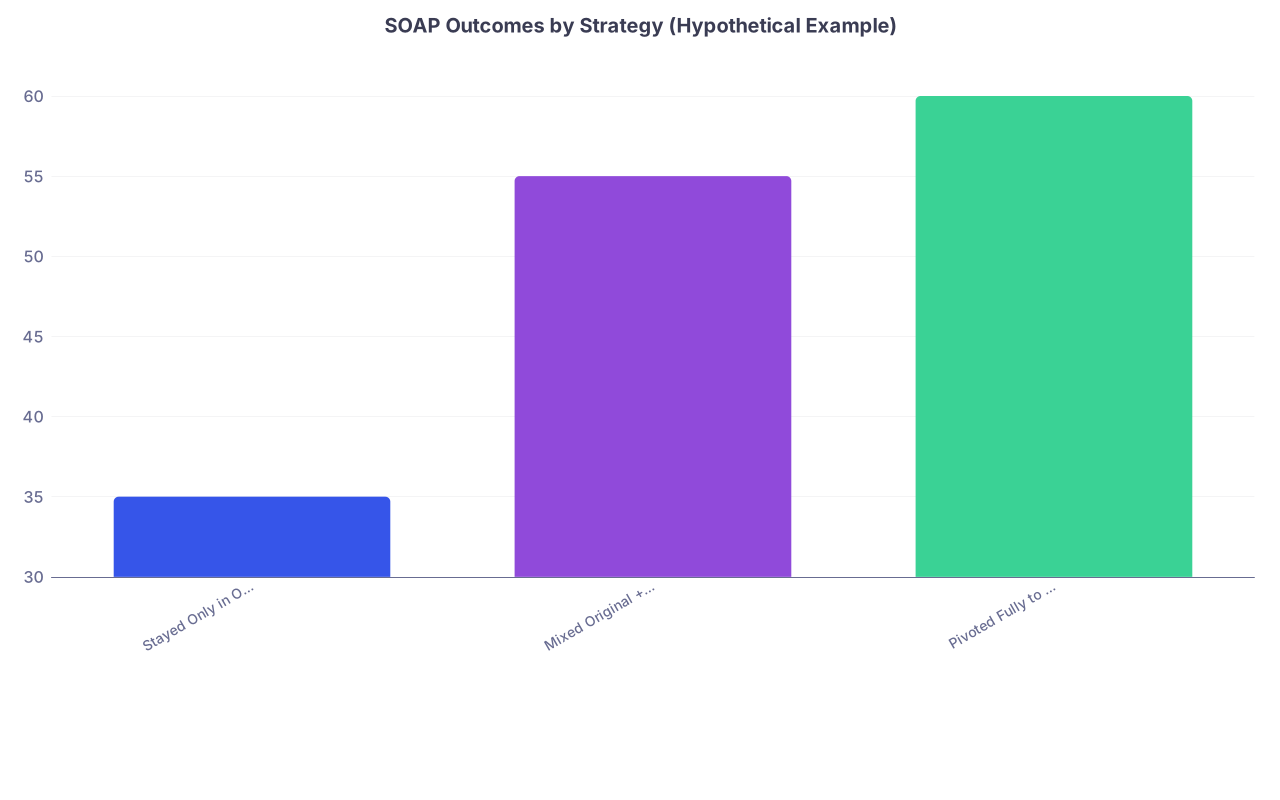
| Category | Value |
|---|---|
| Stayed Only in Original Specialty | 35 |
| Mixed Original + New | 55 |
| Pivoted Fully to New Specialty | 60 |
(Hypothetical but realistic pattern I’ve seen: people who mix or pivot often do better than those who cling only to their original field.)
How Risky Is the Pivot, Really?
The risk level depends on three things you probably aren’t evaluating clearly when you’re panicking:
- Your original specialty’s competitiveness
- The actual SOAP position landscape this year
- Your personal profile and flexibility
Let’s walk through each without sugarcoating.
1. Your Original Specialty May Already Be a Lost Battle in SOAP
Some specialties are graveyards in SOAP. If you’re trying to SOAP into:
- Dermatology
- Plastic surgery
- Neurosurgery
- Ortho
- ENT
- Optho (outside of SF, but same vibe)
…then staying committed to “I must match this now” is like arguing with gravity.
By SOAP, most of those are empty or have such microscopic numbers and insane applicant pools that “loyalty to the specialty” stops being noble and just becomes strategically bad.
On the other hand, if your original specialty is:
- Internal medicine
- Pediatrics
- Family medicine
- Psych
- Pathology
- Even prelim medicine or surg
Then your risk calculus is different, because there may actually be seats left.
But here’s the nasty little secret: some people in these fields still don’t match in SOAP because they under-apply, or they refuse to consider slightly less desirable options (community programs, lower-tier locations, prelim years).
2. The SOAP List Doesn’t Care About Your Feelings
You can’t answer “Is pivoting risky?” in a vacuum. You can only answer:
“Is pivoting riskier than staying given the SOAP list in front of me?”
So you need to look at:
- How many positions are open in your original specialty
- What types of programs they are (academic vs community, location, visa status, DO-friendliness, etc.)
- How many positions are open in realistic alternative specialties (IM, FM, peds, psych, prelims, transitional years)
Then compare: where is there actual oxygen?
| Specialty | Open PGY-1 Spots | Typical Competitiveness | Realistic for SOAP Pivot? |
|---|---|---|---|
| Dermatology | 1 | Extreme | No |
| Orthopedic Surg | 3 | Extreme | No |
| Internal Medicine | 120 | Moderate | Yes |
| Family Medicine | 90 | Lower | Yes |
| Psych | 35 | Moderate | Maybe |
If your original specialty looks like derm in that table and you’re still asking “Is it risky to pivot?” — you’re asking the wrong question.
The risk might actually be not pivoting.
The Real Risk: Not Matching vs Not Loving Your Specialty
You’re secretly juggling two fears:
- “I won’t match at all.”
- “I’ll match into something I don’t love and be miserable.”
Both are valid. They just aren’t equal in how fixable they are.
Not matching at all:
- Hits your finances, timeline, and mental health hard.
- Makes reapplying more complex.
- Can create a “why didn’t you match?” narrative you’ll carry around.
Matching into something you’re not sure about:
- Can be adjusted. People switch fields. People retrain. People carve niches.
- Gives you a paycheck, clinical experience, and credibility.
- Keeps you in the system instead of on the outside knocking.
I’m not saying “just take anything.” I hate when people say that like your entire career is a random scramble. But from a pure risk standpoint, having A residency often beats having NO residency, especially if the pivot is into something broad (IM, FM, peds, psych) where transitions are more possible later.

| Step | Description |
|---|---|
| Step 1 | Check SOAP List |
| Step 2 | Identify realistic new specialties |
| Step 3 | Apply both original and new |
| Step 4 | Prioritize broad specialties |
| Step 5 | Maximize applications |
| Step 6 | Submit SOAP list |
| Step 7 | Original specialty has viable spots |
| Step 8 | Enough spots and you are competitive |
How Programs Actually See a SOAP Pivot
Here’s where your brain is probably lying to you the most.
You’re imagining programs saying: “Wow, they were going for anesthesia and now they’re applying to IM. Clearly desperate. Hard pass.”
Reality is different.
Program directors in SOAP are thinking:
- “Can this person safely take care of patients July 1?”
- “Will they show up, do the work, and not implode?”
- “Are they a massive professionalism risk?”
- “Do they have some reason to be here, or are we obviously just a dump option?”
In SOAP, they know most applicants are there because Plan A blew up. You’re not fooling anyone with “Lifelong dream” anyway.
What they actually respect:
A coherent explanation in your application / PS addendum:
“I initially applied to X because of Y. Through my rotations and experiences, I’ve realized my strengths and long-term goals align better with [new specialty], especially in areas like [specific concrete example].”Evidence you can function in that specialty:
Clerkship grades, LORs, sub-I’s, even if they weren’t originally tailored for that field but still show you’re clinically solid.
What makes them hesitate:
- Zero mention of the specialty anywhere in your record and a completely generic, copy-paste personal statement.
- Red flags: failures, unaddressed gaps, weird professionalism issues.
A pivot doesn’t automatically scream “red flag.” A chaotic, unexplained, or half-baked pivot does.

When Pivoting Is Smart vs Self-Sabotage
Let’s be blunt.
Pivoting is usually SMART when:
- Your original specialty has almost no SOAP spots and is notoriously cutthroat.
- You have solid but not superstar stats (mid Step/COMLEX scores, average grades) and no special connections in that field.
- You’re open to broad specialties you could see yourself in long term or as a stepping stone.
- Your main goal this year is to get into the system and avoid another full unmatched cycle.
For example:
You applied anesthesia with a 225, average clerkship grades, and got 0 interviews. SOAP list shows 2 anesthesia spots nationwide, 150 IM, 100 FM, 30 psych. Pivoting to IM/FM/psych is not reckless. It’s rational.
Pivoting is usually SELF-SABOTAGE when:
- Your original field actually has a decent number of SOAP positions and you’re reasonably competitive for them.
- You’re emotionally spiraling and choosing a random pivot specialty just because “there are spots” and you’ve never once considered it before.
- You refuse to apply broadly even in the new specialty (location obsession, only university programs, etc.).
- You’re trying to pivot into another hyper-competitive specialty in SOAP. That’s just rearranging deck chairs.
The danger isn’t the pivot itself. It’s the blind, panicked pivot.
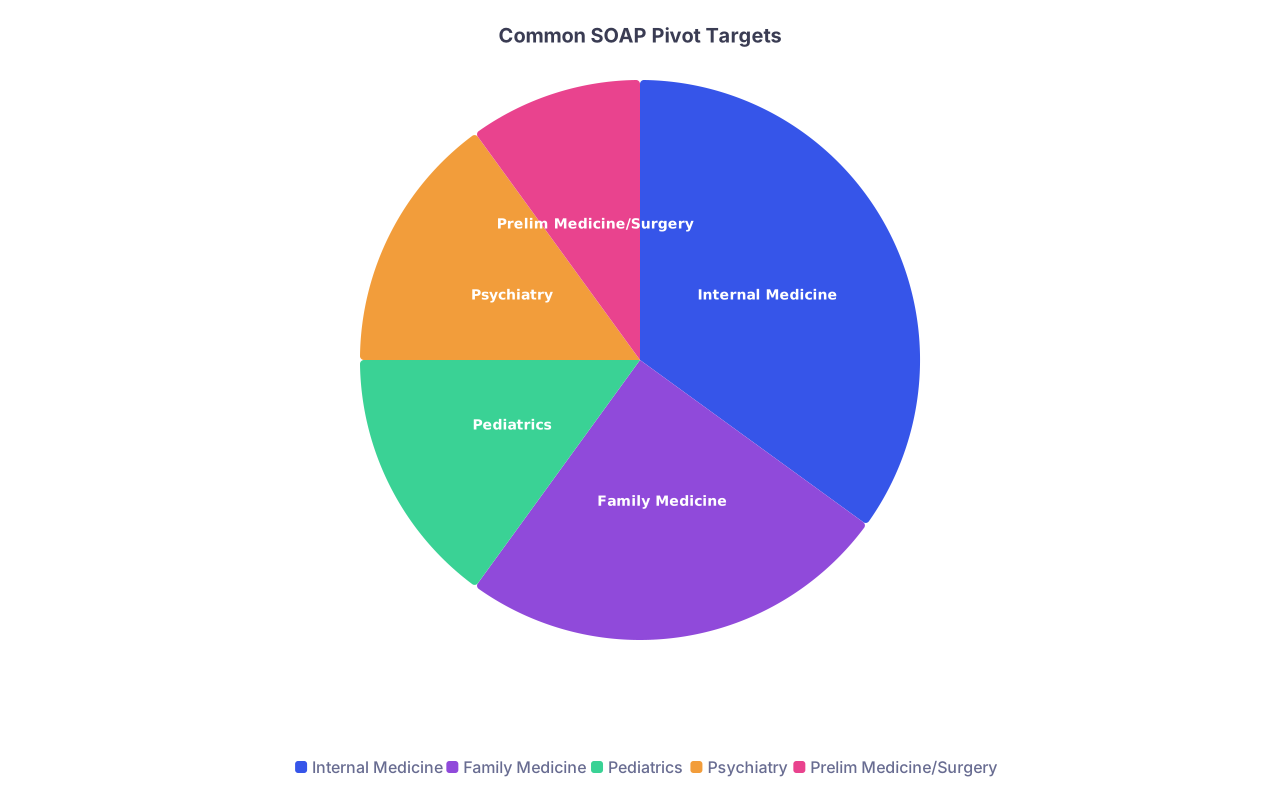
| Category | Value |
|---|---|
| Internal Medicine | 35 |
| Family Medicine | 25 |
| Pediatrics | 15 |
| Psychiatry | 15 |
| Prelim Medicine/Surgery | 10 |
How to Pivot Without Torching Your Chances
If you decide to pivot, you need to do it like someone who knows exactly what they’re doing, not like someone throwing their application into a tornado.
Here’s the calm version of the chaotic mental checklist you’re probably cycling through at 2 AM:
Pick 1–2 realistic pivot specialties, not 5 random ones
Multiple scattered applications can make you look directionless. A tight story looks intentional: e.g., IM + prelim medicine; FM alone; peds + FM; psych alone.Rewrite your personal statement / short SOAP blurb
You don’t have time for a masterpiece. You do have time for a clear, specific half-page that says:- Why this specialty actually makes sense for you
- How your experiences to date support this shift
- That you understand what the work is like (aka you’re not just listing clichés)
Get at least one LOR that isn’t wildly off-base
If you can’t get a specialty-specific letter, use the best clinical letter you have that shows: work ethic, reliability, ability to manage patients.Apply broadly and humbly
The people who stay unmatched in SOAP with a pivot often:- Apply to 10 programs when they could’ve applied to 30+
- Avoid community programs
- Avoid certain regions for personal preference
In SOAP, pick between:
- “I only want exactly what I envisioned”
- “I want to match this year”
You don’t always get to have both.
Prepare your quick explanation for interviews
You WILL be asked: “So you initially applied to X. Why Y now?”
Your answer needs to be:- Short
- Honest-ish but framed well
- Future-focused (“Here’s how I see my career in Y and how this fits me.”)
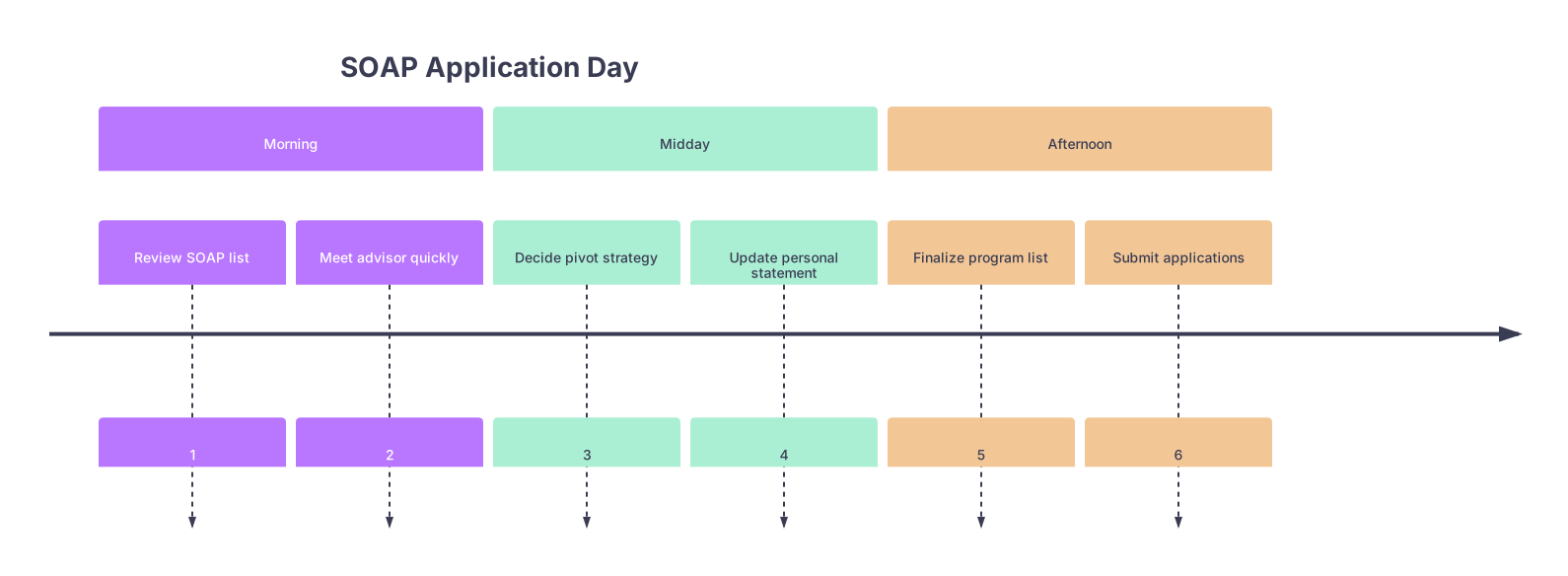
| Period | Event |
|---|---|
| Morning - Review SOAP list | 1 |
| Morning - Meet advisor quickly | 2 |
| Midday - Decide pivot strategy | 3 |
| Midday - Update personal statement | 4 |
| Afternoon - Finalize program list | 5 |
| Afternoon - Submit applications | 6 |
The Quiet Truth: Most People Don’t Regret Surviving
You’re imagining future-you 10 years from now saying, “I ruined my life pivoting into IM during SOAP instead of holding out for anesthesia.”
I’ve seen something different.
What I actually see is:
- People who matched into a pivot specialty and are like, “Honestly, I’m just glad I’m practicing and not stuck reapplying again and again.”
- People who discovered they like the pivot field more than their original plan once ego and fantasy are removed.
- A smaller group who later transitioned (fellowship, second residency, niche focus) because they had an MD/DO, a license, and a residency background — which only happened because they matched somewhere.
And yes, I’ve also seen people who didn’t pivot when they should have and spent a brutal, expensive extra year trying again from the outside.
You’re not choosing between perfect and terrible. You’re choosing between:
- A realistic path to being a doctor, maybe via a specialty that wasn’t your first crush
- A gamble on a shrinking number of spots in a field that might not have room for you this year
That’s the actual risk landscape.
What You Can Do Today (Not Someday, Not “When I Calm Down”)
You’re not going to totally get rid of the anxiety. But you can at least make sure it’s not the one in charge.
Today — like, after you finish reading this — do this:
Pull up the SOAP list and count actual spots in:
- Your original specialty
- 1–2 realistic pivot specialties
Be brutally honest: are you truly competitive for what’s left in your original field?
If the answer is “not really,” open your personal statement doc right now and change the first paragraph so it makes sense for a pivot specialty you could live with.
That’s your next step:
Open the SOAP list, pick 1–2 realistic specialties, and rewrite your opening paragraph to match that pivot. Don’t overthink the entire future. Just fix that one paragraph today.
FAQ (Exactly 6 Questions)
1. If I pivot in SOAP, am I burning my chance to ever try for my original specialty again?
Not necessarily. It depends on the fields. If you pivot into a broad field like IM or FM, you might later:
- Do a fellowship that overlaps with your original interest
- Transition via a second residency (harder, but not impossible in some cases)
- Build a niche practice that scratches similar itches (procedures, subspecialty clinics, etc.)
What you are doing is accepting that this specific year might not be the year you enter that original specialty. But you’re not slamming the door on all future paths.
2. Will programs judge me for switching interests so “late”?
Less than you think. PDs live in the real world. They know:
- People don’t always get into the specialty they initially chase.
- SOAP is chaos. Everyone’s plans exploded.
If your pivot comes with a coherent explanation and your docs aren’t obviously copy-paste garbage, most will see it as:
“This person regrouped under pressure and picked something reasonable.”
That’s not a bad look.
3. What if I truly have zero prior exposure to the pivot specialty?
Then you need to be honest but still intentional. You can say something like:
“I initially pursued [X] but realized through my core rotations and clerkship experiences that my strengths are in [continuity of care / patient communication / complex chronic disease management], which align more closely with [new specialty].”
Lean on:
- Skills (communication, teamwork, procedures)
- Values (long-term relationships, acute care, etc.)
Rather than pretending you’ve always loved that field. Everyone sees through that.
4. Is it better to SOAP into a prelim year in my original field or categorical in a different one?
This is one of the nastiest choices. General rule I’ve seen work out more often:
- If there’s a categorical spot in a reasonable pivot field → often safer, more stable route.
- A prelim year can be great if:
- You’re truly committed to pursuing advanced positions next year
- You understand that prelim + unmatched advanced spot is its own specific hell
If you’re extremely risk-averse about ending up in limbo again, a categorical pivot often has less long-term anxiety attached.
5. If I don’t pivot and don’t match in SOAP, is reapplying next year that bad?
It’s not career-ending, but it’s tough:
- You’ll need a gap-year plan (research, MPH, prelim if you somehow get one late, etc.).
- You’ll be explaining “why you didn’t match” everywhere.
- The psychological grind of another full cycle is real.
I’ve seen people do it and succeed. But almost all of them, in hindsight, wish they’d at least seriously considered a rational pivot in SOAP as plan B.
6. I’m afraid I’ll regret whatever I choose. How do I decide?
You probably will have some regret. That’s human. The better question is:
“Which regret can I live with more?”
- Regret A: “I pivoted and didn’t chase my original specialty as hard as I could have this year.”
- Regret B: “I stayed rigid, didn’t match anywhere, and lost a year.”
When I watch people 2–3 years down the line, more of them are at peace with Regret A than with Regret B. That’s not universal. But it’s common enough that you should at least weigh it honestly.
So, right now: pull up your SOAP list, look at the numbers, and pick which regret you’re more willing to live with. Then rewrite that first paragraph of your statement to match the choice you make today.