
It is Monday, 9:59 a.m. Eastern. Your heart is doing that uneven, hollow thud. The NRMP email hits: “We are sorry… you did not match.”
Your inbox is quiet. No backup “we filled” emails yet. No sudden rescue. Just that one line.
You have less than 24 hours until the first SOAP offer round opens. This next day is brutal and decisive. People either flail around in chaos or move with a checklist and come out with offers.
You are not going to flail.
Below is a strict, time-based plan from the unmatched email to the first SOAP offer window. Follow it like you are on call with a crashing patient. Prioritize. Cut the noise. Move.
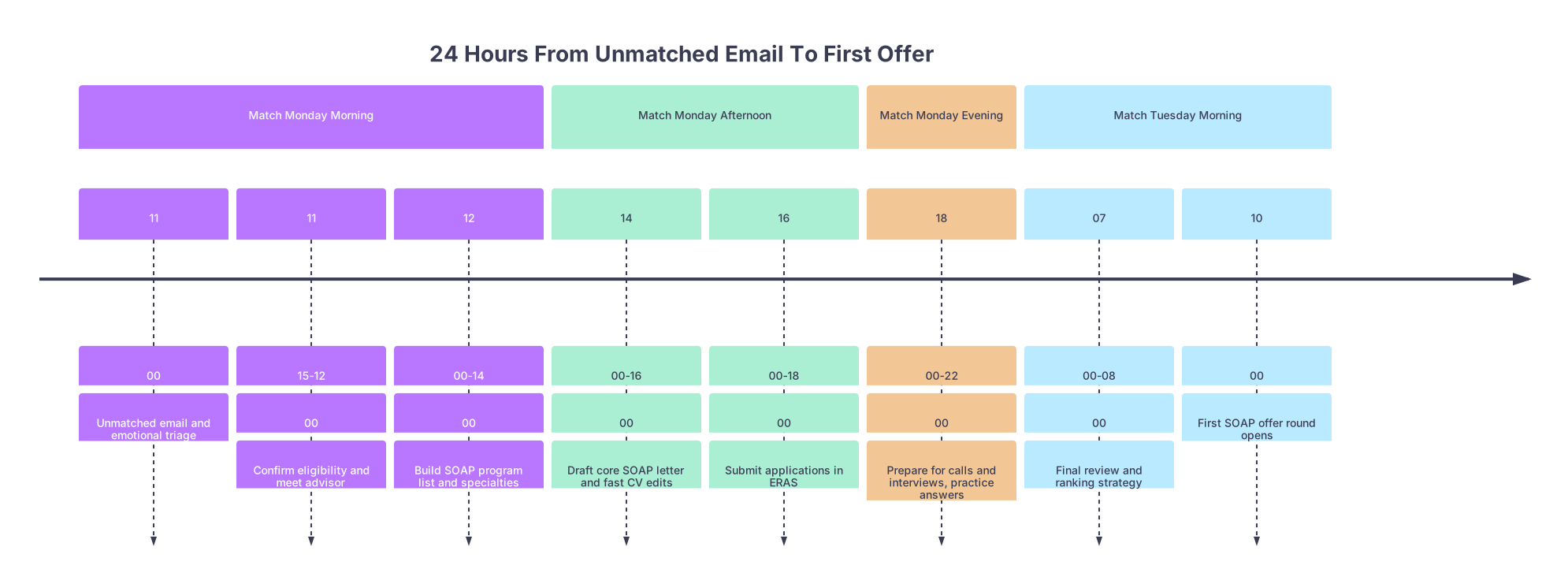
| Period | Event |
|---|---|
| Match Monday Morning - 11 | 00 |
| Match Monday Morning - 11 | 15-12 |
| Match Monday Morning - 12 | 00-14 |
| Match Monday Afternoon - 14 | 00-16 |
| Match Monday Afternoon - 16 | 00-18 |
| Match Monday Evening - 18 | 00-22 |
| Match Tuesday Morning - 07 | 00-08 |
| Match Tuesday Morning - 10 | 00 |
Hour 0–1: Right After the Unmatched Email
Time frame: Match Monday, 11:00–12:00 p.m. ET
At this point you should stabilize yourself and confirm you can actually enter SOAP. Then immediately pull in support.
1. First 10 minutes: Emotional triage and ground rules
You have to control the next 24 hours, not your panic.
For the first 10 minutes:
- Get off social media.
- Stop checking GroupMe / class chats. They will melt your brain.
- Text one trusted person:
“I did not match. I am entering SOAP. I will be busy for the next 24 hours. Please be available if I need quick advice.”
Ground rules for yourself:
- No doom-scrolling.
- No long conversations explaining what happened.
- No comparing with classmates’ match results.
Your only job: SOAP strategy and execution.
2. Next 20–30 minutes: Confirm SOAP eligibility and access
At this point you should verify that you are actually in the game.
Log in to NRMP:
- Confirm your status shows “Unmatched” and “SOAP Eligible.”
- If it shows not eligible, call NRMP immediately. Do not email. Call.
Log in to ERAS:
- Confirm SOAP functionality appears (SOAP program list, 45-application limit).
- Check that USMLE/COMLEX scores, transcript, MSPE, and letters are uploaded and assigned broadly. If anything is missing, contact your dean’s office right now.
Open your school email:
- Look for instructions from:
- Student affairs / dean’s office
- Career advising office
- Most schools have a SOAP process. It may be clunky, but use it. They often:
- Help you pick realistic programs.
- Make direct calls for you.
- Know which PDs answer the phone.
- Look for instructions from:
3. End of first hour: Contact your support team
By 12:00 p.m. ET, you should have live humans in your corner.
Priority list:
Designated SOAP advisor at your school
- Email + text or call:
- “I did not match. I am SOAP-eligible. Can we meet (phone/Zoom) in the next hour to strategize programs and specialties?”
- Email + text or call:
Specialty-specific mentor or PD who knows you
- Especially if you are switching or expanding specialties.
- Ask: “Can I SOAP into prelim medicine / surgery / transitional year realistically with my scores? What about [alternate specialty]?”
If you are an IMG without strong school support:
- Identify one or two trusted faculty or alumni in the US.
- Avoid random paid “SOAP consulting” this late. It is usually overpriced and generic.
Hour 1–4: Building Your SOAP Strategy and Program List
Time frame: Match Monday, ~12:00–3:00 p.m. ET
Now the clock is brutal. At this point you should be deciding: what are you applying to, and why?
4. Understand the SOAP playing field
Pull up the List of Unfilled Programs on NRMP (your school / dean’s office typically sends this quickly).
You will see:
- Categorical IM, Peds, FM spots.
- A lot of prelim medicine / prelim surgery.
- Transitional years (if you are lucky).
- Some less competitive specialties, plus a few random surprises.
Your constraints:
- Max 45 programs total during SOAP.
- No direct contact with programs by you before they reach out (PDs and staff can contact you; you cannot cold call them at this phase).
- All communication must be through ERAS / official channels. No DMing PDs on Twitter. That is how you get reported.
| Original Target | Common SOAP Targets | Risk Level |
|---|---|---|
| Derm, Rad Onc, ENT | TY + Prelim Med/Surg | Low/Moderate |
| Ortho, Neuro Surg | Prelim Surg, TY | Moderate |
| Anesthesia, Rads | Prelim Med, TY, FM | Moderate |
| EM | IM, FM, Peds, Prelim Med | Moderate/High |
| Competitive IM/Peds | Community IM/FM, Prelim Med | Moderate |
5. Hour 1–2: Decide your SOAP outcome hierarchy
At this point you should decide your hierarchy of what you actually want, not what sounds good.
Ask yourself, very directly:
Would I prefer:
- A categorical spot in any core specialty (IM, FM, Peds, Psych), or
- A prelim/TY year with the option to reapply?
How flexible am I on:
- Geography?
- Community vs university?
- DO vs MD?
- Night float heavy, lower reputation programs?
Write down a ranked outcome list, for your own brain:
- Best-case: Categorical [X specialty] in [broad set of regions].
- Good: TY or prelim medicine at stable program where I can reapply.
- Acceptable: Prelim surgery if it keeps doors open and I can tolerate the lifestyle.
- Not acceptable: Nothing.
The last line is important. You are not here to be “picky.” You are here to get a job and a training slot.
6. Hour 2–3: Build and prune your SOAP program list
Now you go program by program, fast but not sloppy.
Steps:
Filter by specialty based on your hierarchy.
For each candidate program:
- Check basic filters:
- Requires USMLE Step 1 / 2 minimum? (If you are below, skip.)
- IMG-friendly in the past? (Look at prior residents if possible.)
- Visa sponsorship if relevant.
- Glance at:
- Resident list (are there DOs? IMGs? People from non-top schools?)
- Location (avoid only if truly impossible).
- Check basic filters:
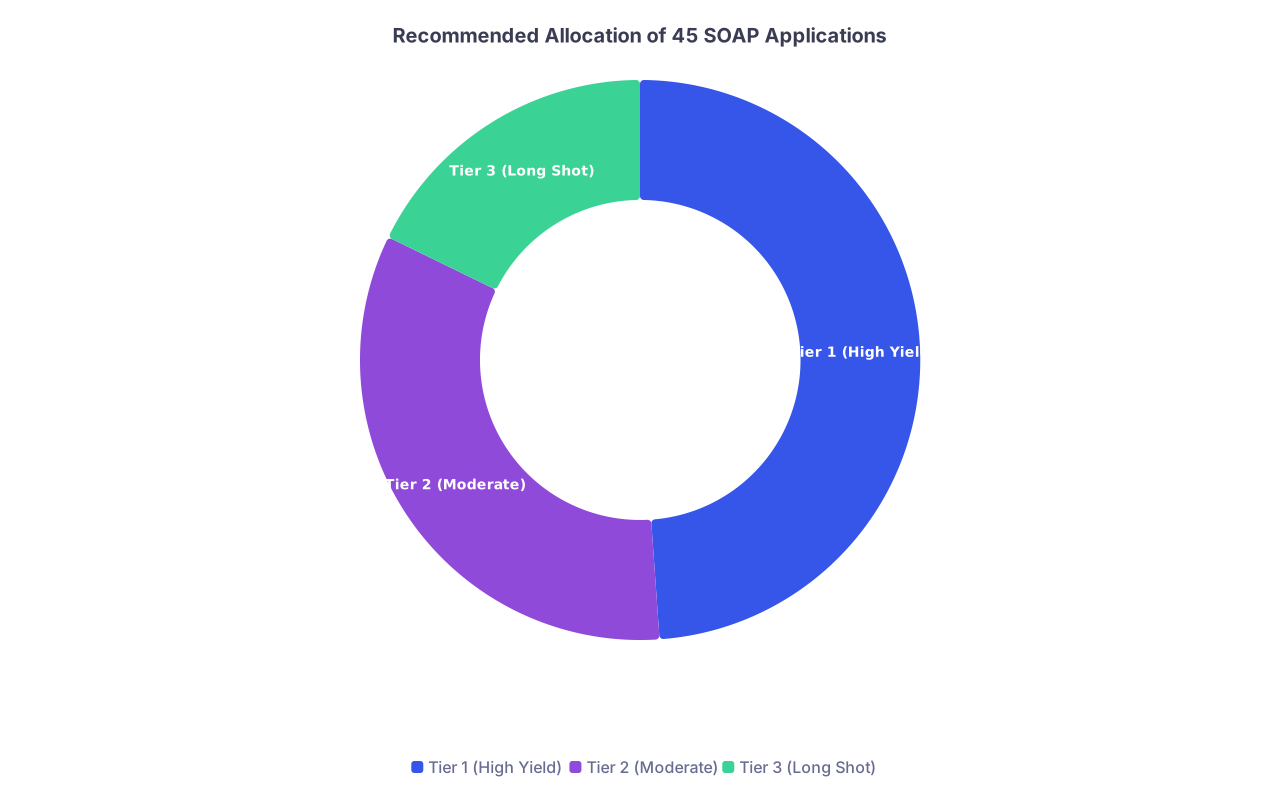
Make a tiered list:
- Tier 1: Most realistic + desirable (20–25 programs).
- Tier 2: Realistic but less ideal (15–20).
- Tier 3: Long shots or backup (whatever remains to hit 45).
| Category | Value |
|---|---|
| Tier 1 (High Yield) | 22 |
| Tier 2 (Moderate) | 15 |
| Tier 3 (Long Shot) | 8 |
Do not waste 10 applications on the one big-name IM program that never takes SOAP candidates. I have seen people do that. They end up with nothing.
Hour 4–7: Documents, ERAS Cleanup, and Core SOAP Letter
Time frame: Match Monday, ~3:00–6:00 p.m. ET
At this point you should be cleaning your ERAS, then writing one master SOAP letter that you adapt slightly by specialty.
7. Quick ERAS cleanup (30–60 minutes)
You do not have time to rebuild your application from scratch. But you do have time to de-weaponize it.
Focus on 3 things:
Personal statement(s)
- If your existing statement is neutral and generic for internal medicine, family med, etc., you can often reuse it.
- If your old statement screams “I only care about dermatology research,” write a SOAP statement:
- Shorter (3–4 paragraphs).
- Emphasize:
- Work ethic.
- Clinical performance.
- Teamwork.
- Your willingness to go where needed and grow from failure.
Program signaling
- If you signaled a hyper-competitive specialty, do not delete it backwards in time. But lean your ERAS narrative toward the SOAP targets:
- Move core clerkships and clinical experiences higher in the descriptions.
- Tone down niche research if it overshadows your clinical side.
- If you signaled a hyper-competitive specialty, do not delete it backwards in time. But lean your ERAS narrative toward the SOAP targets:
CV / experiences
- Remove anything that looks unprofessional, political, or controversial.
- Clarify any large gaps if not already explained.
This is not the time for perfection. This is damage control and clarity.
8. Write a master SOAP message template (60–90 minutes)
You need a core message you can adapt when programs call or email.
Core elements to write out:
Two-sentence explanation of why you did not match
No self-pity. No vague nonsense.Example:
- “I applied exclusively to categorical emergency medicine positions and limited my geography because of family considerations. I received a small number of interviews but unfortunately did not match, and I recognize my strategy was too narrow.”
Three key strengths relevant to SOAP specialties
- “Strong clinical performance in core rotations (Honors in IM, FM, Surgery).”
- “Consistently strong evaluations on teamwork and communication.”
- “Comfortable managing high-volume, high-acuity inpatient settings.”
One or two sentences tailored by specialty
- Internal medicine angle: interest in chronic disease management, complex patients.
- Family med: continuity, underserved care, full-spectrum interest.
- Prelim/TY: desire for broad base and plan to apply into [target specialty].
Write this out. Use it as:
- The skeleton for updated personal statement.
- The core of emails if your dean contacts PDs.
- Your spoken script during interviews.

Hour 7–9: Submitting Your SOAP Applications
Time frame: Match Monday, ~6:00–8:00 p.m. ET
By now you should have:
- A tiered program list.
- Clean-enough ERAS.
- One or two updated personal statements.
Now your priority is getting those 45 applications in before programs start seriously reviewing overnight.
9. Assign documents and submit strategically
Steps, in order:
Assign letters of recommendation
- Use broad, credible letters:
- Core IM, FM, Surgery, or Sub-I letters.
- Avoid hyper-specialized letters (e.g., “best dermatology researcher I have ever seen”) unless applying to that exact field.
- Make sure each program has at least 3 letters assigned.
- Use broad, credible letters:
Assign appropriate personal statement per specialty
- General IM / FM / Peds / Psych can usually share one “general primary care / inpatient interest” statement.
- Prelim/TY can share one “strong clinical base year” statement.
Submit in logical batches
- First: Tier 1 programs in your highest-priority specialty.
- Second: Tier 1 in secondary specialty (e.g., prelim med, TY).
- Third: Tier 2 and 3 to fill up to 45.
Do not obsess over the order within each tier. Time matters more than microscopic preference.
10. Confirm submission and document status
Before you log off ERAS for the night:
- Confirm:
- 45/45 applications used (or whatever number you decided).
- Each application has:
- Correct personal statement.
- 3–4 letters.
- Transcript and MSPE attached.
- Take screenshots of:
- Your list of applied programs.
- Any specialty distribution you want to remember quickly.
You will forget details when you are sleep-deprived. Screenshots save you.
Hour 9–14: Evening Before Offers – Prepping for Contact
Time frame: Match Monday, ~8:00 p.m.–Tuesday 1:00 a.m. ET
This is where many people make a critical mistake: they keep tinkering with ERAS instead of preparing to speak to PDs and coordinators.
At this point you should shift from paperwork to performance.
11. Build a one-page “SOAP quick sheet”
Make a one-page document you can glance at when a program calls:
Sections:
- Header: Your name, AAMC ID, phone number, email.
- Bullet list:
- Step scores / COMLEX scores.
- Class rank or quartile if known.
- Honors in key rotations.
- Any red flags already explained (one-line neutral explanation: “Remediated one clerkship in M3, subsequently passed with strong evals.”).
- Three one-line selling points:
- “Reliable, no-drama team player, comfortable with night shifts.”
- “Strong inpatient rotations with excellent feedback.”
- “Flexible about geography and patient population.”
Print it or have it open on screen during the day.
12. Practice core SOAP interview questions (1–2 hours)
You will not get traditional 30–60 minute interviews in most cases. You will get:
- 5–15 minute phone calls.
- Rapid Zoom chats.
- Occasional “panel” calls with PD + APD + chief.
Prepare answers to:
- “Can you briefly tell me about yourself?”
- “Why do you think you did not match?”
- “Why are you interested in our program specifically?”
- “If you join us, do you see yourself staying in this specialty long-term?”
- “What are your strengths and weaknesses as a resident?”
- “If you do not SOAP this year, what is your plan?”
Keep answers under 90 seconds each. No monologues.
Pair up with:
- Another unmatched classmate (if they are in a similar headspace).
- A partner / friend willing to role-play PD for 30 minutes.
13. Coordinate with your dean’s office / mentors
Before midnight, you should:
- Send your institutional advisor:
- Your final list of applied programs.
- A 3–4 sentence summary they can use if they call PDs on your behalf.
- Ask explicitly:
- “Are there any PDs you personally know at these programs?”
- “Can you reach out today or tomorrow morning?”
Sometimes those calls make no difference. Sometimes they do. You want that door at least cracked open.

Hour 14–22: Overnight – Sleep and Contingency Planning
Time frame: Late night Monday to early Tuesday morning
At this point, your applications are in and your scripts are prepared. You have two main jobs: sleep and clarity.
14. Get actual sleep
Yes, really. Residents can tell when someone is sleep-deprived and frantic on the phone. You sound worse. You think slower.
Aim for at least 5–6 hours. Minimum 4 if you really cannot settle.
Set alarms:
- Primary: 6:30–7:00 a.m. ET.
- Backup: 6:35 a.m. on a different device.
Phone on loud. Do not put your phone on Do Not Disturb.
15. Early Tuesday: Final clarity check (7:00–9:00 a.m. ET)
By early Tuesday, before the first offer round:
At this point you should:
Re-verify:
- You know exactly which specialties and programs you want to prioritize if multiple offers appear.
- You have your personal rank list of desired programs written out.
Review:
- Your quick sheet.
- Your core interview answers.
- Any notes on high-priority programs (1–2 bullet points each: community focus, ICU exposure, geographic ties).
Prepare your environment:
- Quiet space.
- Laptop charged.
- Headphones ready.
- Paper + pen for call notes.
Hour 22–24: Just Before the First Offer Window
Time frame: Tuesday morning, two hours before first SOAP offer round
Programs will be:
- Reviewing remaining applications.
- Conducting last-minute phone screens.
- Meeting as a ranking committee.
At this point you should be reachable, calm, and ready to commit.
16. Understand how offers will work
NRMP SOAP rules (always verify current year, but the structure is consistent):
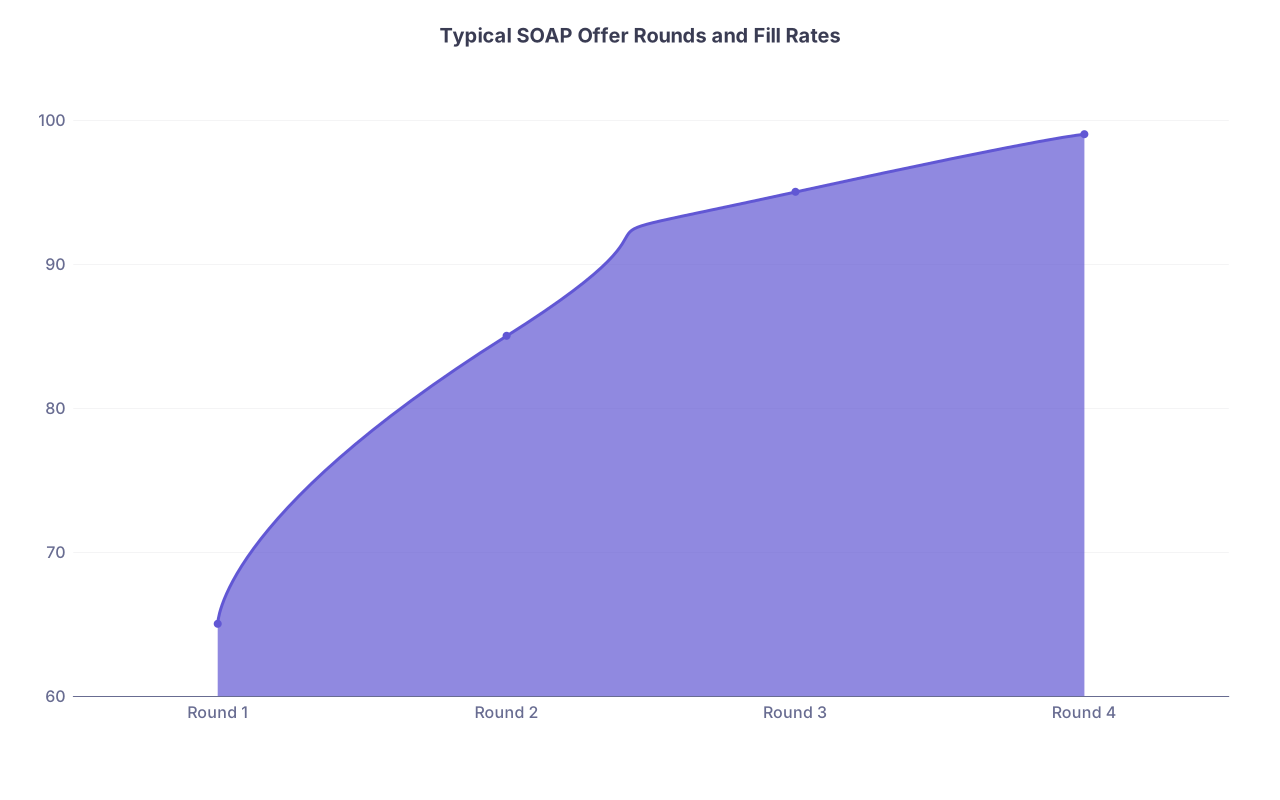
- There are multiple offer rounds Tuesday–Thursday.
- During a round:
- You may receive 0, 1, or multiple offers.
- You can:
- Accept one.
- Reject.
- Let them expire (which is usually worse than an intentional reject).
- Once you accept a position in SOAP, you are done. You are committed.
| Category | Value |
|---|---|
| Round 1 | 65 |
| Round 2 | 85 |
| Round 3 | 95 |
| Round 4 | 99 |
(The percentages are approximate fill rates across rounds: most spots go early.)
17. Create your personal pre-offer rank list
Programs will rank you. But you also need to rank them, before emotions hit.
Make a simple table for yourself:
| Rank | Program Name | Specialty | Type | Must-Accept? |
|---|---|---|---|---|
| 1 | Program A | IM Cat | Community | Yes |
| 2 | Program B | TY | Community | Yes |
| 3 | Program C | IM Cat | Rural | Yes |
| 4 | Program D | Prelim Med | University | Depends |
| 5 | Program E | Prelim Surg | Community | No |
Label for yourself:
- “Must-accept” if offered.
- “Depends” (if you want to compare if you get multiple offers).
- “No” if you would truly rather go unmatched and reapply. Be honest. These should be rare.
When the offer window opens, you should not be deciding from scratch. You should be matching the offer to this list.
18. Plan for multiple scenarios
Spend 15–20 minutes walking yourself through:
No offers in round 1
- You will feel punched in the chest. Pre-plan your reaction:
- Email / meet with advisor.
- Review if any misalignment in specialties or program types.
- Prepare for round 2 calmly, not destructively.
- You will feel punched in the chest. Pre-plan your reaction:
One offer from a “good enough” program
- If it is on your “must-accept” list: accept it.
- Do not chase hypothetical “better” offers that may never come.
Multiple offers, mixed quality
- Use your rank list. Not group chats. Not panic.
The First Offer Window: How to Act
When the first SOAP offer round opens (check the exact NRMP schedule for your year), you should have:
- Your phone on loud.
- Your email open.
- Your pre-made rank list in front of you.
As offers appear:
- Match the program to your rank list.
- Do not stall excessively. Offers have expiration rules.
- If it is a must-accept:
- Accept. Take a breath. You have a job.
- If it is “depends” and you also got others:
- Choose based on:
- Categorical > prelim (in most cases).
- Specialty fit for your long-term goals.
- Program stability and culture (from any intel you have).
- Choose based on:
What You Should Do Right Now
You may not be in SOAP week at this exact moment. But if you are reading this anywhere near Match season, your next step is simple:
Open a document and draft your 3-part SOAP script:
- Two sentences on why you might not match (narrow specialty, geography, late scores, etc.).
- Three bullet-point strengths that any PD would care about.
- One specialty-agnostic paragraph about why you will be a reliable, low-drama intern.
Type it out. Save it as “SOAP_Core_Script.md” or similar.
That way, if that unmatched email ever hits at 9:59 a.m. on Monday, you are not starting from zero. You are starting from a plan.