
The most dangerous Match Day mistake is emotional, not strategic: people burn the first 4 SOAP hours panicking instead of executing.
You do not have that luxury.
Below is exactly what to do from the minute you open the “We are sorry to inform you…” email through the end of Day 1 of SOAP. Hour by hour. Task by task. No fluff.
T‑0 TO T+30 MINUTES: THE EMAIL HITS
At this point you should stabilize and triage yourself before you touch ERAS.
T‑0 minutes: You open the “Did Not Match” email
You’ll feel your stomach drop. Your brain will want to spin stories: “I’ll never match,” “Everyone will know,” “I should have ranked more programs.”
Ignore all of that for the next 2 hours. You are now in an operations role, not a feelings role.
Immediately:
Physically move.
Walk out of the crowded auditorium/room. You need:- Quiet space
- Laptop + charger
- Reliable Wi‑Fi
- Your phone
- A notebook or Google Doc
Notify only 2–3 key people.
Do not blast group chats. Do not post. Tell:- Your dean’s office / student affairs contact
- One trusted mentor (ideally in your desired specialty)
- One emotional support person (who will not start drama)
Script:
“I just learned I did not match. I’m entering SOAP. Can we talk briefly by phone in the next 60–90 minutes?”Set your mindset rule for the day.
Write this on a sticky note / top of a doc:- “Purpose today: get any acceptable accredited position.”
- “I will not argue, blame, or spiral before 5 pm.”
You’ll come back to that when your brain tries to wander.
T+30 TO T+90 MINUTES: FACT‑FINDING AND ACCOUNT ACCESS
At this point you should get a clear operational picture: your status, your options, your support.
T+30–45 minutes: Confirm your status and tech access
Check NRMP and ERAS logins.
- Can you log in without issues?
- Are your documents visible (transcript, MSPE, LORs, USMLE/COMLEX)?
- Is your photo correct? (Yes, this still matters.)
Quick score and red‑flag inventory.
On your notebook or doc, list:- USMLE/COMLEX scores (Step 1, Step 2)
- Any failures or repeats
- Gaps, LOA, professionalism issues
- Specialty you applied to and number of interviews
This is not for shame. It’s for targeted SOAP strategy.
- Ping your dean’s office again if you have not heard back.
- Call, not email.
- Ask: “Who is the SOAP point person today? When can we review the unfilled list and my program list together?”
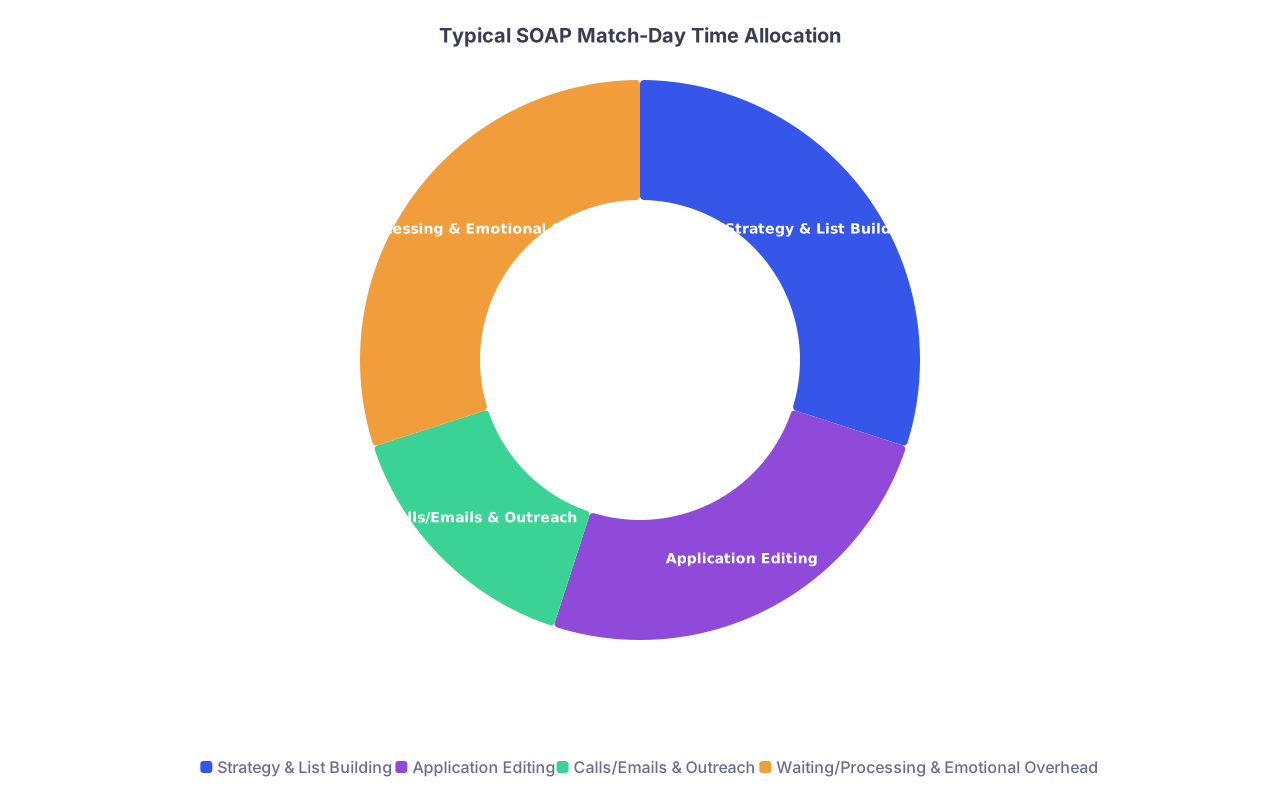
| Category | Value |
|---|---|
| Strategy & List Building | 30 |
| Application Editing | 25 |
| Calls/Emails & Outreach | 15 |
| Waiting/Processing & Emotional Overhead | 30 |
T+45–90 minutes: Gather the official SOAP tools
Pull up NRMP SOAP schedule.
Confirm exact times for:- Unfilled list release
- Application submission window opening
- Offer rounds on Day 1
Open a fresh “SOAP Master Sheet.”
Simple spreadsheet with columns like:- Program name
- Specialty
- State/region
- Categorical vs prelim
- Program ID
- Priority (1–3)
- Notes (connections, visa, step cutoffs, etc.)
- Applied? (Y/N)
- Heard back / status
You’ll fill this within the next 2–3 hours.
- Clarify your personal constraints.
On the same sheet or a second tab, write:- Must‑have: citizenship/visa constraints, absolute location no‑go’s (only if truly impossible), need for prelim vs categorical
- Nice‑to‑have: geography preferences, perceived prestige, lifestyle considerations
Be brutally honest: today is not “dream fit,” it’s “secure an accredited job that moves my career forward.”
WHEN THE UNFILLED LIST DROPS: FIRST 2 HOURS
At this point you should turn shock into a prioritized attack plan.
This is the most critical 90–120 minutes of your entire SOAP.
Step 1: Rapid scanning pass (30–45 minutes)
Once the unfilled list appears:
Filter by specialties that will realistically take you.
For most unmatched applicants, that means:- Internal Medicine
- Family Medicine
- Pediatrics
- Psychiatry
- Transitional Year
- Preliminary Surgery/Medicine (if you’re set on an advanced spot like Derm, Rad, Anes)
If you originally applied to something highly competitive (Derm, Ortho, ENT, etc.), assume those spots are long shots unless you’re a standout with a personal connection.
Hard filter by deal‑breakers.
- Visa: If you need one, filter by programs that sponsor.
- Exam failures: Some programs explicitly say no Step failures.
- Location: Only exclude locations you absolutely cannot live in for personal/safety/visa reasons. Not “I prefer coastal cities.”
Mark everything plausible on your Master Sheet.
For this first pass, you are not being precious. If there’s even a 20–30% chance you’d take it, it goes on the list.
Step 2: Build your actual target list (next 45–60 minutes)
You’ll likely have 40–120 plausible programs after the first pass. Now you sharpen.
Sort by specialty priority.
Decide your Day‑of‑Match hierarchy:- Tier 1: Categorical in a core field you can be happy in (IM, FM, Peds, Psych, etc.)
- Tier 2: Prelim or TY that keeps longer‑term options open
- Tier 3: “Only if absolutely necessary” (e.g., very remote, poor reputation, or specialty you are uncertain about)
Use your dean/mentor for reality checks.
Quick 10–15 minute call:- “Here are my scores and red flags.”
- “Here are the specialties and program types I’m targeting.”
- “Any programs or specialties I’m over/under‑valuing?”
Rank programs within each tier.
Use simple 1–3 priority scores:- 1 = Strongly prefer
- 2 = Acceptable
- 3 = Last‑ditch
Goal: by the time ERAS allows submission, you have at least 45–60 programs tagged and ranked so you can quickly pick your allotted number (typically 45 programs total per SOAP round).
| Program | Specialty | Type | Priority | Visa OK |
|---|---|---|---|---|
| Univ A IM | Internal Med | Categorical | 1 | Yes |
| Comm Hosp B FM | Family Med | Categorical | 1 | No |
| Univ C Peds | Pediatrics | Categorical | 2 | Yes |
| Comm Hosp D Psych | Psychiatry | Categorical | 1 | No |
| Univ E TY | Transitional Year | TY | 2 | Yes |
| Comm Hosp F IM | Internal Med | Prelim | 3 | No |
| Univ G Surg | Surgery | Prelim | 3 | Yes |
| Comm Hosp H FM | Family Med | Categorical | 2 | No |
| Univ I IM | Internal Med | Categorical | 1 | Yes |
| Comm Hosp J Peds | Pediatrics | Categorical | 2 | No |
PRE‑SUBMISSION: DOCUMENTS AND ERAS CLEANUP (1–2 HOURS)
At this point you should make sure your application is “SOAP‑ready” before the submission window opens.
1. Personal statement: fast rewrite, not a novel
If you only applied to one specialty originally, you may already have a usable statement. But SOAP often pushes you into a different specialty or into prelim/TY.
You need, at minimum:
- One targeted PS for your primary SOAP specialty (e.g., IM/FM/Peds/Psych)
- One brief PS for prelim/TY (if you’re applying to those)
Keep it to 3–4 short paragraphs:
- Opening: One or two lines tying you to that specialty (a specific rotation moment works).
- Middle: Concrete evidence: rotations, sub‑Is, research, or work that shows you can do this job.
- Address the elephant (briefly):
- Example: “While I did not match in the main residency Match this year, the process clarified that I am most aligned with Internal Medicine…”
- Closing: Commitment to growth and being a reliable team player.
Do not:
- Apologize for 4 paragraphs.
- Blame programs, the system, COVID, etc.
- Write long explanations for every gap or failure. One sentence is enough.

2. Letters of recommendation: triage, don’t overhaul
You cannot chase new letters on SOAP Monday. Use what you have intelligently.
- If your original letters were specialty‑specific (e.g., Ortho) and you’re now aiming for IM/FM/Peds:
- Prioritize any general medicine, inpatient, or sub‑I letters.
- If you have a strong “student affairs dean” letter, keep it active.
- Remove any letter that actively works against you (e.g., a known lukewarm or generic letter in a now‑irrelevant specialty).
Ask your dean’s office if they can quickly upload a SOAP‑specific support letter summarizing your strengths and addressing why you didn’t match. Some schools do this routinely.
3. ERAS application content: minor edits only
You do not have time for a full rewrite.
You can:
- Update specialty preference in your experiences descriptions slightly (emphasis on teamwork, continuity of care, complex medical management).
- Quick‑edit glaring typos.
- Add one or two key recent experiences if they clearly improve your story.
You should not:
- Massively change everything and risk breaking consistency.
- Invent anything. People do get called on inconsistencies during SOAP.
APPLICATION SUBMISSION WINDOW OPENS: THE FIRST 1–2 HOURS
At this point you should submit quickly but not blindly. Speed matters. So does alignment.
1. Choose your 45 (or allotted) programs
Using your Master Sheet:
- Start with Tier 1 categorical spots in realistic specialties.
- Load as many of these as your cap allows.
- Add Tier 2 prelim/TY and slightly less ideal categorical programs.
- Only fill with Tier 3 if you’re short.
You want a balanced, realistic list. Forty‑five applications all to hyper‑competitive programs is functionally the same as ten.
2. Pair the right personal statement with the right program
ERAS allows you to choose which PS goes to which program.
- For IM/FM/Peds/Psych categorical: send the targeted statement for that specialty.
- For TY and prelim: send your prelim/TY PS.
- Do not send a surgery‑heavy letter to a FM program if you can avoid it.
Double‑check a small batch, then move faster. Perfectionism kills SOAP outcomes.
3. Submit in waves, not one by one
Strategy:
- Load a first wave of ~20–25 high‑priority programs and submit within the first 30–45 minutes.
- Then load the next 20–25 slightly lower priority but still acceptable programs.
The point: You don’t want to be submitting your top‑choice programs 3 hours after everyone else. Commit and move.
AFTER SUBMISSION: HOURS OF SILENCE AND PREPARATION
At this point you should assume you might get a call or email at any time and be ready within minutes.
1. Build your “SOAP call kit”
Have this open on your laptop and phone:
- One‑page summary:
- Name, med school, graduation year
- Scores, citations of any failures (with one‑line context)
- Top 3 reasons you’re a good fit for IM/FM/Peds/Psych (custom bullet list)
- A 30‑second intro script:
- “I’m [Name], a fourth‑year at [School]. I applied originally in [Specialty] but realized [X] about my interests and strengths, which aligns well with [SOAP specialty]. I’ve had strong experiences in [rotations], where I [brief concrete example]. I’d be excited to contribute as a [PGY‑1 in X].”
- A brief, honest explanation for not matching:
- Rank‑order problem (“I limited my list too narrowly”)
- Late score, weak interview season, or shift in specialty
- Red flag you’ve rehearsed explaining in 2–3 sentences
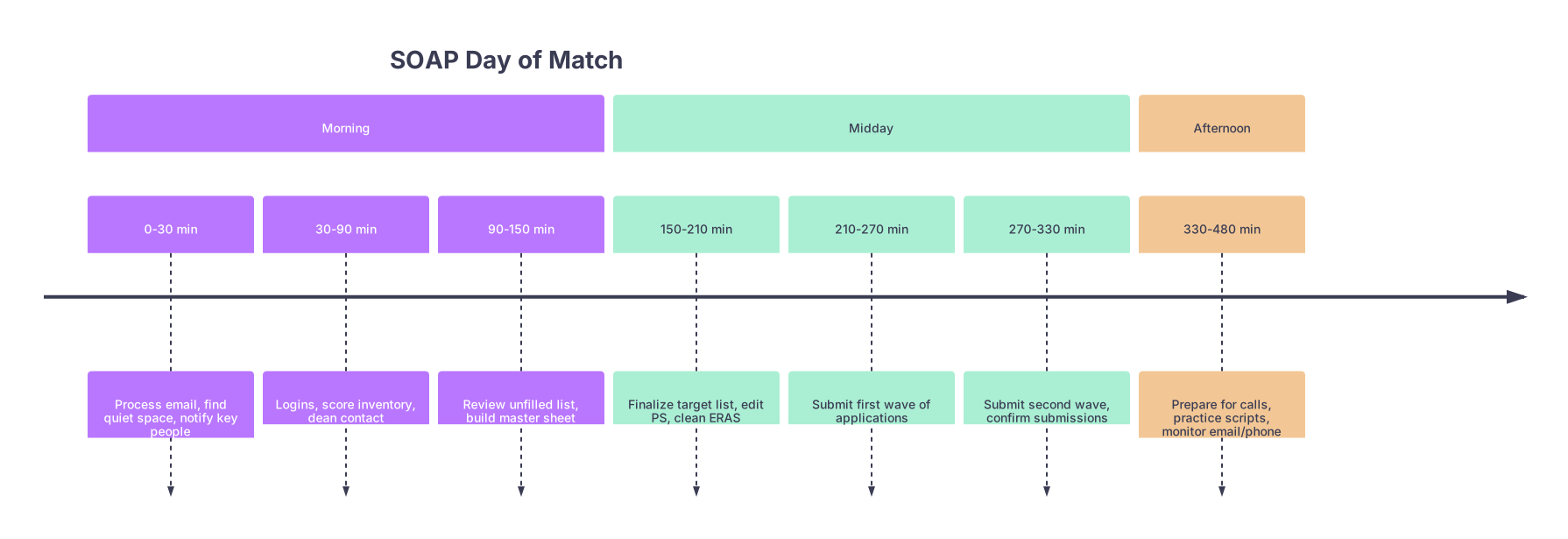
| Period | Event |
|---|---|
| Morning - 0-30 min | Process email, find quiet space, notify key people |
| Morning - 30-90 min | Logins, score inventory, dean contact |
| Morning - 90-150 min | Review unfilled list, build master sheet |
| Midday - 150-210 min | Finalize target list, edit PS, clean ERAS |
| Midday - 210-270 min | Submit first wave of applications |
| Midday - 270-330 min | Submit second wave, confirm submissions |
| Afternoon - 330-480 min | Prepare for calls, practice scripts, monitor email/phone |
2. Physically anchor yourself
- Stay in one quiet location with:
- Strong Wi‑Fi
- Outlets
- Water and easy snacks
- Bathroom breaks: take your phone with you, ringer on, vibration on.
You do not want to miss a program director calling from a random area code.
3. Practice 3–4 mini‑interviews out loud (20–30 minutes)
Common SOAP‑day questions:
- “Why are you interested in our program?”
- “Why [specialty] now when you originally applied in [other specialty]?”
- “Tell me about your failure / gap / lower score.”
- “If we offer you a position, will you come?”
You don’t need polished, Step 2‑style answers. You need honest, concise, and calm.
RESPONDING IN REAL TIME: CALLS, EMAILS, AND OFFERS
At this point you should treat every contact like a real interview and every verbal commitment like it’s binding.
When a program emails requesting interest or a quick call
Respond within minutes:
- Short, direct email:
- “Thank you for reaching out. I remain very interested in [Program] for [Specialty]. I’m available for a call at [times] today and can speak on short notice. Phone: [number].”
- Do not ask basic things you could have Googled.
- Skim the program website for 3–5 minutes before any call.
On the phone with a PD or APD
Remember:
- They are moving fast. They might be talking to dozens of applicants.
- You have about 5 minutes to sound competent, sane, and interested.
Core moves:
- Lead with your 30‑second intro.
- Directly address why you’re in SOAP, once. Then move on to fit.
- If asked about commitment, don’t be cagey.
- If you would definitely take an offer: “If you’re able to offer me a position, I would be honored to accept and commit.”
- Do not give that line to multiple programs casually. Your reputation follows you.

Handling actual SOAP offers
When the formal SOAP offer round occurs (through NRMP):
- You cannot “hold” multiple SOAP offers; you accept or decline within the system.
- If you get an offer from a program you pre‑decided you would accept:
- Accept it. Do not overthink.
- If you get an offer from a borderline program:
- This is where your morning priorities list saves you. Check where you ranked that type of program.
- Remember: having a residency spot beats a theoretical “better” that never materializes.
I’ve watched students decline early solid offers chasing a fantasy and end SOAP unmatched. That’s a brutal, avoidable outcome.
EMOTIONAL TRIAGE THROUGHOUT THE DAY
At this point you should protect your focus and limit emotional interference.
Practical rules:
- No group chats while you’re making program lists or taking calls.
- No doom‑scrolling Reddit/SDN “SOAP megathreads” between offer rounds.
- Set 2 scheduled check‑ins:
- One with your dean/mentor
- One with your support person
- When you feel shame spike: stand up, walk around the room, read your sticky note (“Purpose today: get any acceptable accredited position.”)
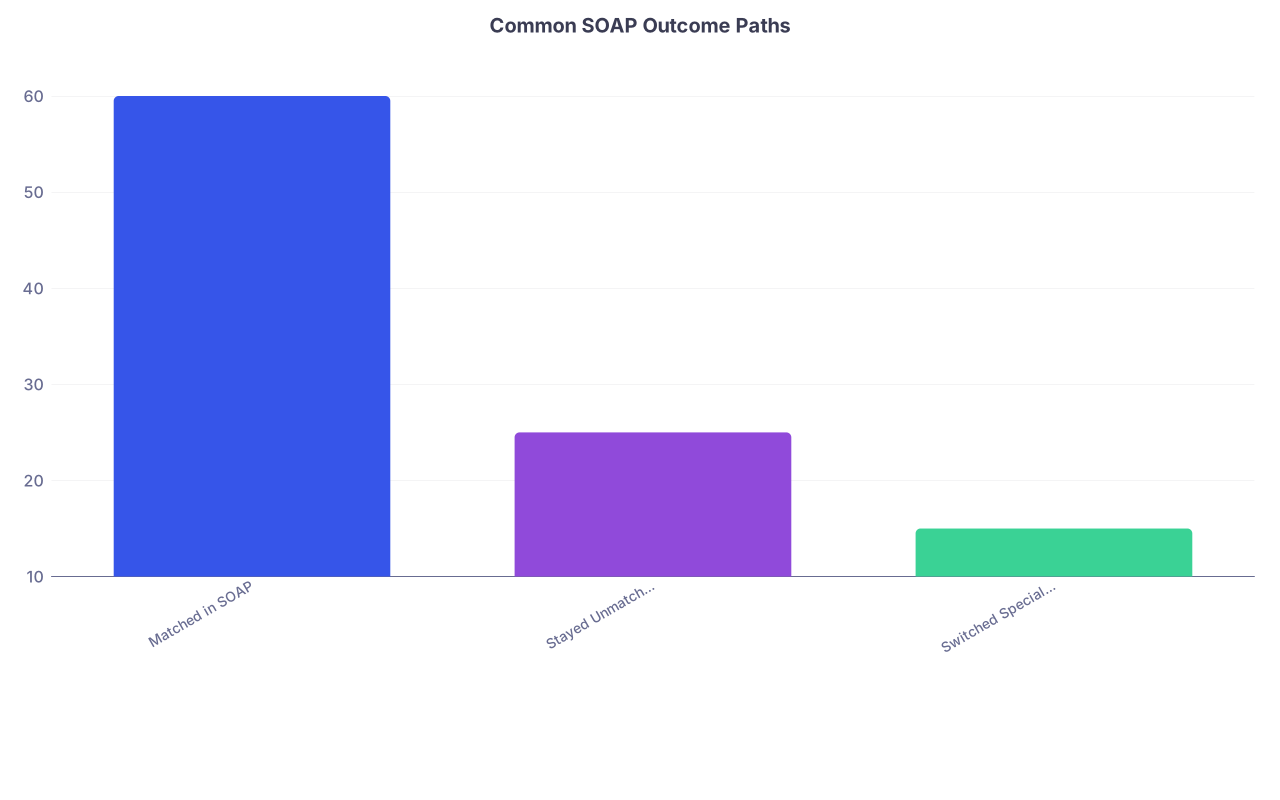
| Category | Value |
|---|---|
| Matched in SOAP | 60 |
| Stayed Unmatched, Reapplied Next Year | 25 |
| Switched Specialty During SOAP | 15 |
END OF DAY 1: CONSOLIDATE AND PLAN NEXT MOVES
Whether you receive and accept an offer or not, you need a closing routine for Day 1.
If you accept an offer
At this point you should:
Confirm in writing.
- Screenshot NRMP acceptance.
- Save any confirming emails from the program.
Notify your dean’s office.
- They need to update records and may help with onboarding logistics.
Shut down SOAP activity.
- Stop contacting other programs.
- Do not second‑guess your decision out loud to PDs or coordinators.
Then, and only then, let yourself feel things. Relief, disappointment, whatever. But preserve the relationship with your new program by staying steady in your communication.
If you do not get an offer on Day 1
At this point you should avoid catastrophic thinking and prep for the remaining rounds.
Review your application data with your dean/mentor.
- How many programs did you apply to?
- Any immediate red flags that came up in calls?
- Are there additional programs you can still add within your cap if more spots open?
Decide if you need to adjust specialty emphasis.
- Maybe you need to lean more heavily into FM vs IM.
- Or accept that a prelim year is the right bridge this cycle.
Set tight behavioral rules for the night:
- No big social gatherings.
- Limit replaying every conversation in your head.
- Aim for 6–7 hours of sleep if you can. Tomorrow may bring new movement.

THE CORE TAKEAWAYS
Speed + structure beats panic. The first 2–3 hours after learning you didn’t match are for building a prioritized, realistic target list and getting your application SOAP‑ready—not for spiraling.
Decide your rules before the offers come. Pre‑rank program types and specialties so that, when a SOAP offer hits, you already know whether to accept. Day‑of bargaining with yourself usually ends badly.
Treat every contact like a condensed interview. Have a 30‑second intro, a two‑sentence explanation for not matching, and a clear statement of interest ready. Calm, concise, and consistent wins SOAP, not desperation.