
Being unmatched with barely any interviews does NOT automatically doom your career — but it does change the game you’re playing.
Let me say the thing you’re probably too scared to say out loud: you’re wondering if you’ve just ruined your life. That this one Match cycle with a tiny interview list (or zero) means you’re done. That programs have decided who you are forever.
You’re not crazy for thinking that. I’ve heard versions of this from real people:
- “No one will ever rank me now. I’m damaged goods.”
- “If I SOAP once, I’ll never match into anything decent.”
- “I picked the wrong specialty and now I’m trapped.”
- “I had two interviews. That’s basically nothing. I’m screwed.”
Here’s the uncomfortable mix of truth and reassurance:
You’re not doomed. But you also can’t keep doing what you just did and expect a different result.
Let’s walk through this like someone who is terrified, exhausted, and still has to decide what to do this week.
Step One: Admit How Bad This Feels (You’re Not Overreacting)
You didn’t just “not get a job.” You spent:
- Years of med school
- Thousands of dollars on exams and ERAS
- Endless nights worrying about scores, grades, LORs
And then your ERAS dashboard basically said:
“Thanks for playing. Try again next year. Maybe.”
If you had only 0–3 interviews, you’re in that awful gray zone. Enough interest to get your hopes up. Not enough to feel safe.
And if you’re officially unmatched now? Your brain is probably doing the catastrophe spiral:
- “Programs saw my app and didn’t want me. That means everyone will always reject me.”
- “SOAP is just scraps—only the worst applicants end up there.”
- “If I SOAP into a prelim/TY, that’s the kiss of death.”
- “My school will think I’m a failure.”
- “My classmates will all move on while I freeze in place.”
Let me be blunt: those thoughts are emotionally understandable. But they’re strategically useless. And a lot of them are flat-out wrong.
You are not branded for life as “the unmatched one.”
But if you let shame run the show, you’ll make bad decisions this week that actually will hurt your long-term options.
So we’re going to do two things at the same time:
Hold space for the panic.
And act like a ruthless strategist anyway.
What Limited Interviews Actually Mean (Versus What Your Brain Says)
When you only got a handful of interviews, your brain turns it into a character judgment. Programs don’t think like that. They think in numbers and filters.
Here’s what limited interviews usually mean in real life:
- You were filtered out at the “checkbox” level (scores, attempts, graduation year, visa, no Step 2, etc.)
- Your specialty list was too narrow or too competitive for your exact stats
- Your school or geography limited your exposure
- Your personal statement / experiences / letters didn’t clearly tell a story that screamed “pick me”
- Or you submitted late and got buried
None of those are permanent character defects. They’re tactical problems.
To make this less abstract:
| Interview Count This Cycle | How Bad Is It? | Future Match Outlook |
|---|---|---|
| 0 | High risk | Still salvageable with major changes |
| 1–2 | Very fragile | Needs restructuring + broader list |
| 3–4 | Borderline | Often matchable with better targeting |
| 5–7 | Moderate | Many still match; reapplicants usually fix strategy |
This year’s interview count is not a prophecy. It’s feedback. Brutal, yes. But feedback.
SOAP With Limited Interviews: Is This Your “Last Chance”?
Here’s the question gnawing at you:
“If I go through SOAP and end up in something random, am I locking in a bad path forever?”
No. But you can make choices in SOAP that paint you into a corner. Especially if you’re panicking.
Let’s untangle what SOAP actually is and what it isn’t.
SOAP is:
- A chaotic, fast, numbers-driven scramble
- Programs trying to plug holes in their schedules
- A place where dozens of solid, normal applicants land every single year who later successfully rematch
SOAP is not:
- A shame mark that everyone secretly uses to blacklist you forever
- Proof that you’re not “doctor material”
- A one-way drop-chute into the worst specialties
But. SOAP decisions do have consequences. The main fork in the road:
- Do you SOAP into something now, even if it’s not your dream?
- Or do you not SOAP / fail to SOAP, regroup, and come back stronger next year?
To even begin answering that, you need a clear picture of your actual competitiveness.
Cold, Honest Audit: How Bad Is My Application Really?
You can’t fix what you’re too afraid to examine.
You probably already know where your weak spots are, but let’s lay them out. Most “limited interview” stories include at least one of these:
- USMLE/COMLEX scores: near or below the typical cutoffs for your specialty, or multiple attempts
- Specialty choice: aiming at hyper-competitive fields (Derm, Ortho, ENT, Plastics, Ortho, some IM subspecialty-intent) without matching stats
- Red flags: LOA, professionalism issues, failed courses, gaps with weak explanation
- Late or messy application: late ERAS submission, late letters, vague personal statement, scattered experiences
- Geography constraints: you only applied to one region or radiused your applications tightly
- Too few programs: you applied to 20–40 places in a field where most people like you need 80–120+
Here’s the part that hurts:
If nothing major changes, next year will probably look a lot like this year.
But that sentence cuts both ways:
If you do make major, targeted changes, your next cycle doesn’t have to repeat this nightmare.
Should I Take Any SOAP Spot Or Sit Out And Reapply?
This is the decision that keeps people up at 3 AM refreshing their email.
Let’s be very honest. Both paths have risks.
If you SOAP into a prelim/TY or non-ideal specialty
Pros:
- You stay clinically active and current
- You get US clinical experience and real attendings who can vouch for you
- You get a paycheck and avoid the “what are you doing this year?” question
- You show programs you can handle residency-level work
Cons:
- You may have less time and energy to massively rework your application
- If you don’t plan well, you can end up stuck repeating a prelim situation multiple years
- Some programs may assume you’re committed to that specialty unless you’re explicit
If you don’t SOAP (or don’t match through SOAP) and take a gap year
Pros:
- Time to fix big structural problems: research, Step 3, observerships, extra degrees, etc.
- You can shift specialties strategically based on your real profile
- You can rebuild your narrative and relationships in a focused way
Cons:
- Explaining the gap poorly can hurt
- Financial and emotional strain
- If you waste the year (no structure, no clear plan), you’ll be in a worse position
There’s no universal right answer. But here’s my personal rule:
If the SOAP position:
- is in a field you can at least tolerate long-term
- or is a prelim year in a place that has real pathways to categorical spots
- and you’re not completely opposed to pivoting specialties
…then taking it is often better than disappearing for a year with no plan.
If the SOAP position is:
- in a specialty you know you’ll hate and never want to stay in
- in a chronically malignant place everyone warns you about
- or would block you from doing the work necessary to fix your app
…then saying no and intentionally reapplying can be smarter.
This isn’t about pride. It’s about future flexibility.
Does Being Unmatched Once Permanently Stain Me?
You’re terrified programs will secretly label you as defective: “reapplicant = reject.”
Some will quietly screen you more harshly. That’s reality. But a lot won’t.
What matters isn’t that you unmatched. It’s what you did after.
Program directors care about patterns:
- Did you pass Step 3?
- Did you get strong new letters from people who actually know your work?
- Did you show up consistently in a clinic, research lab, or residency setting and prove reliability?
- Did you apply more smartly this time—wider net, realistic specialties, earlier submission?
I’ve seen people who:
- Unmatched in Surgery with 1–2 interviews → did a strong prelim → matched categorical IM, then later cardiology.
- Unmatched in Psych → did a clinical research year with 2–3 publications → matched Psych the next year.
- Unmatched FM with 0 interviews → took a structured hospitalist scribe + Step 3 + observership route → matched FM on second or even third try.
Were those paths fun? No. Brutal. Humbling. Lonely.
But “unmatched once” did not bar the door. Their response to it is what mattered.
How To Use SOAP Week When You’re Terrified And Tired
SOAP week is not the week to completely reinvent yourself. It’s triage.
Here’s how to approach it if you feel like a walking disaster:
Get a real human to look at your app today.
Not your mom. Not just a classmate. An advisor, dean, or faculty who’s seen many match cycles. Tell them you want brutal honesty:
“If I reapply next year, what specifically has to change?”Decide your red line.
Before the SOAP chaos, decide what specialties/locations you absolutely won’t accept, even if you panic later. Write it down. Emotions will spike when offers come in. You need that anchor.If you SOAP into something:
- Show up and treat it like the most important year of your career.
- Tell your PD or trusted faculty (when appropriate) about your long-term plans in a professional way. Not “I hate this specialty,” but “I’m deeply interested in X and might pursue categorical training there later; I want to do the best job possible here.”
If you don’t SOAP or decide not to:
You must treat the next 12 months like a full-time, structured rehab program for your application. Half-effort here is how people end up unmatched multiple years in a row.
If I Reapply, How Do I Actually Fix This?
You’ve probably heard a ton of vague advice: “Do research! Get stronger letters! Broaden your list!” That’s not enough.
You need specific, measurable moves.
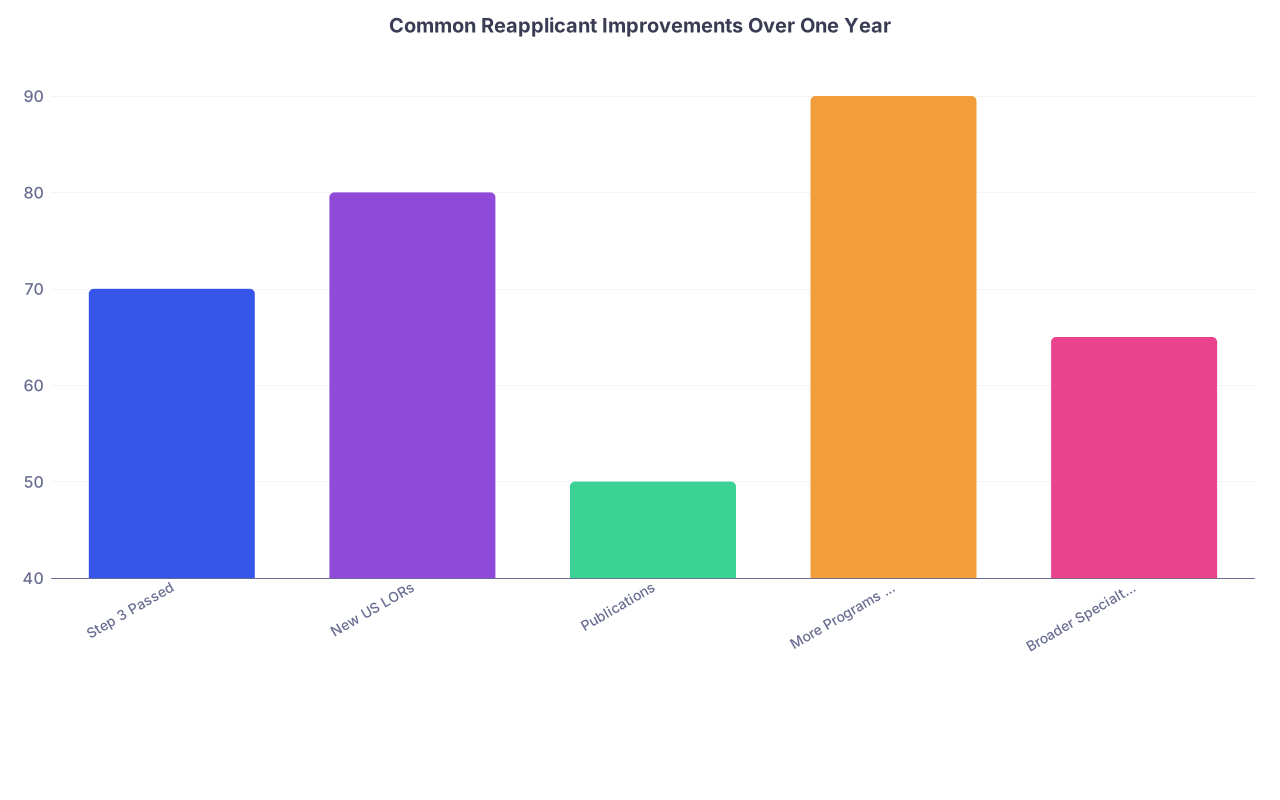
| Category | Value |
|---|---|
| Step 3 Passed | 70 |
| New US LORs | 80 |
| Publications | 50 |
| More Programs Applied | 90 |
| Broader Specialties | 65 |
For a lot of unmatched applicants, successful reapplication usually involves a combo of:
- Passing Step 3 (huge for PDs worried about exams)
- Getting 2–3 new letters from people who have seen you clinically for months
- Pivoting to a less competitive specialty that still fits your interests and personality
- Applying to far more programs in more regions
- Rewriting your personal statement and experiences so they actually sound like a clear, coherent person, not a generic template
And you need to be honest about specialty choice. If you’re sitting on a 215–220 Step score dreaming of Derm or Ortho with no research, you’re not “chasing your dreams.” You’re ignoring the data.
Choosing a more realistic specialty is not failure. It’s refusing to stay stuck.
Emotionally: How Do I Live With This Feeling Of “Falling Behind”?
This is the quiet part that no one likes to admit:
Watching your classmates post “Matched!!!” while you’re sitting there refreshing your email is nauseating.
You might feel:
- Ashamed to show your face at school
- Terrified of family questions
- Physically sick thinking about graduation
- Completely alone
You’re not behind in some moral or existential way. You’re on a different timeline. That’s it.
Years from now, when everyone is stuck in the grind of RVUs and call schedules, no one’s going to sit there counting who matched PGY-1 vs PGY-2 vs PGY-3. They’ll care if you’re competent, decent to work with, and good to your patients.
But right now, it feels like your life is over.
It isn’t. It just got messier and more complicated than the brochure version.
That doesn’t mean it’s ruined. It means you’ll have to be more deliberate than some of your peers who slid through on the first try.
You can handle that. Even if your brain is screaming that you can’t.
Quick Reality Check: Are You Doomed?
Let’s be mercilessly clear.
You are not doomed if:
- You’re willing to accept that your original plan may need to change
- You’ll do unglamorous work this year (research assistant, observerships, prelim grind)
- You’ll apply more broadly and strategically next time
- You’ll let people help you instead of hiding out of shame
You are at higher risk of long-term problems if:
- You double down on the same specialty with the same application
- You refuse to get feedback because it’s uncomfortable
- You waste the next year doing nothing structured
- You let ego, pride, or denial run your decisions
The Match is not a moral judge. It’s a system. You learned this year that the way you moved through that system didn’t work. That’s all.
You can learn the system better. Or keep doing the same thing and call yourself cursed. One of those leads somewhere.

| Step | Description |
|---|---|
| Step 1 | Unmatched or Few Interviews |
| Step 2 | Planned Gap Year |
| Step 3 | Start Prelim or Categorical |
| Step 4 | Reassess and Plan Reapplication or Stay |
| Step 5 | Step 3, Research, Clinical Work |
| Step 6 | Reapply Strategically |
| Step 7 | SOAP Offer? |
| Step 8 | Acceptable Program? |

FAQ: Six Questions You’re Probably Too Afraid To Ask Out Loud
1. If I SOAP, will future programs look down on me forever?
Some might pause. Most won’t, if you show growth. What they really care about is: did you use that SOAP year to prove you can function as a resident, get solid evaluations, and collect strong letters? “SOAP once, then crushed my prelim year and reapplied smartly” is not a death sentence. It’s a story of persistence. How you frame it (and what you actually did) matters more than the word “SOAP.”
2. I only had 1–2 interviews. Does that mean no one will ever want me?
It means this specific strategy with this exact application didn’t work. It doesn’t mean you’re unmatchable. I’ve seen people go from 1–2 interviews to 10–15 the next year when they: passed Step 3, pivoted specialties, broadened geographically, and fixed their letters/personal statement. Your interview count is feedback, not a forever verdict.
3. Should I switch specialties now or try again in the same one?
Brutal honesty time: if you were far below average for your chosen specialty (scores, research, etc.) and still got almost no interviews even with a broad list, switching is usually the smarter move. If you were close to competitive and made clear tactical mistakes (late apps, too few programs, missing Step 2/3), you might have a real shot staying in the same field—but only if you fix those specific issues. This is where a faculty advisor who knows your full story is invaluable.
4. Will taking a research or gap year make me look weak?
A vague, unproductive gap year looks weak. A clearly structured year—research with output, strong US clinical experience, Step 3, deeper involvement in a specialty—actually makes you look more mature and committed. Programs love applicants who can say, “I got knocked down, here’s what I did with that time, and here’s what I learned.”
5. Is it better to take a bad prelim spot or no spot at all?
A truly toxic prelim with no support, chronic duty hour violations, and a reputation for burning through interns can hurt you more than help. But a solid prelim/TY year where you can thrive, learn, and get strong letters is often better than nothing—especially if you’re switching into IM, Anesthesia, Neuro, etc., where prelim training is relevant. The question isn’t “bad vs none.” It’s “is this a place where I can get good evaluations and not fall apart?”
6. What should I do today if I’m unmatched and panicking?
Three concrete moves:
First, email or message your dean’s office or advisor and say, “I need an urgent match/SOAP/reapplication strategy meeting. I’m willing to hear hard feedback.” Second, make a written list of what you think went wrong this cycle, even if you’re unsure. Take it to that meeting. Third, decide in advance your SOAP boundaries—what you’re willing to accept and what you’re not—so you don’t decide purely out of panic when the clock is ticking.
Open your ERAS application (or PDF of it) today and, in a different color or with comments, mark every section you already suspect is weak—scores, letters, experiences, specialty choice, personal statement. That marked-up document is your starting map. Don’t close it and run away. Sit with it for 20 minutes and write, in plain language, “If I had to fix just three things before next cycle, they’d be…” That’s your first real move out of this hole.