You failed an M1 exam. The shame hits fast. The panic follows right behind. But here's the reality: one bad performance does not mean you're unfit for medicine. It doesn't mean you've let your family down. It means something went wrong, and you need to find it and fix it, fast, without torching the rest of your life in the process.
I've seen this exact scenario play out dozens of times. Smart students. Dedicated students. Students with spouses and kids who are terrified this one result will unravel everything. It won't. Not if you respond like the professional you're becoming, not like a panicked undergrad.
This article is your no-nonsense recovery guide. It's built for people who don't have the luxury of locking themselves in a library 16 hours a day. You've got a family at home. That means the plan has to be different, smarter, tighter, and grounded in real-life constraints. Let's walk through it.

You Failed an M1 Exam. First: What It Means and What It Doesn't
Right now, your brain is screaming "I don't belong here." That's fear talking. A failed M1 exam is a performance problem. That's it. Not a character flaw. Not a prophecy. It means the way you studied didn't match what the exam demanded. Maybe you missed the forest for the trees. Maybe you choked on timing. Maybe you were so sleep-deprived you couldn't think straight. None of those make you a bad future doctor.
Stop catastrophizing. In the first 24 hours, do not make any irreversible decisions. Don't quit medical school in your head. Don't send a panicked email to the dean. Don't skip all meals. You are in the acute emotional phase, and everything feels worse than it is.
The extra weight you're carrying as a parent or partner is real. I know you feel like you're failing on two fronts: the exam and the family. But let's separate the facts. You got a low score on one test. That is a data point. It tells you something was off. So your job now is to gather information, not to spiral. I'll tell you exactly how in the next section.
The First 48 Hours: Stabilize, Don't Spiral
Your first two days after the result are about damage control, both academically and emotionally. Use this simple framework:
- Breathe and stop doom-scrolling. No comparing yourself to classmates who passed. No reading every post on Reddit about M1 failures. That's fuel for the fire, not a solution.
- Get the facts. Download the score report. Which areas tanked? Was it one block (biochemistry, physiology) or everything? Look at the distribution if it's available. You need the raw data.
- Read the school's remediation policy. Right now. Not tomorrow. Find out: Is there a retake? A supplemental exam? When is it? What's the passing threshold? What happens if you fail the remediation? This is not the time to guess. Open the student handbook. Print it. Highlight it.
- Tell your partner or a trusted person. Say it in plain language: "I failed an exam. It's not the end, but I need to make a plan. Here's what I know so far and what I'm doing." More on this later.
- Sleep and eat. A fried brain can't plan. If you stay up all night agonizing, you'll make bad decisions tomorrow. Trust me.
I've watched students skip step 2 and 3 and immediately start cramming for a retake they don't understand. That's how you fail twice. Don't be that person.
By the end of 48 hours, you should know the "what" and the "when." Now we move to the "how."
How to Recover Academically Without Burning Out Your Household
Here's where most students with families go wrong. They panic and decide to study every waking minute, so they cancel family dinner, skip bedtime routines, and snap at their kids. That strategy backfires. The house becomes a stress pressure cooker, your partner feels abandoned, and your retention actually drops because you're not managing cognitive load.
You need a focused reset, not a time-based one.
Step 1: Find the real problem. Sit down with your exam feedback and ask: Was it a content gap (I never memorized the Krebs cycle intermediates) or a strategy gap (I ran out of time, I second-guessed every answer)? Test anxiety is a real factor too. Be honest. I've had students who'd've aced the material in a tutorial but froze when the clock was ticking. That's not fixed by more reading.
Step 2: Strip your resources down. Pick one primary resource, textbook, video series, or review book, and one question bank. That's it. More resources = more overwhelm. I've seen students drown in seven different review sheets and end up knowing a little bit about everything and not enough about anything.
Step 3: Switch to active recall and spaced repetition. Stop passive reading. Make flashcards for the weak areas, draw concept maps, do practice questions in timed blocks. For M1 material, 30-40 questions a day, reviewed thoroughly, beats 12 hours of highlighting.
Step 4: Build a daily schedule with hard boundaries. Block your calendar into study windows and family windows. For example:
- 8:30 a.m., 12:30 p.m.: Block 1 (focused, no phone)
- 12:30 p.m., 1:30 p.m.: Lunch, check in with partner
- 1:30 p.m., 5:00 p.m.: Block 2 (practice questions + review)
- 5:00 p.m., 7:30 p.m.: Family time, dinner, kids' bedtime
- 8:00 p.m., 10:00 p.m.: Block 3 (light review or catch-up)
If you have childcare, use it. If you need to swap duties with your partner for a few weeks, negotiate that. Tell your children in age-appropriate language: "Mommy/Daddy has a big test to study for, so things might look a little different for a while. But we still have our special time after dinner."
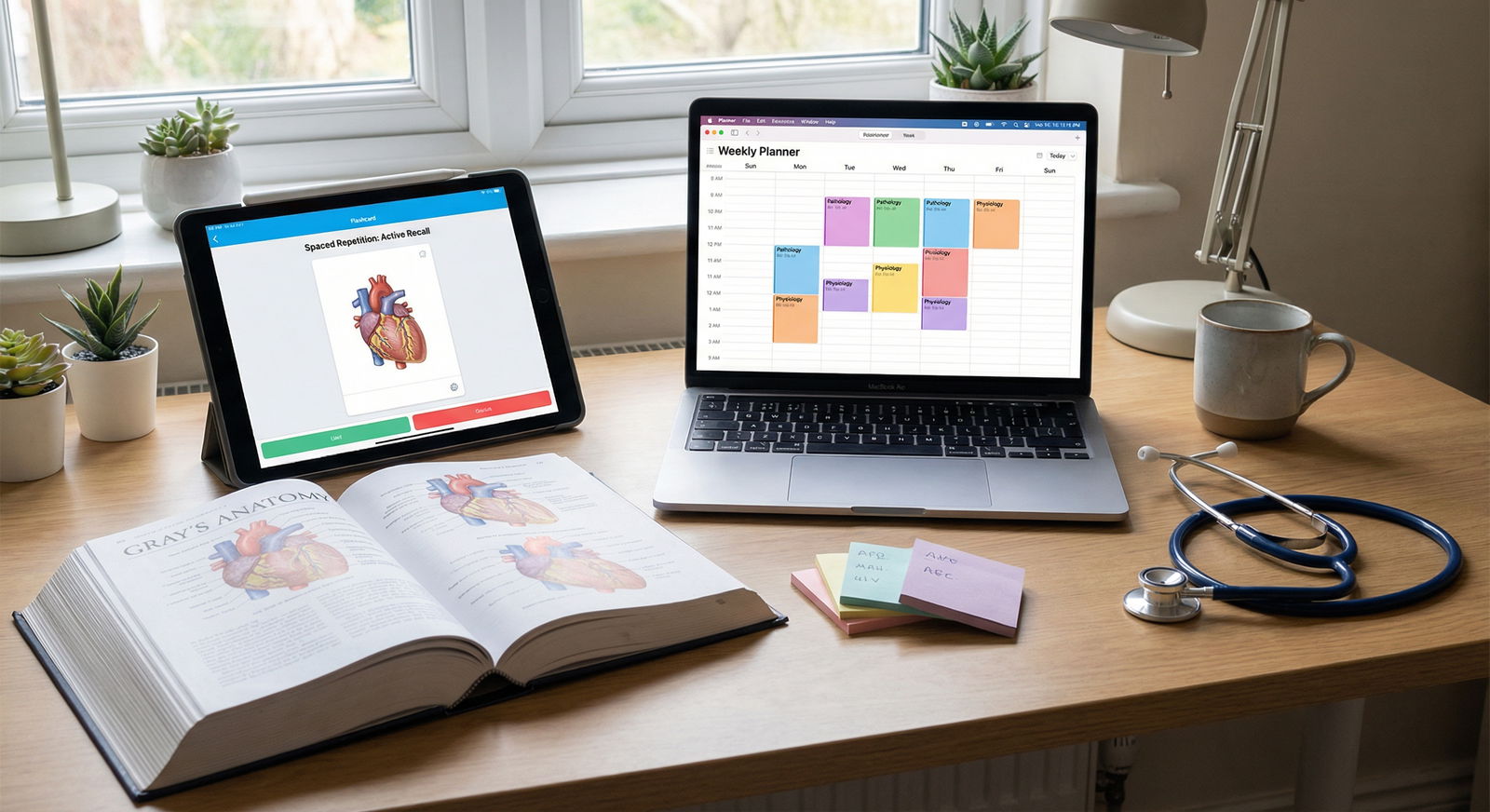
And a warning: studying every hour of the day is a trap. It kills retention and makes you a ghost at home. Your brain needs sleep and disengagement to consolidate memory. Protect those boundaries like your career depends on it. Because it does.
Talk to Your Partner, Kids, and Support System the Right Way
This conversation is often scarier than the exam itself. But you can't recover in silence. Here's how to do it without creating panic or inviting unsolicited advice you don't need.
For your partner or closest support person: Use a calm, direct script. Something like: "I got my exam result back and I didn't pass. It's a setback, but I've already checked the school policy. I can retake it in [X weeks]. What I need right now isn't a solution, it's [specific help: e.g., you handling dinner three nights a week, keeping the kids quiet during my morning study blocks, just acknowledging this is hard]. How does that sound to you? Can we figure out a short-term plan together?"
Notice: you're not asking for permission to be upset. You're not dramatizing. You're stating facts and making a concrete ask. Vague pleas like "I need more support" leave your partner guessing. Ask for what you actually need.
For your kids: If they're old enough to sense tension, be honest but brief. "I had a tough test and now I need to study extra for a few weeks. I'm okay, and we'll still do [regular activity, e.g., Saturday pancakes] together." Kids are resilient when the routine is predictable.
Deal with the guilt head-on. Asking for help does not make you a bad parent, a bad spouse, or a failure. It makes you someone who's handling a crisis with maturity. The guilt will show up anyway. Name it, and then do what the situation requires anyway.
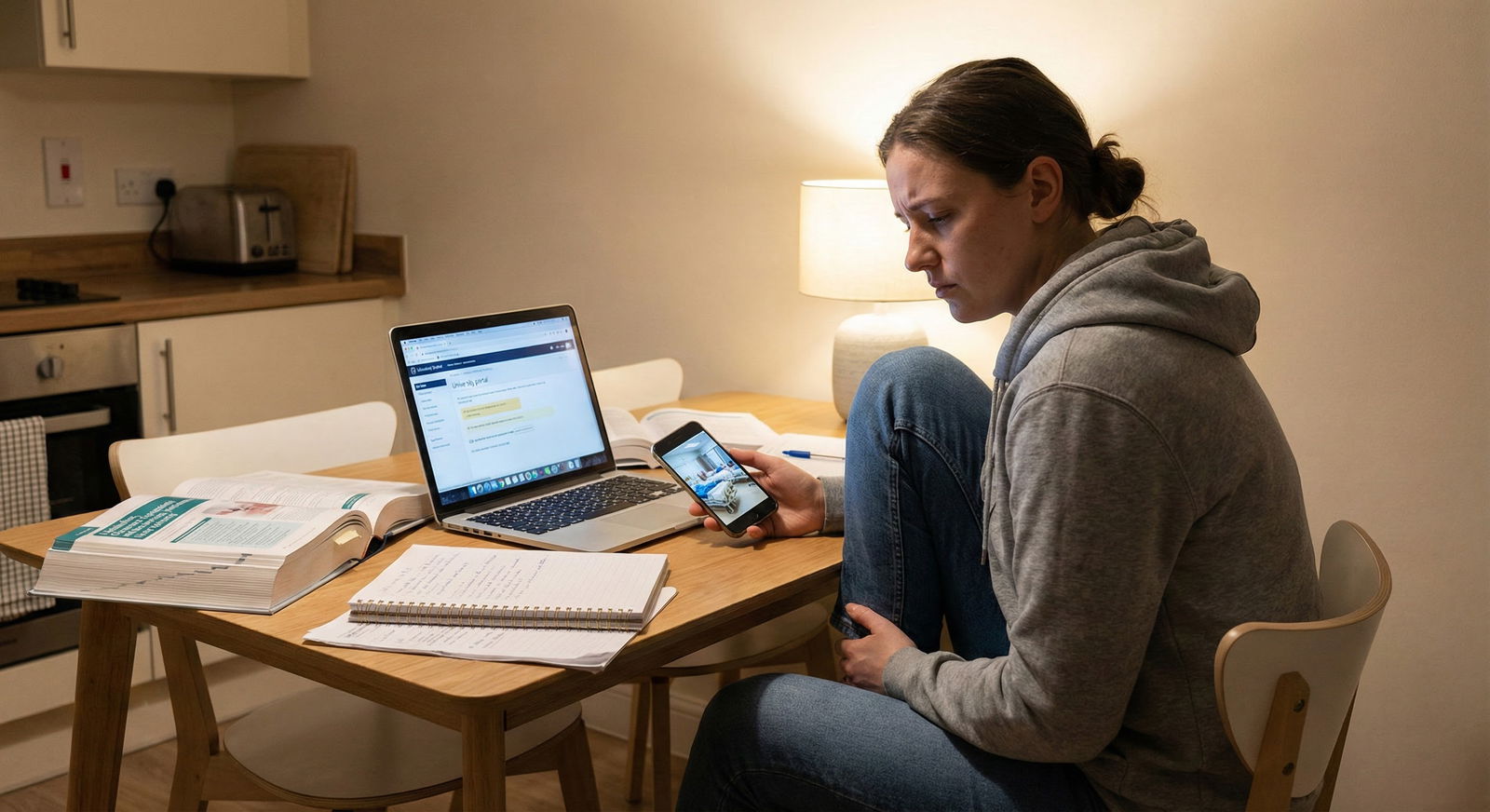
Set some non-negotiable boundaries. No exam talk during dinner. No last-minute schedule changes unless it's an emergency. No pretending everything is normal. Acknowledging the weirdness makes it easier for everyone.
When to Ask for Help from School, Advisors, or Mental Health Services
Sometimes the problem goes deeper than study strategy. If any of these sound familiar, you need more than a home reset:
- You can't sleep or you're so exhausted you nod off during the day.
- You have panic attacks before, during, or after exams.
- You feel numb or hopeless, not just disappointed.
- You're snapping at your kids or partner uncontrollably.
- The thought of studying makes you physically nauseated.
- This isn't your first failure, you've had a string of near-misses or full misses.
Don't "tough it out." Medical schools have resources because they know this happens. Contact your academic advisor or course director. Schedule a meeting with a learning specialist. If you think anxiety or depression is in the mix, book an appointment with student mental health services. Bring your score report, a summary of what you think went wrong, and any notes on symptoms. Walk in and say: "I failed an exam and I'm struggling. I need help making a plan and figuring out if there's something else going on."
I've seen students wait until the remediation deadline was a week away before even admitting they needed help. Don't let pride sabotage you. Early intervention often turns a failing situation into a passing one.

Advocacy matters. Ask your advisor: "What exactly do I need to do to pass the remediation? Can we put that in writing?" Document the plan. If you have a disability or mental health condition that affects test-taking, ask about accommodations. That's not cheating, it's leveling the playing field.
How to Move Forward: A Reset Plan You Can Actually Stick To
You now have the pieces. Here's your checklist:
- I understand why I failed (content gap, strategy, anxiety, or combo).
- I know the school's remediation deadline and requirements.
- I've streamlined my study resources to one or two.
- I've built a daily schedule with protected family time.
- I've had the honest conversation at home and asked for specific help.
- I've checked in with myself: sleep okay? Panic under control? If not, I've sought professional support.
- I commit to evaluating progress weekly, not obsessing daily.
This phase is about short-term stability, not perfection. Your goal is to pass the next exam, rebuild your confidence, and prove to yourself that you can bounce back. Long term, you'll refine your methods. Right now, consistency matters more than intensity.
If you do all this and still struggle, the plan must change, not just your effort. Maybe you need a tutor. Maybe you need a lighter course load (if your school allows). Maybe there's an undiagnosed learning issue. That's not failure; that's data you use to adapt.
And remember: I've met many, many doctors who failed a preclinical exam and went on to graduate, match, and practice without anyone ever asking about that M1 grade again. This is a bump, not a wall. You handle it, you learn, you move forward.