

What do you actually do the day you get the call that someone died or your family is falling apart—and you still have exams next week?
Let’s not dress it up.
You’re in anatomy lab, or halfway through a practice exam, or walking between lectures, and your phone buzzes. A parent in the ICU. A sibling’s car accident. A grandparent dead. A spouse or partner saying “We need to talk” and it is absolutely not good.
Everything in your head just… detaches. But the calendar doesn’t care. You’ve got an exam Monday, mandatory small group, labs, patients.
Here’s what you do right now, and in the next few days, to keep your life from completely exploding.
Step 1: Stop Pretending You Can Power Through
The worst move I see students make? Acting like this is “just another stressor” they should grind through. It is not.
If you’re in one of these situations:
- Someone close to you just died or is actively dying
- A parent/sibling/partner is hospitalized, unstable, or in surgery
- A major family crisis is blowing up (abuse disclosure, divorce, legal issues, eviction, etc.)
- You’re suddenly needed as a caregiver or decision-maker
…then your brain is not in “exam prep” mode. It’s in survival mode. You will not out-discipline cortisol.
So first decision: you are going to treat this as a legitimate emergency, not an inconvenience. That means you’re not going to quietly disappear for a few days and hope no one notices. You’re going to formally loop people in.
Today. Not “after the exam.”
Step 2: Identify Your “Triangle” – The 3 People to Notify First
You don’t need to tell everyone. But you must tell the right three “nodes” in the system. I call this your crisis triangle:
- A real human at your school (not just a generic email address)
- Your course/block director or main academic contact
- Someone in your personal life who can buffer/advocate for you
Let’s break that down.
2.1 The school human: Student affairs / dean / counselor
This is usually one of:
- Office of Student Affairs / Student Support Services
- Your academic advisor
- The Assistant/Associate Dean of Students
- School counselor or wellness office
You pick the person who:
- Has answered you before
- Or is specifically responsible for student crises and leaves
Your email can be short and blunt:
Subject: Urgent Personal Situation – Need Guidance
Dear Dr. [Name],
I just learned of a serious family emergency today involving [very brief: “my mother’s critical illness” / “the death of a close family member”]. I am currently in [M1/M2, block/course name] and have [upcoming exam/mandatory sessions] this week.
I am not in a position to manage this alone and need guidance on short-term accommodations (exams, attendance) and whether a brief leave or extension is appropriate.
Could we please speak as soon as possible by phone or Zoom?
Thank you,
[Name], [Class year]
Then, if you can, follow it up with a phone call to their office.
2.2 The course/block director
You do not need to pour your heart out. You need to flag functional impact.
Dear Dr. [Name],
I wanted to let you know I’m dealing with a sudden family emergency involving [e.g., “a critically ill first-degree relative”]. I’ve contacted Student Affairs to discuss formal accommodations.
Given the situation, I may not be able to attend [lab/small group] or sit for the scheduled exam on [date]. I will work with Student Affairs to arrange official documentation, but I wanted to let you know as early as possible.
Thank you for your understanding,
[Name], [Class year]
You’re not asking them to solve it. You’re documenting that they were told before you “no show.”
2.3 Your personal point person
Pick one: partner, sibling, trusted friend in your class, mentor, or close friend outside school.
You tell them clearly: “I need help. I might not be able to track emails or logistics. Can I use you as a second brain for a few days?”
Your job is not to be stoic. Your job is to not disappear.

| Step | Description |
|---|---|
| Step 1 | Receive bad news |
| Step 2 | Pause & breathe 60 seconds |
| Step 3 | Decide: stay or leave current setting |
| Step 4 | Notify Student Affairs/dean |
| Step 5 | Notify course/block director |
| Step 6 | Tell one trusted personal contact |
| Step 7 | Clarify next 72 hours: travel, exams, duties |
Step 3: Decide Your Role in the Family Crisis (and Be Honest About It)
Here’s the part people lie to themselves about.
You need to answer: How central are you to what’s happening?
You’re in a very different situation if:
- You’re the healthcare proxy / POA for a parent
- You’re the only adult child who can physically be there
- You’re the one who has to manage funeral arrangements
- You’re responsible for siblings or dependents
Versus:
- Extended relative, and your presence is supportive but not essential
- Lots of other family already there making decisions
This matters because it changes what level of academic disruption is rational.
Let me be blunt:
- If you’re a primary decision-maker or caregiver, you should be seriously considering:
- Emergency travel
- Deferring exams
- Short-term leave
- If you’re supportive but not central, you may be able to:
- Attend funeral/services, then return
- Reduce academic load but not stop completely
You’re not “selfish” for not flying home if ten other relatives are already there and your presence changes nothing. You’re also not “weak” for saying, “I can’t pretend to study for a major exam while we’re planning my father’s funeral.”
You decide your role, then you align your academic asks accordingly.
Step 4: Know What You Can Reasonably Ask For
Most schools actually have more flexibility than students realize. The trick is: you must ask early and through the right channels.
Here’s what’s often on the table:
| Option | Typical Use Case |
|---|---|
| Exam deferral | Grief, emergency travel |
| Make-up OSCE/practical | Illness, immediate crisis |
| Remote participation | Temporarily out of town |
| Attendance waivers | Funerals, hospital visits |
| Short leave (1–4 weeks) | Major illness, death of close family |
Concrete examples
You can say things like:
- “I need to defer Monday’s exam to the make-up date / later in the block due to a first-degree family member’s death.”
- “I will be out of town for the next 7 days due to a funeral and related arrangements; I’m requesting excused absences from in-person sessions and the opportunity to make up required activities.”
- “Given my role as health-care proxy, I’m requesting a short personal leave through [date], knowing I may need to repeat this block if assessments are missed.”
You’re not gaming the system. You’re doing damage control like an adult.
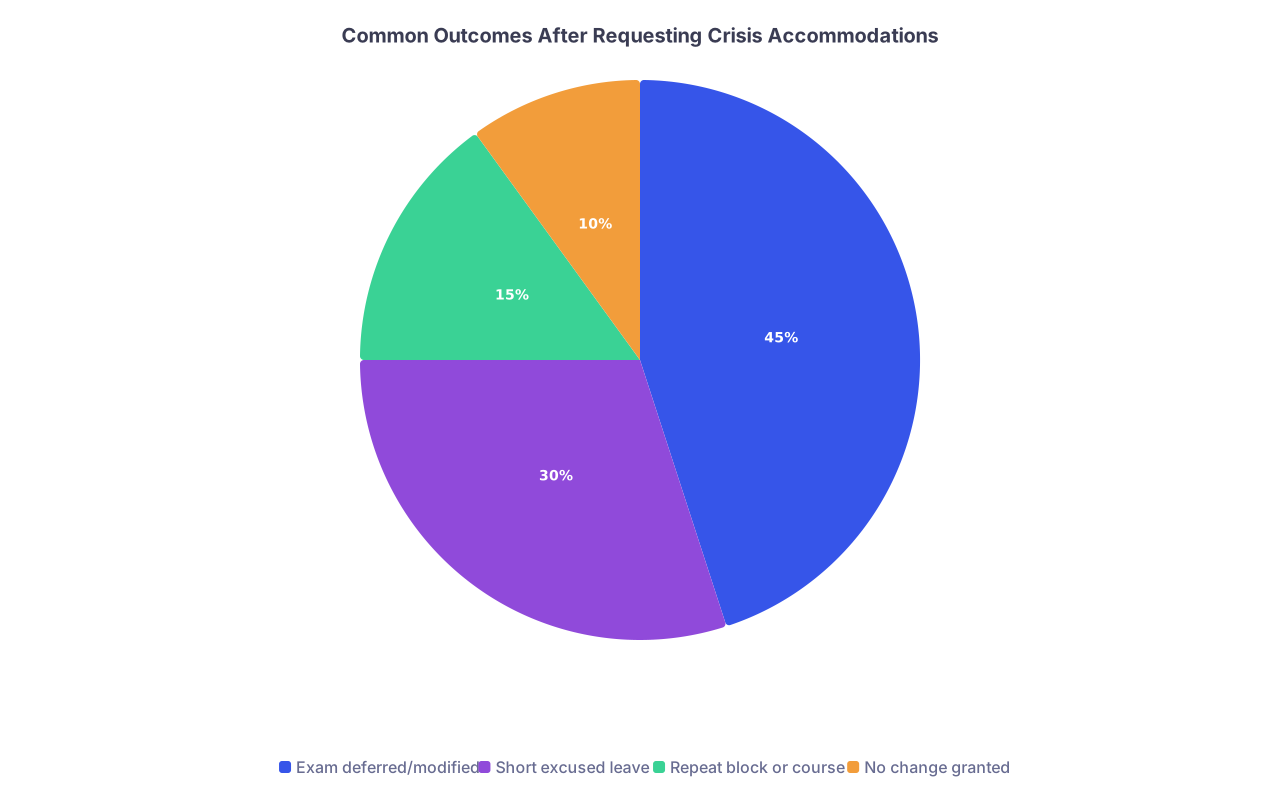
| Category | Value |
|---|---|
| Exam deferred/modified | 45 |
| Short excused leave | 30 |
| Repeat block or course | 15 |
| No change granted | 10 |
Step 5: Triage Your Life for the Next 72 Hours
Stop thinking about “the semester.” Think 72 hours.
You’re going to make three lists:
- Time-critical family tasks
- Time-critical school tasks
- Everything else that can burn
5.1 Time-critical family tasks
Examples:
- Call ICU/hospital team, speak with attending
- Book travel
- Join family meeting about code status/goals of care
- Select funeral home / arrange services
- Organize care for younger siblings / dependents
These are non-negotiable. Put them on the calendar with actual times.
5.2 Time-critical school tasks
These are not “all the lectures I’m missing.” These are:
- Exams or OSCEs in the next 7–10 days
- Mandatory small groups or clinical sessions with strict policies
- Administrative deadlines: add/drop, leave of absence request, exam registration
Your email to Student Affairs may literally be: “My priority is addressing [exam on X date / mandatory session Y]. Please advise on the process to defer or excuse these given the current emergency.”
5.3 Everything that can burn
Let it. Lectures. Optional review sessions. Extra volunteer shifts. Reading assignments. Research meetings. Interest groups.
You’re not going to do them. You’re not going to feel guilty about not doing them. You’re going to survive your actual responsibilities first.

Step 6: If You Have An Exam Very Soon
This is the nightmare scenario: family chaos and a major exam within days.
You have three real options:
- Defer the exam
- Take it but adjust expectations
- Withdraw/leave the block if the crisis is prolonged
Let me cut through the nonsense.
6.1 When to defer
You should strongly consider asking to defer if:
- You’re traveling within 48–72 hours of the exam
- You’re sleeping 3–4 hours a night because of calls/updates
- You’re organizing or attending a funeral or end-of-life rituals
- You cannot sit for 3 hours without breaking down
Do not martyr yourself to the exam. I’ve watched students fail courses because they tried to “be strong” and take a test while actively in shock.
6.2 If you insist on taking it
Fine. Then set a new goal: “Pass with whatever I can salvage,” not “crush it like nothing happened.”
You do:
- 1–2 focused review blocks a day max
- Highest-yield questions only (Anki, UWorld/Qbank, previous school questions)
- Sleep before memorization
- No perfectionism, no “just one more video”
You don’t:
- Try to “catch up” fully
- Add new resources
- Study at the hospital overnight
You walk in, do your best, walk out. If it goes badly, you’ll deal with it later with data, not shame.
Step 7: Protect Your Brain from Going Off the Rails
Grief and crisis do weird things to medical students.
Common patterns I’ve seen:
- Numbness → binging Netflix/YouTube 10 hours a day
- Hyperfunction → signing up to “help” with even more responsibilities
- Self-harm thoughts or impulsive behavior popping up for the first time
- Old coping mechanisms coming back: alcohol, self-harm, disordered eating
You need a hard minimum safety plan for yourself.
That means, very concretely:
- Eat something with calories 2–3 times a day (does not need to be pretty)
- Maintain existing antidepressant/anti-anxiety meds as prescribed
- Avoid massive new alcohol/intoxicant use while you’re a mess
- One stable sleep block (even 4–5 hours, but consistent time)
If you start having thoughts like “Maybe it’s easier if I just don’t wake up,” that’s not “dramatic.” That is your sign to:
- Call your school’s counseling / mental health service
- Call your own therapist if you have one
- Tell one person explicitly: “My brain is going to dark places. I need you to check in.”
If it gets more acute: call a crisis line or go to an ED. I’ve seen students need 24–72 hours of real containment and then get back on their feet. That’s not career-ending. That’s called being a human under extreme pressure.

Step 8: If You Need a Formal Leave of Absence
Sometimes the honest answer is: “This isn’t a 1–2 week disruption. My life is on fire for months.”
If any of these are true:
- You’re now a primary caregiver for a sick relative
- You’re dealing with complicated grief that’s not stabilizing
- Legal/financial chaos is consuming your day-to-day
- You’ve already failed one block or are about to fail another because of this
Then a leave of absence (LOA) is not failure. It’s triage.
A basic LOA conversation sounds like:
“Given [brief description], I do not see a realistic way to meet academic requirements this [block/semester]. I would like to explore a personal leave of absence, understand how this affects my progression, tuition, loans, and access to health insurance, and what documentation you require.”
You need answers to:
- Will I need to repeat the entire course/block?
- How does this affect my graduation date?
- What happens to my financial aid / loan status?
- Can I still use school mental health services while on leave?
You push past the guilt. You gather hard facts. Then you decide.

| Step | Description |
|---|---|
| Step 1 | Crisis occurs |
| Step 2 | Short disruption <2 weeks |
| Step 3 | Extended disruption >2 weeks |
| Step 4 | Defer exams/absences |
| Step 5 | Return to full coursework |
| Step 6 | Consider LOA discussion |
| Step 7 | Adjust graduation timeline |
| Step 8 | Plan structured re-entry |
Step 9: Managing The “Medical Student Guilt Spiral”
Let me guess what’s already in your head:
- “Other people have it worse.”
- “Real doctors work through this, I should too.”
- “If I ask for accommodations, they’ll think I’m weak.”
- “My classmates are going to pull ahead and I’ll never catch up.”
This is the guilt spiral. It’s garbage. Here’s the sane counterpoint:
- Other people’s suffering doesn’t cancel yours.
- Real doctors also take leaves, swap calls, and call in coverage when tragedy hits.
- Every Student Affairs office I’ve dealt with would rather give a deferral than watch a student crash and burn silently.
- Falling “behind” a year is annoying, not fatal. Half the attendings you’ll meet took some non-linear path.
Right now, your job is not to be the perfect trainee. Your job is to be a survivable human who can later be a decent doctor.

Step 10: After the Immediate Shock: A 2–4 Week Plan
Once the dust of the first week settles, you’ll hit a weird phase. The world expects you to “be okay” again. You’re not. You’re semi-functional at best.
Here’s a simple 2–4 week structure that works better than “try to be normal”:
Pick 1–2 anchor routines
- Class/required sessions OR
- Dedicated half-day of studying + one support meeting (therapy, support group, check-in with dean)
Get a written plan from someone at school
- What are your minimum requirements this block?
- What happens if you miss more?
- What’s the backup if you underperform on the next exam?
Schedule grief, don’t fight it
I know that sounds cold, but it works. Give yourself:- A daily window where you let yourself fully feel it (walk, journal, sob in the shower, whatever)
- Permission to not “hold it together” 24/7
Use peers strategically
- One or two trusted classmates who know the story
- Ask for: notes, summaries, recording links, study guides—concrete help, not vague sympathy
Over time, your bandwidth will creep back up. Not to 100% yet. But enough to do something more than just survive.
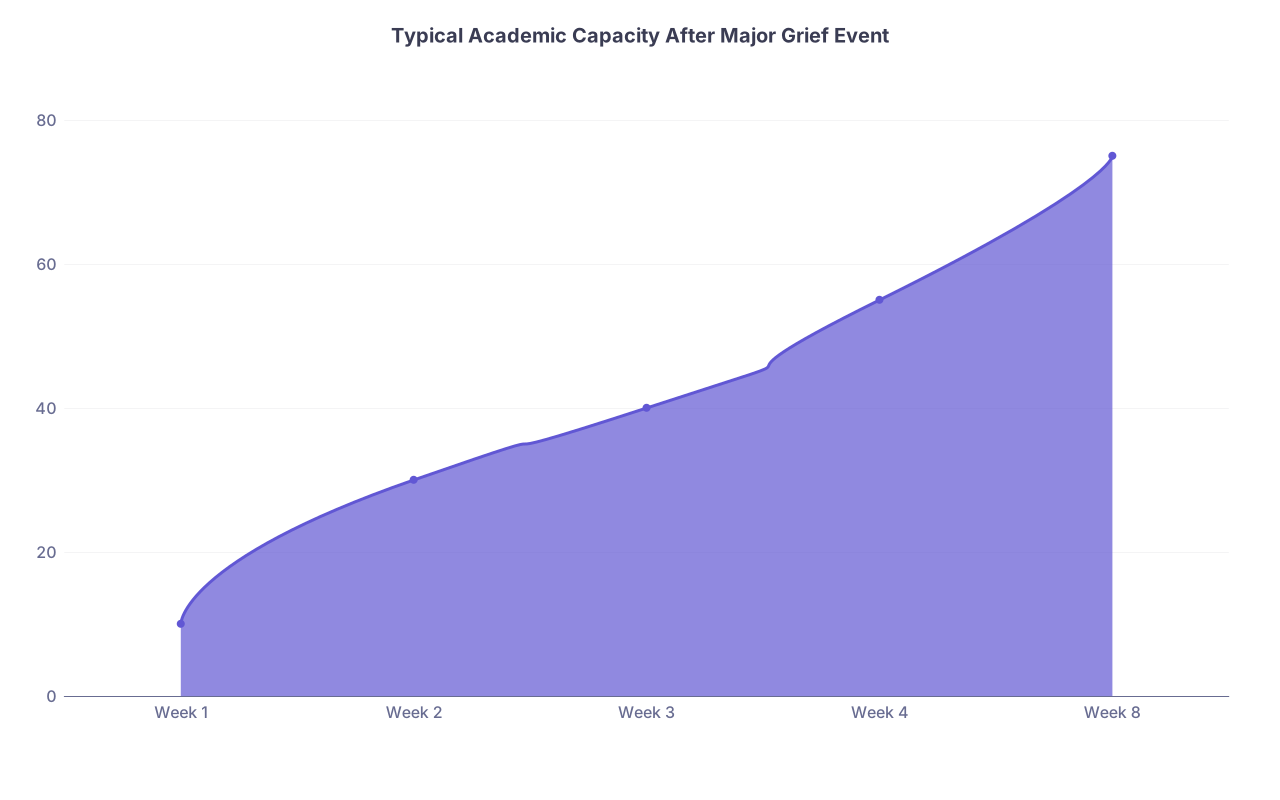
| Category | Value |
|---|---|
| Week 1 | 10 |
| Week 2 | 30 |
| Week 3 | 40 |
| Week 4 | 55 |
| Week 8 | 75 |
FAQ: When Med School Collides with Grief or Crisis
1. Will this ruin my chances at residency?
No, unless you hide it until it wrecks your transcript. A leave of absence with a clear reason, explained briefly later, is common and survivable. Failing multiple courses because you refused to take help looks far worse than a documented, time-limited break during a major life event.
2. Do I have to give detailed personal information to get accommodations?
No. You usually do not need to share graphic details. “Death of a first-degree relative,” “serious family health emergency,” or “personal medical crisis” is often enough. If documentation is needed (e.g., obituary, physician note), you can provide it discreetly through Student Affairs, not broadcast to every course director.
3. What if my culture/family expects me to drop everything indefinitely?
Then you’re juggling two sets of expectations that don’t fully align. You may need to have a blunt conversation with a trusted family member: “I can be fully present for [X days/weeks], but then I have to return to my program. After that, we may need to look at other support options.” And if your family’s ask is truly incompatible with staying enrolled, that’s exactly the situation where a formal leave—and honest planning about the future—becomes necessary.
Open your email right now and draft a three-sentence message to Student Affairs or your dean telling them there’s a major family emergency and you need to talk about short-term accommodations. You don’t have to send it yet—but get the words on the screen so it’s one step easier to actually hit send today.


