

You’re not weak for struggling with M1 and a chronic illness. You’re under-resourced for the load you’re carrying.
Let me be blunt: medical school wasn’t designed with chronically ill students in mind. The default model is: healthy 22–24-year-old, full-time stamina, can sit in lecture 8–5, then study 7–11, maybe live on caffeine and vibes for a year. If that’s not you, you are not the problem. The structure is.
But you still have to survive inside that structure.
This is the playbook I wish more M1s with POTS, Crohn’s, lupus, migraines, MS, long COVID, major depression, or anything else had on Day 1. I’m going to walk you through what to do, in what order, with specifics: who to email, what to say, what to push back on, how to protect your stamina, and how to handle disclosure without tanking your reputation.
Step 1: Stabilize Your Reality Before You “Power Through”
Most M1s with chronic illness do the same thing at first: they try to behave like everyone else and “wait and see” if they really need help.
That’s usually a mistake.
You want infrastructure in place before you hit a flare during an exam week or anatomy practical.
Your first month should include three parallel moves:
- Medical reality check
- Academic reality check
- Administrative reality check
1. Medical reality check
You need a brutally honest conversation with your treating clinician(s) about what M1 actually looks like.
Ask specifically:
- “Realistically, how many hours of cognitively demanding work per day can I sustain without worsening my condition?”
- “What are my flare triggers—and how does med school lifestyle hit those (sleep loss, stress, standing, sitting, infections)?”
- “If I start to crash, what is our stepwise plan? Medication adjustments? Labs? When do I pull the emergency brake on school?”
Get it documented in the chart. This is gold for accommodations later.
If you don’t have a local specialist yet (you moved for school), make that appointment now, not when you’re already spiraling in October.
2. Academic reality check
Look at your schedule like a project manager, not a student trying to “keep up.”
Concrete actions:
- Map out high-load blocks: usually anatomy, neuro, or combined “Foundations” blocks.
- Identify exam-heavy weeks and anatomy practicals.
- Note required vs optional sessions: small groups, labs, clinical skills are usually mandatory; lectures often are not.
You’re trying to answer:
“On weeks where my disease is average-to-bad, can I still hit the required stuff without crashing?”
If the honest answer is “barely” or “no,” you need formal support.
3. Administrative reality check
Every school has a different culture about disability. Some are quietly excellent. Some are performatively supportive in brochures and stingy in real life.
You have to find out which one you’re dealing with early.
Do this in week 1–2:
- Find your school’s disability services (often called “Student Accessibility Services” or similar).
- Skim their health-related accommodations page: exam time, absences, lecture recording, flexible attendance, etc.
- Book an appointment—even if you’re still “not sure” if you’ll need accommodations.
You are not committing to anything by having that meeting. You’re building a relationship and understanding the menu of what’s possible.
Step 2: Getting Accommodations Without Setting Yourself on Fire
You’re not asking for favors. You’re asking for the minimum support needed to perform at your actual cognitive level instead of your disease-limited level.
There are three layers: documentation, disability office, and course/faculty implementation.
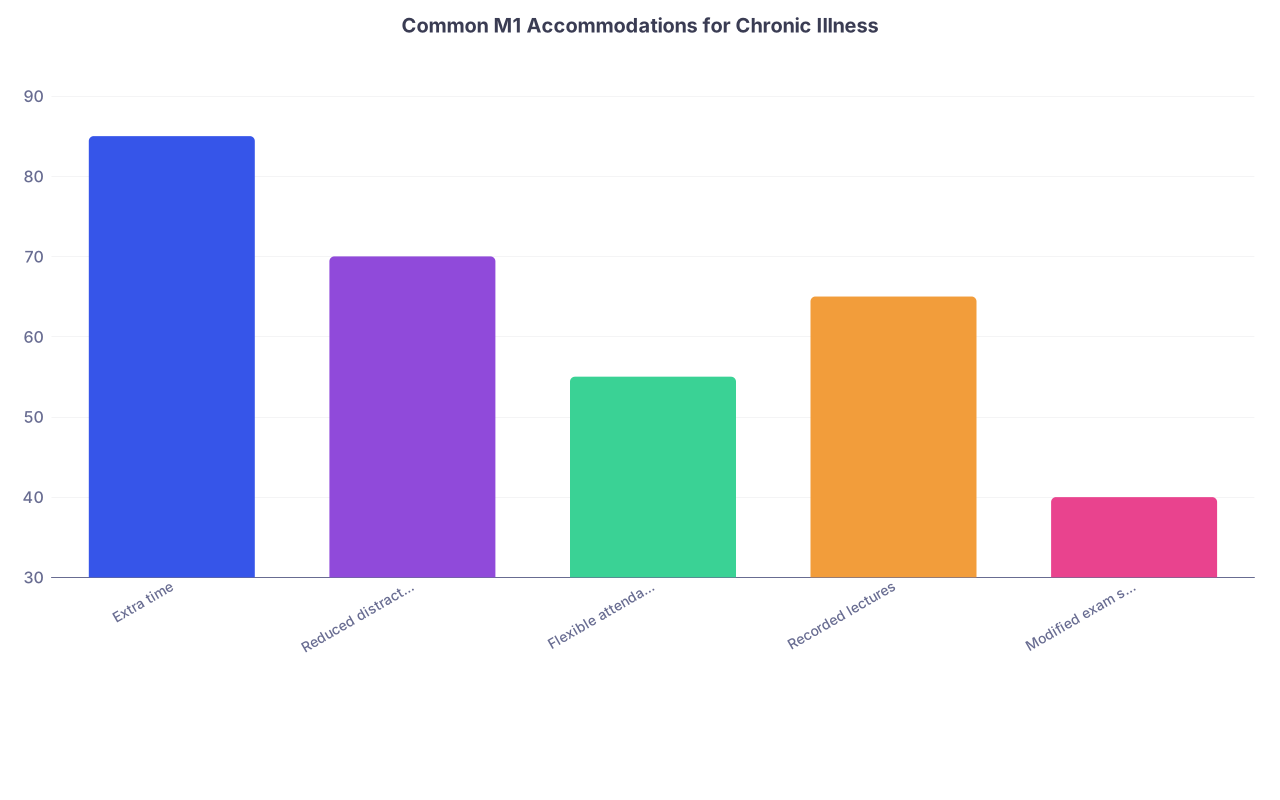
| Category | Value |
|---|---|
| Extra time | 85 |
| Reduced distraction room | 70 |
| Flexible attendance | 55 |
| Recorded lectures | 65 |
| Modified exam schedule | 40 |
1. Get solid documentation (not vague letters)
What your clinician writes matters. “Patient has chronic health issues” is useless.
Ask them to include:
- Diagnoses (or at least functional description, if you’re not comfortable with the exact label shared broadly).
- Functional limitations: fatigue, pain, cognitive slowing, orthostatic intolerance, medication side effects, frequent medical appointments, unpredictable flares.
- Specific academic impacts: difficulty sitting for long exams, need for restroom breaks, variable attendance capacity, need for rest breaks.
- Explicit recommendations:
- Extended time on exams (usually 1.25x or 1.5x)
- Reduced-distraction exam environment
- Breaks during long exams
- Flexible attendance policy / remote participation when ill
- Ability to reschedule exams during severe flares
- Access to lecture recordings or asynchronous content
You want a letter that basically hands disability services an easy rationale.
2. Meet with disability services like a strategist, not a supplicant
Go into the first meeting with:
- A summary of your condition in 3–4 bullet points
- Clear asks: “I likely need X, Y, and Z.”
- Worst-case scenarios: “My flares sometimes mean I cannot get out of bed for a day or two; here’s how that might hit exams and labs.”
Be direct:
“I’m not asking to do less school. I’m asking for structure that allows me to do the same curriculum without destabilizing my health.”
Push where necessary. Some offices default to just “extra time on exams” because it’s easy. For chronic illness, exam time is often not the main issue. Stamina and predictability are.
Reasonable things to request in M1 with chronic illness:
- Extended exam time and breaks
- Ability to test in a small room near a restroom
- A slightly earlier exam start time if your meds/fatigue are worse later
- Attendance flexibility for lecture and non-patient-facing sessions
- Make-up policies for mandatory small groups during documented flares
- Preferential scheduling for clinical skills that involve standing or physical exertion
- A note to faculty that you may need to sit during labs/clinicals
You’re not gaming the system. You’re trying not to end up in the ED the week before your block exam.
3. Implementing accommodations with faculty
Usually the disability office will send a generic letter to faculty saying “Student X is entitled to Y, Z.” They won’t disclose your diagnosis. Good.
But for some types of accommodations—like flexible attendance or adjusting lab participation—you may still need to email individual course directors.
Template you can adapt:
Dear Dr. [Name],
I’m enrolled in [Course] and registered with Student Accessibility Services. You should have received my accommodation letter, which includes flexible attendance for health-related reasons.
My goal is to participate fully and meet all course obligations. Because my condition can cause unpredictable flares, there may be rare days when I cannot safely attend in-person activities. In those instances, I’d like to clarify the process for:
– Notifying you in advance when possible
– Making up required activities or contentI’m happy to discuss options that align with course requirements while respecting my health limitations.
Sincerely,
[Your Name]
Keep it businesslike. Do not overshare details. You’re setting expectations and a protocol.
Step 3: Disclosure – Who Actually Needs to Know?
You don’t owe your classmates an explanation for leaving early, sitting down in anatomy, or missing a random Tuesday. You do need to be strategic about who knows what.
Think in layers:
- Required disclosure: disability office, sometimes student health, rarely the dean.
- Tactical disclosure: course directors, small-group facilitators, lab instructors.
- Optional/relational disclosure: friends, study group, future mentors.

1. With administration and disability services
Be specific but not dramatic. You’re not writing a personal statement; you’re describing functional limits.
Good:
“I have a chronic autoimmune condition that causes unpredictable fatigue and joint pain. I remain fully capable of the academic workload when my symptoms are managed, but I need flexibility on attendance and exam logistics to avoid flares.”
Skip the emotional backstory unless it directly explains why certain accommodations are critical.
2. With faculty and preceptors
You can use what I call the “one-sentence functional disclosure”:
“I have a chronic medical condition that sometimes affects my stamina and mobility, so I may need to sit intermittently and take brief breaks, but I’ll participate fully.”
That’s it. If they push for more detail, you’re allowed to say:
“I prefer to keep the specifics private; I’m already working with Student Accessibility Services.”
If someone violates boundaries (“What do you actually have? Are you really disabled?”), that’s not you being difficult—that’s them being inappropriate. Make a mental note and consider flagging it to the disability office or the ombudsperson if it escalates.
3. With classmates and friends
Three options, all valid:
- Very private: Tell almost no one. Advantage: control. Disadvantage: isolation, misunderstandings (“Why do you always leave early?”).
- Selective: Tell your core group or study partner(s). This is usually the sweet spot.
- Open: You’re comfortable naming your illness casually. This can reduce stigma, but once the info is out, you can’t claw it back.
When you do tell someone, keep it simple:
“I’ve got a chronic illness that affects my energy and pain levels. I’m managing it, but I sometimes need to miss stuff or study differently. If I disappear for a day, I’m probably dealing with that, not ghosting you.”
You don’t need to justify, explain every medication, or provide lab values. This isn’t rounds.
Step 4: Protecting Your Stamina Like It’s Another Required Course
Your energy is not comparable to your healthiest classmate’s. Stop grading yourself against their capacity.
Think of your total daily “work capacity” like a limited budget. M1 wants to overdraw you every day. Your job is to make aggressive tradeoffs.
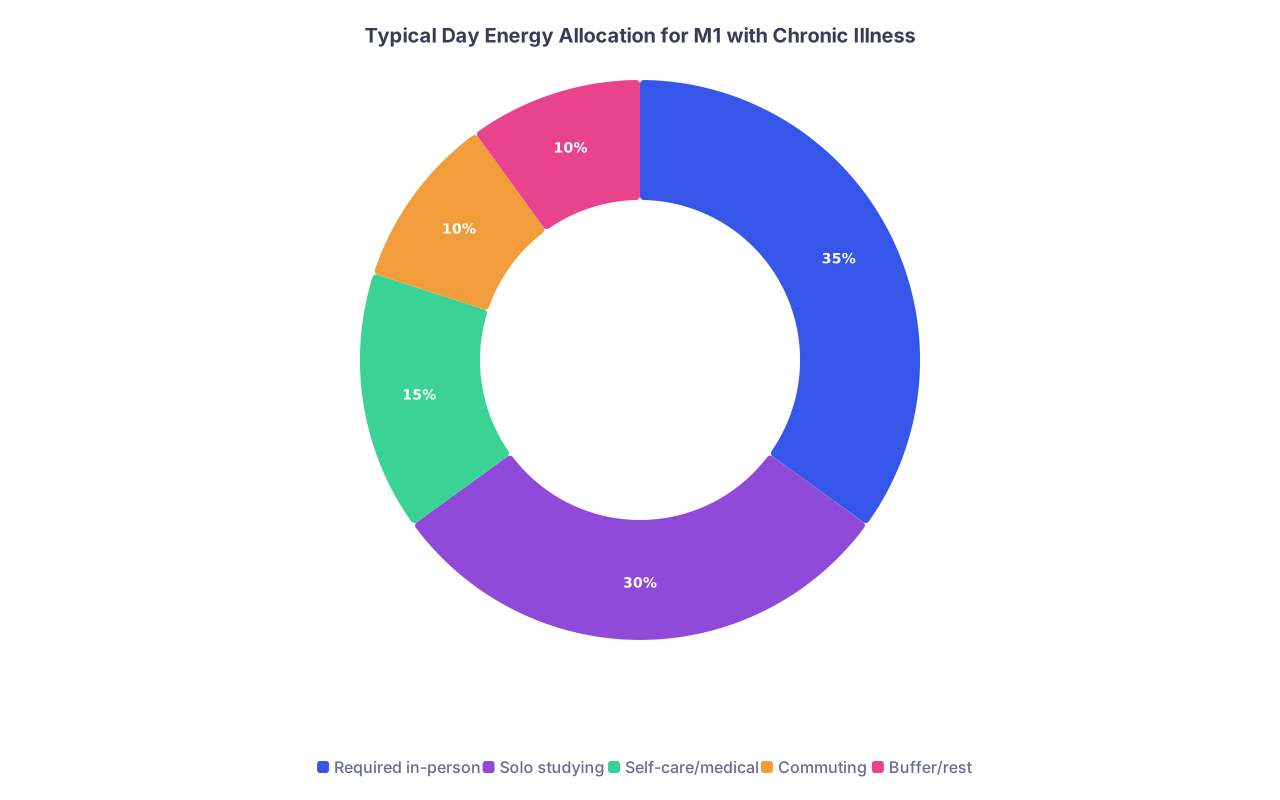
| Category | Value |
|---|---|
| Required in-person | 35 |
| Solo studying | 30 |
| Self-care/medical | 15 |
| Commuting | 10 |
| Buffer/rest | 10 |
1. ruthlessly separate “required” from “nice-to-do”
Examples:
Required:
- Exams, anatomy labs, clinical skills sessions, mandatory small groups.
- Enough studying to pass blocks and not drown later.
Nice-to-do but optional:
- Live lectures when recordings exist.
- Every single interest group lunch talk.
- Volunteering weekly at 3 different free clinics.
- Extra shadowing in week 3 of M1.
You may want all of these. Right now, they may be bad trades. Especially if they cost sleep or trigger flares.
2. Design a low-friction study system
You don’t have the stamina to waste 2 hours a day deciding what to study.
Build default routines:
- Use one main resource per subject (e.g., Anki deck + class objectives), not five different videos and textbooks.
- Front-load your best energy time for the hardest tasks. If mornings are clearer before meds side effects hit, do practice questions then.
- Create “flare-day” study modes:
- Audio-only review while lying down.
- Light Anki review on your phone.
- 25-minute micro-sessions with long rest breaks.
Your goal is consistency, not perfection. On bad days, 30–60 minutes of focused, realistic work is fine. You’re playing the long game.
3. Sleep is non-negotiable for you
Plenty of healthy M1s abuse sleep and get away with it. You probably cannot.
Set hard lines:
- Minimum hours of sleep you will not violate except for true emergencies (often 7–8 for chronic illness).
- A cut-off time where you stop studying, even if you feel behind.
- “Emergency-only” late nights—like 1–2 times a block, not 4–5 times a week.
If your classmates brag about staying up till 3 doing flashcards, smile, nod, ignore them. They’re playing a different game with different rules.
4. Build flare protocols, not just hope
A “flare protocol” is a plan you execute when your body starts to tank, instead of panicking each time.
Write two versions down:
Mild/moderate flare day:
- Email course director if you’ll miss in-person sessions.
- Switch to low-effort study tasks from your pre-made list.
- Hydrate, meds as directed, maybe brief walk/stretch, then rest.
- No unnecessary extras (social events, non-essential Zooms).
Severe flare / can barely get out of bed:
- Zero guilt about not studying. Health takes the whole day.
- Quick email: disability office (if pattern), course admin if exam is near.
- Consider whether this meets your emergency plan threshold from your clinician (e.g., call clinic, urgent care, etc.)
This isn’t you being lazy. It’s you acting like a clinician-in-training managing a complex chronic condition—yours.
Step 5: Handling Exams, Practical Skills, and “Performance Days”
Exam days, OSCEs, and anatomy practicals are where chronic illness gets extra punitive if you’re not prepared.

| Step | Description |
|---|---|
| Step 1 | Two weeks before exam |
| Step 2 | Confirm accommodations |
| Step 3 | Plan lighter social/extra activities |
| Step 4 | Three days before: prioritize sleep |
| Step 5 | Day before: low-intensity review only |
| Step 6 | Exam day: execute med & food plan |
| Step 7 | Post-exam: rest & short debrief |
Written exams
If you have extra time and breaks:
- Use breaks strategically: stand, stretch, bathroom, glucose, water. Even 3–5 minutes can reset your brain fog or orthostatic symptoms.
- Eat and hydrate like it’s a procedure day: what sits well with your meds and nerves? Test this on practice exams.
The week before:
- Don’t suddenly double your study hours. That’s how you show up to the exam already half-flared.
- Define a “minimum viable prep” if you start to crash: what absolutely has to get done to pass?
If everything goes sideways (hospital visit, severe flare):
- Email disability services + course director as soon as you can type something coherent:
“I’m currently experiencing a severe flare and am under medical care. I’m not medically able to complete the exam as scheduled. I’ll provide documentation as soon as I’m able and would like to discuss a make-up plan.”
Anatomy and standing-heavy sessions
These are brutal for joint pain, POTS, fatigue.
Reasonable adjustments:
- A high stool at the dissection table so you can sit intermittently.
- Short, pre-agreed movement breaks (step outside the lab briefly, sit, hydrate).
- Being assigned a role in the group that doesn’t require constant standing (e.g., note-taking, structure identification while others do more of the physical work, depending on your group dynamics).
Do not wait until you collapse at the table to bring this up.
OSCEs and clinical skills
If your condition affects mobility, stamina, or fine motor skills:
- Make sure standardized patient staff and preceptors know you may need to sit, take brief pauses, or adjust how you do parts of the exam.
- Practice a quick explanation you can use in-station if needed:
“I have a chronic condition that affects my stamina, so I’ll be seated while we talk/examine, but I’ll still conduct the full evaluation.”
They’re evaluating your clinical skills, not your ability to pretend you’re healthy.
Step 6: When It’s Actually Too Much – Considering LOA or Schedule Changes
This part no one wants to talk about until they’re already shattered: sometimes the load + your disease activity is objectively unsafe.
Signs you should seriously consider a leave of absence (LOA) or reduced load:
- Repeated hospitalizations or urgent care visits in one semester.
- Worsening, not stabilizing, symptoms over 2–3 blocks despite max accommodations.
- You’re passing, but your health is crashing to a level your own physician is worried about.
A leave of absence is not a failure. It’s a medical decision.
| Option | Pros | Cons |
|---|---|---|
| Short LOA (1 block) | Time to stabilize disease | Graduation delayed slightly |
| Year-long LOA | Full reset, major treatment changes | Social cohort shifts, logistics |
| Reduced load (if allowed) | Ongoing progress with less intensity | May complicate scheduling/loans |
If you even suspect you’re heading here:
- Talk to your treating physician first: “Medically, do you think continuing at this pace is safe?”
- Then disability services + academic dean: ask plainly what LOA options look like, how they affect financial aid, and what return-to-school requirements are.
The worst path is dragging through until you fail multiple courses and then being forced into a leave under crisis conditions. Early, proactive conversations give you more control.
FAQs
1. Will having a documented disability or accommodations hurt my chances for residency?
No, not directly. Residency programs do not see whether you had testing or attendance accommodations. They see your grades, board scores, narratives, and professionalism notes.
What will hurt you is uncontrolled illness leading to repeated failures, professionalism issues from disappearing without communication, or needing emergency remediation every semester. Stabilizing your health with accommodations is usually the smarter path for your long-term career.
2. Should I tell my small-group classmates or PBL group about my illness?
Only if it will help the group function better and you feel reasonably safe with them. For example, if you know you’ll occasionally have to miss a session or keep your camera off, a light disclosure can prevent resentment:
“I have a chronic health condition that sometimes flares. I’m committed to the group, but there may be days I’m quieter or absent. I’ll pull my weight in other ways.”
You do not need to name the diagnosis unless you want to.
3. What if disability services denies the accommodations I think I need?
This happens. Sometimes they’re conservative; sometimes they misunderstand your condition. Steps:
- Ask for the reasoning in writing.
- Provide additional documentation from your physician tying specific functional limits to the requested accommodation.
- Request a follow-up meeting and, if available, appeal or second review.
If they still stonewall on something genuinely necessary (like flexible attendance for a condition with unpredictable flares), consider looping in your physician to speak directly with them, and if needed, consult your school’s ombudsperson or student affairs dean.
4. How do I handle feeling “less than” my classmates because I need accommodations?
You reframe the whole thing. Accommodations are not “extra help”; they’re a partial correction for an uneven playing field. You’re doing M1 while managing a body that requires clinical work on top of your school day. That’s more responsibility, not less.
If the shame noise is loud, a therapist familiar with chronic illness and disability can help dismantle it. You’re not the lazy one in the room. You’re the one running med school on “hard mode” and still showing up.
If you remember nothing else, remember this:
- Get infrastructure early: disability office, documentation, and flare protocols.
- Treat your stamina like a limited resource and spend it on requirements, not ego or FOMO.
- You’re not weak for needing a different path through M1—you’re doing the same mountain with a heavier pack. Act accordingly.


