
The fluorescent lights in the ICU bay buzzed at 2 a.m. when Dr. Lena Park made her decision. She had just finished stabilizing a patient whose vitals were crashing because the EHR kept kicking her out of the medication reconciliation screen, a glitch she'd reported three times over six months. She'd spent more of her night fighting software than fighting disease. That's when it clicked: the people building these systems had never stood where she was standing. They didn't know what they didn't know.
That was three years ago. Today, Lena runs the clinical product team at one of the largest telehealth platforms in North America. She still sees patients two days a week. She hasn't lost a single clinical skill. And she's making more impact on patient care than she ever did as a hospitalist, because now every workflow decision she makes affects thousands of clinicians, not just one patient at a time.
Let me tell you what really happens when a clinician pivots to telehealth product management. Not the LinkedIn version. Not the "I followed my passion" narrative. The actual path, with the potholes, the politics, and the specific moves that get you in the door.
Quick note on what follows: the information here is for educational purposes only and is not financial advice, not legal advice, and not tax advice. Career transition figures vary widely by company, geography, and individual negotiation. Before making a major professional move, consult a qualified professional who understands your specific situation.
The Hidden Job Market You Were Never Told About
Here's the first secret: most telehealth PM roles never get posted on LinkedIn.
The public job boards show you maybe 30% of what's actually available. The rest flows through two channels: alumni networks from specific fellowships (more on that in a moment), and recruiters who run "passive candidate" searches, meaning they're hunting for people like you who haven't applied because they think they need a coding bootcamp first.
I've sat on hiring panels at three different digital health companies. When we posted a "Senior Product Manager, Clinical" role, we got 400 applicants, mostly MBAs and engineers. When my recruiter called five clinicians cold, four said no immediately because they assumed they weren't qualified. The one who said yes now runs our chronic care vertical.
That's the math. Apply and you're competing with thousands. Get recruited and you're one of five.
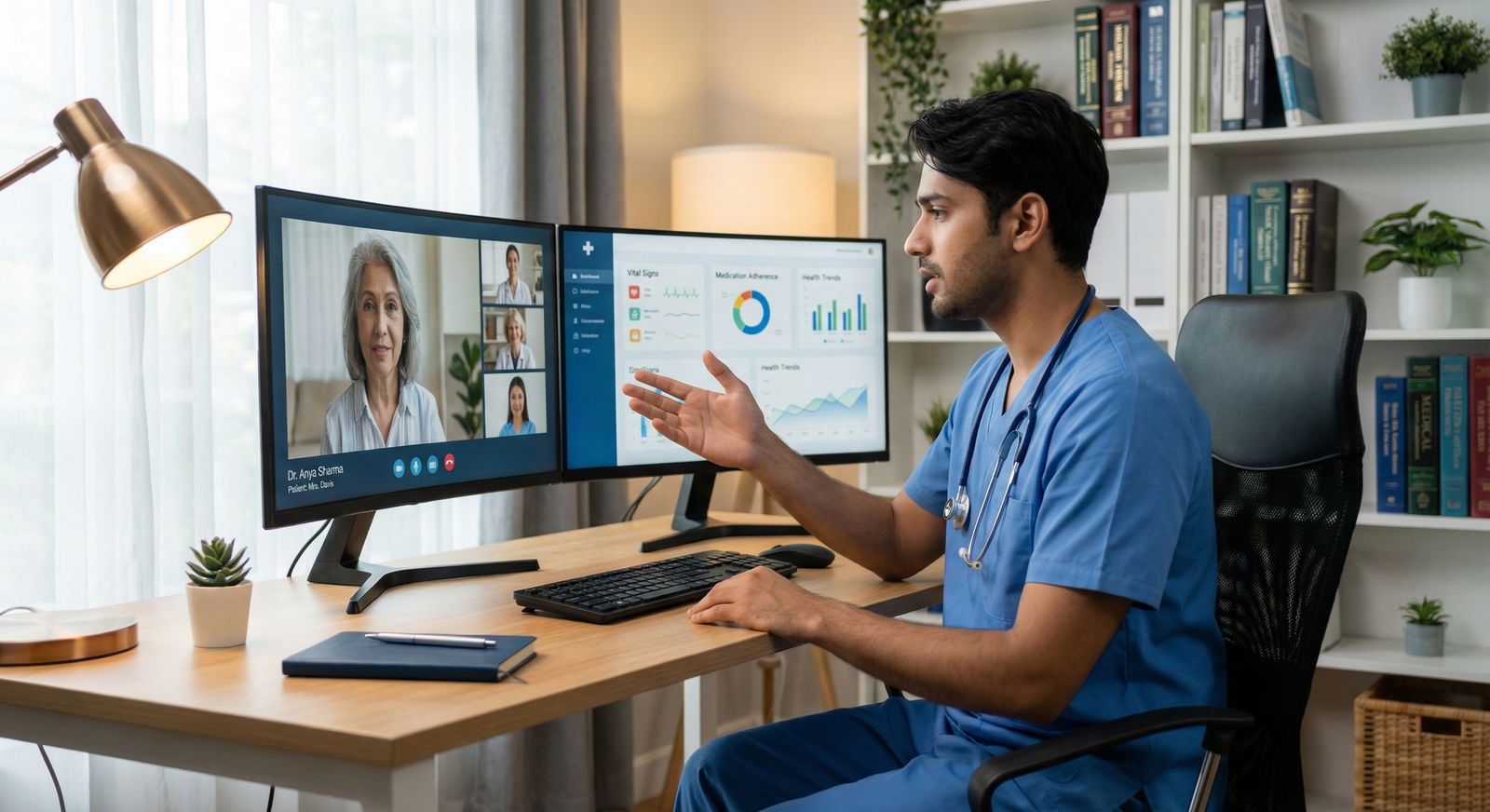
How do you get recruited? You build a public artifact that demonstrates product thinking. Not a resume. An artifact. A teardown of a competitor's telehealth workflow. A Medium post titled "Why This Patient Onboarding Flow Fails Clinicians" with annotated screenshots. A Figma mockup of an async visit tool you built as a side project. Something tangible that says, "I think like a product person because I think like a clinician."
The Skill Translation Most People Botch
Now let me save you two years of confusion. You already have 80% of the skills. You just don't recognize them in product-speak.
When you triaged a crashing patient in the ED by deciding which orders to enter first, which nurse to delegate to, and which consultant to call, you were managing a complex workflow with stakeholders, dependencies, and competing priorities. That's product management.
When you led a QI project that reduced central line infections by 40%, you identified a user problem (CLABSI rates), defined a metric (infection rate per 1,000 line days), shipped an intervention (chlorhexidine bathing protocol), and measured outcomes. That's the entire product lifecycle.
When you pushed back on a hospital administrator about staffing ratios because it would harm patients, you were advocating for user needs against business pressure. Product managers do this daily.
The skill you're missing isn't technical. It's vocabulary and framework. Learn to talk in terms of "user stories," "OKRs," "MVP," and "north star metric," and suddenly you're fluent. The frameworks, Jobs to Be Done, Design Thinking, Lean Startup, can be learned in a weekend. The judgment about what matters clinically takes a decade.
That asymmetry is your unfair advantage. Don't waste it trying to become an engineer. Become the person who can translate between the engineers and the clinicians. That's the role worth $250K to $400K base.
The Three Entry Points That Actually Work
Path one: the Fellowship Trap. There's a graveyard of "digital health fellowships" that charge you $5,000 to do free work for a startup. Avoid those. The fellowships that work are the ones run by health systems (like Kaiser Permanente's or Mayo Clinic's innovation arms) or by established accelerators (like Plug and Play or MassChallenge Health Tech). These pay stipends, place you inside real teams, and convert to full-time roles at roughly 40% of places I've tracked. The secret most people miss: even if the fellowship doesn't convert you directly, the network gets you three interviews in your first month of searching.
Path two: The Internal Pivot. You're already working somewhere. Find the digital health, innovation, or telemedicine department. Volunteer for committees that touch product decisions. Offer to be the "clinical subject matter expert" for any cross-functional project. Six months of showing up, asking sharp questions, and delivering on small asks will get you a transfer. Internal pivots are the highest-conversion path because your employer already trusts your clinical judgment, they just need to see your product thinking.
Path three: The Startup Scramble. This is the highest-risk, highest-reward path. You join a Series A telehealth company as employee #30, you wear six hats, and you learn product management by doing it. You'll be underpaid for two years. You'll work 70-hour weeks. But when the company hits Series C and raises a $50M round, your equity might pay for your kid's college. Or it might be worth nothing. That's the gamble. Only take it if you can afford to be wrong.
The Politics Nobody Warns You About
Here's the part that surprised me most: the hardest part isn't learning the skills. It's navigating the politics between clinicians and engineers.
Engineers think in systems. Clinicians think in patients. When an engineer proposes cutting a "redundant" safety check to speed up workflow, they're not being malicious, they're optimizing for efficiency. When you push back because that check has saved three patients from medication errors in your career, you're not being unreasonable, you're protecting users. Both perspectives are valid. The product manager's job is to hold both truths simultaneously without alienating either side.
The clinicians on your team will resent you for "going to the dark side." The engineers will resent you for "not thinking like a builder." Your manager will wonder why a simple feature is taking six weeks instead of three. You'll feel like a translator who nobody fully trusts.
This is normal. Every clinician-turned-PM I've mentored has gone through a 6-to-12-month period of imposter syndrome so intense they consider going back full-time to clinical work. Push through it. The work gets easier once you ship a few wins and the team sees you protect them from clinical disasters they didn't know existed.
One specific move that helps: in your first 90 days, identify the one clinician stakeholder everyone on the product team secretly fears, the surgeon who sends angry emails, the pediatrician who refuses to use the platform. Win that person over. Become their translator. Once the loudest skeptic trusts you, everyone else falls in line. This is real political capital that pays dividends for years.
What the Next Decade Actually Looks Like
Telehealth isn't a temporary pandemic artifact. It's the default mode of care for 30-40% of ambulatory encounters going forward, and the product management roles that govern it are going to professionalize in ways we can't fully predict yet.
The clinicians who pivot now will be the senior VPs and Chief Medical Officers of these platforms in five to seven years. The window for entry-level clinical product roles is wide open because the field is so new. In five years, employers will want "5 years of clinical product experience" and the door will be much harder to walk through.
The compensation trajectory looks like this: entry-level clinical PM roles start at $140K to $180K base. Senior roles with three to five years experience hit $220K to $300K. Director and VP roles clear $350K to $500K plus equity. Compare that to the average physician salary of $250K to $350K, and you're making similar money while having more control over your schedule, more leverage over patient care at scale, and often better work-life balance. You're not trading down. You're trading differently.
The telehealth industry is also at an inflection point where AI scribes, ambient documentation, and automated triage are about to reshape the clinician experience entirely. The companies building these tools need PMs who can distinguish between a workflow improvement that genuinely helps clinicians and a flashy feature that creates new safety risks. That's a judgment call only a practicing clinician can make well. Your value isn't going down as AI gets better. It's going up, because the stakes of getting clinical workflows wrong are getting higher.
The field is hungry for you. The path is clearer than it was even three years ago. The only question is whether you'll commit to the pivot or spend another decade telling yourself you're "not technical enough."
You're not technical enough. Neither is anyone. The PMs who succeed are the ones who learn just enough to be dangerous and rely on engineers for the rest.