
The comforting story that “telemedicine is recession-proof” is wrong.
Telemedicine is not a magical safe harbor in an economic storm. It is a business model welded onto the same fragile reimbursement system that governs brick-and-mortar medicine. In some niches it holds up better than clinic jobs; in others, it’s actually the first thing to get cut when the economy tightens.
Let’s dismantle the myths and talk about what actually happens to telemedicine jobs when the market turns ugly.
The Myth of “Recession-Proof” Telemedicine
The common pitch goes like this: people always get sick, telehealth is cheaper, and remote visits are convenient—so in a recession, volume goes up and your job is safe.
Reality is messier.
There are three main forces that decide whether telemedicine jobs survive a downturn:
- Who’s paying (fee-for-service vs capitated/value-based)
- What problem you’re actually solving (cost avoidance vs convenience)
- How fast your employer can pivot (or panic) when margins compress
Here’s what the high-level data and recent history actually show.
During COVID’s early phase (2020), telehealth visits exploded, peaking at around 13–17% of all outpatient encounters in the U.S., depending on specialty. But by 2022–2023, most systems had settled to 5–10% telehealth share overall, with big variation by specialty (behavioral health much higher, procedural fields lower).
Recession data is thinner, but we can triangulate:
- After the 2008 financial crisis, virtual care was still niche, but phone triage and nurse call lines (telehealth’s ancestors) were cut in many health systems as “non-essential overhead”.
- During COVID’s economic shock, many venture-funded direct-to-consumer (DTC) telehealth outfits ramped hiring in 2020–2021, then started layoffs in 2022–2023 even while demand remained decent. Why? Investor money got tighter and unprofitable growth stopped being acceptable.
So no, telehealth is not inherently stable. But certain telemedicine roles do have more resilience than comparable in-person jobs—if you’re in the right structure.
Follow the Money: Where Telemedicine Holds Up (and Where It Cracks)
If you take nothing else from this: job stability in telemedicine during downturns is mostly a function of how your employer gets paid, not whether you’re on Zoom instead of in an exam room.
Let’s break down the major buckets.
| Model Type | Relative Stability | Main Risk |
|---|---|---|
| Integrated health system | Medium-High | Internal budget cuts |
| Value-based/capitated | High | Contract loss |
| DTC subscription | Medium | Member churn |
| DTC fee-for-service | Low | Demand + ad costs |
| Venture-backed startup | Very variable | Funding drying up |
1. Health-system-based telemedicine (hospital/large network)
These are your big players: Kaiser, Cleveland Clinic, large regional systems that simply brought their visits online. Your paycheck usually comes from the same entity that pays in-person docs.
In a downturn:
- Hospitals aggressively cut capital projects, consulting, and new initiatives first.
- They consolidate service lines and push more volume to fewer clinicians.
- Telehealth volumes often stay relatively strong because patients like convenience and systems like the incremental revenue with less physical overhead.
I’ve seen multiple large systems quietly close “telehealth-only” departments but keep hybrid clinicians who do both in-person and virtual. The pure-telehealth FTEs were the first to be “absorbed” or pushed out.
So in a recession, being a hybrid clinician embedded in a large system usually beats being a pure remote doc in a siloed telehealth department.
2. Value-based and capitated telemedicine (especially primary care)
This is where telemedicine actually behaves closer to “recession-resistant.”
If the organization gets paid per-member-per-month (PMPM) or under shared savings / full risk contracts (think ChenMed-style, Oak Street Health, or virtual-first MA plans), the game is cost avoidance, not visit count.
In downturns:
- Employers and payers lean into models that can lower total cost of care.
- Telemedicine that can reduce ED visits, hospitalizations, and specialist leakage is a cost-containment tool, not a “nice-to-have”.
So virtual primary care teams plugged into risk-bearing entities tend to be relatively protected. Fewer downsides from lower patient spending, because revenue is tied to panel size and contracts, not how many video visits got billed last week.
The caveat: if a big payer kills or “rebases” a value-based contract, things can get painful fast.
Where Telemedicine Gets Hammered in Downturns
Now the parts people do not like to talk about.
DTC, Cash-Pay, and “Telehealth as E-commerce”
Think about the explosion of online platforms:
- Acne and dermatology apps
- Men’s health / ED / hair loss platforms
- GLP-1 weight loss clinics
- ADHD and mental health subscription services
These are often structured like e-commerce companies with a medical veneer: heavy on marketing, subscription-based, and dependent on a constant flow of new users with discretionary income.
In a recession:
- Ad spend becomes more expensive relative to conversion.
- Consumers cancel subscriptions that aren’t absolute necessities.
- Investors stop tolerating “grow at all costs” burn rates.
That’s exactly what we saw in 2022–2023 when interest rates went up: several prominent telehealth startups did layoffs despite seemingly strong product–market fit. The problem wasn’t clinical demand; it was the funding environment and customer acquisition costs.
In practical terms, if your job is:
- 100% remote
- For a relatively young, venture-backed company
- Doing largely cash-pay or lightly reimbursed services
- With aggressive hiring during “good times”
…you are near the front of the line when the CFO starts cutting.
Contract Telemedicine “Gig Work”
Another fragile segment: hourly or per-visit contractors doing:
- After-hours urgent care
- Brief refill-only encounters
- 5–10 minute asynchronous visits
Your volume is directly tied to platform demand and insurer willingness to reimburse low-complexity telehealth. In a downturn, payers quietly tighten rules, deny more, or cut rates. Platforms respond by:
- Slashing per-visit rates
- Enforcing tighter encounter times
- Cutting low-volume clinicians loose
You won’t see this in press releases. You will see it in your inbox: “Effective next month, your compensation will be adjusted to remain competitive…”
What the Limited Data Actually Shows About Utilization in Hard Times
We do not have a clean “recession-only” telemedicine data set, but we can tease out a pattern from:
- COVID-era telehealth adoption
- Claims data on visit types and demographics
- Historical patterns of healthcare utilization in recessions
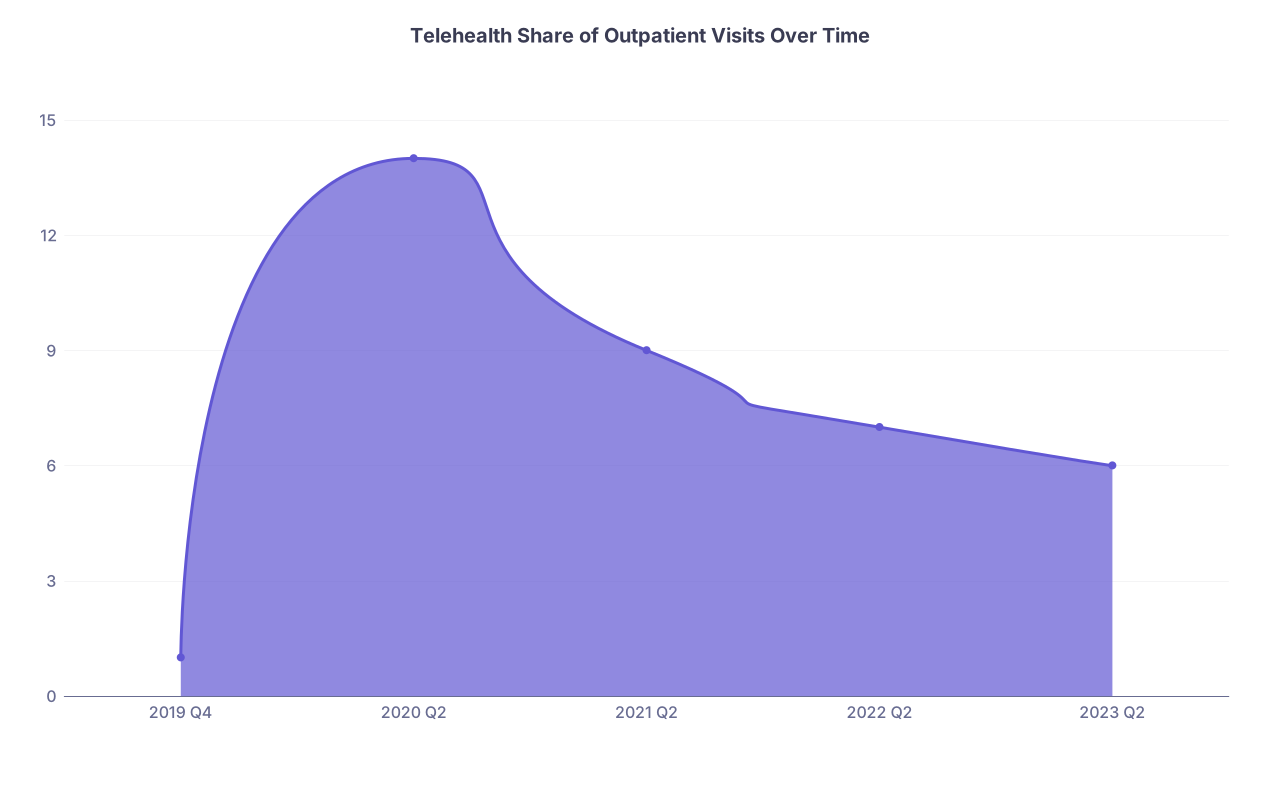
| Category | Value |
|---|---|
| 2019 Q4 | 1 |
| 2020 Q2 | 14 |
| 2021 Q2 | 9 |
| 2022 Q2 | 7 |
| 2023 Q2 | 6 |
A few real patterns that matter for your job stability:
Non-urgent care is deferrable. In both 2008 and early COVID, routine and elective visits dropped first. If your telemedicine niche is “nice to have” (skin checks, lifestyle meds, cosmetic concerns), patient demand is not guaranteed.
Mental health telemedicine is unusually resilient. Behavioral health visits stayed high and mostly tele-based long after other specialties drifted back to in-person. Even in economic stress, depression, anxiety, and substance use do not politely pause because GDP dipped.
Tele-urgent care partially substitutes ED / walk-in clinic visits. Some systems actually prefer tele-urgent visits in downturns if they can divert expensive ED use. If you’re employed by the system, that’s good. If your employer’s business model is to bill payers at urgent-care rates from outside the system, you’re competing in a race-to-the-bottom reimbursement environment.
Rural and access-constrained patients keep using telehealth. When gas prices are high or jobs are unstable, people with chronic diseases may actually lean on telemedicine more—if it’s covered. Again: reimbursement policy is king.
The Real Stability Levers You Actually Control
You can’t control the Fed or your company’s last funding round. You can choose how exposed you are.
1. Avoid telemedicine roles that sit on a single brittle revenue stream
If one payer contract, one big employer client, or one narrow wellness product line is basically the whole business, your risk is high. I’ve watched companies whose “entire pipeline” was one large self-funded employer. When that employer changed benefits consultants, half the clinical staff were gone within months.
Look for:
- Multiple payer contracts or diversified client base
- Both commercial and Medicare/Medicaid exposure
- Clear pathway to profitability, not just “growth story”
If you ask about payer mix and leadership hand-waves the question, that’s an answer.
2. Prefer telemedicine embedded in care delivery, not marketing gimmicks
The more your work is woven into actual longitudinal care—chronic disease management, complex care coordination, integrated behavioral health—the harder it is for admins to frame your job as optional.
If your visits prevent readmissions, close quality gaps, or generate HCC coding lift in MA populations, losing you hurts their bottom line.
If your visits primarily pump out short-term scripts or low-complexity encounters that any cheaper clinician can do, you are a cost center to be replaced or automated.
3. Maintain in-person competency, even if you love remote work
I’ve seen physicians corner themselves into “haven’t stepped in a clinic in 4 years” niche telehealth roles. Looks fine in boom times. In a downturn, they discover:
- Recruiters and credentialing committees are skeptical of long purely virtual stretches.
- Their skills, notes, and habits are shaped for 7-minute low-acuity visits, not full-spectrum outpatient medicine.
- Malpractice carriers may price them differently once they try to return.
Keeping even a small in-person panel or hospital affiliation makes you harder to discard and easier to redeploy.
What Economic Downturns Actually Change for Telemedicine Clinicians
Let’s be concrete. You’re post-residency, doing or considering telemedicine, and the economy tanks. What changes on the ground?
You see compensation compression, not necessarily pink slips
Most organizations do not fire everyone overnight. They:
- Decrease per-visit rates for contractors.
- Remove or tighten productivity bonuses.
- Push more encounters per shift (“We think 3.5 patients per hour is reasonable now”).
So yes, you may technically keep your job, but your effective hourly rate drops. If your personal finances are built on 2021 telehealth boom rates, recession-era adjustments will hurt.
You see narrower clinical scope and more protocols
To protect margins, many telehealth outfits move toward:
- Protocol-driven care
- Narrow formularies
- Tighter visit times, more templated notes
Clinical autonomy shrinks. If you thought telemedicine would mean more control, an economic downturn pushes it toward assembly-line care in some environments. If you’re in it strictly for flexibility and not okay with being boxed in, this is where burnout spikes.
You see a brutal difference between high- and low-quality operations
The mature, operationally sound telemedicine groups:
- Focus on retention over churn-and-burn recruiting.
- Communicate early about financial realities.
- Redeploy clinicians across product lines rather than cut abruptly.
The chaotic shops:
- Vanish from email for weeks, then drop surprise changes.
- Delay payments “due to billing transitions.”
- Blame “market conditions” while leadership stays strangely silent on their own decisions.
The same downturn reveals which category you picked.
How to Actually Stress-Test a Telemedicine Job Offer
Before you sign:

| Step | Description |
|---|---|
| Step 1 | Job Offer |
| Step 2 | How do they make money |
| Step 3 | Ask about margins and runway |
| Step 4 | High risk - single revenue |
| Step 5 | Ask about downturn history |
| Step 6 | Decide risk tolerance |
| Step 7 | Multiple payers or clients |
Specific questions that cut through the fluff:
- “What percentage of your revenue is from your top three clients or payers?”
- “How did your organization handle the 2022–2023 funding tightening? Any layoffs or pay changes?”
- “If visit volume drops by 30% for six months, what happens to clinician schedules and pay?”
- “What proportion of visits are covered by value-based contracts vs pure fee-for-service?”
- “Do you have a path to hybrid roles or in-person work inside the organization?”
You’re not being difficult. You’re acting like a professional who understands that “work from home” is not a risk-management strategy.
So, Is Telemedicine More or Less Stable Than Traditional Jobs?
The annoying but honest answer: it depends entirely on the business model, not the video platform.
Compared with traditional outpatient employment:
- Telemedicine roles in integrated systems and value-based care are at least as stable, sometimes more, during downturns. They’re relatively cheap to run and can replace costly care settings.
- DTC, venture-fueled, and gig-style telemedicine roles are less stable, sometimes dramatically so, and hypersensitive to investor sentiment and consumer discretionary spending.
- Pure-telework “side gigs” are a poor backbone for your financial security in a recession. As a supplement, fine. As your entire plan, naïve.
The myth is that “telemedicine” is a single category with a single risk profile. It is not. It’s as diverse as “clinic work” or “hospital work,” with equally big differences in stability across settings.
FAQs
1. Should I avoid startup telemedicine companies completely if I want stability?
Not necessarily, but go in with open eyes. Late-stage, revenue-positive companies with diversified contracts are very different from seed-stage outfits burning investor cash. If stability is your top priority in a potential recession, you should weight offers from integrated systems and mature value-based groups more heavily, and treat early-stage startups as higher-risk, potentially higher-reward bets.
2. Is it safer to keep telemedicine as a side gig rather than my main job?
For many physicians, yes. Using telemedicine as 10–30% of your income—on top of a reasonably secure primary role—lets you capture flexibility and extra earnings without tying your entire financial life to a volatile reimbursement and funding environment. Relying solely on per-visit telehealth work from a single platform leaves you exposed when volumes or rates drop.
3. Which telemedicine specialties have shown the most resilience so far?
Behavioral health, chronic disease management (especially tied to value-based contracts), and tele-primary care embedded in large systems or MA plans have held up best. Acute low-acuity urgent care, cosmetic / lifestyle medicine, and cash-pay convenience services tend to be more sensitive to economic stress and changes in payer behavior.
Key points: telemedicine itself is not a shield against recessions; payment model and employer type drive your job stability. Hybrid and value-based roles generally hold up; DTC and gig-style telehealth are the first to bleed when the economy tightens. Treat “remote” as a feature, not your entire risk management plan.