
The glossy corporate line about telemedicine QA is a lie of omission. What actually happens in a telemedicine QA review is part patient safety, part legal shield, and part business optimization exercise—usually in that order only on paper.
If you’re a post‑residency physician thinking about telemedicine (full‑time or as a side gig), you need to understand this: QA is where your practice gets dissected when you are not in the room. It’s where people you’ve never met decide whether you’re “safe,” “on brand,” or “a problem.”
Let me walk you through what really happens on the other side of the platform.
The Real Purpose of Telemedicine QA (Not the Marketing Version)
On the website and in your onboarding slide deck, QA is framed as:
“Ensuring high quality, evidence‑based, patient‑centered care.”
That’s the brochure. Internally, the hierarchy of priorities looks more like this:
- Prevent lawsuits and regulatory trouble
- Protect contracts with insurers and employers
- Keep patient satisfaction scores high enough for growth
- Standardize care to match internal protocols and order sets
- Improve quality of care (yes, it’s on the list—but it’s not #1)
I’ve sat in those QA meetings where a medical director literally says, “Is this a clinical issue or a contract risk?” before deciding whether to escalate a case. That’s the actual lens.
To understand QA, you have to know who’s at the table.

Typically, a serious QA review process involves a core group like:
- A medical director (often EM/IM/FM background)
- One or more physician reviewers (same specialty as service line, sometimes moonlighting docs)
- A nurse or advanced practice provider experienced in the workflow
- QA/compliance staff who track metrics and documentation
- Operations or product rep quietly listening, taking notes
They’re not just judging you on “was this good medicine.” They’re judging you on: “Does this match our protocols, our risk appetite, and our contracts?”
That’s the frame everything else hangs on.
How Cases Actually Get Pulled Into QA
You might think QA is a random sample of cases. That’s partially true—and mostly incomplete.
Cases end up in QA review through five main pipelines:
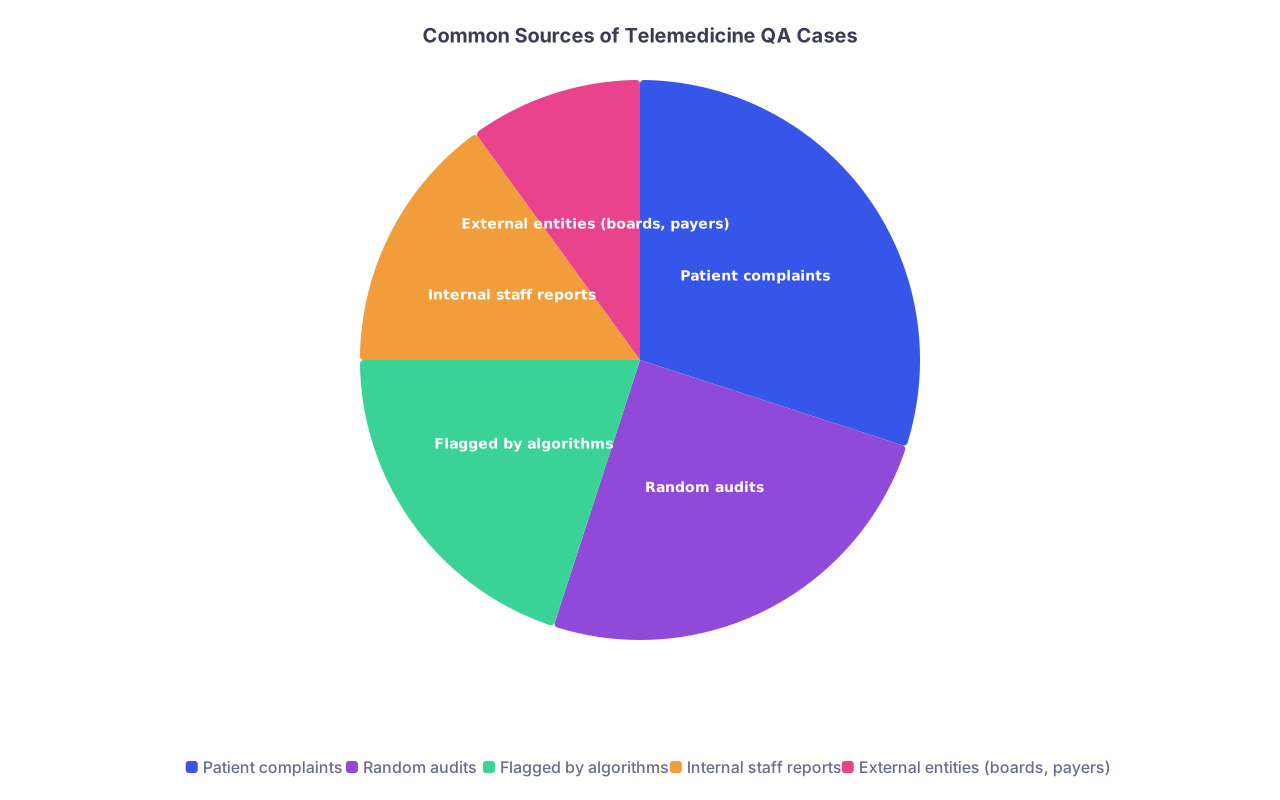
| Category | Value |
|---|---|
| Patient complaints | 30 |
| Random audits | 25 |
| Flagged by algorithms | 20 |
| Internal staff reports | 15 |
| External entities (boards, payers) | 10 |
1. Patient Complaints
The biggest, loudest driver. Not necessarily the most clinically important.
What gets flagged:
- “The doctor refused antibiotics.”
- “The doctor was rude / rushed / dismissive.”
- “They didn’t give me a work note / refill I wanted.”
- “Misdiagnosis” (sometimes accurate, sometimes pure hindsight bias).
Here’s the part nobody tells you: QA reviewers know that a large chunk of these complaints come from patients angry they didn’t get what they wanted. But those complaints still trigger a chart review because patient satisfaction and complaint rates are watched like a hawk by leadership and payers.
You will see ridiculous complaints land in the same review bucket as legitimate safety issues. And you’ll be judged on both.
2. Random or Targeted Audits
Most platforms claim to audit X% of visits monthly. That might be 1–5% for low‑risk services; higher for controlled substances, behavioral health, or new service lines.
But “random” isn’t always random.
Frequently, it’s:
- Random plus oversampling of high‑risk diagnoses
- Random plus extra scrutiny for new providers
- Random plus any provider with previous issues
Translation: once you’re on their radar, you stay on it for a while.
3. Algorithmic/Rules‑Based Flags
This is newer, but it’s everywhere now. The platform runs backend analytics to flag outlier behavior:
- You prescribe antibiotics for URI at twice the platform average
- Your average visit time is way below peers
- You almost never refer to ED
- Your controlled substance rate is suspiciously high or suspiciously variable
- You close visits with almost no documentation fields completed
Those charts get pulled automatically for QA.
The data is crude. It doesn’t know who’s good, but it knows who’s different. QA then comes in to decide whether “different” equals “unsafe” or “off‑brand.”
4. Internal Staff Escalations
This is the “whisper channel” you don’t see.
- RNs or MAs flag weird encounters they triage or support
- Customer service reps escalate cases where patients are clearly harmed or distraught
- Other clinicians report concerning behavior (yes, peer complaints absolutely happen)
I’ve heard:
“He discharged a chest pain patient after a three‑minute visit.”
“She’s prescribing phentermine on every third visit.”
“He kept doing visits while clearly sick and slurring his speech.”
These do not go into the random audit pile. They go straight to “special review.”
5. External Pressure: Boards, Payers, Employers
The nuclear triggers:
- State medical board inquiry
- Malpractice letter or claim
- Employer/partner health system complaining about virtual care quality
- Payer asking why your group has abnormal prescribing patterns
Those cases get dissected. Thoroughly. And sometimes retroactively—meaning your past encounters can suddenly be under the microscope because of one high‑profile incident.
What Actually Happens in a Single QA Case Review
Let’s get into the mechanics. Suppose your case got flagged. What happens in that room?
There’s a fairly predictable playbook.
Step 1: The Chart Autopsy
A clinician reviewer (or a panel) opens your chart. They’re not reading it the way you wrote it. They’re reading it as if they have no context other than what’s on the screen.
They go through:
- Chief complaint
- HPI detail (or lack of it)
- ROS (is it meaningful or pure template spam?)
- Virtual exam elements documented
- Differential, assessment, and plan
- Patient instructions and safety netting
- Any follow‑up or messaging after the visit
- Alignment with company‑approved guidelines
Here’s the dirty secret: in telemedicine, documentation quality often matters more than clinical nuance for QA. If you did the right thing but didn’t document it, the QA committee will still call it a miss.
I’ve watched cases where the clinician clearly thought through red flags—but never wrote their reasoning. QA had to assume they didn’t think it through.
Step 2: The Standard of Care vs “Standard of Platform”
There are really two thresholds you’re being tested against:
- General medical standard of care
- “House style” of that telemedicine company
These are not always identical.
Example:
Medically, you might be within reasonable practice variation on borderline UTI symptoms. But if the platform’s protocol says, “No UTI diagnosis without at least X, Y, Z documented” and you skipped one, QA may call it a failure—even if it wouldn’t hold up as malpractice in the wild.
Same with:
- When to send to ED
- When to order in‑person follow‑up
- What medications are “discouraged” or forbidden
- How many days of a prescription you’re “allowed” to give
You’re being graded against their playbook, not just your training.
Step 3: Risk Categorization
Every QA team has some variant of a severity grid.
| Level | Label | What It Usually Means |
|---|---|---|
| 1 | Excellent/Ideal | Textbook visit, strong documentation |
| 2 | Acceptable/Minor | Small gaps, not safety‑relevant |
| 3 | Moderate Concern | Deviation from protocol, low risk harm |
| 4 | Major Concern | Clear risk of harm, near‑miss |
| 5 | Sentinel/Catastrophic | Actual harm or board/legal level issue |
A lot of your visits will land in 1–2 and never cross your desk.
It’s the 3–5s that generate emails, coaching, performance plans, or in extreme cases: offboarding and reporting.
Step 4: Pattern Hunting
If your name shows up often, they’ll start asking: “Is this a one‑off or a pattern?”
So they’ll pull more of your charts.
I’ve seen this cascade: one flagged pediatric fever case leads to a sample of 20 of your peds cases, which reveals that you consistently under‑document, under‑safety‑net, and rarely recommend in‑person follow‑up. Now you’re not being reviewed for that one visit—you’re being evaluated as a risk category.
This is how people quietly get put on “heightened review” without being told the full backstory.
Step 5: The Behind‑Closed‑Doors Verdict
The QA committee talks. They debate. And it’s not always pretty.
You’ll hear things like:
- “I wouldn’t have done that, but it’s probably defendable.”
- “If this hits a plaintiff attorney with this documentation, we’re screwed.”
- “We need to talk to this provider—they’re not practicing in line with our model.”
- “This one is borderline, but we should at least send an FYI and education.”
That’s where your fate for that case is decided—and which formal process will be used on you.
The Emails, “Coaching,” and Disciplinary Steps You Actually See
From your perspective as the physician, QA shows up as:
- A “friendly” feedback email
- A required call with a medical director
- A formal performance improvement plan
- Sudden drop in shifts offered without clear explanation
- In the worst case: abrupt contract termination
Let’s break those down.
The “FYI / Coaching” Message
This is the mildest form:
“During a routine QA review of your recent encounters, we noted some opportunities for improvement…”
They highlight a chart, point out specific misses (often documentation, sometimes clinical reasoning), and attach or link to internal guidelines.
There’s usually a phrase like “no further action is required at this time” if it’s truly low‑level.
Read those very carefully. They’re testing two things:
- Are you teachable and responsive?
- Are you going to argue, stonewall, or be defensive?
Your response gets remembered. Sometimes even documented.
The “We Need to Discuss This Case” Call
This is step two. You’ll get a scheduling link for “case review with medical director.”
Behind the scenes, that almost always means:
- Your case was level 3–4 on their internal grid
- Someone on QA is uneasy about your pattern
- Or non‑clinical operations flagged you as an outlier
The director will “walk through” the case with you. They’re listening for:
- Insight: Do you recognize the red flags now?
- Attitude: “Thanks, I see that” vs “You’re wrong, I did nothing wrong.”
- Alignment: Will you adjust practice to fit the platform?
If you get multiple calls like this in a short period, you’re on the edge of being considered a risk provider.
Performance Improvement Plan (PIP) or “Heightened QA Review”
When things are serious but not yet fireable, they formalize it.
That looks like:
- Written document with specific expectations
- Examples of what must change (documentation, prescribing, triage thresholds)
- Extra chart reviews for a defined period (e.g., next 50–100 visits)
- Metrics they’ll monitor (antibiotic rate, visit time, escalations)
This is as much a legal CYA as it is genuine coaching. If they end up terminating you, this is the paper trail they show: “We identified issues, provided guidance, and the provider did not meet expectations.”
Immediate Offboarding / Suspension
This happens for:
- Clear, high‑risk mismanagement with harm or severe near‑miss
- Suspected impairment (substance, mental, or physical)
- Fraudulent documentation or misrepresentation
- Repeated non‑compliance after PIP
- State board or legal instructions
You’ll know it’s serious because your access is cut off quickly. Sometimes before anyone even has a “conversation” with you.
In the background, they’re also deciding:
- Do we have to report to the state board?
- To NPDB?
- To partner institutions?
You usually won’t see those discussions, but they absolutely happen.
What QA Reviewers Actually Judge You On (Not Just What’s on the Rubric)
Let’s talk criteria. The official rubric is all about:
- History completeness
- Appropriate virtual exam
- Differential and assessment
- Plan matching guidelines
- Patient education and follow‑up
- Documentation clarity
Fine. That’s the surface. Underneath, there are softer—and very real—dimensions.
1. “Would I Want My Family Seen Like This?”
Real line I’ve heard committee members use. QA physicians ask themselves:
- Did you seem to care, based on what’s written?
- Did you think through red flags?
- Would this level of thoroughness be acceptable if it was their kid with that fever?
You’re being judged not just on correctness, but on thoroughness and humanity—abstracted through your notes.
2. Your Risk Posture
Some docs are reflex triagers: everything is “go to ED or urgent care.” Others almost never escalate.
Both extremes get attention.
If you’re too conservative, the ops people worry about:
- Cost escalation
- Partner employers complaining about too many “ED for nothing” referrals
- Patient dissatisfaction (“I paid for this visit just to be told to go in person”)
If you’re too loose, the QA people worry about:
- Missed MI, sepsis, meningitis, ectopic pregnancy
- Any headline‑ready telemedicine horror story
The sweet spot is: thoughtful, documented safety netting with clear criteria for escalation. Not “go in for everything,” not “you’re fine” with no guardrails.
3. Your Documentation Style vs Platform Templates
Let me be blunt: a lot of telemedicine platforms love templated documentation because it’s fast, defendable, and standardized.
If your notes look:
- Minimalist, almost free‑text only
- No structured fields, just a short HPI and plan
- No explicit mention of ruling out red flags
…you will look bad in QA, even if your care was fine.
I’ve seen excellent clinicians burned because they thought “quick note” standards from busy brick‑and‑mortar practice would fly in telemedicine. QA hates ambiguity.
4. Whether You’re a “Problem Generator”
If ops or customer service keeps sending names to QA, those names get a little mental asterisk.
- High number of patient complaints
- High refund request rate
- Patients repeatedly calling back upset or confused
- Nurses constantly cleaning up after your visits
You don’t see that scoreboard, but QA does. And once you’re seen as a “problem generator,” every case review is less generous.
What You Should Do Differently If You Want to Survive QA
This is where you have leverage. You can’t control the politics in that room, but you can control what they see when they open your charts.
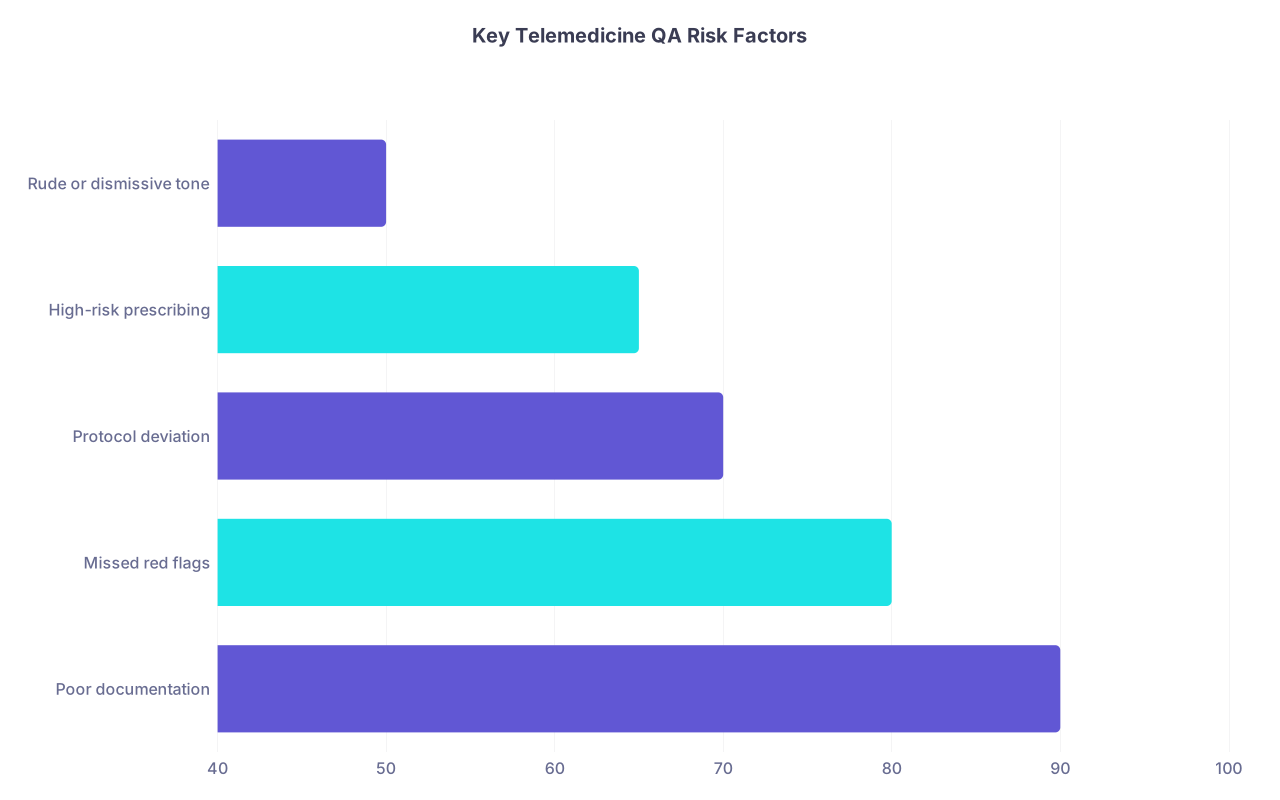
| Category | Value |
|---|---|
| Poor documentation | 90 |
| Missed red flags | 80 |
| Protocol deviation | 70 |
| High-risk prescribing | 65 |
| Rude or dismissive tone | 50 |
1. Document Like Someone Hostile Will Read It Later
Because they might.
Make sure your note answers:
- What did I consider and rule out?
- What red flags did I specifically ask and document?
- Why did I decide not to escalate to ED/in‑person?
- What exactly did I tell the patient about when to seek urgent care?
Short doesn’t mean vague. You can be concise and explicit at the same time.
2. Make Safety Netting Unmissable
In telemedicine QA, safety netting language is your seatbelt.
Example:
“Discussed that if fever persists beyond X days, or if new symptoms such as XYZ develop (worse headache, neck stiffness, confusion, SOB, chest pain), patient should seek immediate in‑person evaluation at urgent care or ED. Patient verbalized understanding.”
That one paragraph has rescued more charts in QA than anything else.
3. Respect the House Protocol (Even if You Don’t Love It)
You can be the world’s best clinician, but if you’re out of sync with their protocol on antibiotics, steroids, benzos, or imaging, you’re going to spend your life in QA hell.
If you truly disagree with a platform’s stance—on principle—don’t work there. Because they will not redesign their risk profile for you.
4. Don’t Be Cute With Controlled Substances
Telemedicine plus controlled substances is how careers get burned.
If your platform’s rules are strict, follow them to the letter. If they’re too loose, understand that regulators may show up later and everyone will suddenly get religion about “tightening controls,” retroactively judging past visits.
When in doubt, err towards conservative, documented rationale and/or in‑person follow‑up.
5. Own Your QA Feedback Like a Professional, Not a Defendant
When you get a QA email or call:
- Don’t reply in anger. Ever.
- Acknowledge the points you agree with.
- Ask specifically, “How would you like this approached in future similar cases?”
- Show you’re aligning your practice with their model.
People who take feedback well buy themselves a lot of goodwill. People who argue every point become “not worth the risk” incredibly fast.
The Part No One Mentions: QA as a Career Filter
Telemedicine QA reviews don’t just protect patients and companies. They also sort physicians into three buckets:
- Safe and aligned → more shifts, more responsibility, maybe leadership
- Safe but annoying or off‑brand → kept, but watched, limited growth
- Risky or resistant → quietly phased out
If you’re eyeing telemedicine as a long‑term career path or leadership role, the QA process is the audition you don’t know you’re in.
Medical directors are chosen from the pool of clinicians whose charts make QA comfortable, whose names aren’t constantly attached to complaints, and who don’t trigger panic calls from compliance.
So when you think, “This is just one annoying QA email,” understand you’re building a reputation inside a system that runs heavily on pattern recognition and internal whispers.
Quick Mental Model: How Your Visit Looks From the QA Side
Here’s the flow they effectively run in their heads:

| Step | Description |
|---|---|
| Step 1 | Flagged Case |
| Step 2 | Review Documentation |
| Step 3 | Protocol Deviation |
| Step 4 | Low Level Feedback or None |
| Step 5 | Moderate or Major Concern |
| Step 6 | Education or PIP |
| Step 7 | Targeted Coaching |
| Step 8 | Heightened Review or Removal |
| Step 9 | Meets Protocols |
| Step 10 | Any Safety Concerns |
| Step 11 | Pattern of Issues |
You can’t see it, but that’s roughly how they’re moving through the case. Automatically after a while.