The myth that telemedicine companies just want “any board‑certified body with a license” is dead wrong.
I’ve sat behind the curtain with medical directors for national telehealth groups, virtual urgent care lines, specialty e-consult services, even the VC-backed startups that brag about growth on LinkedIn. They are far more selective than most applicants realize. And they filter you out in ways that never show up in the job posting.
You’re post‑residency, you want remote flexibility, maybe some geographic freedom, maybe you’re burnt out from in‑person grind. I get it. But the telemedicine medical director is not just asking “Can this person see patients online?” The real question is, “Will this person lower my risk, protect my metrics, and not make my life hell with escalations?”
Let me walk you through how they actually think.
The Real Hiring Filter: Risk, Speed, and Headache Potential
On paper, job ads talk about “patient-centered care,” “teamwork,” “innovation.” Nice words. The informal evaluation is much harsher:
- Will you create medicolegal or regulatory problems?
- Will you slow down throughput and hurt revenue/SLAs?
- Are you going to be needy, argumentative, or high‑maintenance?
If you look like a risk, a drag on metrics, or a headache, you’re done. Even if your CV is gorgeous.
| Priority | What They Actually Mean |
|---|---|
| Safety/Risk | Low malpractice risk, knows when to refer out |
| Throughput & Efficiency | Fast, decisive, minimal hand‑holding |
| Guideline & Protocol Fidelity | Follows algorithms, not a cowboy |
| Tech & Platform Reliability | No constant troubleshooting or missed shifts |
| Attitude & Communication | Low drama, concise, coachable |
Notice what’s missing: “brilliant diagnostician” and “published 6 papers.” Those don’t hurt. They just aren’t decisive for a telehealth hire.
Clinical Judgment in a Low‑Information Environment
Telemedicine exaggerates your weaknesses. In person, you can compensate—poke the abdomen, re-examine, keep the patient a bit longer. Virtually, you get one shot, with bad lighting and worse audio.
So medical directors look hard for doctors who are safe and decisive under uncertainty.
They’re asking:
- Does this person understand the limits of virtual care?
- Do they know when to stop and send the patient in?
- Will they resist the patient who’s pushing for antibiotics, benzodiazepines, or narcotics over video?
I’ve watched medical directors reviewing recordings of sample visits. The candidate said, “Well, I suppose we could try an oral steroid burst even though I can’t examine your lungs.” The director paused the video, leaned back, and said, “Nope. This is how I get sued.”
You’ll see code words in job descriptions: “Comfort in practicing within telemedicine scope,” “understands appropriate escalation,” “experience in protocol-driven environments.” Translated: they do not want a cowboy. They want someone who treats telemedicine like an airport urgent‑care kiosk: stabilize, risk‑stratify, and hand off anything questionable.
If your background screams “hero complex”—lots of language about “always going the extra mile,” “never saying no,” or stories of managing ICU‑level care in rural clinics—some directors will see that as a liability. Telemedicine is not where they want improvisational medicine. It’s where they want disciplined triage.
Productivity: What They Really Mean by “Reasonable Volume”
Nobody tells applicants the real numbers, but they absolutely track you like a call center.
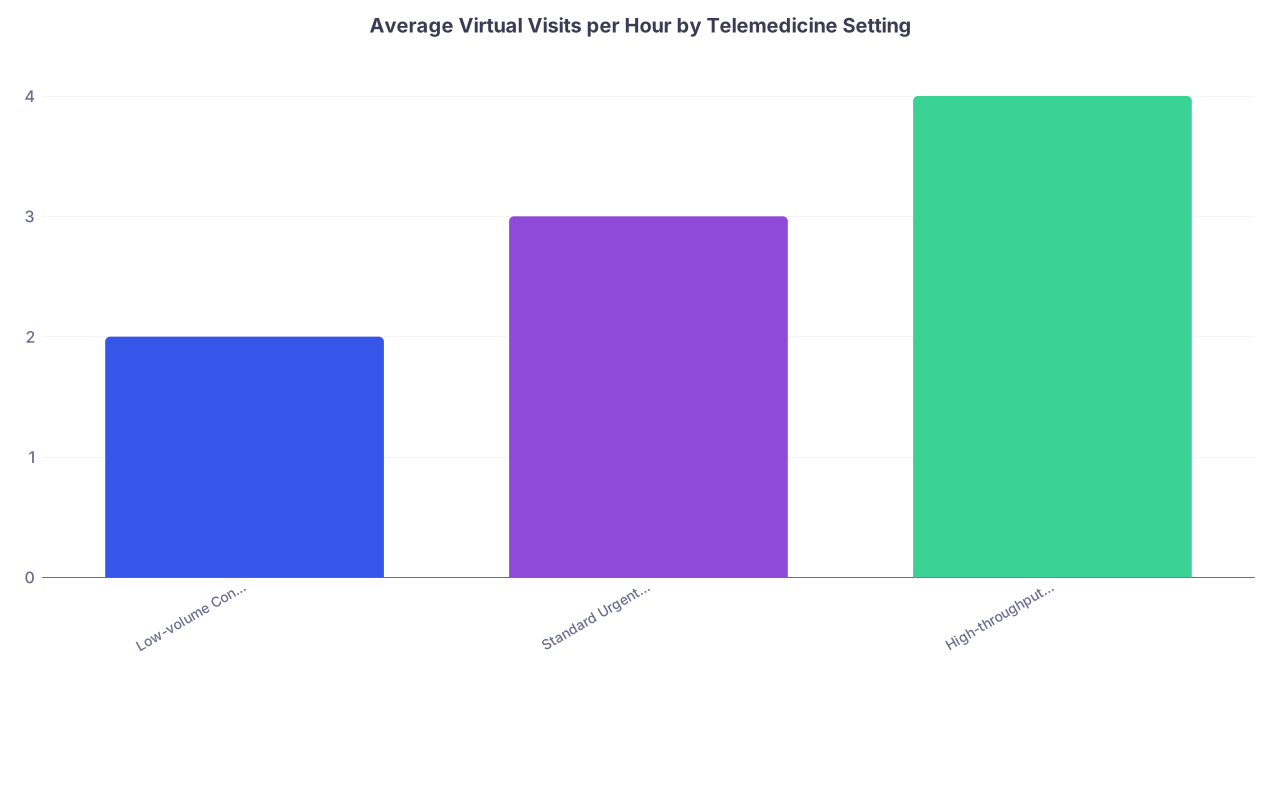
For synchronous tele-urgent care, typical internal benchmarks look something like this:
| Category | Value |
|---|---|
| Low-volume Concierge | 2 |
| Standard Urgent Care | 3 |
| High-throughput Platform | 4 |
If you’re consistently at 1–2 patients per hour on a platform that expects 3+, you’re gone. Not immediately—first you’ll get a gentle “coaching” email. Then the shifts dry up. Then they “regret to inform you we’re moving in a different direction with our staffing needs.”
Medical directors look for signs you can handle volume:
- EM or urgent care background
- Documented high RVU productivity in previous roles
- Comfort with protocols and templates
- Any history with call centers, advice lines, or e-consults
What they’re wary of:
- Fellows who’ve only done academic half-day clinics seeing 6–8 patients
- Primary care physicians used to 30–45 minute visits
- Residents who proudly say, “I really take my time to get the full story”
You do not say that in a telemedicine interview. You say, “I’m efficient with focused histories, problem-oriented visits, and I’m very comfortable with protocol-driven care.”
And then you have to prove it.
Protocol Fidelity: The Unsexy Dealbreaker
Here’s a dirty little secret: many telemedicine programs are quietly under constant payer, regulator, or pharmacy-benefit-scrutiny. Antibiotic overuse, controlled-substance prescribing, high-ordering patterns—these attract audits.
So medical directors obsess over whether you will follow their playbook.
They will not say, “We want robots.” But functionally, that’s what they want in the high-volume operations: clinically competent, protocol-compliant operators with a low variance in practice patterns.
You’ll see it during orientation:
- Step‑by‑step flow for UTI, URI, rash, back pain.
- Very clear “do not prescribe” lists.
- Hard stops in the EMR preventing certain orders.
- Pre‑set smart phrases and discharge instructions.
The candidates who wash out fastest are the ones who say, “But what if I think the protocol is wrong?” or “I like to do things my own way.” That’s an instant red flag.
A medical director at a national platform once said, off the record:
“Give me a solid B+ clinician who follows the protocol 100% over an A+ diagnostic genius who thinks our guidelines don’t apply to them. The B+ will never make me infamous in front of the board.”
So if you want these jobs:
- Talk about your comfort working with care pathways and clinical decision support.
- Mention EMR order sets you helped design or adhered to.
- Show that you know when to ask, “Is this within telemedicine scope?” instead of winging it.
You can still advocate for nuance and case-by-case judgment, but don’t lead with autonomy. Lead with reliability.
Tech Fluency: They’re Screening You Way Earlier Than You Think
You think the “tech skills” part is about clicking buttons in the EMR. That’s the easy part. They’re really judging:
- Are you going to constantly blame the platform for your mistakes?
- Can you troubleshoot basic tech issues or will you page support every 10 minutes?
- Do patients complain they “couldn’t connect” with you constantly?
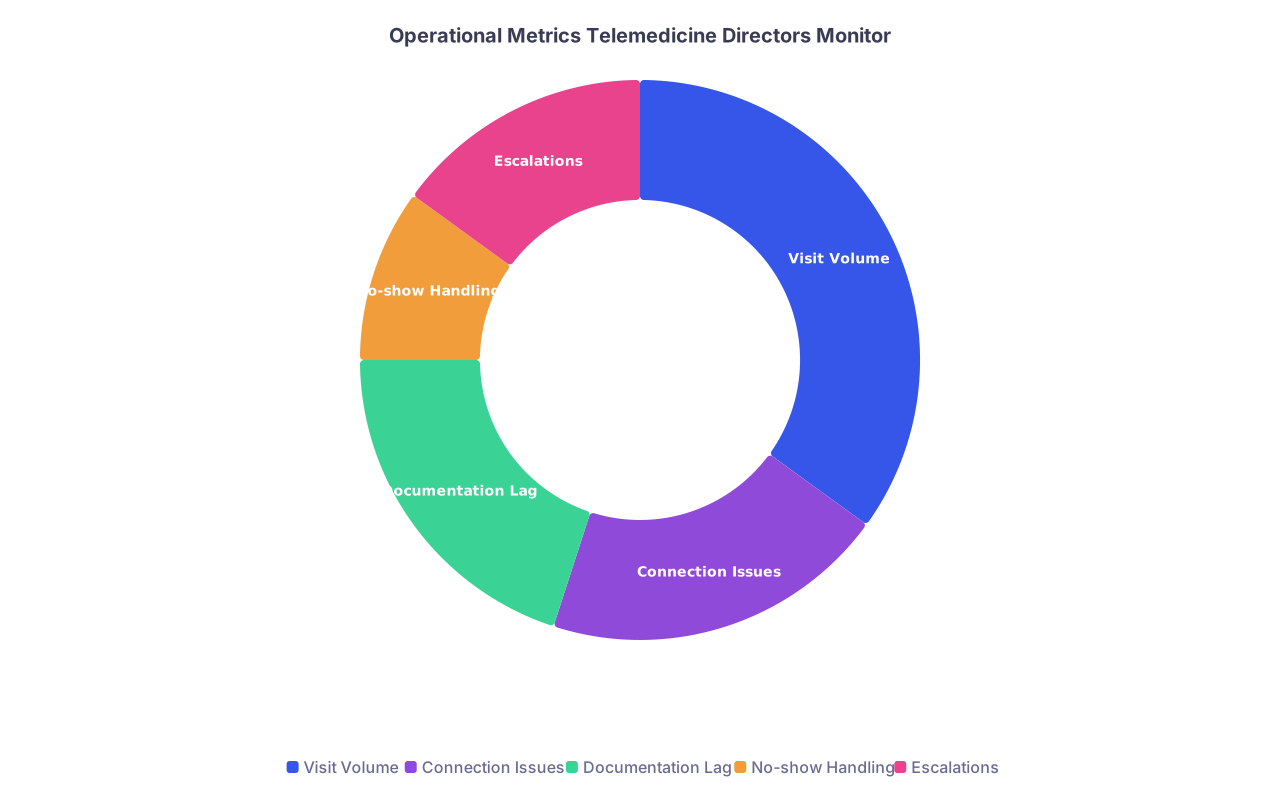
Medical directors, especially in larger companies, get detailed metrics that most physicians never see:
| Category | Value |
|---|---|
| Visit Volume | 35 |
| Connection Issues | 20 |
| Documentation Lag | 20 |
| No-show Handling | 10 |
| Escalations | 15 |
You become a problem if:
- Your visits constantly run over the allotted time
- You finish your charts hours late, slowing QA and billing
- You cancel or miss shifts with “internet issues” more than once
- Patients repeatedly disconnect on your visits while others are fine
In interviews, your tech posture matters more than you think. When someone logs into a video interview from a dim room, with AirPods that keep cutting out, or clearly hasn’t tested the link beforehand—guess what the director is thinking: “This is exactly the person who will tank our patient satisfaction scores.”
Show up to the interview demonstrating that you can:
- Use a headset or quality mic
- Stay on stable internet
- Share your screen if asked
- Handle a basic glitch without panicking
Say explicitly: “I’ve worked with multiple EMRs, I’m comfortable with dual monitors, and I’m very proactive about testing my setup before shifts.” That sounds trivial. It’s not. It makes you look like someone they won’t have to babysit.
Communication Style: Short, Clear, and Non‑Defensive
Telemedicine magnifies poor communication. Every small hesitation or confusion looks much bigger on camera.
Medical directors quietly favor doctors who are:
- Direct but warm
- Structured in their explanations
- Comfortable setting boundaries with entitled or angry patients
They’re listening for specific patterns:
- Do you ramble?
- Do you over‑explain and eat up time?
- Can you say “No” in a way that doesn’t generate complaints?
Here’s what they do not want to hear in a mock case or behavioral question:
“I usually just try to give the patient what they want so they feel heard.”
That line terrifies medical directors. That’s how you get reviewers writing, “Doctor just gave me antibiotics without even examining me,” and then the plaintiff attorney pulls the transcript.
They do like hearing something like:
“If a patient demands something inappropriate, I acknowledge their concern, explain my reasoning clearly, and offer safe alternatives. I’m comfortable saying ‘no’ when it’s unsafe or outside policy, but I do it in a way that keeps the relationship intact.”
If you’ve ever worked in a call center or high-conflict environment (correctional care, ED with high LWBS, etc.), highlight how you handled difficult conversations efficiently. That’s directly translatable.
Red Flags Directors Talk About Behind Closed Doors
I’ve heard these exact lines in debriefs after interviews:
- “He sounds like a malpractice case waiting to happen.”
- “She’s going to argue every protocol.”
- “Way too academic; that pace is not going to work here.”
- “Smart, but I don’t want to be on call when his patient shows up septic.”
- “She wants ‘mentorship’—we’re not an attending-supervised clinic.”
Patterns that trigger those reactions:
- Overemphasis on wanting “lots of support” or “close supervision” post‑residency
- Aggressive “I know better” vibe about practice guidelines
- Romanticizing deep differential diagnosis work in a 10‑minute tele‑urgent slot
- Demonstrating zero understanding of telehealth limitations (talking like you’ll diagnose appendicitis over video and keep them at home)
Remember: telemedicine medical directors are already managing fragile systems—state‑by‑state regulations, payer contracts, operational targets. They want new hires who reduce variance, not amplify it.
The CV and Interview: What Actually Moves the Needle
Your CV for telemedicine should not read like a grant application. They are scanning for:
- Board certification and clean licensure
- Meaningful clinical volume, especially in acute/urgent settings
- Multi-state licenses (this is huge; more on that in a second)
- Prior telehealth, call center, triage, or protocol‑driven experience
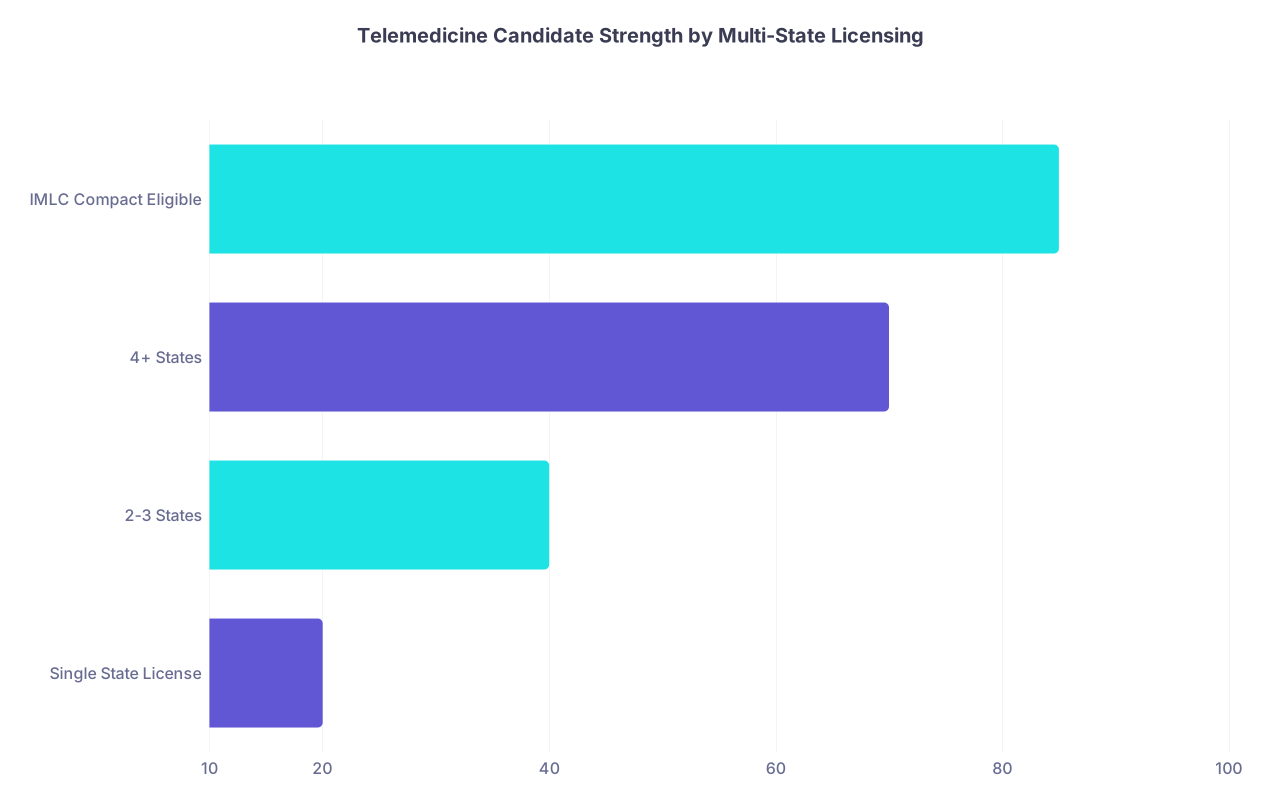
| Category | Value |
|---|---|
| Single State License | 20 |
| 2-3 States | 40 |
| 4+ States | 70 |
| IMLC Compact Eligible | 85 |
The multi‑state licensing thing is not a subtle factor. It’s a force multiplier. You might be an average candidate clinically, but if you’re licensed in 5–8 states or can rapidly obtain them (IMLC), you’re suddenly very attractive. Directors live in a world of staffing coverage maps. If you help fill multiple colors on that map, you win.
In interviews, do not just say “I’m interested in telemedicine for flexibility.” Everyone says that. The directors are tired of hearing about your desire to travel, move abroad, or watch your kids while on shift. They want to know:
- Why are you specifically suited to this kind of medicine?
- How will you protect them from risk and complaints?
- Will you be independent and low‑maintenance?
Better talking points:
- “I enjoy focused, problem‑oriented visits and am very comfortable making decisions with limited data, as long as there are clear protocols and guardrails.”
- “In residency, I was usually one of the faster yet thorough people in clinic; I can document in real time and stay on schedule.”
- “I’ve worked with standing orders and care algorithms before and appreciate the clarity they bring to high‑volume settings.”
Add one to two concise stories that show you:
- Recognized a case that was not safe for outpatient/tele care and escalated appropriately.
- Handled an angry or demanding patient efficiently without giving inappropriate care.
- Quickly adapted to a new EMR or workflow.
Those stories stick. Directors remember them when ranking candidates.
The Business Side They Don’t Spell Out
Telemedicine is a business first, a clinical environment second. If you ignore that, you’ll give off the wrong signals.
Here’s the part they usually don’t say explicitly:
- Many programs are graded by corporate leadership on visit volume, abandonment rate, average handle time, and prescribing metrics.
- Medical directors are personally accountable when outlier physicians trigger payer audits or mass complaints.
- The fastest way for a director to get fired is a major safety event tied to lax telemedicine practice.
So when they’re hiring, they’re picking people who:
- Won’t tank patient satisfaction scores by being rude or chaotic
- Won’t tank safety metrics by under‑ or over‑treating
- Won’t tank throughput by being slow and disorganized
- Won’t tank compliance by ignoring documentation and EMR structure
If you talk in the interview like you’re joining a purely academic virtual clinic, you’re misreading the room. Acknowledge the business reality in a subtle way:
“I understand that in telemedicine there’s a balance between quality, safety, and efficiency. I’m comfortable working within defined workflows and targets as long as they’re clinically safe, and I see my role as supporting both patient care and program reliability.”
That tells a medical director: this person gets it. They won’t fight every operational decision as if it’s an affront to their autonomy.
How to Make Yourself an Obvious “Yes”
If you’re serious about telemedicine post‑residency, here’s the honest short list of what materially moves your application into the “hire” pile:
Get at least one telehealth‑adjacent experience on your CV
Could be resident tele-clinic, triage line work, e-consults, virtual follow‑ups. Anything.Stack licenses
Start IMLC if eligible. Add 2–3 high‑demand states (often TX, FL, CA if you can, plus a few compacts). It’s boring. It’s a game‑changer.Learn to think in protocols
Study real virtual‑care guidelines: antibiotic stewardship, common tele‑urgent algorithms. Be ready to talk in that language.Fix your tech setup
Ethernet if possible, good webcam, headset, dual monitors. Screenshare experience. Don’t look like you’re calling in from a dorm.Practice brief, structured communication
1‑line assessment, 2‑3 lines of plan, clear safety netting. Get used to closing visits under time pressure while patients still feel heard.
You do those, and you start looking like the kind of physician a telemedicine medical director is relieved to hire, not nervous about.
FAQ (exactly 4 questions)
1. Do telemedicine medical directors care where I trained or if I did a fellowship?
They care far less than brick‑and‑mortar academic centers. Prestige helps only at the margin. What carries more weight is whether your training environment resembled high‑volume, protocol‑driven practice: EM, urgent care, busy community primary care. Fellowship can actually be a mild negative if it suggests you expect complex, slow‑paced cases in a setting that runs on 10–15 minute slots. If you did a fellowship, frame it as enhancing your ability to triage and risk‑stratify quickly rather than as a license to do deep dives on rare diseases in every visit.
2. How much does prior telemedicine experience really matter for a first job?
It matters, but not in the “5 years or don’t bother” way IT job ads pretend. One solid rotation, a moonlighting tele‑urgent care gig, or structured experience with virtual follow‑ups can be enough to signal you’re not naïve about the workflow. Directors mainly want proof you’ve seen how constrained virtual exams are and that you respect those limits. If you have zero telehealth exposure, you’ll have to work harder in the interview to show you understand its boundaries and aren’t expecting to practice exactly like in-person clinic.
3. Can I be fully remote from day one, or do programs prefer local/hybrid physicians?
Plenty of national platforms will take you fully remote if licensure and time zones line up, but there’s a quiet bias toward physicians who can help with local coverage or occasional in‑person needs, especially health systems running both bricks‑and‑mortar and virtual lines. Being able to say, “I’m licensed in X and can align with your local call schedules” or “I’m open to a small hybrid component” makes you more flexible in their staffing grid. That said, purely remote roles absolutely exist; you just need to be extra strong on reliability and multi-state coverage.
4. What are the fastest ways to get fired from a telemedicine job?
Three patterns: safety issues, reliability issues, and attitude issues. Safety: repeatedly managing borderline cases at home that should go to ED or urgent care, overprescribing antibiotics or controlled substances, ignoring red‑flag symptoms. Reliability: missed shifts, chronic lateness, slow documentation, frequent “tech problems” that somehow only affect you. Attitude: fighting protocols, arguing in writing with QA or medical leadership, or being condescending to staff and patients. You can be clinically solid and still get quietly de‑prioritized from the schedule if you’re a hassle in any of those domains.
Key points: Telemedicine medical directors hire for risk containment, throughput, and low drama, not academic sparkle. Multi‑state licensure, protocol comfort, and solid tech/communication skills outweigh fancy publications. If you can show you’re safe, fast, and easy to manage, you’ll get offers—if you look like a cowboy or a hand‑holder, you won’t.