The idea that “telemedicine doesn’t count as real clinical experience” is wrong. Not outdated. Not incomplete. Just wrong.
Hospitals, payers, and medical boards are already credentialing telemedicine work as real practice. But they’re doing it in ways that surprise people who think a few PRN video shifts on Teladoc will magically replace years of in-person experience. That’s where the myth collides with reality.
Let’s separate the fantasy from what actually happens when you try to turn telemedicine into career capital after residency.
What “Counts” Depends on Who’s Doing the Counting
“Does telemedicine count?” is the wrong question. The only question that matters is: “Count for whom and for what?”
Different gatekeepers care about very different things:
- Medical boards care about competence, supervision, and disciplinary history
- Hospitals care about malpractice risk, procedures, and availability
- Payers care about documentation, billing, and compliance
- Recruiters care about whether you can function in the job they need filled
Telemedicine fits into that picture. But not evenly.
Licensing and Boards: Telemedicine Is Just Medicine With a Different ZIP Code
State medical boards don’t have a separate “telemedicine doctor” license. You’re either licensed to practice medicine or you’re not. Telemedicine is simply the medium.
Boards do look at:
- Gaps in practice
- Whether your recent work shows “active clinical practice”
- Any complaints, malpractice, or quality concerns from telehealth platforms
If you’ve spent two years doing high-volume tele-urgent care, prescribing, managing risk, getting peer reviews, and maintaining CME, state boards will generally treat that as clinical practice. Not as “fake” practice.
Where people get burned is when they try to use telemedicine to compensate for:
- No recent patient care after many years out
- No residency (for international grads)
- No meaningful continuity, supervision, or documentation
That’s not a “telemedicine problem.” That’s a “this is barely medicine” problem.
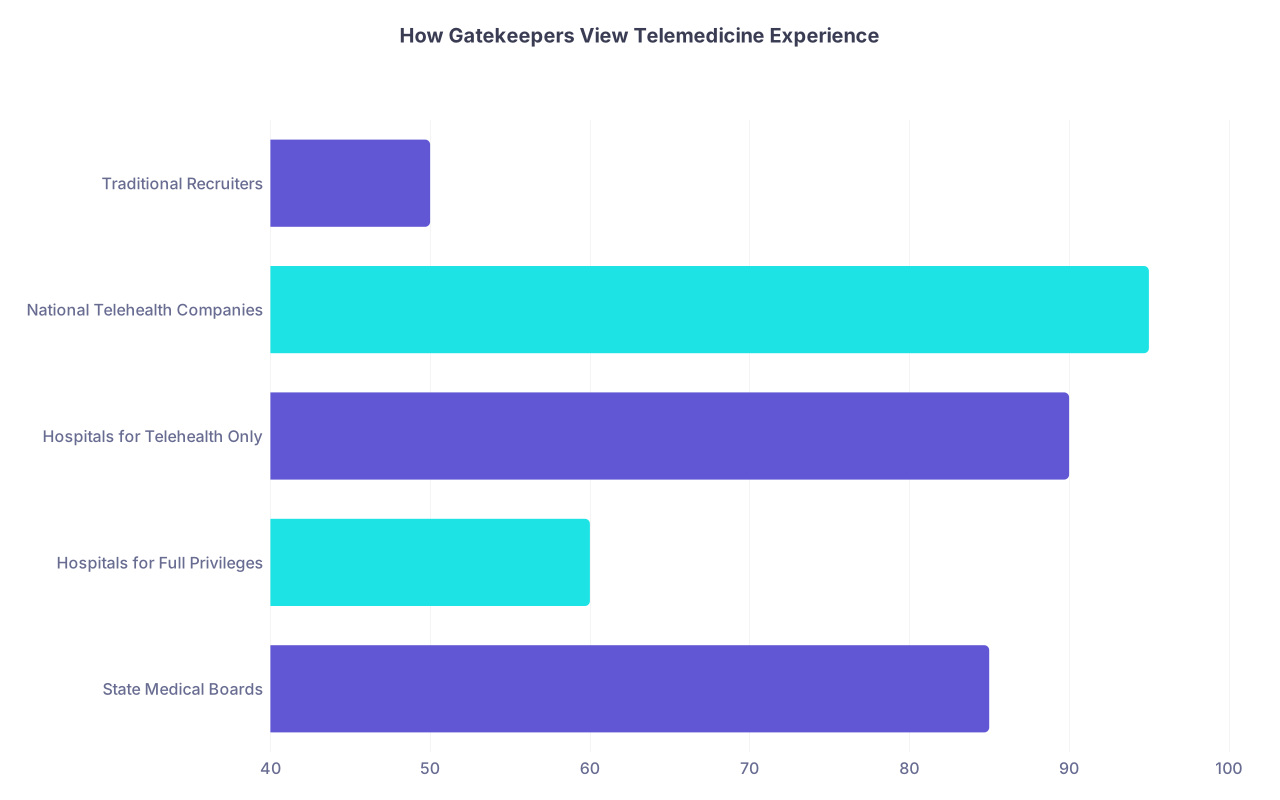
| Category | Value |
|---|---|
| State Medical Boards | 85 |
| Hospitals for Full Privileges | 60 |
| Hospitals for Telehealth Only | 90 |
| National Telehealth Companies | 95 |
| Traditional Recruiters | 50 |
Interpretation (simplified): Board acceptance is high, telehealth companies love it, hospitals are split, traditional recruiters are behind.
Credentialing Reality: Telemedicine Is Real, But Not Equal
Let’s talk hospital credentialing and job applications—where this myth really matters.
I’ve sat in those medical staff meetings. Here’s how it usually goes when a candidate’s CV is 100% remote urgent care for the last 3 years.
Chair of Medicine: “They’ve seen 15k visits, all virtual, no hospital work, no recent procedures.”
Credentials chair: “Any peer references from in-person collaborators?”
Silence.
Someone: “Can we trust their exam skills if everything is ‘video only’?”
You see the problem.
No one says, “Telemedicine isn’t real medicine.” They say, “This doesn’t match what we need for this job.”
How Hospitals Actually Weigh Telemedicine Experience
Think in buckets, not yes/no:
For an in-person hospitalist or ED job
Telemedicine counts as some clinical continuity, but not as a full substitute for recent inpatient experience. If your last real inpatient work was residency five years ago and you’ve only done virtual sinusitis and UTI visits since, you’ll be considered rusty. Fairly.For an outpatient clinic job
Telemedicine explaining chronic disease management, mental health, primary care follow-up? That’s closer. Especially if you can show quality metrics, panel management, or continuity with specific patients, not just transactional visits.For a telemedicine-only role
Your telemedicine experience counts more than any inpatient work. Platforms would rather have someone who already understands virtual workflows than a legendary ICU doc who has never used a ring light.For leadership or medical director roles in digital health
Telemedicine experience is an asset, sometimes the key asset. Quality improvement in virtual workflows, remote prescribing policies, virtual triage protocols—this is gold in that world.
So yes, telemedicine is “real clinical experience.” It just doesn’t convert 1:1 into every possible job.
Billing and Payers: If They’re Paying, They’re Counting
You want to know who already decided telemedicine is real? CMS and insurers. They pay for it. They audit it. They prosecute fraud when it goes wrong.
That’s about as “real” as it gets.
The rapid expansion of telehealth billing codes during COVID—and the fact that many have stayed—tells you how the system views this work: legitimate billable medical care that needs proper documentation and medical judgment.
But here’s the catch recruiters don’t say out loud: not all telemedicine work signals the same level of responsibility.
| Telemedicine Model | How Recruiters/Hospitals Typically Perceive It |
|---|---|
| High-volume urgent care (5–7 min) | Real but shallow; shows speed, not depth |
| Scheduled video primary care | Strong continuity and management experience |
| Specialty teleconsults (e-consults) | High-value, good for specialist credibility |
| Asynchronous text-only visits | Weakest; often seen as borderline “doc-in-a-box” |
| Tele-ICU / remote monitoring | Very strong; highly respected in acute care |
The more your telemedicine work looks like thoughtful, longitudinal, or high-acuity care, the more it “counts” in the eyes of serious employers.
The more it looks like checkbox refills and one-click antibiotics for “sore throat,” the more it counts as “you had a job” and less as “you maintained robust clinical skills.”
The Ugly Truth: Some Telemedicine Jobs Cheapen Your CV
Here’s where I stop being nice.
There’s a whole layer of telehealth work that is, frankly, barely medicine. No meaningful exam. No continuity. No responsibility to manage actual risk—just triage away anyone complex and fire off refills.
I’ve seen job ads literally say:
“5–7 minute visits. Mostly simple meds and refills. We route anything complicated elsewhere.”
If you stack two or three years of only that on your CV, expect:
- Academic centers to be skeptical
- High-end specialty groups to pass
- Even community hospitals to ask, “So…what exactly have you actually been doing?”
This doesn’t mean you should never take those gigs. It means you must understand what they are: income sources, not reputation-builders.
You can offset this by:
- Keeping at least some in-person or procedure-based work
- Choosing telemedicine platforms that handle more complex patients
- Getting involved in QI, protocol development, or leadership on those platforms
But don’t lie to yourself: a stack of 30,000 5-minute UTI visits is not the same career capital as five years of mixed inpatient/outpatient practice, even if the RVUs look impressive.
“I Did All Telemedicine After Residency. Did I Screw Myself?”
Not automatically. But you made the harder path.
Let’s be blunt about the post-residency and job market consequences.
Where Pure Telemedicine Background Helps You
You look attractive to:
- National telehealth companies scaling fast
- Startups building new virtual-first care models
- Remote-only or hybrid positions in primary care, behavioral health, and some specialties
- Institutions launching telemed programs who need “someone who’s done this before”
When they see:
- Massive visit volume
- Clean malpractice record
- Evidence that you met quality metrics or patient satisfaction benchmarks
- Experience across multiple states or payers
they don’t ask if your experience is “real.” They ask how quickly you can help them scale.
Where It Hurts You
You look risky to:
- Hospitalist groups wanting people who can run a code without freezing
- Surgical specialties expecting ongoing procedural competence
- Competitive academic departments valuing on-site teaching and complex inpatient care
- Any place where physical exam skills and procedures are central to the job
You can come back from a telemedicine-heavy period, but the longer you stay away from in-person care, the more you’ll need to prove you’re not clinically deconditioned.
And that’s not unfair. It’s reality. Clinical skills atrophy when you don’t use them, same as any other skill.
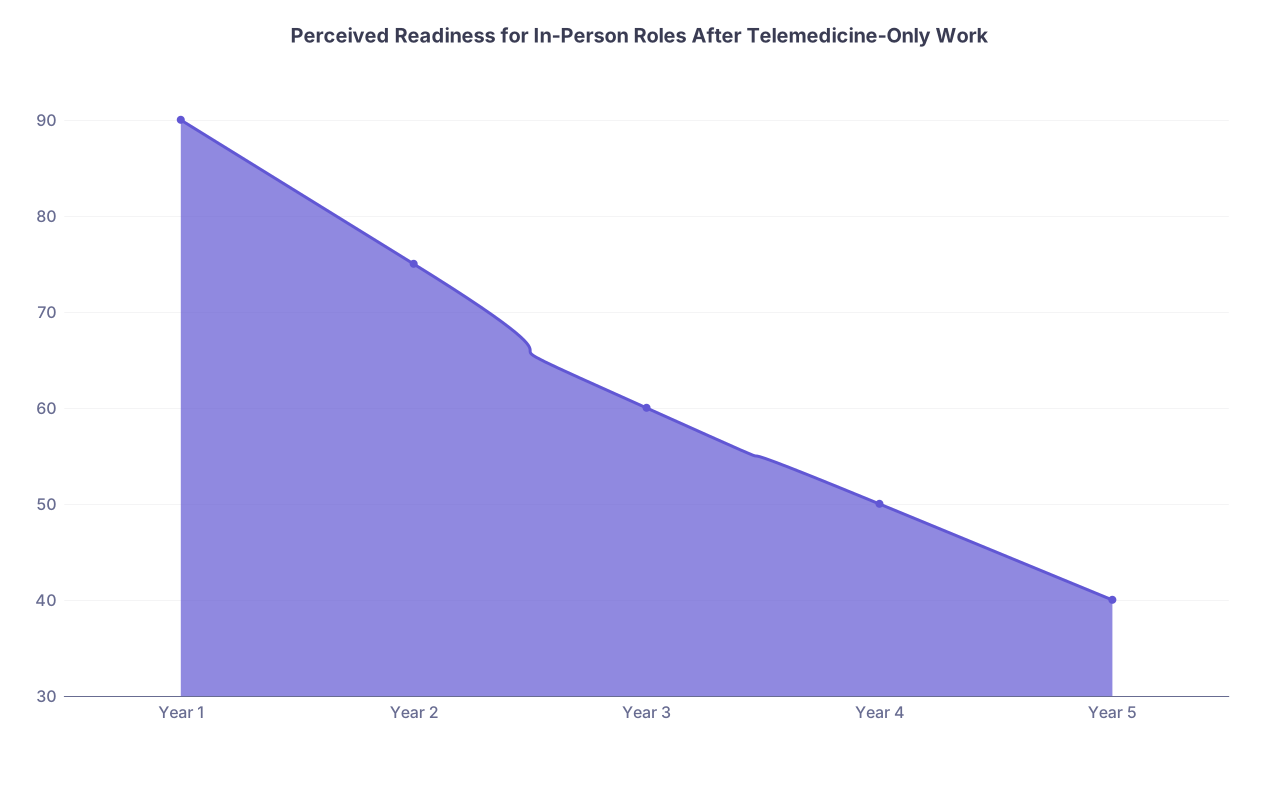
| Category | Value |
|---|---|
| Year 1 | 90 |
| Year 2 | 75 |
| Year 3 | 60 |
| Year 4 | 50 |
| Year 5 | 40 |
That’s not real numerical data from a study; it’s a fair reflection of how department chairs informally perceive you. Year one of telemedicine-only? Fine. Year five? They assume you’ll need ramp-up.
The Legal and Malpractice Angle: Boards Don’t Care That It Was “Just Telemedicine”
The myth that telemedicine is “less risky” is quietly killing careers.
Boards and plaintiffs’ attorneys do not discount your decisions because you were on a laptop instead of in an exam room. If you mismanage chest pain on video and the patient dies, you’re judged by the standard of care for chest pain. Period.
Telemedicine charts are often worse, not better:
- Copy-paste templates
- Minimal documentation of negatives
- No vitals, no real physical exam, just “appears well”
When problems happen, telemedicine cases are sometimes easier to pick apart:
- The record is fully digital
- The video might be recorded or screenshotted
- Every decision is timestamped and auditable
From a credentialing standpoint, a few board actions or malpractice judgments from telehealth can poison your job prospects just as effectively as if they came from any other setting.
So yes, telemedicine counts. All the way. For credit and for blame.
How to Make Telemedicine Experience Work For You, Not Against You
If you’re post-residency and already in or considering telemedicine-heavy work, here’s how to shape that experience into something that actually advances your career.
1. Anchor Yourself With At Least Some In-Person Work
A half-day a week in clinic. A few weekends a month in urgent care. Some inpatient shifts per month if you’re hospitalist-trained.
You don’t need 100% in-person, but you want a line on your CV every year that says, “Yes, I still physically examine people and touch real patients.”
2. Pick Telemedicine Gigs That Aren’t Brain-Dead
Ask blunt questions before signing:
- What’s the average visit length?
- Do I manage chronic conditions or just one-off complaints?
- Do I have protected time to document properly?
- Who handles complex or borderline cases?
If the answer is “you’re a high-throughput signature machine,” don’t pretend it’s career-building. Treat it like locums with a laptop.
3. Collect Real Evidence of Quality
Hospitals and serious employers care about:
- Patient satisfaction scores
- Adherence to guidelines and protocols
- Peer reviews and 360 evaluations
- Leadership roles (lead clinician, QI lead, medical director)
If your telemedicine company tracks this stuff—and many do—ask for it. Use it. Put concrete metrics on your CV.

| Step | Description |
|---|---|
| Step 1 | Finish Residency |
| Step 2 | Risk of Narrow Experience |
| Step 3 | Balanced Skillset |
| Step 4 | Add Some In Person Work |
| Step 5 | Choose Higher Complexity Telemed |
| Step 6 | Document Quality Metrics |
| Step 7 | Stronger Credentialing Profile |
| Step 8 | Job Choice |
4. Control the Narrative on Your CV and in Interviews
If your recent work is mostly telemedicine, don’t hide it. Own it and frame it:
- “Managed 20–25 video visits per day focused on chronic disease management and mental health in an underserved, multi-state population.”
- “Led tele-triage redesign that reduced inappropriate ED referrals by 18%.”
- “Served as state lead clinician overseeing quality and peer review for 25 remote providers.”
That sounds very different from: “Did telehealth from home.”
So, Does Telemedicine “Count” as Real Clinical Experience?
Yes. Unequivocally.
It counts when:
- You’re getting licensed in new states
- Telehealth companies and digital health startups are hiring
- Hospitals look at continuity of practice after residency
- Credentialing committees review your recent clinical activity
But the type of telemedicine you do and what you combine it with will determine whether it makes you look like:
- A serious, modern clinician who can practice in multiple modalities
- Or a burned-out prescription machine who hasn’t touched a real stethoscope since graduation
You do not have to choose between “pure brick-and-mortar” and “pure telemedicine.” The smart play—post residency, in this job market—is a hybrid strategy:
Enough in-person to keep your skills and credibility. Enough telemedicine to give you flexibility, geographic freedom, and leverage in a system that is slowly but surely shifting more care online.
Years from now, you will not remember whether people on Reddit said telemedicine “counted.” You’ll remember whether you used it intentionally—to build a sustainable, defensible, and genuinely clinical career—or whether you let it quietly narrow what you’re allowed to do next.