
The traditional advice to “pick a city and settle into a group” is useless if your spouse’s career moves every 2–3 years.
If you’re a physician whose partner’s job dictates geography—consulting, military, academia, corporate ladder, tech—you do not need to choose between your relationship and your career. But you do need to stop chasing traditional brick‑and‑mortar jobs and start building something that moves with you: a portable telehealth practice.
This is not theory. I’ve watched trailing‑spouse physicians finally stop restarting from zero every move once they treated telehealth like a serious, long‑term business instead of a side gig. There’s a path here—but you have to be deliberate.
Here’s how to think about it, step by step.
1. Get Real About Your Situation (And Your Constraints)
Before you pick platforms or start filing LLC paperwork, you have to define the constraints of your life. Otherwise you’ll build the wrong thing.
Ask yourself, and answer honestly:
- How often do you move? Every 1 year, 3 years, 5+?
- Are moves predictable (military PCS, academic contracts) or chaotic (startups, mergers, promotions)?
- Will you have kids or caregiving responsibilities that impact schedule flexibility?
- Are you willing to do nights/weekends to align with certain time zones?
- How much financial pressure are you under—do you need full‑time income fast, or can you ramp slowly?
If your spouse is military and you’re bouncing from Texas to Germany to California every 2–3 years, your approach will be very different from a consultant couple rotating between US major metros.
Here’s the key mental shift:
Your “location” is not your address.
Your “location” is the set of states you’re licensed in and can legally see patients from.
Think in “license footprint,” not zip code.
2. Licensure Strategy: Build a Geographic Moat
The biggest mistake relocating physicians make with telehealth is license whack‑a‑mole: you move, then you chase whatever state you just landed in. That’s reactive and fragile.
You want a deliberate multistate license strategy that:
- Covers states with high telehealth demand
- Aligns with your spouse’s likely moves (or likely headquarters)
- Makes you attractive to national telehealth companies
Start here.
2.1. Use IMLC (If You Can)
If you’re in a compact‑friendly specialty (most MD/DO clinical specialties) and your state of principal license qualifies for the Interstate Medical Licensure Compact (IMLC), use it. It’s the closest thing to a cheat code.
Check if you qualify, then prioritize IMLC states first. Even if it’s a few hundred bucks per state, it’s worth it for portability.
2.2. Target High‑Value States
If you’re paying out of pocket for each license, there are better and worse options for telehealth volume and employer interest.
As of recent patterns, these are consistently high‑yield:
| State | Why It Matters |
|---|---|
| California | Huge population, high demand |
| Texas | Large, many telehealth employers |
| Florida | Retirees, snowbirds, high volume |
| New York | Dense population, payor mix |
| Washington | Telehealth-friendly culture |
If your spouse’s work is anchored to a few hubs (Bay Area, NYC, DC, Seattle, Dallas, Atlanta), prioritize those states plus surrounding ones where workers live or travel.
2.3. Decide on Your “Core 5–10”
You don’t need 25 licenses to start. That’s how people burn out on paperwork and fees. Decide on:
- A core 5–10 states you’ll maintain almost no matter what
- A flexible ring of “add-ons” you’ll apply for only if a specific job or contract demands it
Write this list down. Make it explicit. Your licenses are part of your business infrastructure.
3. Employment Models: Platform, W‑2, or Your Own Practice?
You have three main ways to work in telehealth. Each has different implications if you’re moving for someone else’s career.
3.1. Pure Marketplace / Gig Platforms
Think: Teladoc, Amwell, MDLive, Doctor on Demand, Hims/Hers, etc.
Pros:
- Quick start, low overhead
- They handle marketing, malpractice, tech, billing
- You can usually work from anywhere as long as you’re in the US and licensed where the patient is
Cons:
- Volatile volume
- You’re a replaceable commodity if you don’t stand out
- Pay is often visit‑based and not amazing in saturated specialties (e.g., adult psych, basic urgent care)
This is a good entry point while you build experience and test how telehealth fits your life.
3.2. Employed W‑2 Telehealth Positions
Examples: health system telemedicine departments, virtual‑first primary care companies, digital health startups (e.g., Maven, Thirty Madison, Oak Street Virtual, etc.)
Pros:
- Stable salary or predictable RVU floor
- Benefits: health, 401k, CME, paid malpractice
- Some career development, leadership pathways
Cons:
- Less schedule freedom
- Some require you to live in certain states or within specific time zones
- Startups can disappear or pivot fast
These are good if you need stable income and benefits because your spouse’s job is high‑variability or lower paying.
3.3. Your Own Telehealth Practice (Solo or Micro‑Group)
This is the real “portable practice” play.
Pros:
- You own the patient panel; when you move, they don’t
- Maximum schedule autonomy
- You can niche down (ADHD, women’s health, sleep, obesity, LGBTQ+ care) and command higher rates
- Your business can grow independent of your spouse’s career turbulences
Cons:
- You are running a business: compliance, tech stack, marketing, billing
- Slower initial income unless you hustle or bring over a panel
- You must think like an owner, not an employee
For most trailing‑spouse physicians, the ideal is often a hybrid:
- Short‑term: W‑2 or platform telehealth + a small private telehealth panel
- Long‑term: Gradually tip the balance toward your own practice as it grows
4. Design Your Practice To Be Truly Portable
“Telehealth” does not automatically mean portable. You can absolutely paint yourself into a corner (e.g., tied to one health system EMR, one hospital medical staff, one state).
You need to build your practice like you know you’re going to move again. Because you probably will.
4.1. Time Zone Strategy
If your spouse is bouncing US time zones, you need to stop trying to match local time wherever you land.
Pick your “anchor time zone” and stick to it.
For example:
- You decide: “I work 9 am–3 pm Eastern no matter where I live.”
- If you move to California, that becomes 6 am–12 pm local. Annoying? Maybe. But it keeps your patient expectations stable and makes your website, scheduling, and follow‑up consistent.
You can adapt slightly, but don’t reinvent your schedule with every PCS or relocation.
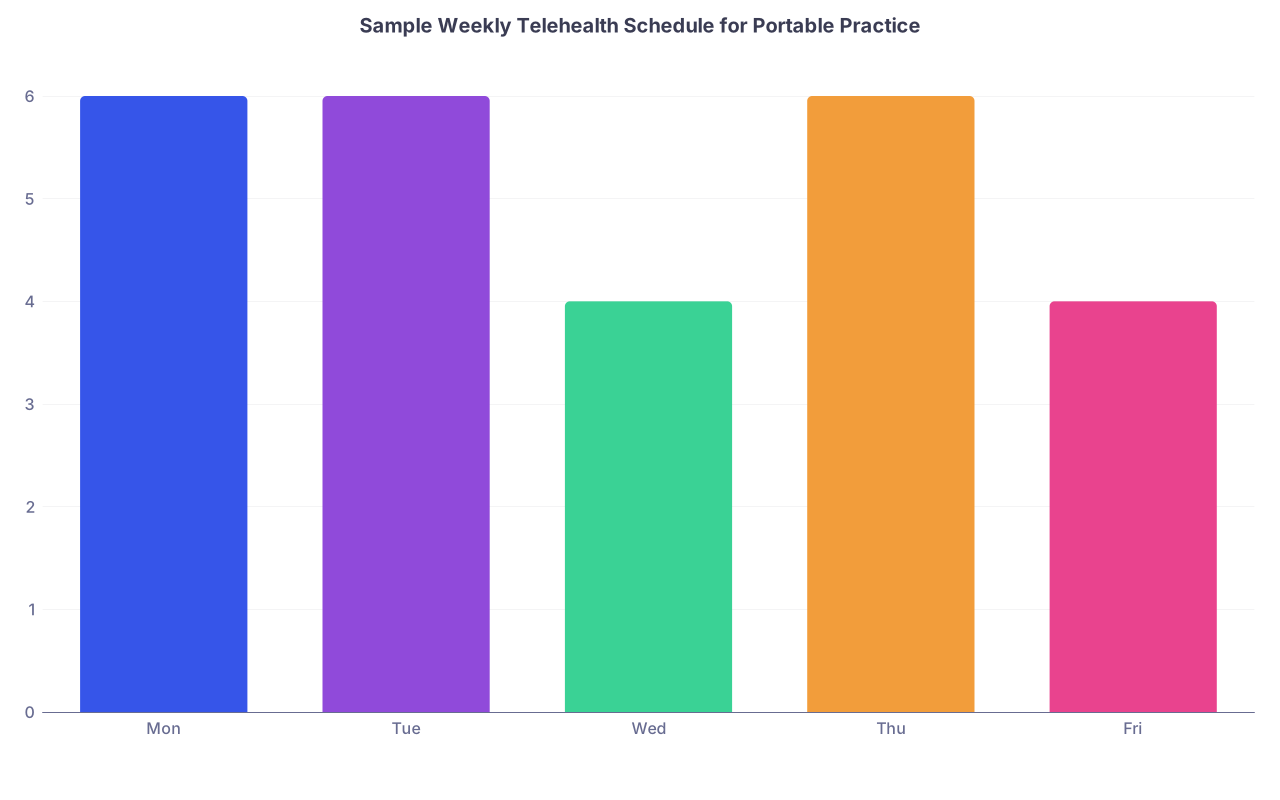
| Category | Value |
|---|---|
| Mon | 6 |
| Tue | 6 |
| Wed | 4 |
| Thu | 6 |
| Fri | 4 |
(Values = clinical hours; the rest is admin/notes/async work that you can flex around family needs.)
4.2. Tech Stack That Doesn’t Care Where You Live
Do not tie yourself to local servers, hospital VPN requirements, or clunky regional vendors.
Bare minimum stack for your own practice:
- Cloud‑based EMR with telehealth built in (examples: AthenaOne, Elation, SimplePractice, Charm, DrChrono, etc.)
- HIPAA‑compliant video (often built into EMR; if not, Zoom for Healthcare, Doxy.me, or similar)
- E‑prescribing with controlled substances support if your niche needs it
- E‑fax or secure messaging
- Online scheduling + automated reminders
- Payment processing (Stripe, Square, etc.) and/or integration with your EMR
All must be accessible from just a laptop and secure internet. No physical office. No local servers. No “only works on hospital Wi‑Fi.”
4.3. Malpractice and Compliance That Move With You
Use a malpractice carrier familiar with multistate telemedicine. Ask explicitly:
- Does this policy cover me for all states where I’m licensed?
- Any exclusions for telehealth or Rx across state lines?
- Requirements when I add new states?
And get clear on prescribing rules:
- DEA requirements if you’re doing controlled substances (especially if you cross state borders)
- State‑specific telehealth exam requirements (some states still have extra steps for certain meds)
You don’t want to learn about an exclusion letter the day after a board complaint in some random state you only saw 10 patients from.
5. Money: Income, Stability, and the Ramp‑Up Reality
You’re not just dealing with career questions here. You’re keeping a household afloat while one partner’s job drives moves.
Let’s talk income and expectations.
5.1. How Long Until Telehealth Replaces a Full‑Time Job?
Ballpark:
If you join a big platform or W‑2 telehealth job full‑time:
1–3 months from signing to “this looks like a normal attending paycheck,” assuming licenses are in place.If you start your own telehealth practice from scratch and don’t bring over patients:
6–18 months to approach full‑time income, depending on niche, marketing, and how aggressively you work.
The worst move is quitting a brick‑and‑mortar job cold with no plan, then “seeing what comes in” on a tiny telehealth platform profile.
Bridge strategy I’ve seen work well:
- Start with 0.5–0.8 FTE W‑2 or platform telehealth for stable baseline income
- Allocate 1–2 half‑days per week to your own telehealth practice growth (website, niche clinic, patient acquisition)
- Gradually shift down your W‑2 as your own panel and revenue climb
5.2. Basic Financial Planning For a Portable Practice
Have:
- 3–6 months of expenses in cash before you rely solely on a new telehealth business
- A separate business bank account if you’re running your own practice
- A simple spreadsheet or software (Wave, QuickBooks, etc.) tracking income and expenses by state if relevant
And be realistic about initial costs: licenses, EMR, telehealth vendor, website, malpractice, maybe a lawyer or accountant to set up your entity.
6. Clinical Niche: Don’t Be a Generic Video Doctor
If you’re moving constantly, the last thing you want is to compete on volume with 500 other generic family medicine telehealth docs on a national platform.
You win by being specific.
Ask:
- What do I actually like treating via telehealth?
- Where am I faster and better than average?
- What do patients search for online?
High‑leverage telehealth‑friendly niches include:
- ADHD / adult psychiatry / medication management
- Weight management and metabolic health
- Sleep medicine and insomnia care
- Women’s health (PCOS, contraception, menopause)
- Men’s health (ED, low T, hair loss—yes, it’s oversaturated, but still big)
- Migraine/headache clinics
- Long‑COVID / chronic fatigue (if you can stomach complexity)
Then design your offer as niche first, not “I’m a PCP who also does some other stuff.”
For your own practice, your headline should read more like:
“Telehealth ADHD and mood clinic for professionals in CA, TX, FL, NY, WA”
Not: “General adult telemedicine in multiple states.”
That specificity protects you from geography and makes your services findable no matter where you live.
7. Day‑to‑Day Logistics When You’re Actually Moving
Let’s talk about the messy part: the weeks when boxes are everywhere, Wi‑Fi is questionable, your spouse is already starting their new job, and you’re somehow supposed to still be a doctor.
Here’s how to not let your practice collapse every time the moving truck shows up.
7.1. Plan Your “Move Window” Clinically
Don’t wing it. For a big move:
- Block off at least 3–5 days of no live visits around your actual move date
- Keep up asynchronous tasks (results, messages) in short blocks via laptop/hotspot
- Tell established patients 4–6 weeks ahead: “I’ll have limited availability the week of [date] due to relocation, but telehealth visits will continue outside that window.”
If you’re W‑2, negotiate this before you sign. Written into your contract if possible: remote work flexibility, understanding of major relocation windows every X years.
7.2. Wi‑Fi Contingency Plan
Do not trust the cable company to show up on time.
You need:
- A phone with generous hotspot data, or
- A separate hotspot device with enough bandwidth to run video visits as backup
Test your setup before the last moment. Video + EMR + e‑prescribing can kill a weak connection.
7.3. Minimal Physical Setup
Your “clinic” should fit in a backpack:
- Laptop + charger
- Noise‑canceling headset or decent mic
- Neutral virtual background or a single portable backdrop (if your background is chaos)
- Notepad or tablet if you like jotting during visits
No massive desktop, no multiple ring lights, no fragile oversized gear. You want to be able to see patients from:
- The corner of a half‑unpacked bedroom
- A quietly rented coworking room
- A guest room at your in‑laws’ house
You’re optimizing for reliability, not aesthetics. Patients care more that you’re on time, clear, and attentive than whether your bookshelf looks Instagram‑worthy.
8. Relationships, Identity, and Sanity
Let’s be honest. Being the doctor who’s always the one “following” your spouse’s career can sting. It messes with identity, ego, and how you think about your own ambitions.
A portable telehealth practice doesn’t just solve the paycheck problem. It helps with the psychological ones.
You’re no longer:
- The person constantly re‑credentialing, re‑applying, starting from “the new doc” every three years
- Stuck choosing between being present for your kids vs. leaning into a career you like
You are:
- The attending with a stable, growing panel across several states
- The one who can keep your work exactly the same while the rest of life is cardboard boxes and address changes
- A legitimate business owner (if you choose that route), not “just doing some video visits”
That matters. More than people admit.
Is this path perfect? No. There’s isolation. Zoom fatigue. Constant emails. Sometimes your spouse gets an amazing international offer and you realize your US‑licensed telehealth practice cannot follow as easily. There are trade‑offs.
But compared to endlessly restarting hospital jobs in new markets where you know no one? A portable telehealth practice is usually the lesser evil—and often, over time, a genuinely better career.
9. Concrete 90‑Day Action Plan
You’re post‑residency, staring at another move (or already deep into that lifestyle). Here’s what I’d do over the next 90 days if I were you.
First 30 days:
- Decide on your core 5–10 licenses and start applications or IMLC process
- Pick your anchor time zone and rough weekly schedule
- Choose your tech stack (EMR, telehealth platform, malpractice) and set up accounts
- Apply to 2–3 large telehealth employers or platforms aligned with your specialty
Days 30–60:
- Finalize branding + niche (simple website or even a good landing page is enough to start)
- Begin seeing some patients via platforms while still onboarding others
- Start a basic online presence: Google Business Profile (if allowed), simple SEO on your niche and states, maybe one or two social channels if you’re comfortable
- Document your workflows: new patient intake, follow-up, documentation templates
Days 60–90:
- Evaluate which employer/platform is giving you consistent volume and fair pay
- Decide how many clinical hours/week you want to lock in for stable income
- Open your own telehealth practice if you haven’t yet—or expand its hours if you have
- Put your “move playbook” in writing: what you block off, what tech you need, how you communicate with patients
After 6–12 months, you’ll know: which states matter, which niches you like, which platforms/companies are worth your time, and how much of your income can realistically come from your own practice.
From there, every move your spouse makes becomes annoying logistics—not a career reset.