
You’re six months into your attending job. You’ve finally stopped double‑checking every order. You’re getting comfortable with the EMR. Then an email drops from administration:
“Effective immediately, all employed providers are prohibited from engaging in external telehealth or virtual care activities.”
You read it three times. There goes the side telehealth gig you were about to sign. Or the one you’ve quietly been doing on your days off. Or the flexible remote work you were counting on if you need to move states.
You’re not crazy to feel boxed in. Hospitals are tightening the screws on external telehealth, and most of those “policies” are vague, lawyer-written, and slanted heavily toward protecting the employer, not your career.
Let’s walk through what you can and cannot realistically do if your hospital bans external telehealth—and how to protect yourself without blowing up your job.
1. First Reality Check: What Does “Banned” Actually Mean?
Do not treat that one-line email as the full story. “No external telehealth” might mean five very different things in practice.
Pull out three documents (literally print them or have them on your screen side-by-side):
- Your employment contract
- The medical staff bylaws (or professional staff rules)
- Any separate “Telehealth / Moonlighting / Conflict of Interest” policies

Here’s what you’re looking for specifically:
- Any clause that says “full-time and exclusive employment”
- Definitions of “outside professional activity,” “moonlighting,” “external telehealth,” or “independent practice”
- Requirements for pre-approval of outside work
- Non-compete / restrictive covenant language tied to geography and “practice of medicine”
Most hospitals actually fall into one of a few buckets:
| Type | How Strict It Is | Typical Wording |
|---|---|---|
| Total clinical exclusivity | Very high | No outside clinical work allowed |
| External telehealth ban only | High | Telehealth specifically prohibited |
| Pre-approval required | Medium | Must get written approval |
| Same-specialty restriction | Medium | No competing practice in specialty |
| No explicit policy | Variable | Silent or vague |
If your contract actually says “Physician shall devote full professional time and attention to Employer and shall not engage in any outside clinical practice without prior written consent,” then yes—they mean they own your clinical capacity, telehealth included, unless they grant an exception.
On the other hand, if the contract is vague but there’s a new email or “policy memo,” understand the hierarchy: the signed contract usually outranks a later generic policy… but you don’t want to be the test case who gets fired and then wins two years later in arbitration. You need to know both the legal and practical reality.
Key move: mark every clause that touches outside work with a sticky note or highlight. You’re going to use those later in conversations and, if needed, with a lawyer.
2. What You Definitely Cannot Do (If You Want to Keep Your Job)
Let me be blunt first. There are a few things that are almost always career-suicide under a “no external telehealth” regime.
a. Secretly doing clinical telehealth under your own name
If your contract bans outside clinical work or specifically says no external telehealth, and you:
- sign up as a contractor for a direct-to-consumer telehealth platform (Hims, Ro, Teladoc, etc.), or
- start your own LLC and provide telehealth visits in your specialty on the side,
and you do this using:
- your own NPI
- your state medical license
- billing payers directly or indirectly
…that is practicing medicine. It is outside clinical work. It is almost certainly a breach of contract.
If they find out (and they usually do eventually—workers’ comp claims, credentialing background checks, patients mentioning it, billing data, or a colleague snitching), you’re looking at:
- Immediate termination “for cause” (which wrecks your narrative for your next job)
- Possible report to the NPDB if they frame it as professionalism / ethics-related
- Board headaches if anyone pushes the “unprofessional conduct” angle
Do not assume “I only see 3 patients a week” makes it small enough to be safe. It just makes it smaller, not safer.
b. Using hospital time, equipment, or premises for outside telehealth
Even if your contract is vague, hospitals go nuclear fast when you use:
- Work hours (on the clock)
- Work devices (hospital laptop, hospital wifi, work email)
- Work space (clinic exam room, call room)
for outside paid work.
I’ve seen people disciplined because a patient screenshot from a telehealth platform showed the physician in a clinic room with the hospital logo visible in the background.
They will call that:
- Misuse of employer resources
- Branding/confusion with hospital services
- Possible HIPAA mess if hospital systems are in view or sound
If the hospital bans external telehealth, do not even check your external telehealth portal from work devices. Use your own phone, at home, on your own wifi, on your own time—or not at all if it’s truly prohibited.
c. Doing “telehealth” with your own patients through external platforms
Some people get clever and say, “Well it’s my own panel, so it’s just continuity of care.”
No. If you:
- See your hospital’s patients through some side telehealth platform that bills separately
- Or schedule them through your own LLC for video visits instead of using the hospital’s telehealth systems
you’ve created direct competition with your employer. Expect fast retaliation.
Hospital lawyers hate:
- Lost visits / lost facility fees
- Shadow charts outside their EMR
- Fragmented records that raise malpractice risk for everyone
Ignore this and you’ll find yourself escorted out with “conflict of interest” documented.
3. What You Probably Can Do (If You’re Smart About It)
Even under a strict “no external telehealth” rule, there are gray zones and safe harbors. This is where you can often preserve some flexibility and income without lighting your career on fire.
a. Non-clinical remote work
Telehealth bans almost never cover non-clinical activities. These include:
- Chart review (utilization review, peer-to-peer, prior auth consulting)
- Medical expert consulting (product development for digital health companies, without seeing patients)
- Medical writing, content creation, guideline writing
- Speaking, teaching, lecture work (CME, webinars, courses)
- Advisory roles or board positions in digital health companies, as long as you’re not the treating doc
You’re not diagnosing or treating individual patients. You’re using your expertise. Different universe.
Still, you should:
- Check if your contract requires disclosure / approval for “any outside compensated activity”
- Avoid using your hospital title in ways that seem like the hospital endorses the company
- Keep it truly non-clinical: no prescriptions, no charting, no patient-specific decisions
If there’s any doubt, write to your employer:
“Per Section X of my contract, I’m requesting permission to engage in limited non-clinical consulting (no direct patient care) with [Company], estimated [Y] hours per month, fully outside my scheduled working hours. No employer resources will be used.”
Get the yes or no in writing. Save it.
b. Telehealth that is clearly, legally not “practicing medicine”
There are fringe cases:
- Group educational webinars: “Understanding your diabetes” for the public, no diagnosing, no individualized advice
- Asynchronous Q&A for general health education content where you’re explicit: “This is not medical care or advice. Talk to your doctor.”
But do not kid yourself. If you are:
- Reviewing someone’s specific symptoms and history
- Making a diagnosis
- Recommending a specific treatment for that individual
you’re practicing medicine, no matter how you label it.
Use the old test: “If this interaction went badly and they sued me, would a court look at it as a doctor-patient relationship?” If the answer is yes or maybe, that’s clinical.
4. The Conversation You Actually Need to Have With Your Employer
If you just silently accept the ban, you’ve closed off a big part of your post-residency career flexibility. You don’t have to fight, but you do need a plan.
Step 1: Get clarity, not vibes
Do not rely on hallway gossip or that one cranky older partner’s interpretation.
Ask for a meeting (or send an email) to:
- Your department chair or service line director
- Or the medical director / CMO if that’s who sent the policy
Your script can be straightforward:
“I read the recent policy on external telehealth. I want to ensure I’m fully complying and also understand what is and isn’t allowed, especially regarding non-clinical remote work or future opportunities. Can we clarify a few scenarios?”
Then ask about specific scenarios:
- Non-clinical consulting
- Teaching and webinars
- Telehealth in a different specialty or niche (e.g., lifestyle medicine, coaching)
- Telehealth in a different state if you move later and stay part-time PRN
Get them talking. Write down exact phrases they use. Sometimes they’ll reveal that the real concern is competition or brand confusion, not the work itself.
Step 2: If you want an exception—ask early and hard
If you have a specific telehealth gig in mind, do not ask “Can I moonlight?” That’s too abstract. Instead:
“I’ve been offered a part-time telehealth role with [Company] doing [X type of visits], completely outside our service area, about [Y] hours a month, on my off days. They don’t market in our state and it’s not overlapping our patient population. Is there a way to structure this that you’d be comfortable approving?”
Then you can negotiate guardrails:
- No overlap with employer’s marketing territory
- Not using your hospital title or logo
- Capped hours and clear schedule so there’s no conflict with your call responsibilities
- Agreement that you won’t see current hospital patients through that platform
If they flatly refuse all external telehealth, at least you have it on record. That tells you exactly what you’re dealing with long-term.
5. Planning Long-Term: Jobs That Do and Don’t Let You Do Telehealth
You might discover the honest answer: this hospital will never, ever let you do meaningful external telehealth. Fine. Then you start planning your exit like a grownup, not like a resident scrambling in March.
Here’s how different employers usually behave regarding external telehealth:
| Employer Type | External Telehealth Attitude |
|---|---|
| Large hospital system | Often restrictive / banned |
| Academic center | Formal policies, some flexibility |
| Private group | Depends on partnership track |
| National telehealth | Encourages multi-platform work |
| Direct primary care | Usually very telehealth friendly |
If you know you want telehealth in your career mix—either for flexibility, geographic freedom, or just sanity—start prioritizing:
- Employers without exclusivity clauses
- Practices that explicitly build telehealth into your job
- Non-hospital-employed models: DPC, micro-practices, small groups
- Hybrid jobs: half brick-and-mortar, half telehealth (sometimes with two employers, as long as contracts allow)
Do not sign another contract until you’ve read the moonlighting and exclusivity sections twice and had them explained to you in plain English.
6. The Legal Angle: When to Get a Lawyer Involved (and What to Ask)
If you’re already in a job and the hospital rolls out a brand‑new “no external telehealth” policy that materially changes your freedom, you might actually have leverage. But you need a health-care employment attorney, not your cousin who does real estate closings.
Times to consider paying for a one-hour consult:
- You already have an external telehealth contract and the hospital’s new policy would force you to breach it
- Your contract is silent on outside work, yet they’re trying to impose a blanket ban after the fact
- The policy feels targeted or selectively enforced (you know other people who are doing external work with a wink and nod)
- You’re considering leaving over this and want to know how much risk you take if you keep telehealth going during your notice period
Bring:
- Your employment contract
- Any addenda or side letters
- The telehealth policy or email
- Any telehealth contractor agreements you’ve signed or been offered
The questions to ask:
- Is this new policy actually enforceable against my originally signed contract?
- What counts as “outside clinical practice” legally in my state?
- If I resign, can they realistically come after me for having done external telehealth previously?
- How do I exit cleanly if I decide this job isn’t compatible with my career goals?
One thing I’ve seen: sometimes just having a lawyer write a short, calm letter asking for clarification on a policy magically leads to the hospital “clarifying” it in a more flexible way. Hospitals don’t actually want to be in court with employed physicians. It’s bad optics and expensive.
7. Borderline Cases: Coaching, Content, and “Virtual Presence”
Let’s run through a few scenarios people constantly ask about.
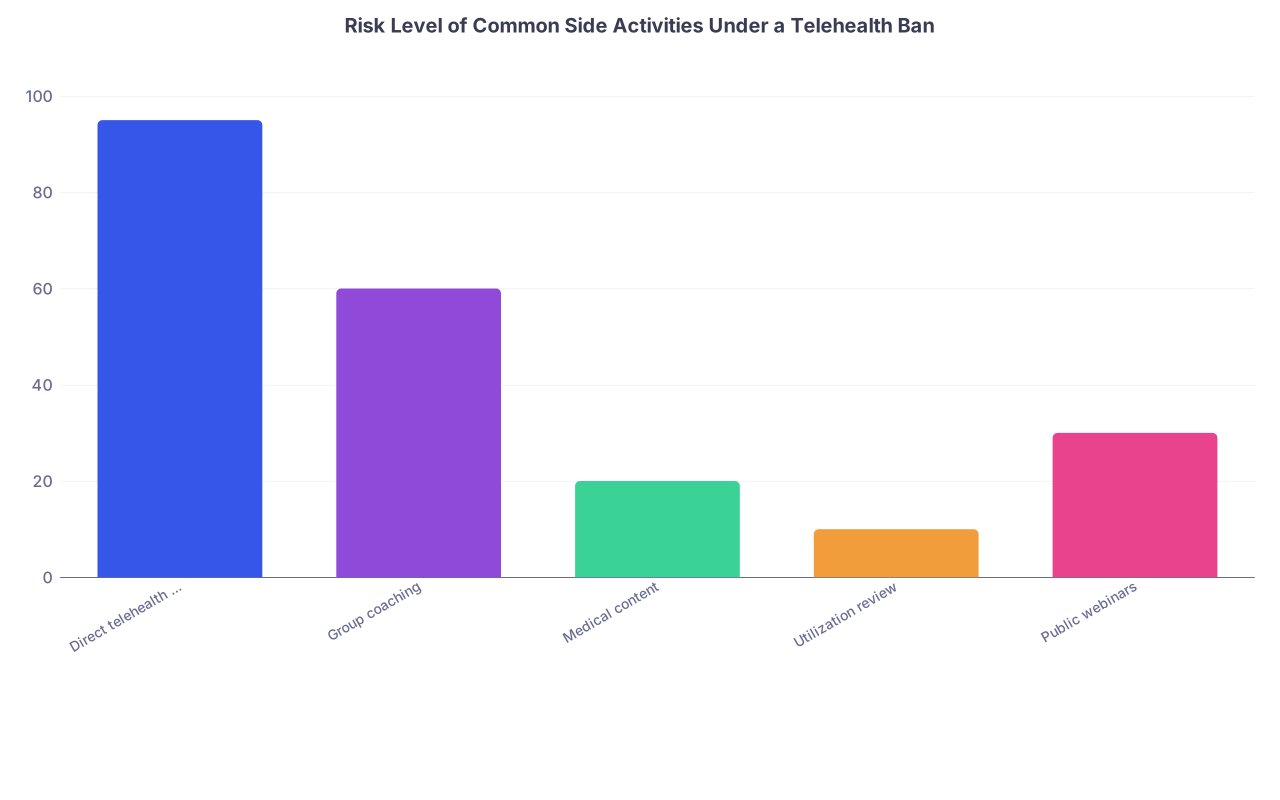
| Category | Value |
|---|---|
| Direct telehealth visits | 95 |
| Group coaching | 60 |
| Medical content | 20 |
| Utilization review | 10 |
| Public webinars | 30 |
Consider “risk level” here as: how likely is your hospital to see this as a violation of a telehealth/clinical exclusivity ban? Not legal risk; employer-anger risk.
a. One-on-one “health coaching”
If you are:
- Giving specific advice about diet, sleep, supplements, lab interpretation, medication adjustments
- To a specific individual
- With knowledge of their medical history
you’re back to practicing medicine, no matter what you call it. I’ve watched plaintiffs’ lawyers gleefully say, “If it walks like a duck…”
If your hospital bans external telehealth, assume one-on-one paid coaching for individuals in your licensed state is high risk.
b. Group coaching programs
Slightly safer, if you:
- Stick to general guidance, not individual diagnoses
- Explicitly state that it’s educational and not a replacement for medical care
- Avoid talking about your own hospital’s patients
- Avoid prescription discussions and “given your labs, you should…”
Could your employer still get mad? Yes. Some will say, “You’re using your clinical reputation to monetize outside our system,” especially if you use your hospital title in marketing. Again: disclosure and approval request help protect you.
c. Content creation and social media
Writing Substack posts about your specialty? Filming TikToks on acne treatment? Doing a YouTube channel on “What this lab means”? Usually allowed.
The lines you cannot cross:
- Offering to diagnose or treat individuals directly in DMs or comments
- Running a “telehealth clinic” through your social media backchannel
- Letting people book “video consults” with you through Calendly links in your bio
Pure content = low risk. Content that morphs into private clinical encounters = high risk.
8. If You Already Broke the Rule: Damage Control, Not Panic
Maybe you signed up for a telehealth platform before you realized your contract barred it. Or the hospital just rolled out a new ban, and you’ve been doing telehealth moonlighting for a year.
Here’s what to do, in order:
- Stop using any hospital resources for that telehealth work. Right now.
- Quietly gather all your contracts and policies in one place.
- Book a confidential consult with a healthcare employment lawyer in your state. Ask about:
- Your exposure if the hospital finds out tomorrow
- Whether you should self-disclose or quietly exit the telehealth work
- How to structure any disclosure to minimize “for cause” language
- Decide, with that advice, whether to:
- Terminate the telehealth contract and cleanly walk away, or
- Ask the hospital for retroactive approval / exception (risky but sometimes viable), or
- Plan to leave the hospital job for a more flexible one and keep telehealth central to your plan
What you do not do: casually mention your telehealth gig in the physicians’ lounge and hope admin never finds out. Loose lips are how these things blow up.
9. Designing a Career Where Telehealth Is Not a Secret Side Hustle
If you want telehealth to be a serious part of your career post-residency—not a thing you’re constantly hiding—accept that some employers will never be compatible. That is not fixable from the inside.
Instead, build toward settings that treat telehealth as normal:
- Jobs at the telehealth companies themselves (full-time or high-volume part-time)
- Hybrid roles where your employer explicitly writes telehealth time into your job description
- Direct primary care or membership practices that expect video visits as part of the offering
- Locums setups where you negotiate telehealth blocks instead of or in addition to in-person coverage
Think in two-year chunks. If you’re in a rigid hospital now, your plan might look like:

| Step | Description |
|---|---|
| Step 1 | Today - Hospital job with telehealth ban |
| Step 2 | Clarify policy and stop risky side gigs |
| Step 3 | Build savings and pay down high interest debt |
| Step 4 | Identify 3-5 telehealth-friendly employers |
| Step 5 | Start low-risk non-clinical side work |
| Step 6 | Apply and interview for flexible roles |
| Step 7 | Negotiate contract with no exclusivity |
| Step 8 | Transition to new job and add telehealth work |
Telehealth is not going away. Hospitals will eventually lose some of these control battles. But your career timeline is shorter than their policy cycle. Don’t wait for them to “modernize” if you already know they won’t.
Key Takeaways
- “No external telehealth” usually means no outside clinical care with your license and NPI, even if you call it something else. Do not try to outsmart plain language with fake labels.
- You still have room: non-clinical remote work, content, teaching, and some group educational work are often allowed—if you disclose and get clear written boundaries.
- If telehealth matters to your long-term career, stop treating it like a secret side hustle and start choosing employers whose contracts, not just their vibes, actually allow it.