
The hospital paycheck alone will not dig you out of your student loan hole fast enough.
If you’re a post‑residency doc staring at $250k+ in loans, standard advice like “tighten your budget” is a joke. You do not have a Starbucks problem. You have an income problem. After‑hours telemedicine is one of the few levers you can realistically pull that can move the needle in the next 6–24 months.
Here’s how to use it like a tool, not a hobby.
Step 1: Get Real About Your Numbers First
Before you chase extra work, you need an exact target. Not a vibe.
Take one quiet evening and do this:
- Pull your loan servicer page.
- Write down:
- Total balance
- Interest rate(s)
- Required monthly payment
- Decide on a goal:
- “I want these gone in 7 years”
- Or “I want enough extra to aggressively save and not just tread water.”
Now translate that into extra monthly cash you actually need.
Example:
- Total loans: $280,000 at blended 6.5%
- Current required payment (standard): ~$3,000/month
- You can comfortably do: $3,000 from your main job + $1,500 extra from side work
- That extra $1,500/month over, say, 7–10 years can shave years and tens of thousands in interest off your repayment.
Now connect that to telemedicine hours.
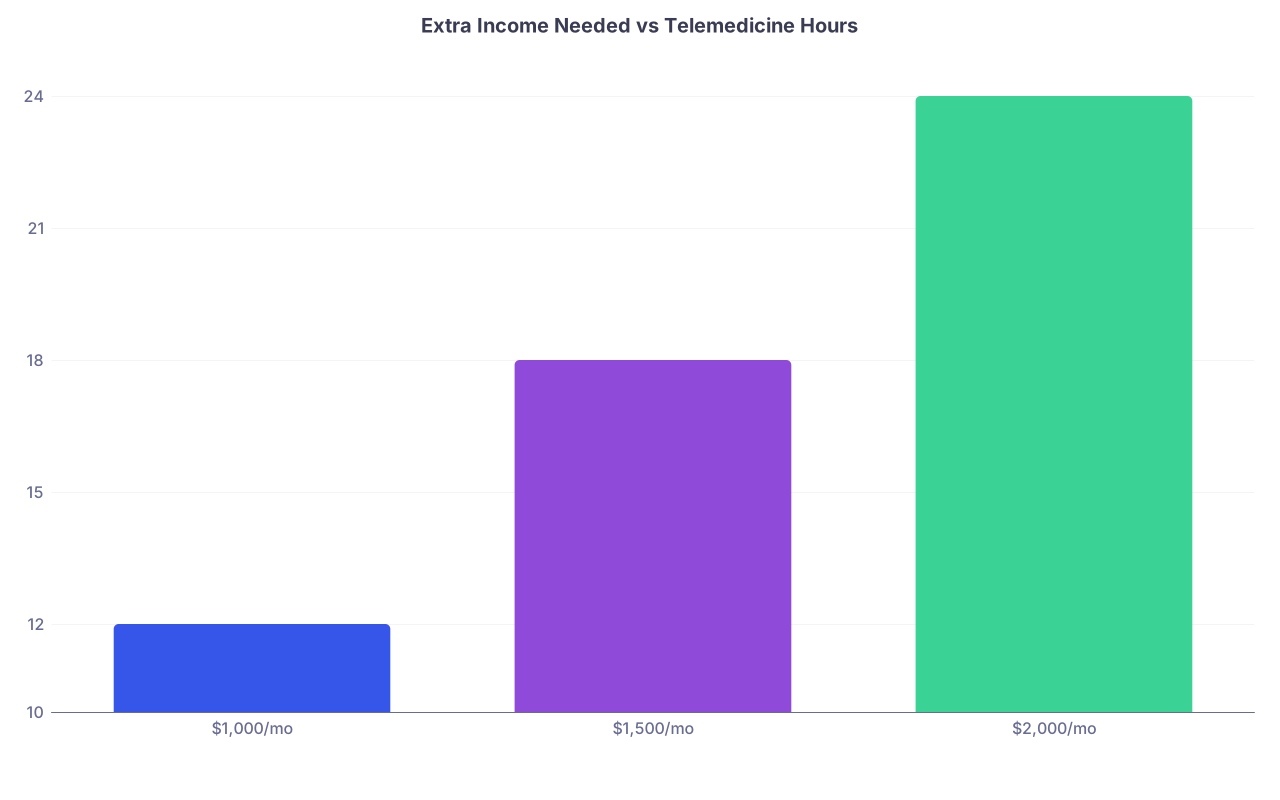
| Category | Value |
|---|---|
| $1,000/mo | 12 |
| $1,500/mo | 18 |
| $2,000/mo | 24 |
Assuming an average after‑hours telemed rate of about $80–90/hr:
- $1,000/month ≈ 12–13 hours
- $1,500/month ≈ 17–19 hours
- $2,000/month ≈ 23–25 hours
You’re not working an extra full‑time job. You’re talking about roughly:
- 1–2 weeknights + 1–2 weekend half‑days per month.
That’s doable if you’re structured and not already drowning in burnout.
Step 2: Understand What After‑Hours Telemedicine Really Looks Like
This is not “scroll TikTok between calls” easy money. But it can be efficient.
Most after‑hours telemedicine falls into a few buckets:
Urgent Care‑style video/phone visits
Think: UTIs, URI, sinus, rashes, simple med refills, minor GI, low‑acuity triage. Usually 24/7 coverage with higher volume evenings and weekends.Asynchronous / text‑based care
You review messages, photos, maybe short videos. You respond within a time window (e.g., 15–30 minutes or a few hours) rather than in real time. Often used for dermatology, contraception, mental health follow‑up, weight loss, etc.Niche tele‑specialty consults
Tele‑psych, sleep medicine, endocrinology (diabetes, weight), neurology follow‑ups, etc. Often evenings to accommodate patients after work.Employer / payer virtual clinics
Big insurers or self‑insured employers contract telemed companies to provide 24/7 virtual urgent care or primary care for their employees.
Here’s how they differ when you’re looking specifically to pay down loans:
| Type | Typical Pay | Best For | Flexibility |
|---|---|---|---|
| Urgent Care Video | $70–$120/hr | EM, FM, IM | Medium |
| Async / Text-based | Per case or RVU | Derm, FM, IM, Psych | High |
| Tele-psychiatry | $120–$200/hr | Psychiatrists | Medium |
| Tele-specialty consults | $100–$180/hr | Boarded specialists | Low–Medium |
If you’re just out of residency, the urgent care / primary care type platforms are often your easiest entry.
Step 3: Make Sure You’re Legally and Contractually Allowed
This is where a lot of smart people screw up. They sign a hospital contract, never read the “outside work” clause, and then quietly moonlight… until someone finds their telemed profile.
You need to check three things:
Your employment contract
Look for:- “Exclusivity” or “outside employment” sections
- Requirements to obtain written permission for outside clinical work
- Any clauses limiting practice to certain entities or affiliated groups
If it says you need permission, then you either:
- Get it in writing (email is fine, PDF is ideal), or
- Choose a telemed option that clearly doesn’t conflict (e.g., different specialty, non‑clinical advising) and get a legal opinion if you’re unsure.
Malpractice coverage
Many telemed companies provide their own malpractice, often claims‑made with tail coverage. You do not want to assume. Ask specifically:- “Do you provide malpractice?”
- “What limits?” (You want something like $1M/$3M.)
- “Is tail coverage included if I stop working with you?”
Licensing and state rules
Telemedicine is state‑specific. For most platforms:- You must be licensed in the state where the patient is located at the time of visit.
- Some companies will help you get additional state licenses (and may cover fees).
If your goal is to maximize income:
- Stack licenses in a few high‑volume or telemed‑friendly states (e.g., FL, TX, CA, NY, AZ, CO).
- Or consider the IMLC (Interstate Medical Licensure Compact) if you’re eligible; it speeds up multi‑state licensing dramatically.
Step 4: Pick the Right Kind of Telemed for Your Situation
You’re not choosing a “fun” telemed gig. You’re choosing a cash‑generating system that fits your real life.
Here’s how to think about it:
Scenario A: Full‑time hospitalist, 7‑on/7‑off
You’re fried on your 7‑on week. The smartest move is to:
- Protect post‑call time – no telemed. Non‑negotiable.
- Use your off week strategically:
- 2–3 short 4‑hour telemed blocks on off days (e.g., Mon, Wed, Sat evenings).
- Prefer video urgent care or asynchronous that you can batch.
Result: 12 hours/week * 2 weeks/month = ~24 telemed hours. At $90/hr → ~$2,160/month before taxes.
Scenario B: Outpatient primary care, 8–5, M–F
Your weekdays are packed. Your brain is mush by 5pm.
Look at:
- Short weekday evening sessions: 2–3 hours max, 1–2 nights/week.
- One solid weekend block: 4–6 hours Saturday or Sunday.
Prefer:
- Lower‑intensity asynchronous/text‑based work if possible.
- Or urgent care video visits during evening peaks (where you get higher volume and sometimes bonuses).
Scenario C: Psychiatry or Psych NP/PA
You’re in the sweet spot. Tele‑psych is one of the highest‑paying telemed gigs.
Options:
- 60‑min initial evals + 30‑min follow‑ups
- After‑hours coverage for clinics
- Employer/insurer behavioral health programs
Even 10 extra hours/month at $150/hr = $1,500 before tax. That’s a serious dent in your loans with relatively few hours.
Step 5: Understand the Pay Structures (And What Actually Affects Your Take‑Home)
Telemedicine companies rarely make this truly clear up front. You need to push for specific numbers.
Common models:
Hourly rate, guaranteed
- Example: $85/hr regardless of volume.
- Good for predictable extra income.
- Less upside but less stress about empty shifts.
Per‑visit pay
- Example: $20–$30 per simple visit; $40–$60 per complex visit.
- Your effective hourly rate depends on visit volume and platform flow.
- If they’re slow, you lose. If they’re slammed, you win (until you burn out).
RVU‑based
- Similar to per‑visit but tied to codes/billing.
- More common on tele‑specialty or integrated health systems.
Hybrid (small hourly + per‑visit bonus)
- A small base + per‑visit incentive.
- This can be ideal—some protection + volume upside.
Then factor in:
Are you an employee (W‑2) or contractor (1099)?
- W‑2: taxes withheld, often less “rate,” but simpler.
- 1099: higher rate, but you must handle quarterly estimated taxes, no benefits, and you can deduct business expenses (home office portion, extra license fees, possibly equipment).
Are there peak hour bonuses?
- Evenings, weekends, holidays sometimes pay more or have surge incentives.
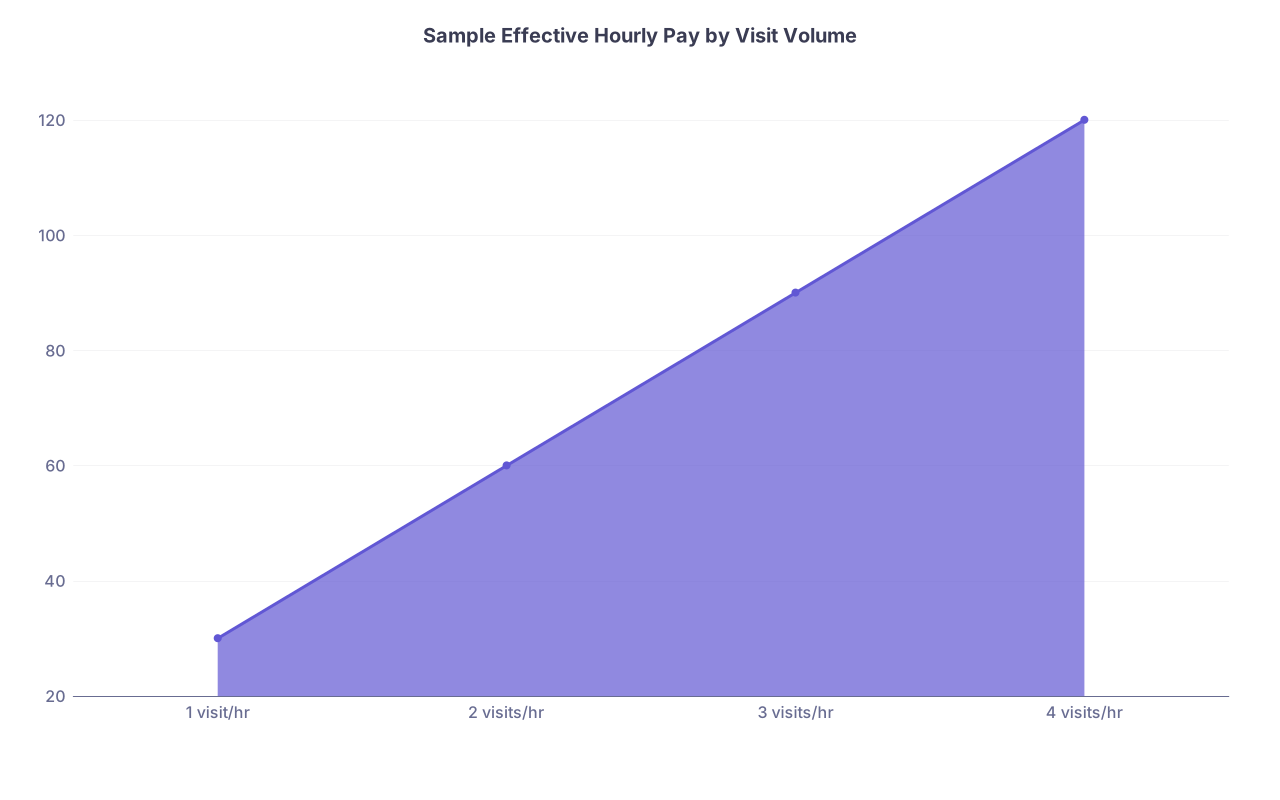
| Category | Value |
|---|---|
| 1 visit/hr | 30 |
| 2 visits/hr | 60 |
| 3 visits/hr | 90 |
| 4 visits/hr | 120 |
If a platform pays $30/visit:
- 1 visit/hr → $30/hr (skip this)
- 2 visits/hr → $60/hr (bare minimum)
- 3 visits/hr → $90/hr (decent)
- 4 visits/hr → $120/hr (worth pushing for, but watch your sanity)
You should be aiming for stable situations where your realistic effective rate is at least $80/hr for urgent‑care type work, more for specialty.
Step 6: Set a Schedule That Won’t Destroy You
This is where people either succeed for 2–3 years or crash in 2 months.
You’re already working a demanding day job. So you have to enforce personal rules:
Cap your weekly extra hours
For most full‑time clinicians, a sustainable cap is:- 8–12 extra hours per week, max, and
- 2–3 days/week with any extra work at all.
Hard no‑go zones
- Post‑call days
- The day after a brutal stretch (like 3 consecutive 12s or admissions heavy days)
- Family commitments you actually care about keeping
Cluster your telemed work
It’s more efficient to do:- Two 4‑hour focused blocks, than
- Four scattered 2‑hour blocks all over the week.

| Step | Description |
|---|---|
| Step 1 | Mon Day Job |
| Step 2 | Mon 6-9 pm Telemed |
| Step 3 | Tue Day Job |
| Step 4 | Wed Day Job |
| Step 5 | Wed 6-9 pm Telemed |
| Step 6 | Thu Day Job |
| Step 7 | Fri Day Job |
| Step 8 | Sat 9 am-1 pm Telemed |
| Step 9 | Sunday Off |
That kind of schedule nets you ~11 telemed hours/week, or roughly:
- 40–45 hours/month → $3,200–$4,000 before tax at $80–$90/hr.
Enough to hammer loans without completely torching your life.
Step 7: Make It Logistically Easy on Yourself
You’ll quit quickly if every telemed shift feels like a chaotic tech demo.
Set it up once, properly:
Tech and Environment
- Solid laptop or desktop with a decent webcam.
- Reliable high‑speed internet (wired preferred, or sit close to your router).
- Headset or earbuds with mic to cut background noise.
- Neutral background — not your dirty kitchen or unmade bed.
- Good lighting: cheap ring light or desk lamp behind the screen.
Documentation shortcuts
- Build your own phrase bank/templates:
- Common HPI patterns (URI, UTI, sinus, rash, back pain).
- Standard counseling scripts (ER precautions, med education, timeframes).
- Physical exam templating for “limited telemedicine exam.”
This turns a 12‑minute visit into an 8‑minute one without cutting corners—because you’re not retyping the same sentences.
Environmental boundaries
- One consistent “telemed station” at home.
- Noise boundaries with family/roommates (a closed door actually means closed).
- A pre‑shift ritual: 5 minutes to pull up protocols, refill water, mental reset.
Do this right and those hours feel like organized, efficient work—not frantic chaos.
Step 8: Target Which Loans You Attack With Telemed Income
A common mistake: people just dump all extra money into their checking account and “try to pay more when I can.” That always dissolves into lifestyle creep.
You need a clear rule for telemed income:
- “100% of telemed money goes to loans.”
- Or “80% to loans, 20% to a sanity fund (vacations, big purchases).”
Then choose an actual payoff strategy:
Attack highest interest loans first
Extra payment to the highest rate loan while making minimum payments on the others. When that one is gone, roll that amount onto the next highest. This usually saves the most money over time.Psychological win: smallest balance first (debt snowball)
If your motivation is shaky, clearing one entire loan chunk fast can keep you going.Pre‑tax options (if employer offers 401k match or PSLF)
If you’re in a PSLF‑eligible job, you might use telemed income not for loans directly, but to:- Max retirement contributions while your required PSLF payments stay lower.
- Build a serious emergency fund while the PSLF clock runs.
Point is: decide in advance and automate it. Extra income needs a job the moment it arrives.
Step 9: Watch for Red Flags and Know When to Quit a Platform
Not all telemedicine companies are worth your time. Some are straight‑up bad deals.
Red flags:
- Effective hourly rate < $60 after you’ve tracked it for a month.
- Constant pressure to prescribe unnecessary meds, antibiotics, or controlled substances.
- Clunky EMR that adds 4–5 minutes per visit with no compensation adjustment.
- No clear malpractice coverage.
- Poor support when there are tech issues or clinical safety concerns.
If you’re spending 12 hours/month to make $500, that’s not a loan strategy. That’s abuse.
Give a platform 4–6 weeks. If it doesn’t hit your target effective hourly rate and doesn’t feel clinically safe, move on. Your license and sanity are worth more than squeezing out another $200.
Step 10: Use Telemed as a Bridge, Not a Lifestyle
This is the part nobody says out loud: long‑term, permanent 60–70 hour weeks are how people end up bitter, divorced, or out of medicine.
Telemedicine moonlighting should have an exit plan.
Pick a horizon:
- “I’m doing this hard push for 24 months to crush $50k of my highest interest loans.”
- Or “I’ll keep 10 hours/month until my loan balance drops under $100k, then reassess.”
Put that on your calendar. Actually. A reminder: “Reassess telemed workload and loans today.”
Your life is not a perpetual side‑hustle. This is a tactical phase to get leverage over your debt and your future choices.
FAQs
1. How many extra telemedicine hours per month is actually realistic as a new attending?
For most new attendings in demanding jobs, 20–30 hours/month is realistic and sustainable. That might look like:
- Two 3‑hour evening shifts per week (≈ 24 hours/month), or
- One 4‑hour weekend block + one 3‑hour weeknight per week (≈ 28 hours/month).
Above 40 hours/month on top of full‑time clinical work, most people start to fray. If you’re regularly hitting 50+ extra hours, fine—do it for a few months if you must—but treat it like a short, defined sprint, not a new normal.
2. Can I do telemedicine after hours if I’m an internist or hospitalist without outpatient experience?
Yes, but pick your lane carefully and be honest about your comfort zone. Many hospitalists do just fine with urgent‑care style telemedicine because the problems are simple and algorithmic. However, avoid long‑term primary care telemed panels unless you’re ready for that scope. Also, look for platforms with strong clinical protocols and easy access to backup (clinical leads, chat with other docs). Start with lower‑acuity shifts, build confidence, then adjust.
3. How fast will I actually see an impact on my student loans?
If you’re consistent, you’ll notice real change in 6–12 months. Example: $1,500 extra per month directly to loans = $18,000/year. If your weighted interest rate is ~6–7%, that not only drops principal but also cuts future interest. After 2–3 years of that pace, you can easily be $30–60k ahead of where you’d be on minimum payments alone. It will not feel dramatic month one. It will feel very different when your balance is finally moving in the right direction, faster than the interest can grow.
Open your loan statement and your calendar side by side today. Decide on a specific monthly dollar target, then block out two concrete telemedicine shifts in the next two weeks that will cover it.