
The way most attendings accept telehealth pay is financially reckless. You are delivering full clinical value and getting paid like a side gig scribe.
Let me fix that.
If you treat telehealth as “easy extra money,” companies will happily underpay you for years. If you treat it like real clinical work with real leverage, your compensation can equal or exceed your in‑person rate. Same license, same liability, same brain. Different revenue model. Your job is to understand that model well enough to negotiate like an owner, not a warm body on Zoom.
This is a step‑by‑step playbook to negotiate fair telehealth compensation as an attending—post‑residency, fellowship, or mid‑career. I will assume you already know how to practice medicine. What you probably do not have is a negotiation framework and the benchmarks specific to telehealth.
Let’s build both.
Step 1: Get Clear on What “Fair Telehealth Compensation” Actually Means
“Fair” is not a feeling. It is a number (or range) anchored to:
- Your specialty and experience
- The revenue you generate per hour
- The risk and responsibility you carry
- The intensity and constraints of the platform
You should be aiming for one of two realities:
Comparable or better hourly effective rate than your in‑person work, adjusted for:
- No commute
- Lower non‑clinical overhead for you
- Often higher visit volume / shorter visits
Compensation aligned with revenue generated, not arbitrary flat rates that ignore your productivity.
Here is the mental rule I use with clients:
If your telehealth effective hourly rate (after overhead, unpaid admin, and taxes) is consistently below 65–70% of what you earn for similar acuity in‑person, you are underpaid.
To even know if you are being low‑balled, you need basic benchmarks.
| Specialty | Common Range (2024) |
|---|---|
| Primary Care / IM | $90–$160 per clinical hour |
| Psychiatry | $130–$220 per clinical hour |
| Urgent Care / EM | $120–$220 per clinical hour |
| Endocrine / Rheum | $120–$200 per clinical hour |
| Neurology | $130–$210 per clinical hour |
These are blended “effective” hourly figures. Many companies will disguise this in:
- Per‑visit rates (e.g., $30 per 10‑minute visit)
- RVU‑based formulas
- Hybrid base + productivity models
Your first task: Translate whatever they offer into dollars per true hour of your time—including charting, messages, and meetings.
Step 2: Audit Your Own Value and BATNA Before You Talk Money
You never start negotiation with “What do you pay?” You start with “What am I worth?” and “What is my alternative?”
2.1 Define Your BATNA (Best Alternative To a Negotiated Agreement)
Your BATNA is what you actually do if this deal falls apart.
- Current W‑2 job effective hourly rate
- Locums rate(s) you can access
- Other telehealth offers
- Private practice or direct‑care options
If your in‑person job pays you the equivalent of $130/hr and a telehealth group is waving $85/hr at you, that is not an “opportunity.” It is a discount on your time.
Write this down:
- My realistic, no‑extra‑work option is: $___ per hour
- I will not accept less than % of that for telehealth: $ per hour
That is your walk‑away number.
2.2 List Your Telehealth‑Specific Value
Recruiters love vague phrases: “We like your experience.” Translate that into leverage.
You are more valuable if you:
- Cover multiple states
- Have DEA and buprenorphine/X‑waiver (where applicable)
- Are comfortable with high‑volume, low‑acuity care
- Are board‑certified and clean from a credentialing standpoint
- Have prior telehealth experience (especially high CSAT scores, low complaint rates)
- Speak additional languages
- Can work evenings/weekends or high‑demand hours
Write a 1‑paragraph “value pitch” that hits 3–5 of these concretely. You will use it later when you counter.
Step 3: Learn the Telehealth Revenue Engine (So You Can Talk Their Language)
Telehealth companies are not charities. They pay you from:
- Insurance reimbursement (fee‑for‑service, mostly CPT‑based)
- Capitated or per‑member per‑month contracts with payers/employers
- Direct‑to‑consumer cash fees
Your leverage rises when you:
- Understand how they make money
- Tie your compensation ask to realistic revenue numbers
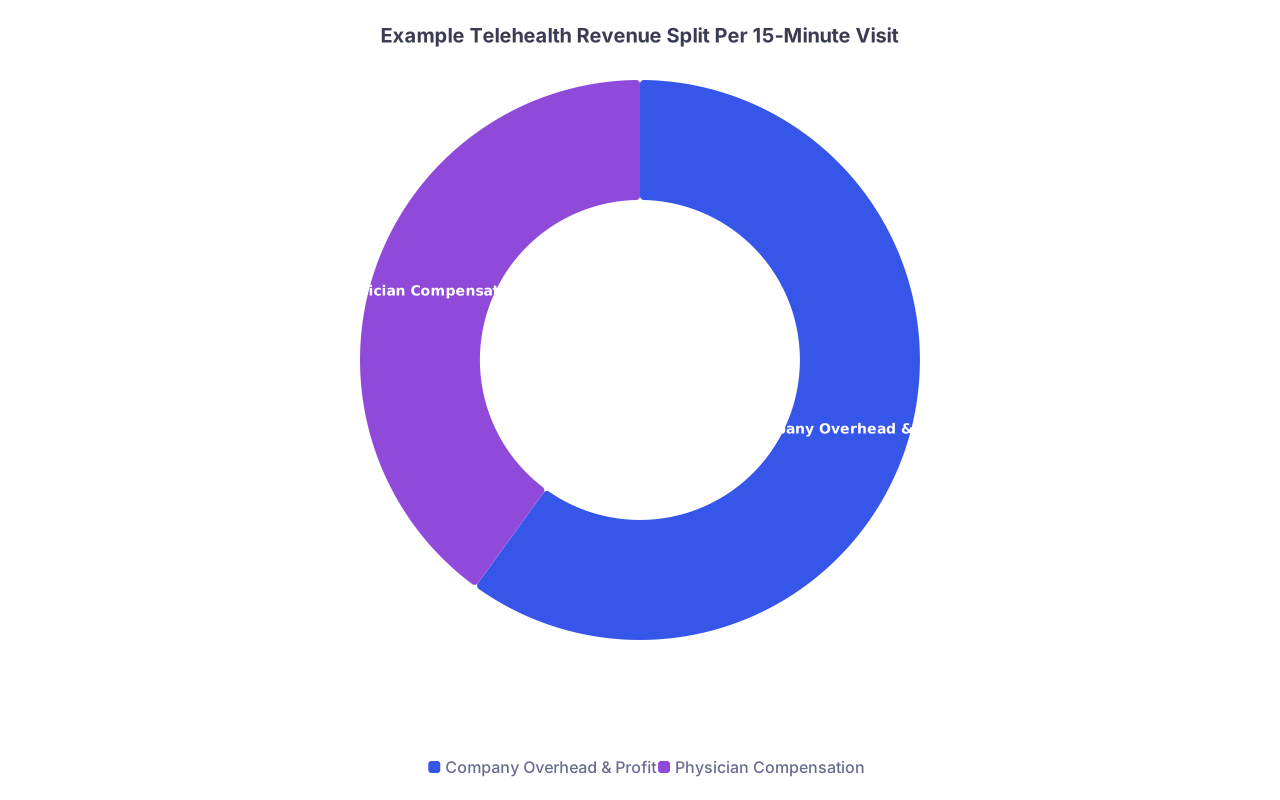
| Category | Value |
|---|---|
| Company Overhead & Profit | 60 |
| Physician Compensation | 40 |
In many mainstream telehealth setups, physicians see ~35–45% of collected revenue. High‑volume, low‑touch platforms might effectively pay you 20–30% of what they collect.
You do not need their exact contracts. You just need ballpark math:
- Typical commercial reimbursement for a 99213 telehealth: $70–$110 depending on region and payer
- If they book you solid at 3–4 visits/hour and collect even $80/visit, revenue is $240–$320/hr
- Paying you $90/hr in that scenario is not “generous.” It is 28–38% of collections
Do this math while you talk. Ask questions like:
- “What is your average collected revenue per visit in my specialty?”
- “How many visits per hour is your typical attending doing?”
- “On a full clinic schedule, what is the expected revenue my hours generate?”
When they dodge or say they “do not share that,” fine. Use conservative assumptions and know your minimum share.
Step 4: Dissect the Actual Pay Structure (Before You React to the Headline Number)
Most physicians get burned here. They hear “$180k a year!” but the fine print turns that into $85/hr with unpaid admin and unrealistic volume assumptions.
You need to break it down.
4.1 Core Pay Models You Will See
- Flat hourly rate (W‑2 or 1099)
- Per‑visit (e.g., $30/short visit, $60/long visit)
- Blended salary + productivity bonus
- Pure RVU (usually rare in telehealth, but exists in large systems)
You must convert all of them into a real, all‑in hourly rate.
Formula:
Effective Hourly Rate =
(Total clinical pay for period) ÷ (Clinical time + Charting + Mandatory meetings + Asynchronous care time)
Example:
- $120/hr “clinical time”
- Average of 15 minutes/charting per hour off the clock
- 2 unpaid hours of team meeting per month
- 160 “paid” hours per month
Reality:
- 160 paid clinical hours + 40 unpaid admin hours + 2 meetings = 202 total hours
- Pay: 160 × $120 = $19,200
- Effective hourly: $19,200 ÷ 202 ≈ $95/hr
That is your real rate. Negotiate off that number, not the glossy brochure rate.
4.2 Watch for Hidden Time Sinks
Ask explicitly:
- “Is charting time included in the paid hour or is it expected off the clock?”
- “Are I responsible for refills, inbox messages, and result review outside scheduled visits? Is that compensated?”
- “How often are clinical meetings, and are they paid?”
Telehealth gigs love to hide work in:
- Patient messaging
- Pre‑visit questionnaire review
- Pharmacy call‑backs
- QA or peer review tasks
All of that is time. Time is money. Price it.
Step 5: Gather Market Data and Create Your Target Range
Now you know:
- Your BATNA
- Your value props
- Rough telehealth revenue realities
- Effective rate from any preliminary offer
Time to define your ask and your floor.
5.1 Pull Real‑World Ranges
Sources:
- Other telehealth offers (ask colleagues, not just recruiters)
- Locums agencies doing virtual coverage
- Online physician forums (yes, filter the noise, but pay attention to specific numbers)
- Physician compensation reports (MGMA, Doximity, but read telehealth lines carefully)
Combine that with your own current rate.
You want three numbers in mind:
- Target rate – Your ideal but defensible ask (e.g., $150/hr)
- Acceptable range – Where you will say yes (e.g., $130–150/hr)
- Walk‑away floor – Below this, you decline (e.g., $120/hr)
Write them down.
Step 6: Script the Actual Negotiation Conversation
If you go into the call winging it, the recruiter will win. They do this 20 times a week. You do it once every few years.
You will sound more confident if you use a structure. Something like this:
6.1 The Sequence
Get their full offer details first.
“Can you walk me through the full compensation structure—base, productivity, bonuses, and any unpaid responsibilities?”Clarify work expectations.
“How many patient contacts per hour are expected?”
“How long are typical visits?”
“What is the average charting time per patient?”Do quick mental math.
Convert to effective hourly rate.Reference your value and market norms.
“Given my current rate of ___ and what I am seeing in the market for telehealth in [specialty], I am targeting an effective rate of about $___ per hour.”Make a clear, specific ask.
“To make this work, I would need either:- $___ per hour guaranteed, or
- $___ per visit at an average of ___ visits/hour.”
Then shut up.
Let them respond. Silence is your friend.
6.2 Concrete Script Example
You (psychiatrist, 3 years out of training):
“Thanks for walking through the numbers. Based on 4 patients an hour at $45 per follow‑up and $75 per intake, that puts me in the range of about $125–130 per clinical hour before unpaid messaging and meetings.
My current in‑person role is effectively about $155/hr, and I am seeing tele‑psych rates in the $140–200/hr range depending on volume and admin load. Given my experience with high‑volume outpatient and coverage for evenings, I am targeting an effective rate of around $160/hr.
If we can get to a guaranteed $150/hr for all clinical plus compensation for inbox time, or adjust visit rates so that a typical booked schedule yields about that, I would be excited to move forward. What flexibility do you have there?”
Not emotional. Not apologetic. Just numbers and reality.

Step 7: Use Non‑Salary Levers When the Rate Hits a Ceiling
Sometimes you hit real constraints. Contracts with payers. Internal pay bands. You will hear, “This is what we pay all our physicians.”
Fine. That does not mean the negotiation is over. You just switch to different levers.
Here is what you can push on that meaningfully improves your effective compensation:
Minimum volume guarantees
- “If the rate is fixed, I would need a guarantee of at least X booked visits per hour on average, or a minimum session revenue of $___ per 4‑hour block.”
Paid administrative time
- “I want 1 paid admin hour for every 8 clinical hours to cover charting and messages.”
Shorter unpaid commitments
- “Remove mandatory unpaid meetings, or make them paid at my clinical rate.”
Schedule control
- “I want the ability to cluster my sessions into 4–6 hour blocks with no gaps, which improves my effective rate and makes the current pay workable.”
Better contract terms
- Shorter notice period for termination (so you are not trapped)
- No unreasonable non‑competes that block you from other telehealth in a huge region
- Malpractice covered with tail
Every one of those has a dollar value, even if they do not show up as $/hour on paper.
Step 8: Be Ruthless About Non‑Competes and Contract Traps
This is where smart attendings still get burned. The rate looks fine. The contract quietly handcuffs you.
Scan for:
- Non‑compete clauses that:
- Ban telehealth in entire states or regions for 1–2 years
- Apply to any platform clients, not just this company
- Moonlighting restrictions that:
- Prevent you from doing any other telehealth, even with different payer panels
- Unilateral pay change provisions:
- “Company may modify payment terms with 30 days’ notice”
Red flags:
- Restricting practice in telehealth across any state where they operate
- 1‑year+ non‑compete for a 0.2 FTE contract
- Ability to slash pay without your written consent
You push back with something like:
“For a part‑time telehealth role, I cannot agree to a non‑compete that blocks me from practicing telemedicine across entire states. I can accept a narrow restriction limited to your direct clients that I have personally seen during the prior 12 months, but not beyond that.”
If they refuse to budge, understand what you are trading: short‑term income for long‑term constraint. Often not worth it.
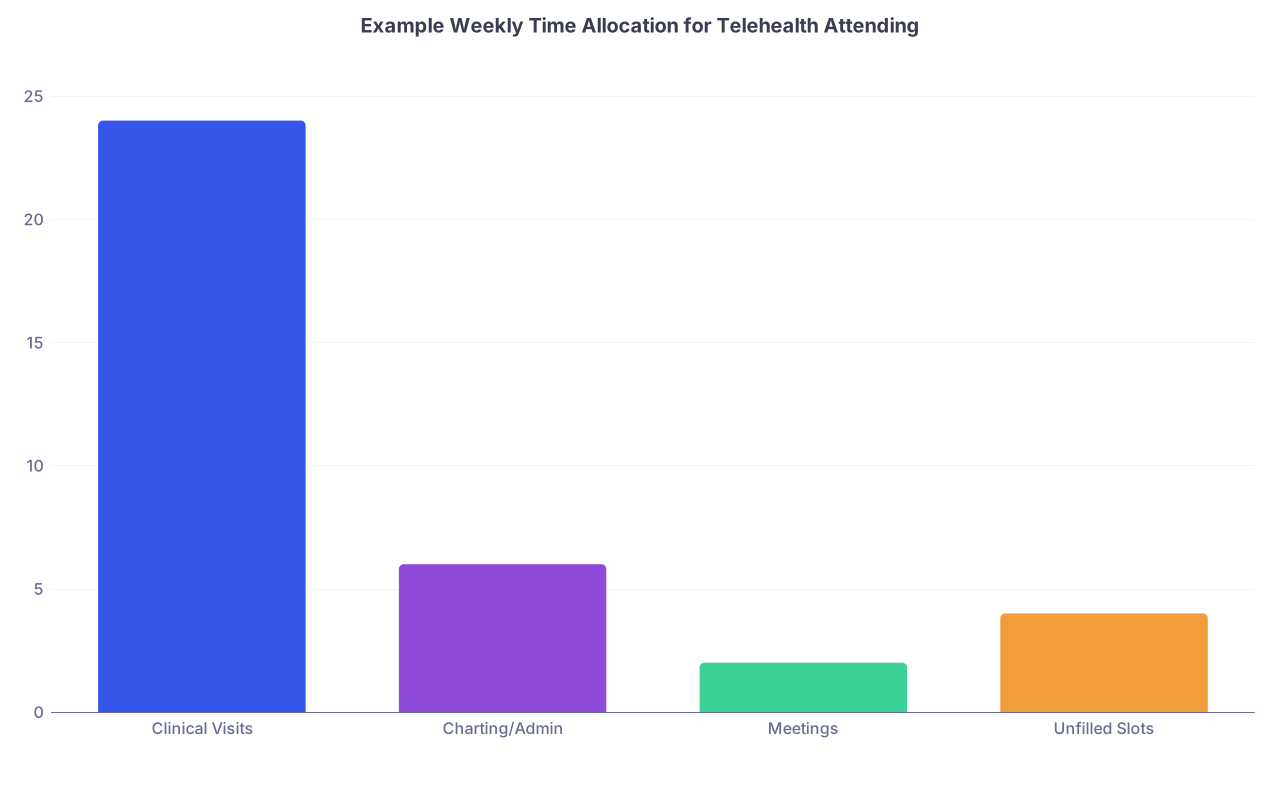
| Category | Value |
|---|---|
| Clinical Visits | 24 |
| Charting/Admin | 6 |
| Meetings | 2 |
| Unfilled Slots | 4 |
Step 9: Compare Offers Side‑by‑Side (Not Just By Headline Salary)
If you are smart, you will have more than one telehealth option. Do not just look at “$180k vs $200k.”
Create a simple comparison table and compute effective hourly rate, flexibility, and risk.
| Factor | Offer A | Offer B |
|---|---|---|
| Headline Pay | $130/hr | $90/hr + $25/visit bonus |
| Expected Visits/Hour | 3 | 4 |
| Paid Admin Time | 1 hr per 8 clinical hrs | None |
| Non‑Compete Scope | Narrow, client‑specific | Broad, multi‑state |
| Effective Hourly (est.) | ~$135 | ~$110 |
I have watched people choose Offer B because “the bonus potential is great.” Then they discover half their shifts are under‑booked, meetings are unpaid, and the non‑compete blocks better gigs later.
Run the numbers coldly. Emotion is how you get stuck.

| Step | Description |
|---|---|
| Step 1 | Define BATNA and value |
| Step 2 | Analyze offer details |
| Step 3 | Calculate effective hourly rate |
| Step 4 | Counter with target range |
| Step 5 | Negotiate admin and terms |
| Step 6 | Walk away |
| Step 7 | Review contract for traps |
| Step 8 | Accept and sign |
| Step 9 | Rate above floor? |
| Step 10 | Company flexible? |
| Step 11 | Noncompete reasonable? |
Step 10: Lock It In Writing and Revisit Annually
Verbal promises are trash. If it is not in the contract or in a signed addendum, it does not exist.
You want in writing:
- Exact pay formula(s)
- What counts as paid time
- What happens with schedule gaps (are you paid minimums?)
- Admin/inbox expectations and pay
- Any bonus structure, clearly defined thresholds
- Who covers malpractice and tail
Then set a calendar reminder for yourself 9–12 months out:
- Pull your actual hours worked and pay stubs
- Calculate your real effective hourly rate
- Compare to your initial target
- If you are under, go back to negotiation with concrete data:
“Over the last 9 months, my average effective pay has been $___/hr based on ___ hours of clinical and ___ hours of required admin. That is below what we projected. Here is what I propose…”
This is how you ratchet your compensation up over time instead of letting it stagnate.

Common Tactical Mistakes to Avoid
Let me be blunt. I have seen attendings make the same avoidable errors repeatedly.
Accepting the first number like it is sacred.
Telehealth recruiter: “Our rate is $110/hr.”
Physician: “Okay, thanks.”
Reality: There was probably 10–20% wiggle room if you had pushed.Overvaluing the “flexibility” pitch.
Flexibility is nice. But if “flexible hours” means you only get solid volume at 3 p.m. on weekdays while you are in clinic, that flexibility is useless. Do not trade thousands of dollars a month for theoretical control of your schedule.Underestimating unpaid work.
Inbox messages are not free. They are unbilled mini‑visits. The platform benefits. You absorb the cost unless you price it in.Ignoring tax and benefits on 1099 work.
A 1099 telehealth gig at $130/hr is not automatically better than a W‑2 at $115/hr with benefits and retirement match. Calculate post‑tax, post‑benefit impact.Signing wide non‑competes out of impatience.
Being blocked from other platforms for a year can easily cost you tens of thousands. For what—signing two weeks sooner? Slow down.
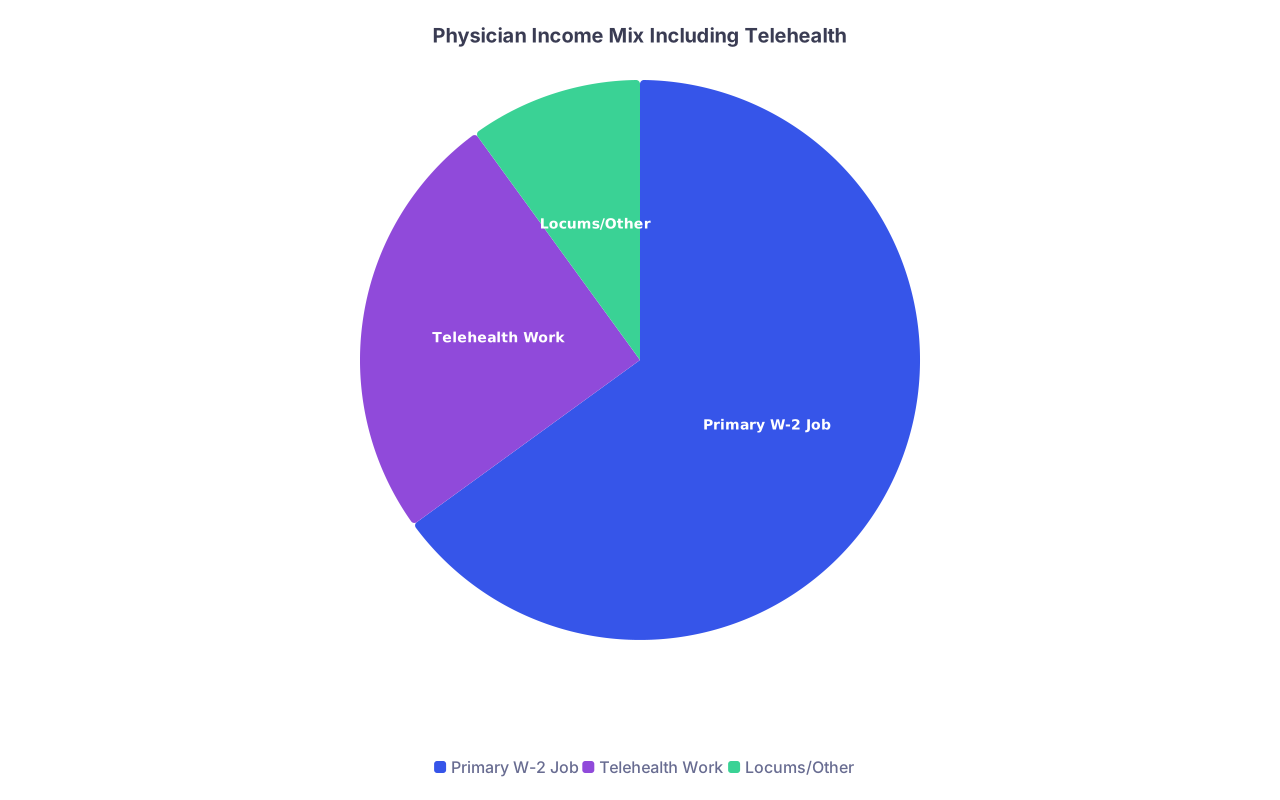
| Category | Value |
|---|---|
| Primary W-2 Job | 65 |
| Telehealth Work | 25 |
| Locums/Other | 10 |
Quick Checklist Before You Accept Any Telehealth Offer
Use this as a pre‑signature sanity check:
- Have I translated the offer into a real effective hourly rate?
- Does that rate meet or exceed 70% of my current in‑person rate?
- Is admin/inbox time:
- Reasonably limited, and/or
- Explicitly paid?
- Are schedule guarantees or minimums clear?
- Is malpractice (including tail) covered?
- Is the non‑compete:
- Narrow in geography?
- Limited to specific clients?
- Short (≤ 6–12 months)?
- Are there clauses allowing unilateral pay changes?
- Do I have in writing:
- Pay model
- Visit expectations
- Admin duties
- Meeting requirements
If you are missing more than one of these, you are not negotiating. You are hoping. Hope is not a strategy.
FAQ (Exactly 4 Questions)
1. Is it realistic to negotiate telehealth pay as a new attending with no telehealth experience?
Yes, if you are thoughtful. You may not get top‑of‑market rates on day one, but you can still negotiate structure and floor. Emphasize your core clinical volume, any underserved language skills, and your willingness to cover less popular hours. Ask for a six‑month review baked into the contract: if you hit specific productivity or satisfaction targets, your rate bumps by a defined amount. You trade initial experience for a clear pathway to better pay instead of being stuck at entry‑level forever.
2. Should I prioritize higher rate or more stable volume in telehealth?
For most attendings, stable volume beats a headline rate that only applies when your schedule is packed. A $150/hr rate with chronically half‑empty sessions is worse than a $125/hr rate with consistently full schedules and paid minimums. Push for either guaranteed hours, minimum shift revenue, or a proven average fill rate. Ask directly: “Over the past 6 months, what percentage of booked hours were actually filled for physicians in my specialty?” If they will not answer, assume variability and price in risk.
3. How do I handle a recruiter who insists ‘we never negotiate, this is standard’?
Treat that phrase as a test. Reply with: “I understand you have standard ranges. Given my current effective rate of $___ and my experience in [X], I would need at least $___/hr effective to justify making this shift. If there is truly zero flexibility on rate, can we adjust admin expectations, paid meeting time, or schedule guarantees to close that gap?” If they still say no to everything, they are telling you your time is a commodity to them. Walk away and allocate that time to better‑paying or more flexible work.
4. When does telehealth pay that is lower than my in‑person rate still make sense?
It can be rational in a few situations:
- You are buying back commute and clinic chaos, and you highly value working from home.
- You are using telehealth for incremental income in otherwise dead time (late evenings at home) that you would not realistically monetize otherwise.
- You are building a track record in a niche (e.g., tele‑psych, remote endocrine) that will let you command higher rates in 12–24 months.
But even then, set a floor. If telehealth pays less than about 60–65% of your in‑person effective rate and brings similar responsibility and risk, it usually is not worth it long term.
Open your latest telehealth offer—or your current contract—right now and do the math: divide your last three months of pay by every hour you spent on visits, charting, inbox, and meetings. If that effective hourly rate is below the number you wrote as your floor, your next step is simple: schedule a meeting to renegotiate, with specific numbers in hand.