
The biggest mistake physicians make with cross‑state telehealth is treating licensing and credentialing as paperwork instead of a multi‑month operational project. That mistake will stall your expansion, burn cash, and wreck your launch timeline.
You need a plan. With dates. With order of operations. And with hard decisions about which states come first and which can wait.
Below is a structured, time‑based playbook: from six months before expansion through the first three months after launch. Use it, adapt it, but do not wing this.
6–9 Months Before Expansion: Strategy, State Selection, and Reality Check
At this point you should not be filling out applications. You should be deciding where and why you are expanding, and whether it is even viable.
Step 1: Define your telehealth business model (Week 1–2)
By now you are post‑residency, either employed or planning independent practice. Telehealth across state lines only makes sense if your model is clear:
- Are you:
- Joining an established telehealth company (Amwell, Teladoc, MDLive)?
- Building your own virtual practice?
- Expanding a current brick‑and‑mortar group into new states?
Decide on:
Specialty and service scope
- Example: Adult psychiatry, medication management only, no controlled substances.
- Or: Primary care, chronic disease management, asynchronous + video visits.
Patient acquisition plan
- Employer contracts?
- Payer contracts?
- Direct‑to‑consumer?
Your licensing strategy depends on volume and payer mix. A psychiatrist doing high‑demand cash‑pay telehealth in rural states will prioritize differently than an employed hospitalist doing follow‑ups via telemedicine.
Step 2: Build a short‑list of target states (Week 2–3)
This is where most people waste time. They scatter‑apply to random states and then cannot staff or market effectively.
You will pick states based on three axes:
Demand and patient volume
- Existing referral patterns
- Employer or health system partners with multi‑state employees
- Your niche (e.g., child psych in states with severe shortages)
Licensing friction
- Are they in the Interstate Medical Licensure Compact (IMLC)?
- Do they require in‑state address, fingerprinting, in‑person visit rules?
- Average processing time (some states routinely take 4–6 months).
Payer and legal environment
- Commercial pay parity for telehealth?
- Medicaid and Medicare telehealth coverage in that state?
- Requirements for telehealth prescribing, PDMP checks, etc.
Create a simple grid. Then rank.
| State | In IMLC? | Typical Processing Time | Telehealth Pay Parity | Priority Tier |
|---|---|---|---|---|
| Colorado | Yes | 4–8 weeks | Strong | Tier 1 |
| Arizona | Yes | 4–6 weeks | Strong | Tier 1 |
| Texas | No | 3–6 months | Mixed | Tier 2 |
| Florida | No (has registration) | 2–4 months | Strong | Tier 2 |
| New York | No | 4–6 months | Improving | Tier 3 |
Make a Tier 1 list of 3–5 states for your first wave. You can always add Tier 2 and Tier 3 once the engine is running.
Step 3: Decide your licensing pathway (Week 3–4)
If your primary license state participates in IMLC and you meet qualifications, you can dramatically speed up multi‑state expansion.
At this point you should:
- Confirm:
- Your primary license state is an IMLC “State of Principal License”.
- You meet IMLC criteria (clean record, board certified or board eligible, etc.).
- Decide:
- Use IMLC for as many compact states as possible.
- Apply individually to non‑compact states (Texas, New York, etc.) only if justified by demand or contracts.
For a solo or small‑group physician, I strongly prefer:
- Wave 1: IMLC states + any state with an unusually attractive contract opportunity.
- Wave 2: High‑value non‑compact states once revenue starts.
If you ignore IMLC and brute‑force every state, you will drown in credentialing, burn months, and launch nowhere on time.
4–6 Months Before Expansion: Document Prep and Application Sequencing
Now you build the machine that will carry you for years: a documentation “vault” and a repeatable application process.
Step 4: Build your licensing and credentialing dossier (Week 1–2)
This is tedious. Do it once, properly.
At this point you should assemble:
- Identification:
- Passport
- Driver’s license
- Social Security card (or equivalent)
- Education and training:
- Medical school diploma
- Residency/Fellowship certificates
- ECFMG certificate (if IMG)
- Exams and certifications:
- USMLE/COMLEX score reports
- Board certification certificates
- DEA registration
- State controlled substance registrations (if applicable)
- Professional history:
- CV in month‑by‑month format, no gaps
- Malpractice claims history letters (from carriers)
- Employment verification contacts
- Legal/disciplinary:
- Explanations and documentation for any past issues (even minor).
Scan and store all of this in a secure, organized folder structure. If you are sloppy here, every state application will be a fresh torture session.
Step 5: Build a state‑by‑state requirements tracker (Week 2–3)
Open a spreadsheet or credentialing platform. You are constructing your control panel.
Include for each target state:
- Application type (standard vs telehealth‑specific registration vs IMLC).
- Fees (license, background check, jurisprudence exam, etc.).
- Notary/fingerprint requirements.
- CME requirements (opioid CME, state‑specific law CME).
- Telehealth‑specific requirements:
- Consent format
- Technology standards
- Prescribing restrictions (particularly controlled substances)
- PDMP use rules.
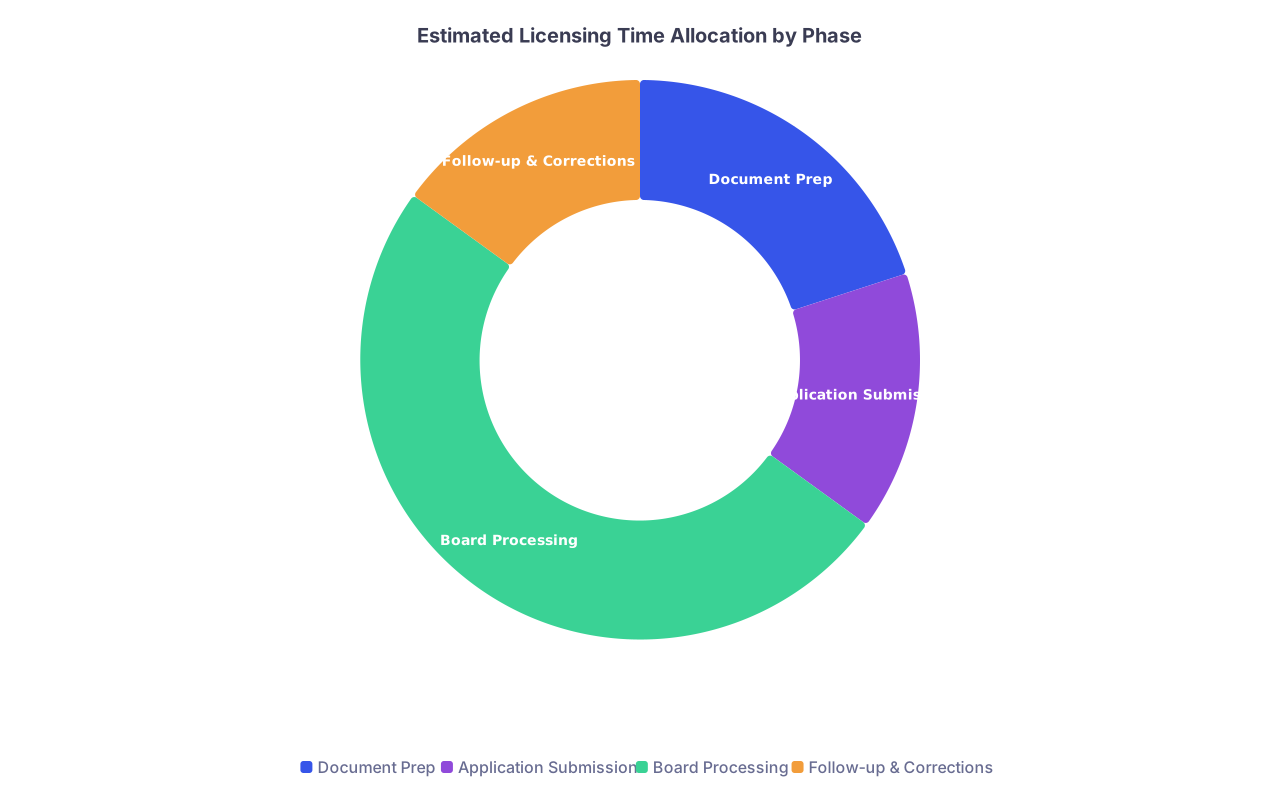
| Category | Value |
|---|---|
| Document Prep | 20 |
| Application Submission | 15 |
| Board Processing | 50 |
| Follow-up & Corrections | 15 |
Expect that board processing time will dominate. Your job is to eliminate delays caused by missing documents and slow responses.
Step 6: Sequence your applications (Week 3–4)
You cannot apply to 10 states simultaneously without bottlenecks, especially if you are partly doing this yourself.
I recommend:
- Month 1:
- Submit IMLC application (if using).
- Submit 1–2 non‑compact priority states with long processing times.
- Month 2:
- Once IMLC Letter of Qualification is issued, apply to 2–3 compact states.
- Add 1 more non‑compact if needed.
- Month 3:
- Second batch of compact states.
- Only add more non‑compact if you have real demand lined up.
Staggered applications prevent your inbox from becoming a graveyard of follow‑up requests.
3–4 Months Before Expansion: Submitting, Tracking, and Parallel Telehealth Infrastructure
At this point you should be actively submitting applications and responding to boards. Concurrently, you must line up the operational side of telehealth.
Step 7: Submit first‑wave license applications (Month 1–2 of active process)
Week by week:
Week 1–2
- Submit IMLC Letter of Qualification (if eligible).
- Submit full applications for 1–2 slow‑processing states.
- Pay all fees immediately; do not “come back later” or you will forget and delay.
Week 3–4
- Complete all required fingerprinting and background checks.
- Schedule any jurisprudence exams early and complete them.
Use your tracker to note:
- Submission dates
- Check deposit dates
- Communication dates
- Outstanding board requests
If two weeks pass with no status change on an application, you follow up. Politely. But firmly.
Step 8: Build telehealth operations in parallel (Month 1–3)
Licenses without infrastructure are useless. While boards are “processing” you should:
Choose your telehealth platform
- Do you:
- Use the hospital/health system’s platform (if employed)?
- Use a vendor like Doxy.me, Zoom for Healthcare, or an EHR‑integrated system (DrChrono, AthenaOne)?
- Confirm:
- HIPAA compliance
- Business Associate Agreement (BAA)
- E‑prescribing integration
- State‑specific telehealth consent functionality.
- Do you:
Configure multi‑state logic
- The platform must:
- Block scheduling for patients in states where you are not yet licensed.
- Log the patient’s location at time of visit (for legal compliance).
- Apply correct consent and intake forms per state.
- The platform must:
Draft state‑specific policies and templates
- Telehealth consent language
- Documentation templates
- Emergency and escalation protocols by state (what is “local” help in each area?)
If you skip this and just “do video visits”, you will eventually document a patient in a state where you are not licensed. That is not a theoretical risk. I have watched it happen multiple times.
2–3 Months Before Expansion: Credentialing with Payers and Facilities
Licensing is only half of the wall. Credentialing is the other half that physicians underestimate badly.
Step 9: Plan your payer strategy (Month 1 of this phase)
Decide:
- Are you:
- Cash‑pay / direct‑to‑consumer?
- Insurance‑based?
- Hybrid?
If insurance‑based even partially, identify:
- Commercial plans you want in each state (BCBS, Aetna, UHC, etc.).
- Medicaid participation decisions (state‑specific).
- Medicare enrollment status (if you are not already enrolled).
Then map: which licenses are needed for which payer contracts. Some payers will credential you across multiple states, others function state by state.
Step 10: Start credentialing applications as licenses approach approval (Month 1–2)
Credentialing lags licenses by 1–3 months, often more. You must overlap these processes.
At this point you should:
- Use CAQH (if in the US) and ensure it is:
- 100% complete
- Updated with each new license as it is issued
- For each payer:
- Start the credentialing process as soon as the license status is “pending with no issues” or “approved”.
- Respond to requests within 24–48 hours, not “when you have time”.
For hospital‑based telehealth (e.g., tele‑ICU, tele‑stroke):
- Start medical staff applications as soon as your license is confirmed or about to be.
- Expect:
- Primary source verification
- Reference checks
- Committee review cycles (scheduled on their timetable, not yours).
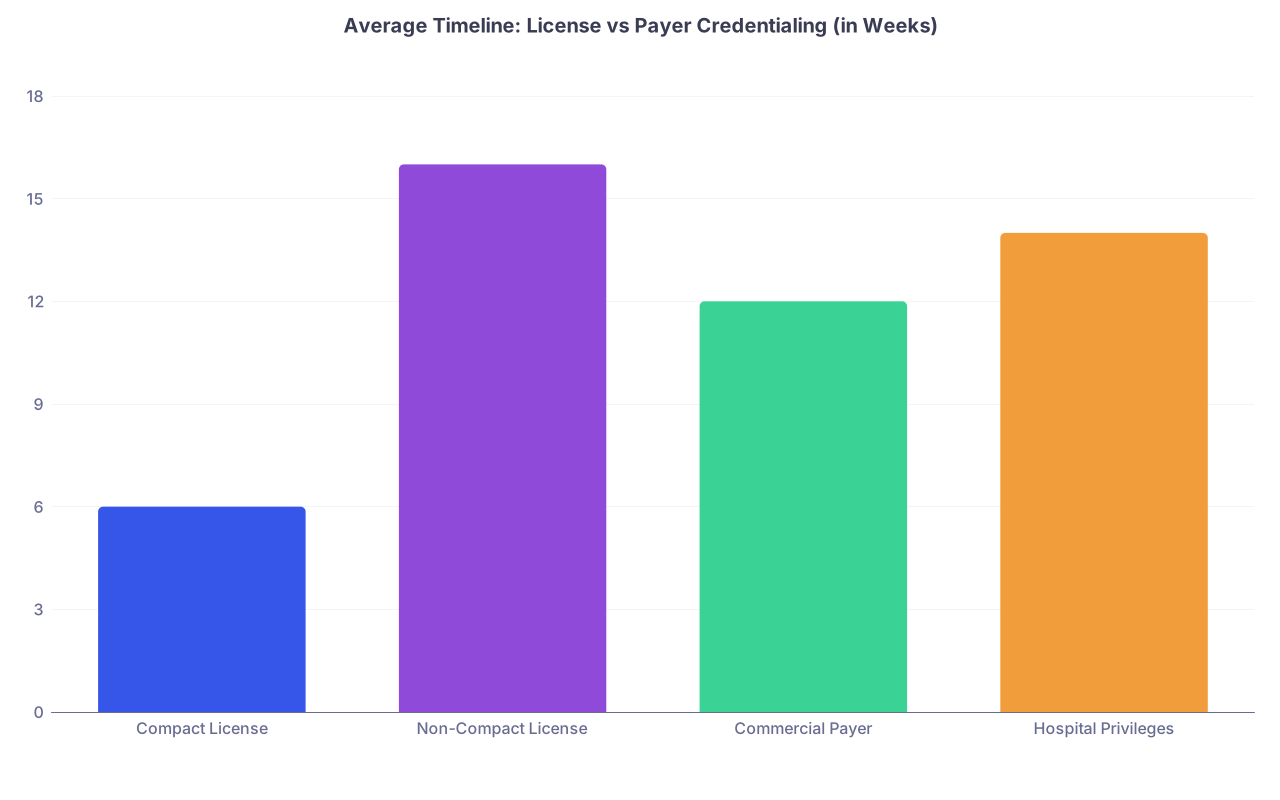
| Category | Value |
|---|---|
| Compact License | 6 |
| Non-Compact License | 16 |
| Commercial Payer | 12 |
| Hospital Privileges | 14 |
Build your launch timeline based on payer credentialing, not just when the licenses show up.
0–1 Month Before Launch: Final Readiness and Soft Opening
You now have at least one new state license approved and payer credentialing underway or complete in that state. This is where people rush. Do not.
Step 11: Compliance and risk final check (2–4 weeks before launch)
At this point you should run through a strict checklist for each active state:
Legal and regulatory:
- Confirm telehealth statutes and board policies (they change frequently).
- Verify:
- Whether initial visits must be video vs can be audio‑only or async.
- Controlled substance prescribing rules, especially under Ryan Haight and any state‑specific telemedicine laws.
Documentation and workflow:
- State‑specific consent integrated and tested.
- PDMP access and workflow configured for each state.
- Documentation templates tested in live‑like environment.
Professional protections:
- Malpractice coverage written to include:
- Telehealth services
- Each licensed state
- Tail coverage implications understood if you switch carriers.
- Malpractice coverage written to include:
If you find a gap—say, malpractice coverage does not explicitly cover a new state—you delay launch in that state. That is not optional.
Step 12: Soft launch in 1–2 states (Launch Month, Week 1–2)
Do not flip the switch on five states at once. That is chaos.
Plan:
Week 1:
- Open scheduling in 1–2 Tier 1 states only.
- Low visit volume on purpose.
- Monitor:
- Tech failures
- Check‑in workflows
- E‑prescribing in real pharmacies in those states.
Week 2:
- Review:
- No‑show rates
- Documentation completion and coding patterns
- Claim submissions and early payer rejections.
- Review:
Use this period to identify hidden state‑specific quirks. For example, a pharmacy chain in one state refusing to fill telehealth‑origin prescriptions for certain meds.
1–3 Months After Launch: Scale, Second Wave States, and Continuous Maintenance
By now, your first state or two should be running smoothly. Time to expand—intelligently.
Step 13: Evaluate performance and refine (Month 1 after launch)
At this point you should look at hard data, not vibes:
- For each active state:
- Visit volume
- Revenue per visit
- Denial rates by payer
- Patient satisfaction or complaint patterns
- Operational headaches (PDMP access, pharmacy issues, tech latency).
Drop or pause any states that are pure headache with low return. You are not obligated to be everywhere.
Step 14: Activate second‑wave states (Month 2–3 after launch)
You already started these licenses months ago. Some will now be approved.
Process:
- As each second‑wave license is approved:
- Immediately confirm malpractice extension.
- Initiate or finalize payer credentialing.
- Configure platform logic and consent for that state.
- Add it to your scheduling system only when at least one major payer is ready or you have a clear cash‑pay strategy.
Resist the urge to list a state as “available” on your website the day the license arrives if you cannot bill or support it correctly yet.
Ongoing: License Maintenance, Renewals, and Strategic Pruning
Once you have more than 5–7 active state licenses, the maintenance burden becomes very real.
You need:
- A renewal calendar
- With reminders at:
- 120 days before expiration
- 60 days before
- 30 days before
- With reminders at:
- A process to track:
- CME for each state’s requirements
- Changes in telehealth laws (e.g., new consent or prescribing rules)
- Malpractice coverage footprint.
Over time, prune states that:
- Generate low volume and high administrative cost.
- Become legally or financially hostile to telehealth.
You are allowed to strategically withdraw and focus where your practice actually thrives.
Final 60‑Second Recap
- Treat cross‑state telehealth expansion as a 6–9 month project, not a form‑filling chore. Build a state prioritization and application sequence early, especially around IMLC.
- Run licensing, payer credentialing, and telehealth infrastructure in parallel with a strict, dated checklist. Licenses without payers or workflows will not generate revenue.
- Launch in waves, not everywhere at once. Soft‑open 1–2 states, fix real‑world problems, then add more states only when each one is legally, operationally, and financially ready.