
You’ve just signed your first telemedicine contract. You’re at your kitchen table, laptop open, already imagining how much better this will be than in-person clinic. No commute. More “flexibility.” Maybe you even told yourself you’d finally have time to work out, see your family, maybe do some consulting on the side.
Fast-forward three months: your days are a mess. Calls running late. You’re charting at 11:30 pm. You’re double-booked between two platforms because you said yes to everything. Your “work from home” life feels more chaotic than residency.
If that sounds even slightly possible for you, good. You’re the person this is for.
Let me be blunt: new telemedicine physicians systematically underestimate how brutal workload planning can be in this space. They think they’re buying flexibility and autonomy. What they actually buy—if they’re not careful—is fragmented work, invisible overtime, and a schedule they do not control.
Let’s talk about the specific workload planning mistakes that will wreck your quality of life in telemedicine—and how to dodge them before they even start.
Mistake #1: Confusing “Flexible” With “Boundary-Free”
The first trap: hearing the recruiter say “You can set your own schedule” and mentally translating that into “I can work whenever, however, and it will magically balance.”
That’s not how it works.
In most real telemedicine setups, “flexible” means:
- You can pick blocks, but you still have to cover peak demand times.
- If you’re per-visit or RVU-based, you’ll feel constant pressure to open more slots.
- If you’re salaried, you’ll feel an unspoken expectation to be “available” far beyond your scheduled hours.
The mistake is this: not defining very hard, very boring rules about when you work and when you don’t—before you start.
I’ve watched new physicians:
- Sign up for early morning and late-night shifts “just for a bit” to build volume.
- Take weekend shifts because “it’s just from home.”
- Let platforms add “urgent” slots to their calendars because “it’s only 10 more visits.”
Six months later: they have no consistent off time, their sleep is trashed, and they’re responding to patient messages at 2 am.
Do not:
- “Try it first” with no clear max hours per day and per week.
- Let operations schedule you in overlapping blocks across multiple time zones.
- Agree to “coverage flexibility” without a written upper limit of hours and after-hours expectations.
You need something boring and rigid: for example, “I work 4 days a week, 6 hours of live visits plus buffer per day, within these fixed time windows. No exceptions unless I explicitly approve a one-off change.” Then you actually stick to it.
Mistake #2: Ignoring the Hidden Work (Messaging, Results, Admin)
Telemedicine looks deceptively efficient. Quick visits, no rooming, no physical exam prep, no walking between rooms. So people assume: “I can easily do 4–6 patients an hour.”
Then they discover the hidden second job: asynchronous work.
- In-basket messages.
- Prescription clarifications from pharmacies.
- Portal messages from patients.
- Lab and imaging results that require follow-up.
- Prior authorizations.
- Secure chats from nurses or MAs.
That stuff doesn’t show up on your “visit” schedule. It silently fills every gap in your day and then leaks into your evening.
, Messages & results, Admin/tech issues](https://cdn.residencyadvisor.com/images/articles_svg/chart-time-breakdown-for-a-typical-telemedicine-physicia-7518.svg "Time Breakdown for a Typical Telemedicine Physician Day")
| Category | Value |
|---|---|
| Live visits | 45 |
| Charting during visits | 10 |
| [After-visit charting](https://residencyadvisor.com/resources/telemedicine-careers/common-telehealth-documentation-errors-that-trigger-malpractice-risk) | 15 |
| Messages & results | 20 |
| Admin/tech issues | 10 |
If you plan your workload based only on visit time—you will be buried.
Common rookie move: booking yourself at 4–5 patients per hour back-to-back, no buffer, for 6–8 hours, thinking “it’s just quick video visits.” Then:
- Every slightly complex case runs over.
- Your inbox piles up.
- Labs from yesterday drop into your in-basket mid-shift.
- You’re staying up late to clear messages you didn’t even realize you were responsible for.
You must budget explicit time for non-visit work. For example:
- For every 1 hour of scheduled visits, assume 15–30 minutes of messaging/results/admin.
- Block dedicated “inbox time” as if it were clinic—morning and late afternoon.
- Treat closing the in-basket as critical work, not something you’ll just “fit in.”
If the company tells you, “Messages only take a few minutes; you can do them in between visits,” that’s a red flag. That attitude is how you end up working unpaid overtime.
Mistake #3: Overestimating Safe Visit Volume (Telemed ≠ Magic)
Another big myth: telemedicine is “faster,” so your visit volume can be higher than in-person clinic.
Sometimes yes—for very simple, tightly scripted visits (e.g., asynchronous acne follow-up). But for real-time primary care? It can be slower:
- You’re troubleshooting tech.
- You’re clarifying what the patient actually means with no exam.
- You’re compensating for poor audio/video or language barriers.
- You’re double-documenting because the platform and EMR are poorly integrated.
Yet I regularly see platforms and group practices push new attendings toward absurd targets: 25–35+ telemed visits per day right out of residency, often with minimal support staff.
Here is where new physicians go wrong:
- They accept “expected productivity” numbers without running the math.
- They don’t trial their personal sustainable pace before committing long-term.
- They think “I’ll speed up once I get used to it” and ignore the early signs of cognitive overload.
You should pressure test this before you sign anything long-term.
For synchronous video/phone visits, a more realistic safe starting point (for primary care or urgent care style telemed):
- 2–3 visits per hour if you’re handling your own messaging and results.
- 3–4 per hour only if visit types are tightly limited and you have support (e.g., nurses, pre-charting).
Push above that and you’re relying on uncompensated after-hours charting. Which will happen. Every time.
Mistake #4: Double-Booking Across Platforms and Jobs
The fastest way to destroy your sanity: stacking telemedicine gigs without a master plan.
I’ve watched fresh grads:
- Keep a part-time clinic job.
- Add one “side” telemedicine platform.
- Then pick up per-diem urgent care telemed shifts.
- And maybe some call coverage “for extra money.”
On paper it looks fine: “Just 8–12 hours here, 8–12 there.” But outages, overruns, and recall visits don’t respect your tidy spreadsheet. You end up:
- Finishing one platform’s visit while late for the next one.
- Answering patient messages from three different systems every evening.
- Never fully off, because some panel, somewhere, is always open.
If you want multiple roles, you need ruthless clarity:
- Only one primary panel-based job at a time. Every panel comes with long-tail responsibility.
- Very strict, non-overlapping blocks for each platform.
- A hard weekly cap on total hours (live + admin) across all roles.

| Step | Description |
|---|---|
| Step 1 | New Telemed Offer |
| Step 2 | Consider as primary job |
| Step 3 | Reject or cut other work |
| Step 4 | Define fixed non overlapping blocks |
| Step 5 | Do I already have a panel job |
| Step 6 | Will this add more than 8 hr per week |
Do not accept a second telemedicine panel job until you’ve lived with the first one for at least 3–6 months and measured your real workload. Otherwise, you’re building a Rube Goldberg machine out of your career.
Mistake #5: Forgetting Time Zones, Peak Hours, and Your Actual Life
Telemedicine is national, sometimes international. That sounds glamorous until you realize what it does to your calendar.
I’ve seen new attendings in Eastern Time happily sign up for “evening” coverage for a West Coast-heavy platform—then realize that means they’re working 10 pm–2 am their time. They also forget:
- Peak hours are often early morning, lunch, and late evening.
- Many companies expect some weekend or holiday coverage, even if they soft-pedal it in interviews.
- If you want predictable income from per-visit pay, you end up chasing those peak times.
This is workload planning, not lifestyle decoration. If you sign up for late nights and weekends to “get started” but you’re a person who actually needs a regular sleep schedule, you’re volunteering for burnout.
Be brutally honest about:
- Your chronotype (are you actually a night owl or just used to residency chaos?).
- Your family obligations: kids, partner schedules, caregiving.
- Your mental health: do late nights wreck you for days?
Then align your telemed hours with what you can actually sustain for years.
Mistake #6: Underestimating Tech Friction and Training Time
New telemedicine physicians underestimate how much time they will lose to technology. Not just at the beginning—ongoing.
You will deal with:
- EMRs that don’t play nicely with the telemed platform.
- Video calls that drop mid-visit.
- Patients who can’t find the “join” button.
- Authentication issues.
- E-prescribe errors and pharmacy system quirks.
If your workload plan assumes “I’ll be 100% efficient from week one,” you will be behind from day one.
Most people don’t:
- Block off slower schedules in the first 4–6 weeks while they learn the system.
- Include tech/learning time in their notion of “work hours.”
- Push back on employers who want full productivity during the onboarding chaos.
You need a ramp:
- For the first month, cap visits at 50–70% of the long-term target.
- Ask explicitly: “What is the expected ramp timeline for full volume?” Get it in writing.
- Treat learning the platform and workflows as real work needing real hours.
Also, if the platform is chronically unstable—plan on repeated disruption. And maybe plan your exit.
Mistake #7: Not Respecting Cognitive Load and Clinical Limits
Telemedicine puts most of the diagnostic weight on your history-taking and judgement. No vitals (often). No exam (or limited). No vibe from walking into the room and actually seeing how sick someone looks.
Running high volumes in that environment is mentally more taxing than clinic, not less.
New telemed docs make this mistake:
- They cram complex care (chronic disease management, polypharmacy, mental health follow-up) into 10–15 minute slots.
- They underestimate how much decision fatigue will hit by the third straight hour of video.
- They don’t schedule breaks because “I’m at home, I’ll just rest between visits.”
You won’t.
You will fill every gap with charting and messages. Then your last patients of the day will get the worst version of you.
You need:
- Protected breaks every 2–3 hours—literally scheduled.
- A hard stop time where no new visits can be booked.
- Rules for what is NOT handled by telemed (e.g., no complex med recon in 10 minutes for a 12-med, multi-comorbidity patient).
If your employer’s model demands unsafe cognitive load to hit their volume goals, the problem is the model, not your “efficiency.” Don’t try to brute-force your way through a broken system.
Mistake #8: Ignoring Compensation Structure When Planning Hours
This one bites a lot of people.
Your workload planning must be built around how you’re paid. Otherwise you either:
- Work way more than you’re being compensated for, or
- Chase volume in ways that kill your quality of care and your health.
Common structures:
- Per-visit pay
- Hourly pay (with or without minimums)
- RVU-based with vague targets
- Salary with “expected” volume, sometimes with bonuses
Each has specific traps.
Per-visit:
- You’re incentivized to keep saying yes to more slots and more platforms.
- Low volume days (summer, holidays) crush your income.
- You will be tempted to schedule too tightly to hit financial targets.
Hourly:
- Companies may quietly pressure you to “optimize” productivity while ignoring off-the-clock admin work.
- If you exceed your scheduled hours for charting/messages, it’s often unpaid.
RVU or salary:
- Translation: “We’ll pay you as if this is a 40-hour week, but design the system like it’s 50–55.”
- If there’s no protected admin time baked into your schedule, that admin time is your nights and weekends.
| Pay Model | Main Trap |
|---|---|
| Per-visit | Over-scheduling to hit income targets |
| Hourly | Unpaid extra admin and message time |
| RVU-based | Volume pressure without time protection |
| Salary | Creep of expectations beyond scheduled hours |
Before you sign, do actual math:
- What is the maximum number of visits they expect per day?
- How much admin time do they assume that creates?
- Is that explicitly scheduled and compensated, or “you’ll just fit it in”?
If the numbers only work by assuming you’ll donate several unpaid hours a week, that’s not a job. That’s a slow-motion trap.
Mistake #9: No System for Measuring and Adjusting Workload
The last, and maybe biggest, planning mistake: flying blind.
New telemedicine physicians rarely track their workload in any systematic way. They just “feel busy” or “feel behind” and blame themselves.
That’s how you get gaslit by your own schedule.
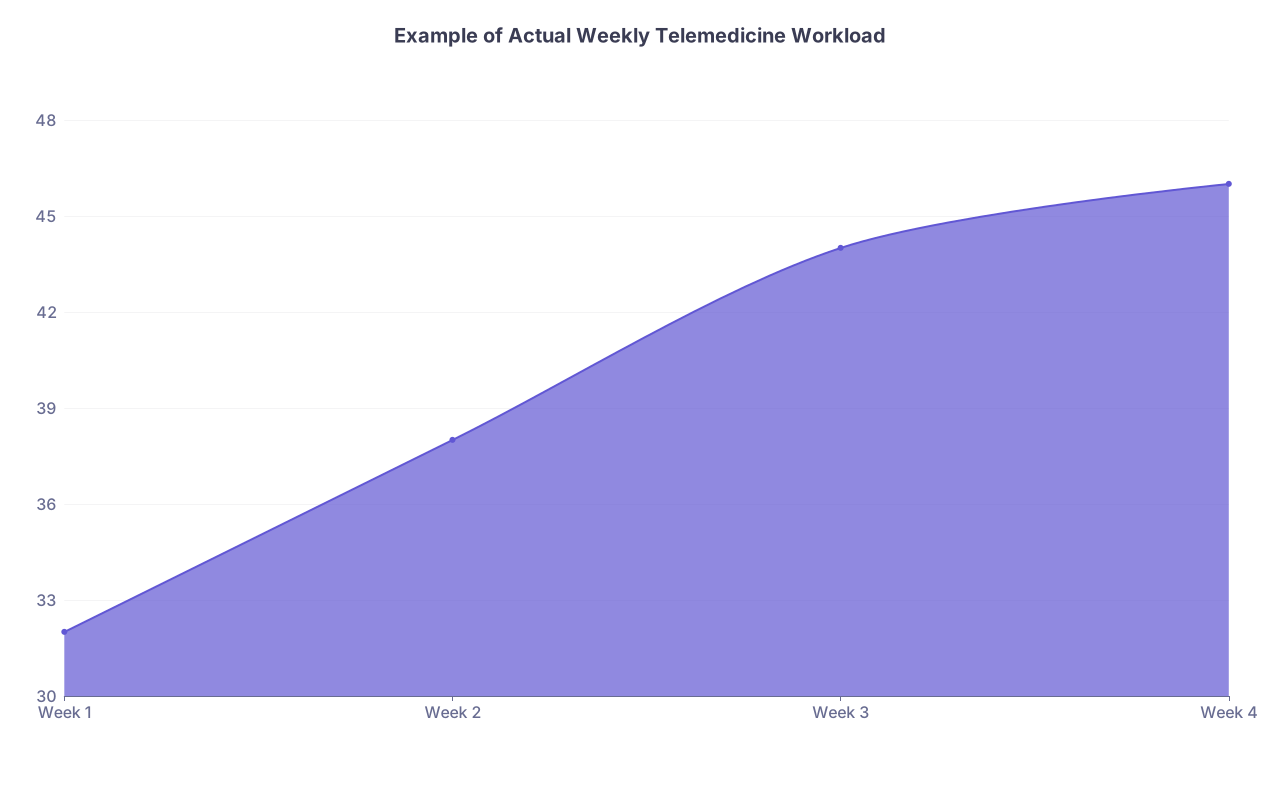
You should track, at least for the first 3–6 months:
- Number of scheduled visits per day.
- Total hours of live patient contact.
- Total hours spent on:
- charting after visits,
- messages,
- results,
- administrative/tech issues.
| Category | Value |
|---|---|
| Week 1 | 32 |
| Week 2 | 38 |
| Week 3 | 44 |
| Week 4 | 46 |
If your “40-hour” telemedicine job is quietly turning into 50+ hours, the data will show it. Then you adjust:
- Reduce bookable slots per hour.
- Drop low-yield extra shifts.
- Renegotiate expectations—or leave.
Do not rely on vibes. Use numbers. Otherwise, you’ll wake up in a year wondering how your “flexible” telemed job became a 1.2–1.3 FTE disguised as 1.0.
Mistake #10: Treating Telemedicine Like a Temporary Side Hustle
One last subtle problem: people approach telemedicine as a stopgap or side hustle, so they never build real systems around it.
“Just for a year while I pay off loans.” “Just some extra shifts on top of my ‘real’ job.” “Just evenings and weekends until I find something more permanent.”
That mindset guarantees sloppy workload planning:
- You don’t set strict availability rules because “it’s temporary.”
- You don’t clarify responsibilities around follow-up and results.
- You don’t push for sane visit lengths or admin time because you think you won’t be there long.
Except… telemedicine is sticky. The money helps. The lack of commute helps. The “I can do this from anywhere” story is appealing. And suddenly two years go by and you’re still in the exact same unsustainable setup.
Treat your telemedicine job like it might become permanent—even if you think it won’t. Build it in a way that could actually be livable for years. That’s how you avoid getting trapped.

How to Plan Your Telemedicine Workload Without Self-Destructing
Let me give you a concrete baseline. Then you can flex it based on your situation, but at least you’ll be starting from something sane.
For a full-time primary care or urgent-care style telemedicine role:
- Cap live visits at:
- 18–22 per full day starting out,
- maybe up to 24 once you’re efficient and supported.
- Plan your day as:
- 4–5 hours of live visits in the morning.
- 1–2 hours of admin/inbox midday.
- 2–3 hours of live visits in the afternoon.
- 1 hour at the end for results/messages/cleanup.
- Hard stop: no new visits in the last 30–60 minutes of your official day.
- Weekly target: 40–45 total working hours, including all admin and charting.
And then test reality:
- If you’re consistently finishing your day 1–2 hours later than scheduled, cut volume by 15–25%.
- If your in-basket explodes, demand either better support, longer visit times, or fewer visits per day.
This isn’t about being soft. It’s about not designing a job that burns you out by year two.

FAQs
1. How many telemedicine visits per hour is actually safe for a new attending?
For synchronous primary care or urgent care telehealth, starting at 2–3 visits per hour is reasonable while you learn the platform and workflows. Some highly standardized low-acuity models can stretch to 4 per hour, but only with tight visit criteria, good support staff, and explicit admin time elsewhere in your day. If you’re regularly going past your scheduled hours to finish charts and messages, your pace is not safe.
2. Can I realistically work two telemedicine jobs at once?
You can, but most people do it badly. The big mistake is having two panel-based jobs at significant FTE (like 0.5 + 0.5) with both expecting you to handle messages, refills, and results. If you’re going to stack roles, keep one as a clear primary panel-based position and the other as truly per-diem or episodic, with carefully non-overlapping hours and a strict weekly cap on total work time.
3. How much unpaid time should I expect in a typical telemedicine role?
If the job is designed well and you’re assertive about boundaries, unpaid time should be minimal—occasional spillover, not a daily pattern. But many new physicians find themselves donating 5–10+ hours per week “off the books” for messages, results, and cleanup because they accepted unrealistic visit volumes and vague expectations. Track your hours honestly for the first few months; if your actual time is far above what you’re being paid for, adjust or renegotiate fast.
4. What’s the biggest red flag in a telemedicine job description regarding workload?
Any combination of these: high expected daily visit volume (25–30+ for full-time), vague or absent mention of admin/inbox time, phrases like “flexible availability” with no upper limits, and compensation that’s per-visit or RVU-based without protected non-visit hours. If they cannot tell you, in concrete numbers, how many visits per day their attendings do, how much time is blocked for messages/results, and what the average total weekly hours look like, assume you’re the one expected to absorb the overflow.
Key points to walk away with:
- Telemedicine doesn’t erase workload—it hides it. Messages, results, and tech issues will eat your “flexibility” if you don’t plan for them.
- Your visit volume, hours, and compensation model must line up, in writing, with reality. If the math only works because you’re giving free labor, it’s a bad deal.
- Treat telemedicine like a long-term career from day one: hard boundaries, tracked hours, and a workload you could actually live with for years, not just months.