
The fastest way to ruin a promising telemedicine career is to misunderstand how RVUs and per‑visit pay really work.
Most clinicians do.
They see a big “$80 per visit” number or an “RVU multiplier” and stop asking questions. Then six months later they realize they locked themselves into a pay structure that rewards speed over safety, punishes complex care, and quietly caps their income.
Let’s make sure that is not you.
The Core Misunderstanding: Chasing the Wrong Number
Almost every bad telemedicine contract I have seen starts with the same mistake:
You focus on the rate instead of the reality.
You compare:
- $60 vs $80 per visit
- 4.0 vs 5.5 wRVU/hr “expectations”
- $45 vs $60 per wRVU
You do not compare:
- Completed visits per hour you can sustainably do
- No‑show and cancel rates
- Unpaid work (charting, messages, prior auths, callbacks)
- Hidden caps, floors, and clawbacks
That is how you end up making less than your current job while working more hours “on your own time.”
The illusion of headline rates
If a company says: “We pay $75 per visit,” your brain does the lazy math:
4 visits/hour → $300/hour.
You think: “That is great. I am in.”
Huge mistake.
You forgot:
- Lag time between visits
- Patients who do not show
- Tech issues
- Required pre‑charting
- Post‑visit messages
- “Soft” quality requirements that add clicks and counseling but no extra pay
The correct question is not: What is the per‑visit rate?
It is: What is my realistic, all‑in hourly rate, including unpaid tasks, on a normal day?
If you are not forcing every recruiter and medical director to walk you through that hourly reality, you are gambling with your income.
RVU‑Based Telemedicine Pay: The Quiet Traps
Telemedicine companies love RVUs. They sound objective, standardized, and fair.
They are not, if you do not understand how they are being used.
Mistake 1: Confusing “wRVU Potential” with Guaranteed Income
Here is the common setup:
“You can easily generate 6–8 wRVUs per hour on our platform. At $50 per wRVU, that is $300–$400 per hour.”
Two red flags in that one sentence:
- “Can” and “easily”
- “Potential” volumes, not measured averages
You need data, not adjectives.
Ask for actual aggregate data from comparable clinicians:
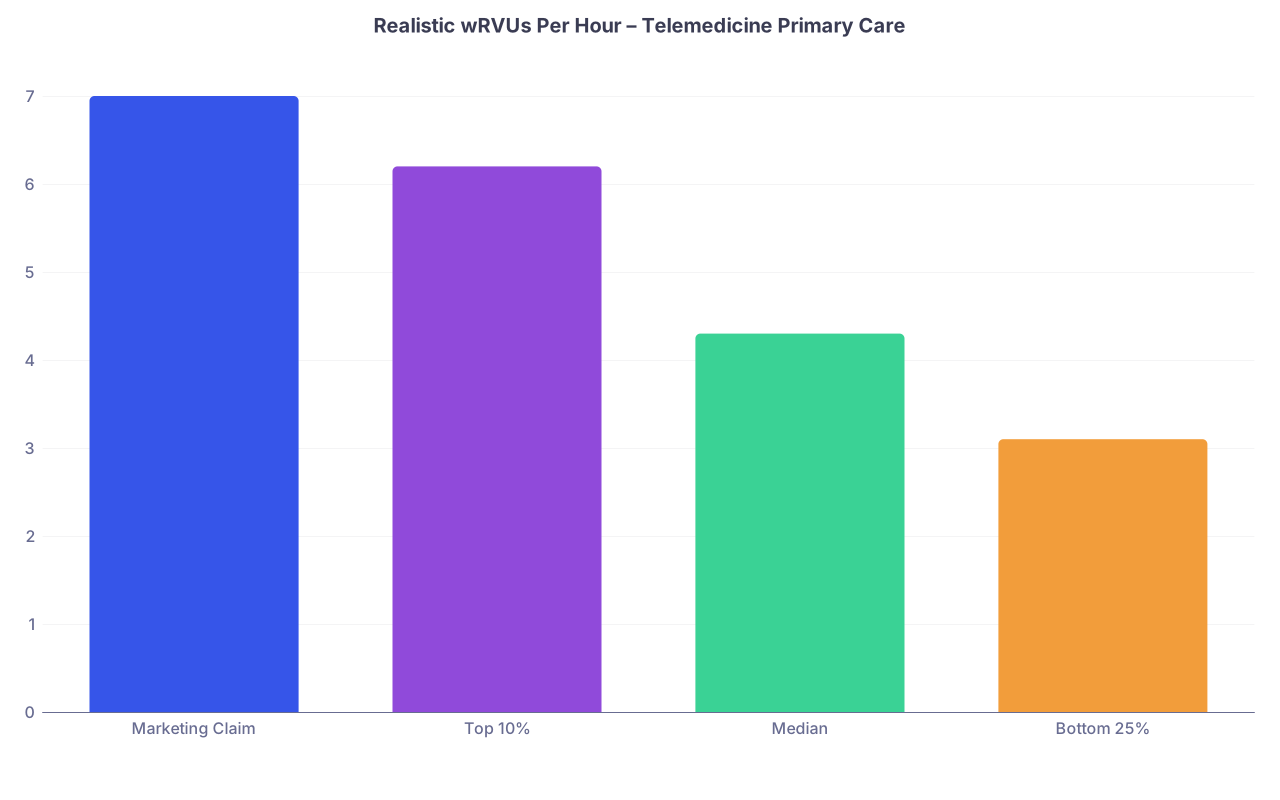
| Category | Value |
|---|---|
| Marketing Claim | 7 |
| Top 10% | 6.2 |
| Median | 4.3 |
| Bottom 25% | 3.1 |
If the company will not share anonymized ranges for current clinicians, they are asking you to trust a fantasy.
Mistake 2: Ignoring Down‑codes and Documentation Risk
In brick‑and‑mortar clinics, you at least have coders, templates, and in‑person context.
In telemedicine:
- Encounters are shorter
- History and exam are limited
- Template over‑reliance can make every note look cloned
- Audit risk is higher if you “up‑code” to chase wRVUs
I have seen new telemedicine docs told, “Most of our visits are coded at level 4.” Then, three months later, compliance reviews quietly push those down to level 3s. Same work. Fewer RVUs. Zero recourse.
Do not assume:
- Your telemedicine visit will “naturally” code at level 4
- The platform’s templates are audit‑proof
- Coding will stay static over time
You must ask:
- What percentage of visits historically land at each code level (99212–99215, etc.)?
- How often are down‑codes happening on audit?
- Who decides coding policy and can it change unilaterally?
Mistake 3: Not Tracking RVU Leakage
RVU leakage is all the work that does not produce wRVUs:
- Secure messages
- Refill requests
- Care coordination
- Results review and patient messaging
- “Quick” chart corrections requested by QA
- Required trainings and meetings
If your telemedicine role includes primary care continuity, messaging alone can eat you alive.
A typical situation I see:
- 20 scheduled visits in a day
- 25–40 patient portal messages
- Several labs/imaging reports to review
- Expectation to respond “within 24 hours”
Guess what? None of that maps cleanly to RVUs in most telemedicine setups.
You think you are earning, say, $120/hour. Then you look at the extra 60–90 minutes per day of unpaid “invisible work” and realize your true rate dropped below $80.
Per‑Visit Pay: Where Good Hourly Rates Go To Die
Per‑visit pay looks simple. It is not.
The main danger: you underestimate how many completed, billable visits you can actually do per hour, sustainably, under that platform’s rules.
The throughput myth
The company says:
“Our average doc sees 4–6 patients per hour. Visits are quick and straightforward.”
You picture a neat block of 10‑minute uncomplicated URIs all day.
Reality on the ground:
- 3 patients no‑show or time out on tech issues
- 2 cases are more complex than advertised
- 1 patient demands detailed counseling, wants to “talk about everything”
- Charting requirements are high
- Platform forces certain canned counseling / consent elements
Most new telemedicine clinicians underestimate:
- How long it takes to load charts, click through workflows, reconcile meds
- How often “simple” issues turn complex once you start talking
- How many visits get canceled / rescheduled / disconnected
If you are not brutally conservative about your expected visit throughput, your effective hourly rate will be 20–40% lower than advertised. Minimum.
The no‑show and cancellation trap
This is the sneaky one.
Does the company pay:
- For reserved slots that do not fill?
- For patient no‑shows?
- For cancellations within a certain time window?
Many do not. And they bury it in the fine print.
You might see something like:
- “Compensation is per completed encounter”
- “Non‑billable or incomplete visits may not be eligible for payment”
I have watched clinicians lose 15–25% of their scheduled “income” to no‑shows and tech failures they did not cause.
Unless you are fully booked with on‑demand urgent care (and even then there is downtime), you must factor this attrition into any hourly calculation.
The charting tail you are pretending does not exist
Per‑visit models incentivize speed. You will absolutely be tempted to let charting “trail behind” to keep clicking into the next visit.
This leads to:
- Long “charting tail” at night or on weekends
- More errors and missing elements
- Higher risk of down‑coding or chart corrections
- Burnout from documentation debt
You might think: “I can handle a bit of charting after hours.”
Multiply “a bit” by 15–20 visits per day. For months. While your pay is still only tied to completed visits, not charting time.
Blended or “Hybrid” Compensation: Where Confusion Thrives
Many telemedicine jobs now use hybrid models:
- Smaller base salary + RVU or per‑visit bonus
- Hourly floor + productivity upside
- Panel management stipends + visit‑based pay
These can be fair. They can also be a maze of traps.
Mistake 1: Over‑valuing the upside
If a recruiter says, “Our docs commonly earn $280k+ with productivity,” assume that number is aspirational until you see:
- Distribution of actual incomes (median, not just top earners)
- Proportion of clinicians who hit the higher tiers
- Time in role required to reach those numbers (panel growth, experience, etc.)
| Model Type | Advertised Annual | Realistic Median | Key Hidden Risk |
|---|---|---|---|
| Pure per-visit | $320,000 | $210,000 | No-shows, charting |
| RVU + small base | $300,000 | $230,000 | Aggressive targets |
| Hourly floor + bonus | $260,000 | $240,000 | Bonus rarely triggered |
| Salary + panel | $280,000 | $250,000 | Slow panel growth |
Companies will always showcase what is possible. Your job is to figure out what is probable.
Mistake 2: Missing the threshold and cliff effects
Hybrid systems often have tiers:
- 0–3 wRVU/hr: base only
- 3–5 wRVU/hr: base plus $X per wRVU
5 wRVU/hr: higher rate per wRVU
Or:
- 0–120 visits/month: no bonus
- 121–160: $Y per visit
- 161+: $Z per visit
The trap is obvious once you see it:
If you land just under a threshold, you get punished. Hard.
You might work 20% harder for a 5% pay bump. Or misjudge your energy and fall just short of the next tier and watch that “projected” income evaporate.
You need to model:
- What your effective hourly/annual payout is at different realistic productivity levels
- What happens if you have a bad month (illness, family issues, platform volume dip)
Quality Metrics, Callbacks, and Inbox Work: The Unpaid Shadow Job
Telemedicine markets itself as efficient. Less hallway chatter, fewer in‑clinic distractions.
That part can be true.
What is also true: many platforms quietly shift a lot of extra work onto you without clear compensation.
Common examples:
- Required follow‑up messaging within 24–48 hours
- Handling lab and imaging results for weeks after a visit
- Quality metrics (screenings, counseling, documentation elements) that extend visit length
- Service recovery calls for unhappy patients
Unless your contract explicitly pays for:
- Asynchronous messages (per message, per block, or RVU‑mapped)
- Result review and follow‑up
- Group or mandatory meetings
- Non‑clinical work (content creation, protocols, leadership)
…it is safe to assume you are doing that for free.
You must count this when assessing per‑visit or RVU pay. Otherwise, you will massively overestimate your real hourly rate.
Red Flags You Should Never Ignore in a Telemedicine Offer
Let me be blunt. If you see these in a telemedicine job discussion and you still sign, you are volunteering to be underpaid.
Vague productivity expectations
Phrases like:
- “Most of our docs see around…”
- “It is very reasonable to hit…”
- “Many clinicians easily reach…”
Translated:
“We will not put real numbers in writing because the reality is worse than the story.”
You want:
- Hard numbers for average and median productivity
- Dataset for clinicians with your specialty, schedule type, and FTE status
- Confirmation in writing that these are based on actual current data
No clarity about non‑visit work
If they cannot clearly answer:
- “How are messages compensated?”
- “Who manages results and follow‑up?”
- “How is after‑visit documentation time accounted for financially?”
Then the answer is: You are doing it, and you are not being paid extra.
Metrics that conflict with safe patient care
Watch out for:
- Hard quotas for visits per hour with no complexity adjustment
- Penalties for longer visits or “off‑script” counseling
- Pressure to avoid ordering tests or referrals that might “hurt metrics”
You will be put in a position where doing the right thing for the patient costs you money or gets you flagged. That is toxic.
A Simple Framework: How Not to Get Burned
You do not need an MBA. You just need discipline and a calculator.
Step 1: Force everything into an hourly rate
For each job you are considering, write down:
- Per‑visit rate or RVU value
- Realistic visits or RVUs per hour (low, medium, high)
- Estimated no‑show/failed visit rate
- Extra unpaid time per shift (charting, messages, follow‑up)
Then calculate:
Effective hourly rate
= (Paid visits or RVUs per hour × pay per visit/RVU)
÷ (Paid clinical hours + unpaid hours needed to keep up)
Be conservative. Use the low productivity scenario first. See if the job is still acceptable.
Step 2: Compare apples to apples across offers
Put each job into a simple comparison. Something like:
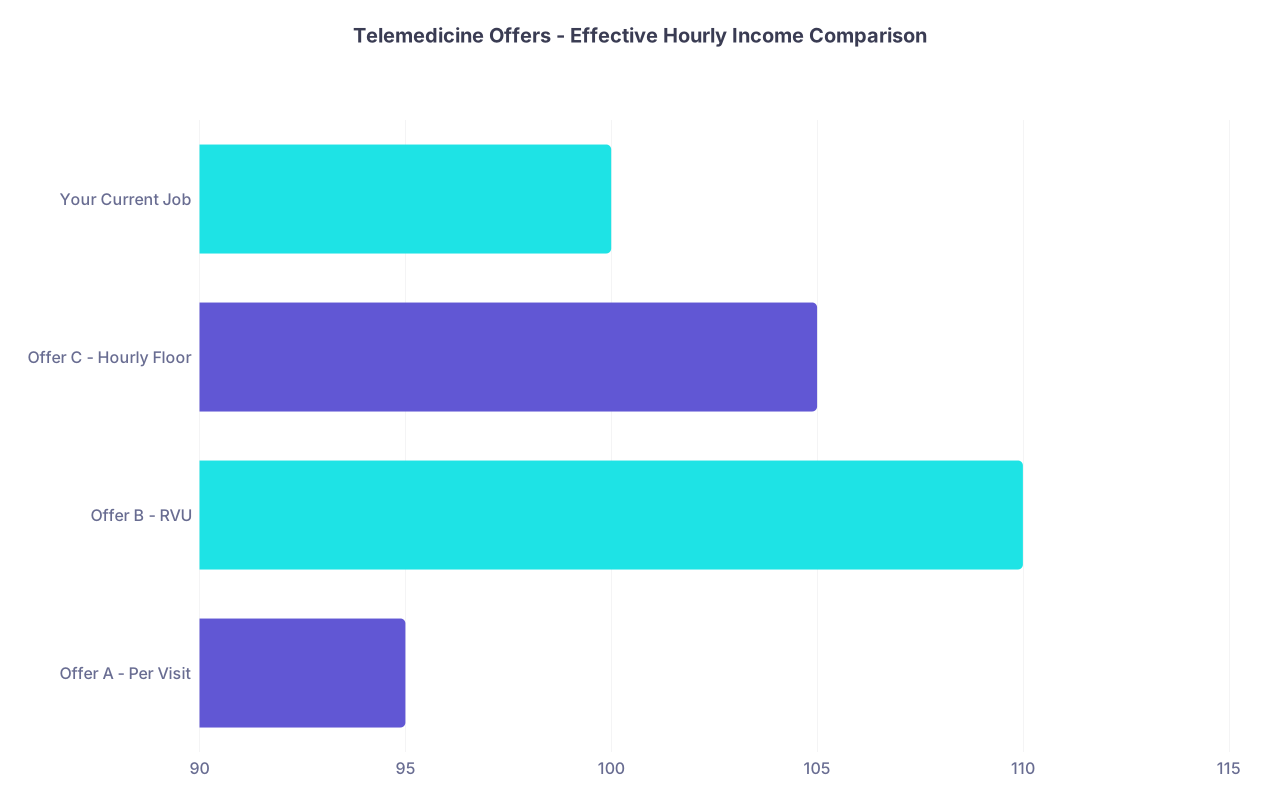
| Category | Value |
|---|---|
| Offer A - Per Visit | 95 |
| Offer B - RVU | 110 |
| Offer C - Hourly Floor | 105 |
| Your Current Job | 100 |
Most people only compare headline numbers. That is how they get fooled. You will not.
Step 3: Stress‑test for bad months
Ask yourself:
- What if my visit volume drops by 20% for three months?
- What if the company changes coding assumptions?
- What if message volume doubles?
If any of those scenarios makes the role financially unacceptable, you need:
- A higher floor (salary or guaranteed hourly)
- Better compensation for non‑visit work
- Or a different job
FAQs
1. Is pure per‑visit pay ever a good idea in telemedicine?
Sometimes. Pure per‑visit can work for:
- Short‑term, side‑gig urgent care work
- Highly transactional, low‑complexity visits
- Situations where you truly control your volume (on‑demand queue, strong platform volume)
But it is dangerous as your primary income if:
- There is significant no‑show risk
- There is meaningful post‑visit work
- You have family or financial obligations that require predictable income
If you rely on this to pay your mortgage, you are better off with at least some guaranteed base or a transparent, well‑modeled hybrid.
2. How many visits per hour is realistic for telemedicine primary care?
For real, safe, non‑rushed care with standard documentation, most primary care clinicians land around:
- 3–4 modest‑complexity visits per hour in continuity models
- 4–5 lower‑complexity urgent care–type visits per hour
Anyone advertising 6–8 full visits per hour as “standard” is either:
- Understating documentation and messaging burden
- Encouraging unsafe speed
- Cherry‑picking their data
You can sprint at 6–8/hr for short stretches. You cannot do that for years without quality or sanity breaking.
3. Should I avoid RVU‑based telemedicine jobs entirely?
No. RVU models can be fair, even attractive, if:
- The RVU values and audit rules are stable and transparent
- They compensate for complexity in a way that matches real patient mix
- There is some reasonable floor or minimum guarantee while panel/volume ramps up
- Non‑visit work is either limited or explicitly paid
You avoid blind RVU contracts where you do not know coding distribution, audit behavior, or realistic wRVU/hr data.
4. What is one number I should insist on before signing?
Insist on this, in writing:
“For clinicians in my specialty, working my expected FTE and schedule type, what was the median total compensation over the last 12 months, including bonus and productivity pay?”
Not the top earners. Not “up to.” The median.
If they dodge, minimize, or say they “do not have that data,” you have your answer: walk.
Open the last telemedicine job email or contract you received.
Now, before you romanticize the flexibility and work‑from‑home setup, grab a pen and write in the margin:
“What is my true hourly rate after no‑shows, charting, and messages?”
If you cannot answer that with hard numbers, you are not ready to sign.