
The fastest way to burn out after residency is to join the wrong telehealth start‑up.
Not a bad fit. A bad system. One that quietly turns you into a license‑risky prescription machine while dangling “flexibility” and “extra income” in front of your face.
I’ve watched smart, careful physicians get dragged into boards of medicine complaints, clawbacks, and DEA scrutiny because they ignored the red flags I’m about to walk you through. They thought, “It’s just some video visits for extra cash.” That is exactly how people get hurt.
You want telemedicine in your career? Good. Just do not walk into a regulatory wood chipper because the recruiter sounded friendly and said “we handle all the paperwork.”
Let’s go through the biggest warning signs before you sign on.
1. The Business Model Smells Wrong
If you remember nothing else: if the business model only works by pushing volume and cutting clinical corners, you’re the commodity.
Watch out for these patterns.
a. “We pay per script / per order” – run
Any telehealth company whose economics rise only when you prescribe or order something is begging for regulatory trouble.
Red flags:
- “You’ll be paid for each Rx written”
- “Most visits result in a prescription”
- “We’re a treatment‑forward platform” (code for: don’t say no)
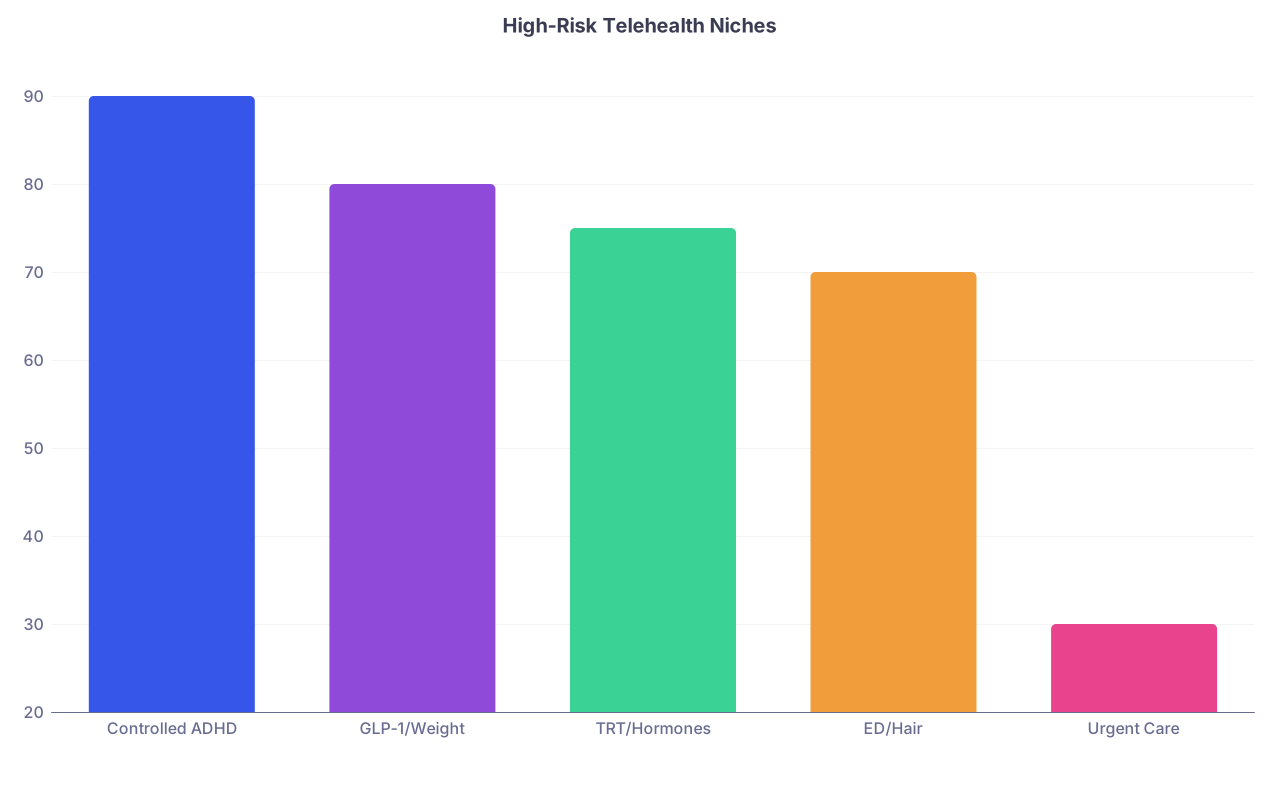
Common high‑risk categories:
- Weight‑loss (GLP‑1s, phentermine)
- Controlled substances (ADHD meds, benzos, opioids)
- Online “testosterone optimization”
- Hair‑loss / ED mills aggressively upselling
Yes, these can be done legitimately. But when the entire funnel is “click ad → get drug,” you’re the thin white coat covering an illegal online pharmacy.
b. No clear answer to “Who is the actual customer?”
I ask this on purpose, and I want a specific answer.
Good answer:
“Our customer is the patient. They pay us a visit fee or subscription. Insurers sometimes reimburse, but the clinical decision is independent of fulfillment.”
Bad answer:
- “We monetize through our pharmacy partners.”
- “We capture lifetime value via medication subscriptions.”
- “We own the pharmacy so we can give patients the best price.”
Translation: they profit more when your clinical threshold drops.
| Category | Value |
|---|---|
| Controlled ADHD | 90 |
| GLP-1/Weight | 80 |
| TRT/Hormones | 75 |
| ED/Hair | 70 |
| Urgent Care | 30 |
(Values = relative regulatory/PR risk level out of 100 based on recent enforcement patterns and news coverage. Rough, but directionally right.)
2. Sloppy or Nonexistent Medical Governance
If they cannot show you who’s clinically in charge, you’re the liability sponge.
a. No real Chief Medical Officer (CMO)
Red flags:
- CMO is part‑time, non‑practicing, or clearly just a figurehead.
- You cannot speak to the CMO; recruitment blocks access.
- CMO has no background in your specialty but “oversees” everything.
A real telehealth organization:
- Has a CMO or medical director who still practices clinically.
- Has specialty leads for higher‑risk verticals (psych, obesity, pain).
- Lets you talk to them before you sign. If they won’t, assume they’re hiding disorganization—or worse.
b. No standing clinical protocols or they’re obviously garbage
Ask to see:
- Clinical guidelines / care pathways for common visit types.
- Policies around red‑flag symptoms and when to refer to in‑person care.
- Escalation protocols for suicidal ideation, chest pain, etc.
Huge red flag phrases:
- “We try to keep patients on the platform when possible.”
- “Our conversion rate from visit to script is very important.”
- “You’ll get used to how our patients expect to be treated.”
I’ve seen platforms where the “guideline” for UTI was basically: if symptoms present, give antibiotic; no urine culture, no nuance, no follow‑up. That’s not telemedicine. That’s a malpractice factory.
3. The Technology Is Built for Speed, Not Safety
You can tell a lot about a telehealth company by how easy it is to do the wrong thing.
a. Visit times that are clinically impossible
If they expect you to safely manage complex issues in 4–6 minutes, they are not serious about care.
Examples:
- “You’ll handle 20–30 visits per hour once you’re up to speed.”
- “Our best providers can close visits in under 3 minutes.”
- “You don’t need a full HPI, just focus on the main complaint.”
Compare realistic ranges:
| Visit Type | Realistic Range | Red Flag Range |
|---|---|---|
| Simple refill / minor rx | 8–12 minutes | Under 4 minutes |
| New anxiety / depression | 20–30 minutes | Under 10 minutes |
| ADHD evaluation | 45–60 minutes | Under 20 minutes |
| Weight‑loss new start | 20–30 minutes | Under 10 minutes |
| Urgent care (simple) | 10–15 minutes | Under 5 minutes |
If their entire comp structure assumes you hit the “red flag” column, you know exactly what they value.
b. History and exam reduced to checkboxes
Fast does not have to mean reckless. But some platforms make recklessness the default.
Red flags:
- HPI templated to one‑line picklists with no free‑text requirement.
- No prompt or field for social history, medication list, or allergies.
- “Auto‑population” of exam findings you didn’t actually assess.
If the interface quietly checks “normal cardiopulmonary exam” on an audio‑only visit, that’s not a convenience. That’s evidence fabrication. Your name is on that note.
c. No safe way to say “this needs in‑person care”
Ask specifically:
- How do you document that you advised in‑person evaluation?
- Does the platform help the patient find local in‑person care?
- Are you penalized in metrics if you “don’t convert” to treatment?
If saying “you need an ER” tanks your rating or income, you’re set up to choose between your license and your paycheck one patient at a time.
4. Licensing, Credentialing, and Compliance Games
This is where your career can end quietly over an email from a medical board.
a. Vague about where you’re actually practicing
Basic rule: you practice where the patient is located. Full stop.
Red flags:
- “We’ll route patients from any state where you hold any license.”
- “We have a multi‑state medical group; it’s covered under that.”
- They can’t tell you at scheduling what state the patient is in.
Ask bluntly:
- “On every encounter, will I clearly see the patient’s location and confirm it before proceeding?”
- “Are we ever seeing patients in states where I’m not licensed?”
If the answer to either is fuzzy, walk away.
b. Misuse of compact licenses or umbrella entities
I’ve seen companies:
- Assume that if they have one physician in a state, everyone can see patients there.
- Claim that telehealth “falls under federal jurisdiction” and state licenses are optional (they are not).
- Use an NP’s license while you “supervise” without clear boundaries.
If they’re playing legal hopscotch to expand coverage, your name and license are the easiest thing for a board to attack when something goes wrong.

| Step | Description |
|---|---|
| Step 1 | Patient Location Known |
| Step 2 | Proceed with Visit |
| Step 3 | Do Not Treat |
| Step 4 | Confirm Location First |
| Step 5 | You Licensed There |
That’s the standard. Anything else is fantasy.
c. DEA and controlled substances shortcuts
If controlled substances are involved, you need:
- Clear policy aligned with Ryan Haight Act / telemedicine exceptions.
- Documented initial evaluations (video, not chat).
- State‑specific rules respected (some states are stricter than federal).
Mass‑prescribing stimulants or benzos with 5‑minute video visits and copy‑paste notes is how you end up on an OIG or DEA radar, even years later.
5. Compensation Structures That Force Corner‑Cutting
The wrong pay model will slowly pull you into bad medicine.
a. Pure volume, zero base
High‑risk structure:
- $X per visit, no hourly minimum
- Bonuses for meeting visit quotas or script “conversion” metrics
- No pay for documentation time or follow‑up messaging
Here’s what happens:
- Slow, careful clinicians quit.
- Fastest, loosest prescribers become “top earners.”
- The company optimizes around them.
- Standards quietly drop.
If you’re post‑residency, you might be used to making things work under pressure. Do not confuse that with letting a company train you to ignore your own clinical standards to keep income stable.
b. Bait‑and‑switch on rates and hours
Pattern I’ve seen repeatedly:
- Initial offer: “$120/hour equivalent, very flexible.”
- After onboarding: “Rate changes to $80/hour after probation.”
- As they scale: “We’re reducing pay per visit; volume will make up for it.”
- Then: “Visit volume is seasonal; you’ll need to be 'available' more.”
Red flags in contracts or verbal promises:
- “Rates subject to change with 30 days’ notice.”
- No guaranteed minimum pay for scheduled shifts.
- “You’ll make more if you’re efficient” with no transparency on visit distribution.
, Per Script/Order](https://cdn.residencyadvisor.com/images/articles_svg/chart-telehealth-pay-stability-risk-1996.svg "Telehealth Pay Stability Risk")
| Category | Value |
|---|---|
| Hourly + Min Guarantee | 10 |
| Hourly Only | 30 |
| Per Visit + Min | 40 |
| [Per Visit Only](https://residencyadvisor.com/resources/telemedicine-careers/misjudging-rvu-and-pervisit-pay-compensation-errors-in-telemedicine) | 70 |
| Per Script/Order | 95 |
(Values = relative risk of being pressured toward speed/overprescribing. Again, directional, not exact.)
6. Contract Landmines You Can’t Ignore
If you don’t read anything else they send, read the contract. Slowly. With a pen in hand.
a. Personal liability shoved onto you
Watch for:
- Indemnification clauses where you indemnify the company for your clinical care—but they don’t indemnify you.
- Requirements to pay for your own malpractice insurance, but they pick the carrier and limit.
- No tail coverage described for claims filed after you leave.
Minimums to insist on:
- Clear statement: they provide malpractice with tail or state otherwise.
- Explicit coverage limits (e.g., $1M/$3M) and whether it’s occurrence or claims‑made.
- Mutual indemnification—if they do something stupid operationally, you are not left hanging.
b. Non‑competes and insane non‑solicit language
You’re telehealth. You’re not moving zip codes. So why are they trying to block you from practicing online anywhere?
Red flags:
- Non‑compete restricting you from any telehealth practice, nationwide, for 1–2 years.
- Broad language like “any company providing remote or digital care.”
- Non‑solicit of patients that effectively prevents you from continuing ongoing care in another setting.
This is especially toxic if:
- Telemedicine is only a side gig for you right now.
- You want the flexibility to later join a hospital‑based telehealth team or another platform.
Overly broad non‑competes are often not enforceable, but you really do not want to fund that legal test yourself.
c. No clear termination rights for you
Look for:
- Your ability to terminate “without cause” with reasonable notice (30–90 days).
- Their ability to terminate you immediately “for convenience” (one‑sided).
If they can dump you instantly and you’re stuck for months, that’s imbalance. If both sides can end the relationship quickly, keep your exposure small until you know what you’re dealing with.
7. Culture Clues: What They Really Expect From You
Ignore the marketing and watch how people talk when they’re trying to impress you.
a. Recruiters obsessed with “numbers,” not patients
Listen for:
- “Our top docs see 40–50 patients a day and love it.”
- “You’ll quickly see how to streamline your assessments.”
- “Most patients are simple, they just want a quick prescription.”
The best telehealth orgs talk about:
- Continuity options.
- Quality metrics.
- Patient satisfaction as a result of good care, not speed.
The worst ones talk about:
- Conversion funnels.
- Ticket closure time.
- “Reducing friction” for patients getting meds.
You’re a physician, not a funnel optimizer.
b. No support for difficult clinical situations
Ask them:
- What happens when a patient becomes abusive or threatening on video?
- Who helps you if you’re worried about a patient’s safety at home?
- How do they handle mandated reporting, domestic violence, child abuse?
If the answer is basically, “Document it and move on,” they’re not serious about the hard parts of medicine—only the billable ones.
c. Thin or absent peer community
In a decent telehealth company, you’ll have:
- Case review channels or regular meetings.
- Access to senior clinicians for complex cases.
- A way to flag patterns you’re seeing (e.g., same patient with multiple aliases).
In a bad one, you’re a silo:
- No contact with other clinicians.
- No feedback except performance metrics.
- The only “support” is a non‑clinical operations manager telling you to be faster.
8. Patient Acquisition Tactics That Drag You Down With Them
How they get patients dictates what those patients expect from you.
a. Aggressive, drug‑forward advertising
Red flags in marketing:
- “Get [controlled drug] in minutes.”
- “No doctor’s office, no hassle, just meds delivered.”
- Before/after photos that look like fitness scams.
- Landing pages where the doctor is a tiny afterthought below huge “Start your prescription now” buttons.
If the ad promises the drug before any evaluation, you’re just the rubber stamp. Guess who regulators and boards will come after when that goes wrong? Not the ad agency.
b. Discounted “first month of meds” bundles
I’ve seen:
- “$20 visit + first month of ADHD meds included.”
- “Subscription includes care and your prescriptions.”
That ties your clinical decision to a pre‑sold product. Patients show up feeling like you’re blocking what they already purchased if you say no. Which is exactly the kind of pressure regulators do not like.

9. Data, Documentation, and Access Nightmares
You’re responsible for care, but do you actually control the record?
a. You can’t easily export your notes
Ask:
- Can I download my own visit notes if I leave?
- Are notes accessible in a standard format (PDF or similar)?
- How long are records retained?
If they control everything and you get nothing, it’s harder to defend yourself later if a complaint pops up and the company suddenly doesn’t exist or “can’t find” data.
b. No integration with e‑prescribing checks
If the system doesn’t:
- Run allergy checks.
- Flag major drug–drug interactions.
- Check PDMP for controlled substances (or at least facilitate it).
You’ll be relying on memory (and luck) in a high‑pressure, high‑throughput setting. That’s not just unsafe; it’s a perfect setup for missing something important.
c. Messaging and follow‑up chaos
Ask:
- Are you expected to respond to patient messages outside of visits?
- Is that time paid or unpaid?
- Are there clear cutoffs vs “always available”?
I’ve seen “side gig” telehealth jobs turn into unpaid, constant inbox management that bleeds into nights and weekends. That’s how burnout sneaks up.
10. Your Personal Risk Profile: Know When to Walk Away
Some physicians can tolerate more risk. New grads generally cannot.
You are especially vulnerable if:
- You’re in your first 3–5 years post‑residency.
- You hold multiple state licenses (more boards, more risk).
- You’re carrying student debt and tempted by “easy money.”
- You’re on a visa and can’t risk license issues.
For you, lean on boring:
- Lower acuity tele-urgent care with solid governance.
- Hospital‑affiliated telehealth programs.
- Established tele-psych/tele-endocrine with robust protocols.

What a “Green Flag” Telehealth Role Looks Like
To keep this practical, here’s the kind of setup I’d actually consider reasonable:
- Clear CMO and specialty leads, available to talk before you sign.
- Documented protocols and pathways, regularly updated.
- Transparent visit length expectations that match clinical reality.
- Hourly or per‑visit pay with a realistic floor, no prescription‑based incentives.
- Company‑provided malpractice with clear limits and tail.
- Reasonable, narrow non‑compete (if any), time‑limited and geography‑specific.
- Explicitly conservative policies around controlled substances and red‑flag complaints.
- Simple, honest marketing: “speak with a licensed clinician,” not “get meds fast.”
- Ability to say “no” or “this needs in‑person care” without income punishment.
- Clear termination terms and ability to walk away if standards slide.
| Category | Value |
|---|---|
| Red Flag Jobs | 70 |
| Green Flag Jobs | 30 |
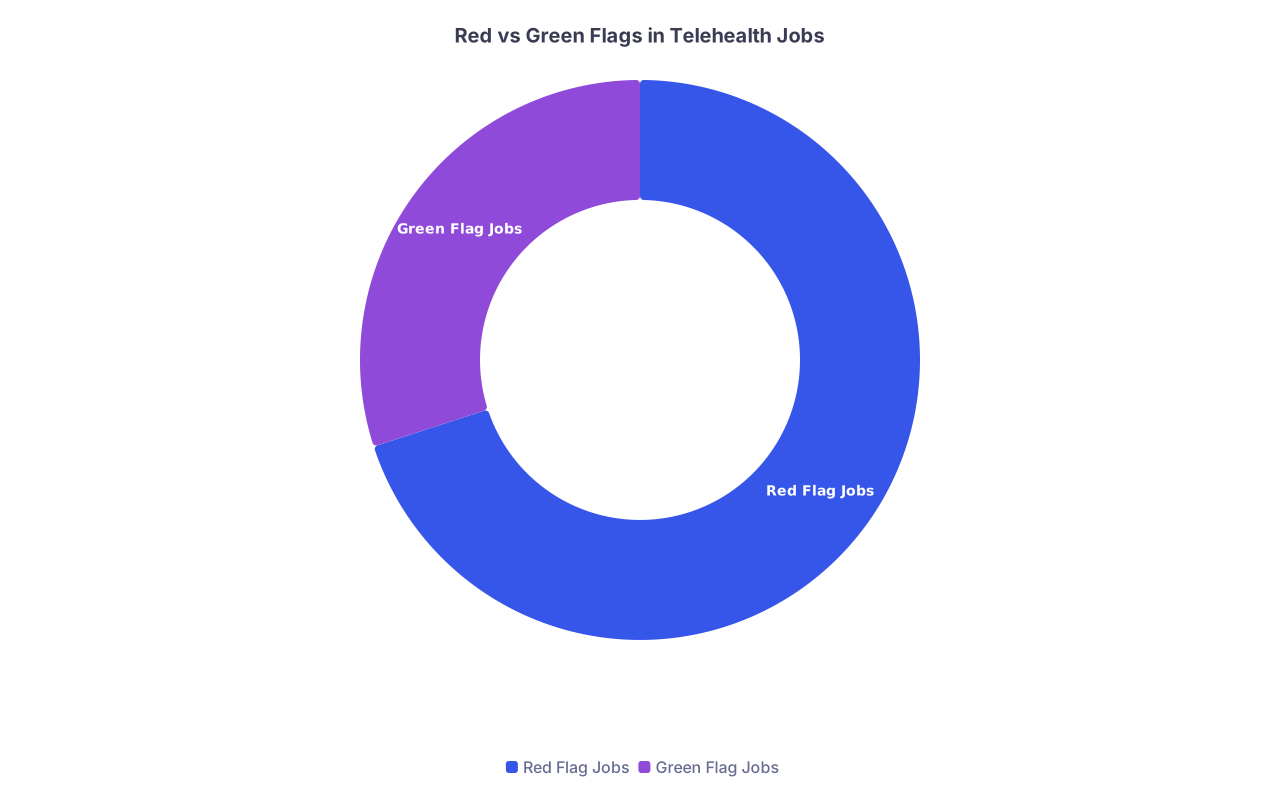
That ratio isn’t scientific, but it matches what I’ve seen: most opportunities are mediocre or risky. A minority are actually designed with patient and clinician safety in mind. Your job is to sort them.
Your Next Step Today
Pull up the last telehealth recruiting email or job posting you saw.
Now go line by line and ask:
- Who makes money here, and how?
- Where are the words “quality,” “protocols,” or “medical director”?
- How, specifically, would I be paid?
- What’s missing that should be spelled out?
If more than two of the red flags you just read apply, do not “just try it for a bit.”
Delete the email. And wait for a role where you don’t have to choose between your license and your paycheck every single shift.