
You’ve finished residency. Maybe a year or two of traditional practice under your belt. It’s 10:30 p.m., you’re on your couch, scrolling through your email after another bloated clinic day, and you see it:
“Telehealth Medical Director – Competitive Comp, Equity Opportunity, Remote First.”
You open the attached PDF. Base salary, RVU-ish productivity, annual bonus, plus equity or “buy‑in” into some future upside. Maybe a sign‑on that looks suspiciously generous compared to your hospital offer. The recruiter says, “This is how we make physicians true partners in the business.”
Let me tell you what’s actually going on behind those numbers.
This is the playbook telehealth leaders use when they build physician deals—how they think about equity, bonuses, and buy‑in, what’s real, what’s fluff, and what you can actually negotiate without blowing up the offer.
How Telehealth Companies Really View Physicians
You need to understand the frame before you touch the terms.
In a traditional group, physicians are the business. In most venture‑backed or growth‑stage telehealth companies, physicians are a critical variable cost and a regulatory requirement. Different mindset.
In closed‑door comp meetings, here’s how leadership talks:
- “What’s our physician cost per encounter?”
- “Can we push more to 1099 and reduce fixed overhead?”
- “What’s the minimum base we need to stay competitive?”
- “Equity pool: how much do we need to give clinicians so they feel invested without giving them real control?”
They respect your license, they need your DEA, they know quality matters—but they are building a SaaS/ops business with clinical attached, not a clinic with tech attached. That distinction drives how deals are structured.
If you walk into this treating it like joining a private practice partnership, you’ll misread almost every clause.
The Core Comp Stack: How They Layer Your Money
Most telehealth leadership teams structure physician comp from the top down like this:
- Protect runway and margins.
- Incentivize volume, responsiveness, and coverage.
- Sprinkle equity or buy‑in to reduce cash spend and increase retention.
You see a job posting; I see a P&L puzzle they’re trying to solve.
At a high level, you’ll see three buckets:
- Base or guaranteed income
- Variable/bonus components
- Equity or ownership‑like features (options, RSUs, phantom equity, or buy‑in)
Here’s how those really get decided behind the scenes.
Base Pay: The “Floor” They Want As Low As They Can Get Away With
For clinical telehealth roles (urgent care, primary care, mental health, subspecialty follow‑up), the base is usually where the games start.
Internally, leadership will have a target “all‑in” cost per full‑time equivalent physician that must land under what they can bill or charge. Then they reverse‑engineer:
- If they’re early‑stage, they’ll underpay base and pump up equity language.
- If they’re PE‑backed and revenue‑positive, they’ll bump base slightly and still hold bonuses hostage to metrics you probably won’t control.
I’ve sat in meetings where the COO literally said, “If they’re MD/DO and remote, we can discount base relative to brick‑and‑mortar because of flexibility.”
Translation: they expect you to trade stable base for lifestyle and “upside.”
For most telehealth clinical roles:
- Full‑time W‑2 telehealth PCPs: think 70–85% of what a comparable brick‑and‑mortar role would pay in guaranteed base, before productivity.
- Psych/behavioral: often competitive with traditional outpatient, sometimes higher if they’re desperate for coverage, but they’ll push hard toward 1099.
The physician who walks in thinking, “But MGMA median for my specialty is X” gets quietly labeled: “Not a fit. Too ‘traditional.’”
If you want a stronger base, you need leverage—prior telehealth experience, niche subspecialty, or a leadership component (med director, regional lead). Otherwise, they’ll expect you to accept a lower base “because it’s remote and flexible.”
Variable Pay and Bonuses: Where They Hide the Strings
This is where telehealth leaders get clever. They know variable comp is how they:
- Drive coverage to nights/weekends
- Enforce response times and throughput
- Keep you emotionally chasing carrots instead of questioning the base
Most “bonuses” you’ll see fall into a few types.
1. Volume / RVU‑like Productivity
This is classic: per‑visit payments, per‑encounter bonuses after a threshold, or telehealth RVU equivalents.
Expect language like:
- “$X per completed consult”
- “Bonus pool for average encounter length under Y minutes”
- “Tiered rates: higher per‑visit payments after N visits per month”
Behind the scenes, leadership is tracking:
- Margin per encounter
- Average time per encounter
- No‑show/cancellation rates
- Chart completion times and coding levels
If they see doctors spending too much time per visit, they silently adjust bonus formulas the next cycle.
I’ve watched comp committees move a threshold from 250 visits/month to 300 with one slide: “We’re seeing too many docs hit the top tier too easily.” You won’t see that logic; you’ll just get a revised comp sheet next contract year.
2. Quality / “Performance” Bonuses
This is where things get fuzzy. Metrics like:
- Patient satisfaction scores
- Prescription adherence to “clinical pathways”
- Documentation quality
- Escalation or transfer rates
Sounds noble. In practice, quality bonuses in telehealth often serve two purposes:
- A justification to withhold money if they need to rein in cost.
- A compliance shield: “See, we tie pay to quality, not volume alone.”
When margins tighten, the CFO’s first suggestion is usually: “Let’s make quality bonuses harder to achieve.” Targets edge up just enough.
3. Access / Coverage Bonuses
Telehealth lives and dies by coverage:
- Nights
- Weekends
- Holidays
- Fast response “on‑demand” windows
So they dangle:
- “Surge rates” or higher per‑encounter pay during peak windows.
- Stipends for holding “virtual call” blocks.
- Extra bonuses if you commit to X nights/week.
Here’s the quiet part: leadership knows most physicians undervalue their nights/weekends at the contract stage. On a spreadsheet, an extra $10/visit to cover Saturday night looks generous. After three months of being chained to your laptop on weekends, it won’t.
They bank on your optimism and short memory.
](https://cdn.residencyadvisor.com/images/articles_svg/chart-typical-telehealth-compensation-mix-8376.svg "Typical Telehealth Compensation Mix")
| Category | Value |
|---|---|
| Base Salary | 55 |
| Productivity Pay | 25 |
| Quality/Performance Bonus | 10 |
| [Equity or Phantom Equity](https://residencyadvisor.com/resources/telemedicine-careers/7-contract-clauses-in-telemedicine-jobs-that-physicians-regret-signing) | 10 |
Equity: The Shiny Object That’s Usually More Signal Than Substance
Now to the part everyone fixates on: “equity.” That word gets abused more in telehealth recruiting than almost anything else.
Telehealth leaders use equity for three reasons:
- To reduce cash compensation.
- To create golden handcuffs (vesting).
- To borrow your credibility as a “partner” for investors and payers.
What they don’t usually intend: to share real control.
Let’s break the main flavors you’ll see.
Stock Options (Startup / VC‑Backed)
You’ll see something like:
- “0.05% – 0.25% equity via stock options”
- 4‑year vesting with a 1‑year cliff
- Strike price based on last 409A valuation
Here’s the internal calculus:
- They reserve a small “clinician pool” (maybe 2–4% of total equity).
- They divide that across all current and projected clinicians.
- They offer tiny fractional slivers and hope the word “equity” does the heavy lifting.
I’ve seen “medical director” offers at a fast‑growing telehealth startup where the equity chunk was meaningfully larger—0.5–1%—but only for true leadership roles that own P&L or strategy, not just “senior docs.”
Traps to watch:
- Cliff vesting: If you leave before year one, you vest nothing.
- No clear exit path: No IPO, no sale, no secondary market? Those options are worth exactly zero until an exit event.
- Massive dilution: If they keep raising, your 0.1% becomes 0.02% in real terms.
The CEO will happily say, “Our last round valued us at $300M. Your equity could be worth $300K!” Internally, the CFO is thinking: “Assuming no down round, no recap, no preference stack wiping common shareholders… which is optimistic.”
RSUs (Larger, Later‑Stage Companies)
If you’re talking to a big telehealth brand—think Teladoc, Amwell, or a health system’s digital arm—you might see RSUs (restricted stock units) instead of options.
These are usually:
- Smaller numbers of shares.
- Vest over 3–4 years.
- Tied to continued employment.
These can be real money. But telehealth leaders will frame them as a “long‑term alignment tool” while quietly treating them as a rounding error in their compensation budget.
They don’t expect most physicians to negotiate RSU amounts. They expect you to react to the word “stock” and move on.
Phantom Equity / Profit Interests
Then there’s the murkier stuff:
- “Phantom units”
- “Profit interest units”
- “Incentive units”
This is how some PE‑backed or private telehealth groups create an “ownership‑like” vehicle without giving you actual equity or voting rights.
You’re basically getting a contract right to a slice of hypothetical future profits or sale proceeds, subject to a giant stack of conditions.
The internal conversation sounds like:
- “We’ll grant physicians phantom equity that only triggers above a certain internal rate of return.”
- “We can claw this back if they leave early or if quality metrics slip.”
- “It costs us nothing today and keeps them hopeful.”
I’ve watched groups enthusiastically sell this to new hires with phrases like, “You’re participating in the same upside as the founders,” which is… generous.
Unless you see:
- The full phantom equity agreement.
- The waterfall on a sale.
- The performance/good‑leaver/bad‑leaver conditions.
…assume this is speculative and heavily stacked in the company’s favor.
| Type | Stage of Company | Realistic Liquidity | Control Rights |
|---|---|---|---|
| Stock Options | Early / VC-backed | Only at exit event | None |
| RSUs | Later-stage / Public | Vests into stock | Minimal |
| Phantom Equity | PE-backed / Private | Only if sale / IRR | None |
| True Partnership | Small groups / Hybrid | Distributions + buyout | Some/Significant |
Buy‑In: When “Partnership” Is Just a Brand Word
Now the other seductive term: “buy‑in.”
There are two very different worlds here.
- Traditional private practice or small telehealth/hybrid groups actually selling you a piece of the entity.
- Corporate or PE‑backed plays using “partner” as a label while you’re effectively just a senior employee with phantom units.
True Buy‑In (Rare in Pure Telehealth, More Common in Hybrid)
In a genuine buy‑in, you’re purchasing equity in the practice or management company. That usually means:
- Capital contribution (often six figures) or sweat equity.
- Voting rights or at least meaningful influence.
- Right to share in profits and a future buyout when you leave.
Telehealth leaders in these settings talk differently. They’ll discuss:
- Capital calls.
- Pro‑rata ownership.
- Partner meetings and votes.
- Distributions, not just salary/bonus.
You’ll see real P&L, partner track timelines, and (usually) a written shareholder or operating agreement.
If they cannot or will not show you any of that and still use the word “partner,” you’re not buying into ownership. You’re buying into branding.
Faux Partnership
Corporate telehealth loves the word “partner.” I’ve seen titles like:
- “Clinical Partner”
- “Partner Physician”
- “Regional Partner Medical Director”
And when you drill down, the structure is:
- No capital contribution.
- No true equity.
- Maybe some phantom or bonus arrangement.
- Performance‑based retention, not ownership.
Internally, they’ll admit it in two sentences:
“We call them partners for culture. Legally, they’re employees.”
That’s not inherently bad. Just don’t confuse it with practice ownership.

How Leadership Actually Sets These Deals Internally
Let me walk you through what happens before an offer ever hits your inbox.
There’s usually a comp committee or a de facto group: CEO, CFO, CMO or VP Clinical, maybe HR/People lead. They walk in with:
- Budget constraints (runway, revenue, investor expectations).
- Market data (MGMA, rivals like hims/hers, Teladoc, Amwell, Ro, etc.).
- Recruitment pain (“We’ve had this role open for 4 months, we need to sweeten it”).
The CFO pushes to:
- Lower fixed base.
- Push more to variable or 1099.
- Conserve equity pool.
The CMO or clinical lead pushes to:
- Raise base enough to attract quality clinicians.
- Avoid burnout/unsafe productivity metrics.
- Obtain at least some long‑term loyalty.
The CEO cares about:
- Keeping total comp under a certain percentage of revenue.
- Looking competitive on paper (especially equity/bonus language).
- Having enough bells and whistles to sound “innovative.”
What you see is the compromise.
For leadership physicians (med directors, VPs, CMOs), the process is more bespoke:
- They’ll benchmark against health system leadership roles.
- They’ll carve out bigger equity chunks or phantom pools.
- They’ll tie part of your bonus to company‑level metrics (EBITDA, margin, growth).
But for rank‑and‑file clinicians, the offers become templated fast. HR/recruiting gets a grid: “If psych, years out X–Y, this is the range; if PCP, here’s the range.” There’s usually 10–15% wiggle room in base and some flexibility in variable mix.
Equity for staff physicians is rarely customized beyond total number of options/units. The vesting schedule, strike price, and terms are pre‑baked.
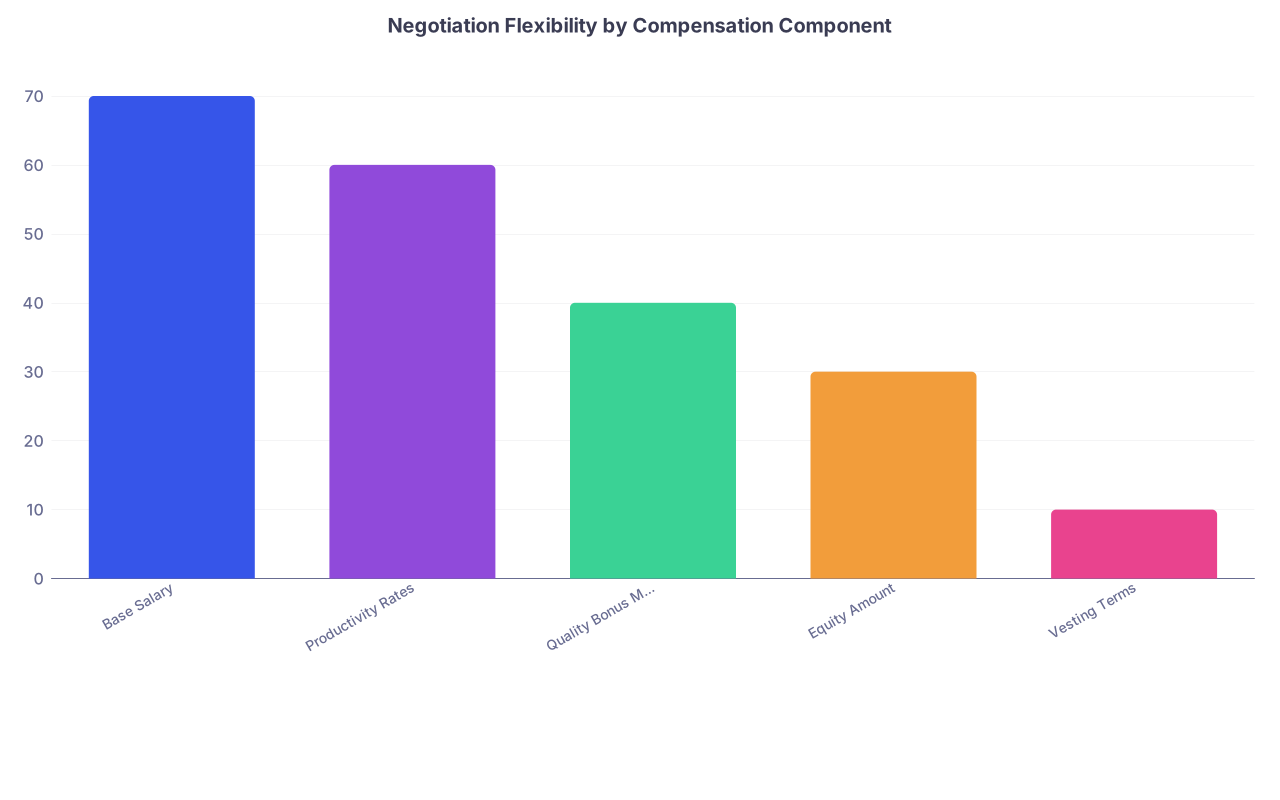
| Category | Value |
|---|---|
| Base Salary | 70 |
| Productivity Rates | 60 |
| Quality Bonus Metrics | 40 |
| Equity Amount | 30 |
| Vesting Terms | 10 |
(Values represent rough relative flexibility: 100 = highly negotiable, 0 = fixed.)
What You Can Actually Negotiate (And How They React)
You have more leverage than you think in some areas, and virtually none in others.
Here’s how it plays out behind closed doors when you push.
Base vs Variable Mix
If you say, “I want more guaranteed and I’m okay with less upside,” leaders will often listen—if you’re a strong candidate. Why?
- It simplifies budgeting.
- They can adjust your productivity rate slightly to offset.
I’ve seen offers move from:
- $220K base + generous per‑visit rates
to - $250K base + slightly lower per‑visit rates
…with no drama, because the total expected comp was similar.
If you’re risk‑averse, this is where you should focus. Push for higher base and clearer, realistic targets for variable.
Specific Bonus Metrics
Quality and performance metrics are usually not negotiable individually. They’re company‑wide. But you can absolutely ask for:
- Written definitions of each metric.
- Historical data on how many docs actually hit those targets.
- A grace period for new hires.
I’ve watched physicians negotiate a 6‑month onboarding window where certain bonuses are guaranteed at a baseline level while they ramp up. That’s reasonable and often granted, especially for leadership roles.
Sign‑On and Relocation‑Type Money
Sign‑ons are one of the easiest things for them to move without re‑opening the entire comp structure.
Telehealth leaders like sign‑ons because:
- They’re one‑time, not recurring.
- They look generous and help you overlook other weaknesses.
Ask for more here if:
- You’re leaving a bonus on the table at your current job.
- You’re walking away from partnership track.
- You’re taking a noticeable base pay cut to go remote.
They’ll almost never increase your equity pool meaningfully. They will bump a sign‑on faster.
Equity
Here’s the reality: the rank‑and‑file equity numbers are usually set.
You can try:
- “Is there room to increase the equity grant given my X years of experience and leadership background?”
- “Would you consider a refresh grant after Y years tied to performance?”
Sometimes you’ll squeeze out a modest bump or an agreement to revisit at 12–18 months. But if you think you’re going to triple your options as a staff telehealth doc, you’re kidding yourself.
Leadership roles are different. For a true med director role, arguing for more equity instead of raw cash can work, especially at earlier‑stage companies trying to preserve runway.

Red Flags in “Equity, Bonuses, and Buy‑In” Packages
Over the years, I’ve seen enough nonsense to know when a deal is mostly smoke.
Here are patterns that should make you pause.
Equity Without Paper
If they talk a big equity game but:
- Won’t show you the actual option or phantom agreement.
- Can’t tell you vesting schedules and strike prices.
- Hand‑wave around total shares outstanding or your approximate percent.
That’s a sign the “equity” is mostly recruiting copy.
Serious companies have this documented and ready. If leadership or HR stumbles when you ask basic equity structure questions, take that as data.
Bonuses Tied to Things You Don’t Control
If your bonus depends heavily on:
- Company‑wide EBITDA or margin.
- “Strategic goals” that are defined annually and not disclosed up front.
- Payer contracts or product decisions you’re not involved in.
Assume that chunk of your “on‑target earnings” is aspirational at best. Telehealth C‑suites love to tell physicians, “We’re all owners here,” while still reserving all real levers to themselves.
Reasonable: a modest company‑level component on a director/VP comp plan.
Ridiculous: a staff clinician with 40–50% of their bonus tied to company metrics.
“Partner” Language With Zero Governance
The word “partner” means almost nothing legally. Ask:
- “Do partners have voting rights?”
- “Is there a partner agreement or bylaws I can review?”
- “Are there capital calls or buyout provisions?”
If the answers are either vague or “we don’t really do that,” you’re not a partner. You’re a marketing asset.

| Step | Description |
|---|---|
| Step 1 | Receive Offer |
| Step 2 | Focus on Cash and Bonus |
| Step 3 | Request Equity Docs |
| Step 4 | Assume Low Real Value |
| Step 5 | Assess Vesting and Exit |
| Step 6 | Negotiate Base and Sign On |
| Step 7 | Decide Accept or Walk |
| Step 8 | Includes Equity? |
| Step 9 | Clear Terms? |
How To Think About These Deals Like an Insider
You’re not trying to win an argument with HR. You’re trying to understand the real trade:
- How much guaranteed money.
- How much effort and lifestyle cost.
- How much speculative upside.
A few hard truths.
Equity is rarely life‑changing for staff clinicians. It can be a nice bonus if the company wins big. It should not be the primary reason you join—unless you’re true leadership and your grant size reflects that.
Bonuses usually pay out around target the first couple of years, then tighten. Telehealth companies are notorious for starting generous to recruit, then quietly raising thresholds or “recalibrating” once they have a stable workforce.
The best leverage you’ll ever have is before you sign. Once you’re in, raises and equity top‑ups are incremental. That first offer is when they’re most flexible.

Final Thoughts: What Actually Matters
Strip away the buzzwords, and you should be asking three questions about any telehealth “equity, bonuses, buy‑in” package:
If all the upside vanished, would the cash and workload still be acceptable for the next 2–3 years? If not, you’re gambling with your career on someone else’s pitch deck.
Is the upside mechanism (equity, phantom, partnership) clearly defined on paper, with a plausible path to liquidity or profit? If you can’t explain it back in plain English, it’s probably not going to pay your mortgage.
Does the bonus structure reward what you can actually control without burning you out? If hitting targets requires unsustainable volume or constant nights/weekends, the math only works on a spreadsheet, not in real life.
Get those three mostly right, and telehealth can be a smart, flexible, financially solid move. Get them wrong, and you end up overworked, underpaid, and “equity‑rich” on paper that no one will ever buy.
That’s how the deals are really built. Use it to your advantage.