
It’s 10:30 p.m. You just finished a brutal inpatient week and you’re scrolling job boards in that half-burned-out, half-hopeful state. A recruiter email catches your eye:
“Work from home. Flexible schedule. Earn up to $300k with telemedicine. Minimal admin work.”
They attach a glossy PDF. Revenue share. RVU “enhancement.” Platform fees “for your benefit.”
You skim it and think, “This actually sounds…good?”
Stop right there. The real money rules of telemedicine are not in the bullet points. They’re in the lines you skimmed, the definitions section, and the “Exhibits” at the end that no one reads.
I’m going to walk you through what program directors and hospital CMOs vent about behind closed doors, what telehealth company founders brag about to investors, and what physicians discover the hard way—after signing.
You’re not just negotiating a job. You’re negotiating who owns the revenue you generate, who controls the data about your work, and how many ways they can slice your income before it hits your bank account.
Let’s pull the curtain back.
The First Rule: Whoever Controls the Patient Owns the Money
Telemedicine companies understand one core principle that many physicians don’t: the money follows patient access and patient data, not medical expertise.
They’ll dress it up as “platform value,” “demand generation,” or “end-to-end care journey.” Translation:
We control the eyeballs. You are replaceable labor.
Here’s how that subtle power shows up in your contract:
- They define “Company Patients” or “Platform Patients” as any patient who interacts with their app or website—even if they searched specifically for you by name.
- They make you agree that all billing goes through them, even if you separately hold contracts with payers.
- They restrict your ability to take patients with you if you leave, even when you were the one who built the relationship, provided the care, and solved the clinical mess.
I’ve sat in executive meetings where a telehealth CEO literally said, “Docs think we’re paying them for visits. We’re paying them for bums-in-chairs time; we make the real money on everything around the visit.”
He’s not wrong. The visit is the hook. The money is in what happens before and after you click “End Call.”
This is why they care so much about:
- Owning the patient account
- Controlling messaging, follow-up scheduling, refills
- Locking all documentation and data behind their proprietary platform
You think you’re getting paid for encounters.
They think they’re building an annuity out of your work product.
If you remember nothing else: the entity that controls patient onboarding, billing, and follow-up wins. Your contract is written to make sure that isn’t you.
The “Per-Visit” Trap and How the Math Actually Works
Most telemedicine offers look physician-friendly at first glance:
- $20–$40 per asynchronous message consult
- $35–$70 per brief video visit
- “Up to” $150–$200 for longer, complex visits
You see the “up to.” They know you’re going to focus on that number. They also know most of your paid work will not hit that tier.
Behind the scenes, reimbursement looks more like this:
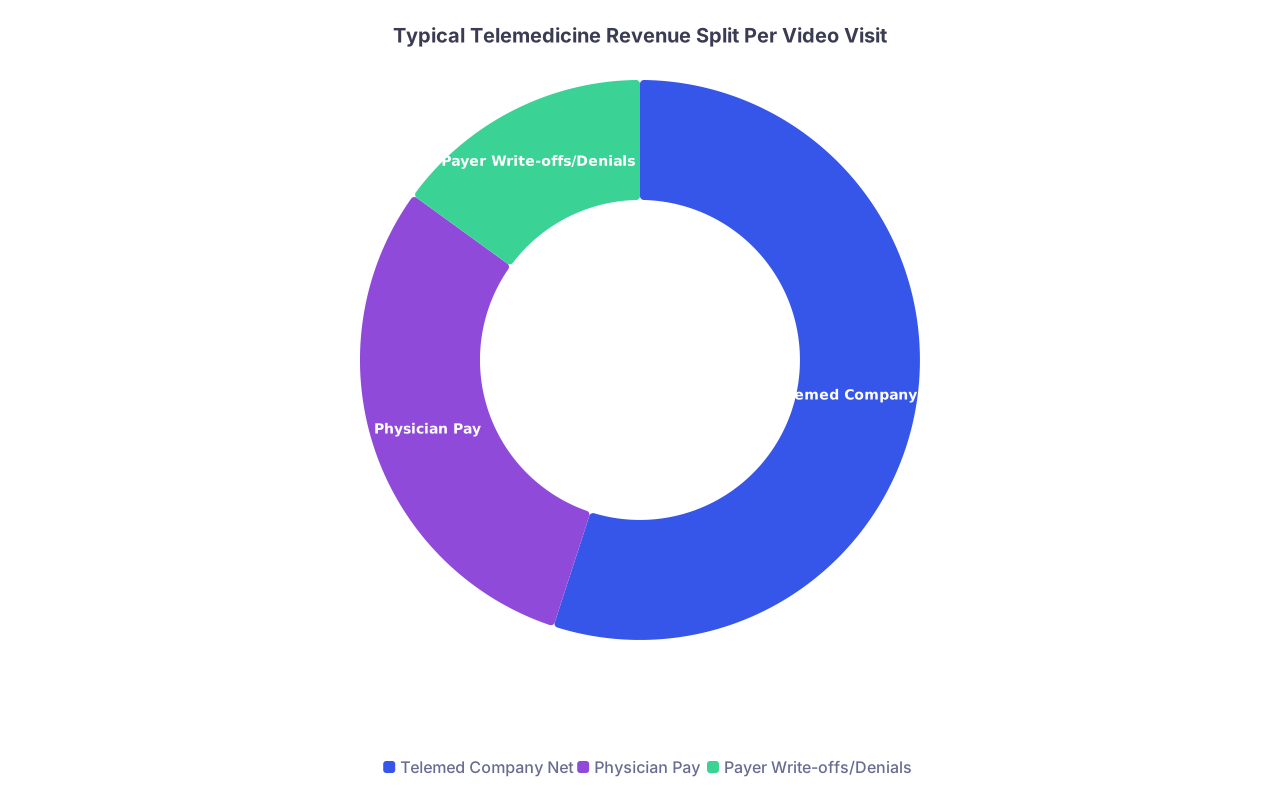
| Category | Value |
|---|---|
| Telemed Company Net | 55 |
| Physician Pay | 30 |
| Payer Write-offs/Denials | 15 |
I’ve reviewed contracts where:
- The company bills $150–$200 to the payer for a 15–20 minute visit
- They pay the physician $40–$60
- They pocket the spread, plus any ancillary revenue from tests, prescriptions, or subscription programs they plug afterward
Now here’s the part no one explains directly to you:
Your per-visit rate is often calculated assuming a denial rate and expected no-shows. They bake that into your pay, not theirs.
Example I’ve actually seen:
- Company average collected revenue per established follow-up: ~$120
- They publicly say “Earn $60 per visit!” in recruiting materials
- Contract quietly sets rate at $45–$50, citing “platform fees and payer adjustments”
They didn’t lose anything. Their margin just got fatter.
If a company is not willing to show you:
- Their average collected amount per visit (not billed—collected)
- The percentage of visits denied or written off
- How your per-visit rate was derived
…you’re agreeing to a black box where they control the dials.
The other trick? They almost always reserve the right to unilaterally adjust rates with 30 days’ notice “to reflect changes in payer mix, platform costs, or regulatory environment.” That’s legalese for: if their margins shrink, yours shrink faster.
Revenue-Sharing vs Flat Rate: What They Don’t Tell You
Here’s a phrase that sounds fair and almost always isn’t:
“Physician will receive 70% of net collections for professional services.”
Sounds better than $50 per visit, right? Until you read how they define “net collections.”
I’ve seen contracts where “net collections” means:
Collected professional fees minus: platform fees, billing fees, marketing costs, “operational overhead,” and “technology expenses.”
Which is whatever they say it is.
Let’s compare what companies pitch vs what actually hits your account:
| Model | What They Pitch | Common Reality for Physicians |
|---|---|---|
| Flat Per-Visit Rate | Predictable, simple | Underprices complex care, rate cuts |
| Percent of Net Collections | “You share upside” | Net shrinks via fees; opaque math |
| Hourly Rate + Bonus | Stability plus performance | Quotas, pressure to see more |
| RVU-Based | “Just like a group job” | Company controls RVU credit & caps |
The ugliest ones are where:
- They set their own RVU schedule that doesn’t match CMS
- They cap “billable time” per encounter (e.g., no extra credit beyond 15 minutes)
- They classify whole categories of your work as “non-billable platform activity”
So you’re doing complex med reconciliation on a 20-med polypharmacy train wreck for the same pay as a simple urgent care URI visit, because their internal table says so.
If you’re going to accept a revenue-share model, you need three things in writing:
- A clear, transparent definition of net collections that doesn’t let them throw every cost bucket into your side of the ledger.
- The right to audit or at least receive periodic, itemized financial statements of what was billed, collected, adjusted, and paid.
- A clause that prevents unilateral changes to the percentage without your written consent.
If they balk at #2 or #3, they like the opacity. That should tell you everything.
The Silent Revenue Streams You Don’t Get Paid For
Here’s the dirtiest little secret of telemedicine platforms: most of the profit is not from your visit fee.
It’s from all the things happening around your visit that your contract never mentions.
Common side revenue streams you’re not seeing a dime of:
- Pharmacy partnerships – Preferential routing to certain mail-order pharmacies that kick revenue back to the platform.
- Lab and imaging markups – They negotiate a discounted rate, the patient pays retail or “member price,” and the spread-stays company-side.
- Subscription programs – Patients are nudged into monthly “care programs” after your visit; you do the work, they keep the recurring revenue.
- Data licensing – De-identified (and sometimes questionably de-identified) data sold for analytics, AI training, or pharma insights.
I sat in a fundraising pitch once where a telehealth startup proudly told investors: “The visit is just step one. Lifetime value comes from pharmD consultations, subscription wellness, and longitudinal programs.” Not one word about sharing that upside with physicians.
Your contract will usually have language like:
Company retains all rights, title, and interest in and to all de-identified or aggregated data generated through the platform.
That “data” is your clinical decision-making, your patterns, your time. Monetized without you.
Do you have to get paid for all those streams? No. But you damn well should know they exist and realize:
If they’re getting ten revenue streams out of every patient touch, and you’re getting one fixed number for “the visit,” you’re not a partner. You’re overhead.
Time, Availability, and the Unpaid Hours Problem
Another revenue rule no one tells you: telemedicine companies make money on your availability, not just your logged visits.
Because the more “instant” their platform feels, the more patients use it. And that increases all those ancillary revenue streams we just talked about.
So they’ll push you to:
- Be “on” for large blocks of time, even if visit volume is unpredictable
- Respond to messages within X minutes or hours
- Review labs, imaging, refill requests, and follow-up messages
And then they’ll only pay you for completed billable visits.

| Category | Value |
|---|---|
| Billable Visits | 40 |
| Inbox/Messages | 25 |
| Charting/Admin | 25 |
| Platform Training | 10 |
In real life, I’ve watched physicians working “5 telemedicine hours” that look like:
- 2.5–3 hours of actual video or asynchronous consults
- 1–1.5 hours answering patient messages, refills, reviewing results
- 0.5–1 hour dealing with documentation quirks, platform bugs, or required trainings
All of that extra time subsidizes their promise to patients of “always-on” care. At your expense.
If your contract:
- Does not define what is billable time vs “expected professional duties”
- Has strict response-time SLAs (service-level agreements) for messages
- Includes required unpaid training, meetings, or QA reviews
…you’re donating hours. They’re monetizing “engagement.”
This is the same game hospital systems play with inbox work. Telemedicine just scales it faster and hides it behind a pretty UI.
Non-Competes, Geographic Games, and “Platform Exclusivity”
A lot of telemedicine doctors think, “There’s no geography; it’s all online, so non-competes don’t matter as much.”
That’s exactly the assumption companies abuse.
They’ll draft restrictive covenants that functionally fence you off from large swaths of the telehealth market.
Common tricks:
- Defining the restricted area as any state where you saw patients on their platform, even once.
- Barring you from providing any telemedicine services for a competing platform for 6–24 months.
- Prohibiting you from directly soliciting or treating any of “their” patients even if the patient wants to follow you off-platform.
Combine that with broad definitions of “platform services,” and you’re stuck.
I’ve seen contracts where:
- A physician licensed in 10 states works part-time telehealth while in traditional practice
- After 18 months, wants to pivot to another telehealth company with better pay
- Old contract’s non-compete plus non-solicitation basically blocks them from doing telemedicine in all 10 states for a year
Corporate lawyers aren’t dumb. They know remote care blurs borders, so they redraw them in the contract instead.
You want any restrictive language to be:
- Narrow in time (ideally 6–12 months max)
- Narrow in scope (only truly direct competitors, defined clearly)
- Narrow in geography (specific states or regions, not every state you hold a license in)
And you push back on any clause that defines “the practice of telemedicine” so broadly that it covers everything from video visits to emailing a patient through a third-party app.
“Independent Contractor” Status: Who Actually Gets the Tax and IP Advantage?
Telehealth outfits love the independent contractor label. They get flexibility, less liability, no benefits, and attractive unit costs for investors.
Physicians hear “IC” and think flexibility and write-offs. They don’t realize the financial asymmetry.
Reality of many IC telemedicine contracts:
- They still dictate your schedule windows, response times, and documentation requirements like an employer
- They control billing, coding, and collections
- They often claim ownership of anything you create related to the platform (education materials, templates, clinical protocols you help develop)
So you get the risk and admin complexity of running a mini-business without the key business levers: customer access, pricing, collections, branding, or IP.
Where IC can be favorable:
- If you’re truly free to work with multiple platforms
- If there’s no non-compete language strangling your options
- If you actually use the status to build your own parallel telehealth practice, not just hop platforms
But do not confuse “we call you a contractor” with “you have leverage.” The revenue rules don’t care what your 1099 says if they own the funnel.
Red-Flag Clauses That Almost Always Mean “We Keep the Upside”
Let me give you the tell-tale phrases that, when I see them in a telemedicine contract, I know exactly where the money’s going.
Look carefully for language like:
- “Company reserves the right to adjust physician compensation rates in its sole discretion upon notice.”
- “Physician acknowledges that all patients are patients of the Company.”
- “All billing, collections, and payment posting shall be performed exclusively by Company.”
- “Physician shall not have access to individual payer contracts or fee schedules.”
- “Physician compensation may be adjusted prospectively to reflect payer mix, platform costs, or other market factors.”
That last one is code for: if they cut a worse deal with insurers, or if marketing spend went up, or if they mispriced their tech, you are the insurance policy.
One more sneaky move: “quality metrics” and “productivity targets” with no floor on pay. They’ll impose more and more metrics over time—patient satisfaction scores, response times, “engagement”—as justification for pay “optimization.”
Meanwhile, did they lower their marketing spend? Did CEO comp go down? Equity dilution kick in?
No. The dial that’s easiest to turn is your rate sheet.
How to Actually Protect Yourself (Without Walking Away From Telemedicine)
I’m not telling you to avoid telemedicine. There are physicians making excellent, flexible incomes, especially when they treat it like a business, not a side hustle.
But you cannot walk blind into these contracts and expect fair alignment.
Here’s what physicians who do well with telemedicine consistently understand:
They think like owners, even when they’re contractors.
They ask:
- Who controls patient flow? Can I build my own brand in parallel?
- What exactly happens to every dollar from a visit? Who takes what?
- What data do I generate, and who is allowed to sell or reuse it?
- What’s my exit plan if pay drops or policies change?
They insist on:
- Defined compensation formulas, not vague “to be set by Company from time to time” language
- Narrow non-competes and non-solicitation clauses
- Transparency on collections and fee schedules, or at least aggregate performance data
- Written limits on unilateral rate changes, or at minimum, short notice and the ability to walk away quickly
And they understand that telemedicine platforms are not benevolent healthcare startups. They’re tech-enabled billing and distribution machines whose financial model depends on underpricing physician labor as much as the market will tolerate.
You can still win. But only if you see the game.
Years from now, you won’t remember the glossy recruiting PDF or the recruiter’s “up to $300k” line. You’ll remember how you handled your first contract that tried to turn your expertise into someone else’s recurring revenue stream.
Read the fine print like someone who knows their time is the most valuable asset in the room—because in telemedicine, it absolutely is.