
The hierarchy in telemedicine teams is more ruthless and data‑driven than in a hospital—and no one will explain it to you during onboarding.
You’re sold a story about “interdisciplinary collaboration,” “flat teams,” and “everyone’s voice matters.” That is marketing. Behind the scenes, power follows money, metrics, and control of the tech stack. If you’re a post‑residency physician stepping into a telemedicine job, you can either learn this fast, or find yourself reduced to a replaceable content node with an NPI number.
Let me walk you through how it actually works.
The Real Power Structure: It’s Not What the Org Chart Says
On paper, the hierarchy in telemedicine looks simple: C‑suite at the top, then medical directors, physicians, advanced practice providers (APPs), nurses, MAs, schedulers, IT, product, support.
In real life, power clusters in three groups:
- Whoever controls the patient flow
- Whoever controls the clinical protocols
- Whoever controls the platform and data
Everyone else is downstream.
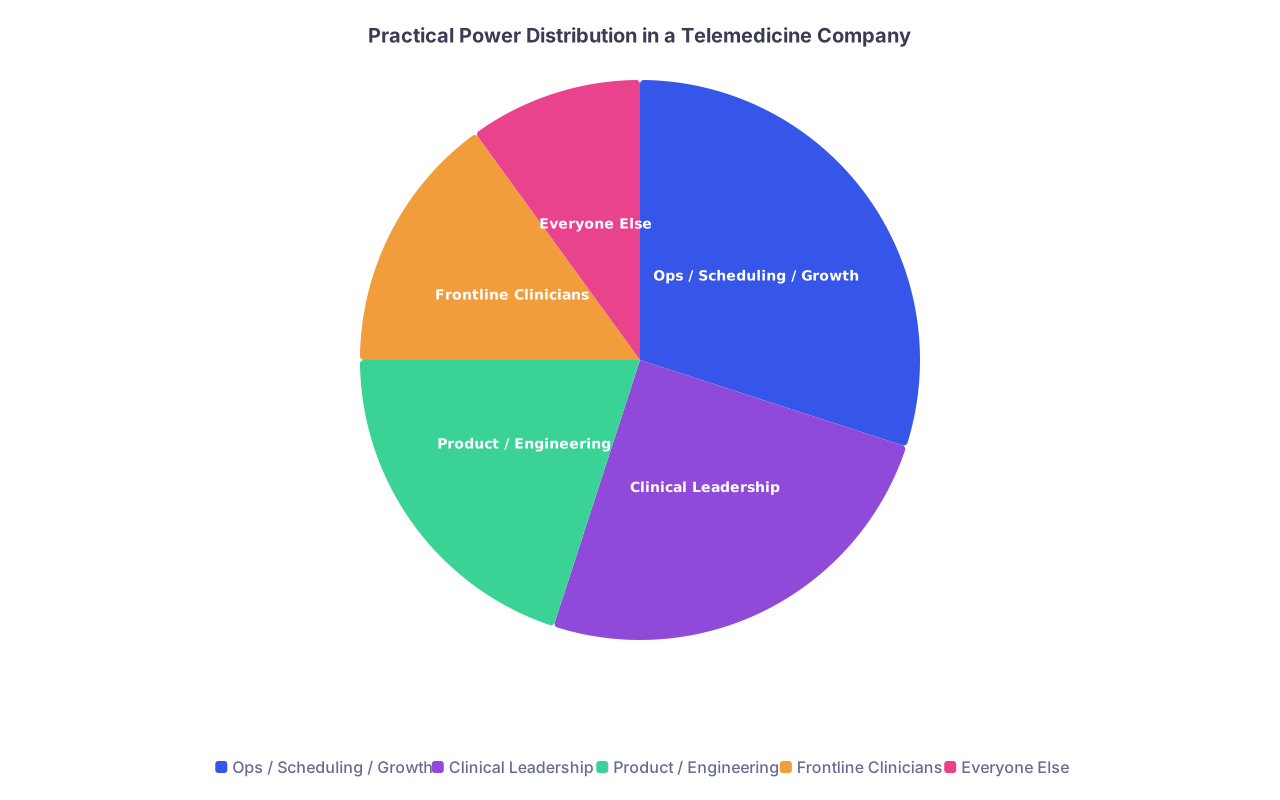
| Category | Value |
|---|---|
| Ops / Scheduling / Growth | 30 |
| Clinical Leadership | 25 |
| Product / Engineering | 20 |
| Frontline Clinicians | 15 |
| Everyone Else | 10 |
That pie chart is closer to the truth than any org chart you’ll be shown on day one.
How this shows up on a typical day
You log in for your shift. The tool that decides which patients you see, how many, and how they’re distributed across the clinician pool? That’s owned by Operations and Product. They can turn your day from humane to meat grinder with a configuration change you never hear about.
You notice the triage nurses starting to push more borderline cases to synchronous video instead of messages? That’s a protocol change from Clinical Leadership plus Operations trying to hit a revenue target.
And when the platform glitches, crashes, or slows to a crawl, your misery level is determined entirely by how much Engineering cares about clinician experience vs feature development. Spoiler: revenue features win unless someone high up is championing you.
So where do you fit, post‑residency?
You are valuable, but not automatically powerful. In telemedicine, MD/DO letters get you a seat; they don’t guarantee you a voice.
Who Really Has Power in Telemedicine Teams (And Why)
Let’s go layer by layer, not how HR describes it, but how decisions actually get made.
1. Growth/Operations: The Quiet Puppet Masters
If you remember nothing else, remember this: in most telemedicine companies, Ops and Growth determine your daily reality more than the CMO does.
Operations owns schedules, staffing ratios, SLAs, routing rules, and “efficiency initiatives.” They speak the language the CEO and investors care about: visit volume, cost per encounter, time to first response, churn.
Growth/Marketing brings in the patients and the contracts. New employer contract? Suddenly you’re doing 30 extra dermatology photo reviews a day because a benefits VP in Omaha liked a slide deck.
They don’t need clinical authority to own your life. They have the dashboards.
You’ll see this in little ways:
- A new “auto‑assign” rule quietly goes live, and your visit load jumps 30% with no extra pay. That is Ops.
- Your carefully suggested cap on mental health visit lengths? Overruled because “the model assumes a 20‑minute average to hit margin.” Growth and Finance backing that.
- You request time off; “staffing constraints” make it impossible for months. That is a spreadsheet somewhere, not your supervisor suddenly hating you.
In hospital medicine, bed availability and call schedules are painful, but there are hard walls. In telemedicine, the walls move. They’re software‑defined.
2. Product and Engineering: Power Through Platform
The people who build and prioritize the platform hold structural power, even if none of them can read an EKG.
The crucial thing no one tells new clinicians: your clinical judgment is mediated by their tools. If they design an intake flow that buries suicidal ideation screening three clicks deep, your “clinical autonomy” is already constrained.
Here’s the quiet hierarchy inside Product/Engineering:
- Product managers: decide what gets built next (and what never will)
- Engineering leads: decide how fast and how stable
- Data science / analytics: decide which metrics define “success”
If those three don’t care about clinician experience, you’re in trouble.
You’ll hear things like:
“We’re seeing a 12% drop in time‑to‑disposition since releasing the new quick‑order pathways.”
Translation: They’re optimizing for speed, maybe at the expense of nuance, and no one has plotted that against near misses or quality flags.
“We’re A/B testing a new triage questionnaire; let us know if you see anything odd.”
Translation: They are experimenting on your workload, and your complaints will be anecdotal unless someone in Clinical Leadership has built a counter‑metric.
In one well‑known national telehealth company, physicians literally found out a new prescription workflow went live when their visit times jumped and the chat started lagging. IT had to revert after a week of chaos not because docs yelled but because ticket volume and abandonment spiked. That’s how Product learns. Pain at scale, measured in numbers, not complaints in Slack.
Clinical Hierarchy: Physicians, APPs, and the New “Blended” Model
You’re post‑residency and thinking: surely physicians still sit at the top of the clinical ladder.
Yes. And also, not exactly.
In telemedicine, the physician’s power is diluted by three forces:
- The protocolization of care
- The heavy use of APPs for cost reasons
- The asynchronous, transactional nature of most encounters
Let’s break that down.
Physicians: Authority Without Guaranteed Leverage
You’re still the one signing off on high‑risk prescriptions, handling edge cases, and acting as back‑stop. Credentialing requirements, malpractice risk, and payer rules still give you leverage.
But when most visits are coughs, UTIs, rashes, med refills, and simple anxiety/depression follow ups, the business model screams: use cheaper labor.
So the unspoken rule becomes: physicians handle:
- Supervisory requirements
- Escalations
- New or complex protocols
- Edge case QA
- High‑liability cases (pediatrics, mental health, anything that might make the news)
APPs and sometimes RNs handle the bulk. You’re not running a clinic; you’re overseeing a machine.
In that context, your power comes from three things:
- Your willingness to say “no” when protocols are unsafe
- Your ability to interpret messy clinical reality back into metrics Ops and Product understand
- Your participation in design conversations (if you can get invited)
If you just log in, see patients, log out, you are necessary but not influential. And they know it.
APPs: Quiet Workhorses, Variable Status
At some telemedicine companies, APPs have near‑parity with physicians in day‑to‑day power, especially NPs with strong telemed experience. In others, they’re treated like human APIs feeding protocols into the EMR.
The ugly truth: many telehealth orgs think in rate sheets, not letters after your name. If an NP can deliver 90% of what a PCP can at 60–70% of the cost, the algorithm is obvious. That’s exactly how it gets pitched to employers and insurers behind closed doors.
You’ll see tiers like this:
| Tier | Role Type | Usual Use Case |
|---|---|---|
| 1 | MD/DO Attending | Complex / high risk |
| 2 | NP/PA with telemed experience | Most primary care volume |
| 3 | RN | Triage / protocol care |
| 4 | MA / Health Coach | Outreach / follow up |
If you want real influence as a physician, you cannot just hover at Tier 1 doing rare complex cases. You need to be the person defining what counts as “complex” and how handoffs happen between tiers.
Non‑Clinical Roles: Where Power Really Concentrates
This is the part many clinicians underestimate when they cross over from brick‑and‑mortar medicine. The non‑clinical functions are not just support—they’re power centers.
Operations and Workforce Management
These folks own:
- How many patients per hour you’re “expected” to handle
- Whether your breaks exist in practice or just on paper
- How cancellations, no‑shows, and wrap‑up time are accounted for
- Whether underperformance is a coaching conversation or a termination email
In old‑school clinics, your volume is capped by room availability and human processes. In telemedicine, they can dial your volume up like a thermostat. And they will—especially during employer launches or flu season—unless someone with clinical authority pushes back using data, not feelings.
Data / Analytics: The Lens That Defines “Good”
The data team decides what a “good clinician” looks like in the system.
Is it:
- Short encounter times?
- High patient satisfaction scores?
- Low re‑visit rates?
- High prescription rates (yes, some companies quietly track this)?
You would be horrified if you saw some of the performance dashboards early telehealth companies used. I’ve seen internal conversations that boiled down to: “This doc is slow and orders too many tests; they’re dragging down our margins,” with zero adjustment for case mix severity because that was “hard to model.”
You want power? You learn which metrics you’re judged on and you influence which metrics matter.
Product, Again: Deciding What Clinicians “Can” Do
Product managers don’t think like clinicians. They think in user stories. “As a clinician, I want to quickly prescribe first‑line antibiotics for uncomplicated UTIs.”
Sounds fine. Until a meaningful percentage of those “uncomplicated UTIs” turn out to be something else, and your interface has made it stupidly easy to over‑treat.
If you’re not in the room when those user stories are written, you’re playing inside a cage someone else built.
The Shadow Hierarchies: Money, Brand, And Risk
Now let’s talk about the stuff no one will say on a company all‑hands.
1. Revenue Producing vs “Cost Center” Roles
If your work is seen as:
- Directly billable
- A driver of contract renewals
- Something sales can brag about
You get attention.
If your work is seen as:
- Compliance, QA, or “clinical integrity”
- Training or education
- Clinician support or wellness
You’re a cost. Costs get minimized. Their leaders get listened to last.
So the medical director who can present a story like, “Our new hypertension protocol reduced hospitalizations and employers saved X dollars” will get a hearing. The one saying “We’re burning our docs out with these visit caps” will get a sympathetic nod and no headcount.
2. “Brand‑Risk” Clinicians
There is a small subset of clinicians whose individual power is disproportionate to their clinical workload:
- The charismatic doc who’s good on camera and appears in company marketing
- The physician who’s tight with the CEO or founders
- The clinical leader who’s respected by external partners or regulators
If one of them threatens to leave, things move. Not because of fairness, but because their departure is seen as brand risk.
You’ll hear, “We really need to keep Dr. X happy,” in private leadership meetings. That’s hierarchy. Make no mistake.
3. Risk Gatekeepers: Legal and Compliance
If Legal and Compliance say no, it’s no. They don’t attend daily huddles, but they shape what’s even possible.
They’re the ones who decide:
- Which states to enter (and thus which licenses are suddenly “strategic”)
- What protocols are “defensible”
- Whether that new async program is “too close to practicing without an adequate exam”
Sometimes their caution protects you; sometimes it boxes you in. But you won’t outrank them in decisions that smell like regulatory risk.
Where Does a Post‑Residency Telemedicine Doc Find Real Leverage?
You’re not going to out‑OPS Ops or out‑PM Product. But you can move up the real hierarchy if you understand how power is earned in this environment.
Here’s the pattern I’ve seen in physicians who actually shape their telemedicine workplaces instead of just serving them.
They Become Bilingual: Clinical and Business
They learn to translate:
“This triage flow is unsafe” into “We’re increasing our risk of high‑severity misses, which could drive up malpractice costs and damage our employer Net Promoter Score.”
Telemedicine leadership listens to arguments framed in:
- Risk (legal, PR, regulatory)
- Revenue (retention, contract expansion, utilization)
- Cost (staffing, overtime, platform resource use)
If you stay purely in “this feels bad to clinicians,” you’ll lose most strategic arguments.
They Get Into the Room Early
The power move is not whining after a change goes live. It’s inserting yourself when ideas are still vague.
You want influence, you do things like:
- Volunteer as a clinician advisor for a new feature
- Offer to pilot a new clinical program and bring structured feedback
- Ask for access to metrics and propose better ones
The doc who shows up at a Product review with, “Here’s how this new workflow affected median resolution time and re‑visit rate for our top three chief complaints,” will get invited back. Every time.
They Own a Niche
Generic telemedicine doc = easily replaced.
But if you become the internal expert on:
- Tele‑psychiatry across multiple states
- Pediatric urgent care teletriage
- Chronic disease management with RPM devices
- Complex employer population with specific needs (e.g., truck drivers, tech workers, rural populations)
Suddenly you’re harder to cut. Leadership will route questions, pilots, and new contracts through you. That’s soft power that becomes hard when org charts get rewritten.

| Step | Description |
|---|---|
| Step 1 | New Telemed Clinician |
| Step 2 | High Clinical Reliability |
| Step 3 | Niche Expertise |
| Step 4 | Data Savvy and Metrics Literacy |
| Step 5 | Advisor to Product or Ops |
| Step 6 | Formal Leadership Role |
Plenty of docs stall at B. Some at C. The ones at F are the ones rewriting the playbook you’re currently constrained by.
How This Feels On the Ground: A Day in Two Different Hierarchies
Let me give you a concrete contrast.
Scenario 1: You’re Low in the Real Hierarchy
You log on. Dashboard is red. You’re double‑booked all day due to “unexpected demand.” IT pushed an update last night that broke your favorite template. Patients are angry about long waits; your satisfaction scores drop. An Ops manager you’ve never met sends a Slack: “Reminder: our target average visit time is 12 minutes.”
You complain to your immediate supervisor, a “team lead” physician with almost no sway outside the clinical org. They empathize. Nothing changes.
Your feedback goes into a JIRA ticket with no priority. Product has a new initiative: a shiny mental health app for a big employer. Fixing your misery is not on the roadmap.
You’re on the bottom of the true pyramid.
Scenario 2: You’ve Built Real Influence
Same spike in demand. But:
- You’ve previously helped design visit caps and escalation rules with Ops. They’re reluctant to break them because you’ve already shown what happens to quality and employer complaints when they do.
- Product pings you before their next release: “Can you test this new template in staging and tell us what breaks?” They know you’ll return not just opinions but numbers.
- You’ve led a small study showing how slightly longer visit times with specific chief complaints cut re‑visits by 25%. The CEO literally saw the slide.
So when you say, “If you override the caps this week, our re‑visit rates will explode and we’ll blow our employer SLA,” people pause. They might still push, but there’s a real conversation.
You’re still seeing patients. But you’re no longer a passive endpoint.
If You’re Deciding Whether to Enter Telemedicine Post‑Residency
Here’s the brutal summary.
Telemedicine magnifies whatever hierarchy already exists in health care and adds a new layer driven by software and venture math. Physicians still have authority, but you are competing with:
- Scripts and protocols
- Cheaper clinicians
- Product priorities
- Investor expectations
This doesn’t mean “don’t do it.” For the right person, telemedicine is an incredible lever: flexible schedule, system‑level influence, exposure to population‑level care.
But go in with your eyes open:
- Your MD/DO is necessary but insufficient for power
- The strongest players understand metrics as well as they understand medicine
- The real hierarchy is defined by who controls flow (patients), rules (protocols), and pipes (platform)
If you can position yourself at the intersection of those three, you will not just survive in telemedicine—you’ll quietly shape how everyone else practices.
And once you understand that, the job hunt after residency stops being “Which telemed company will hire me?” and becomes “Which org is building a hierarchy I’m willing to live in—and how quickly can I move up it?”
With that foundation, you’re ready to start dissecting job offers, equity pitches, “medical director” titles, and remote‑only roles for what they’re actually worth. But that is its own conversation.
FAQs
1. As a new attending, should I start my career in telemedicine or do in‑person work first?
If you can stomach it, do at least 1–2 years of in‑person work first. You’ll build clinical judgment in a richer environment, see complications you’ll never encounter on video, and have more bargaining power when you come back to telemedicine. Starting in telemed can work, but it narrows your exposure and makes you easier to pigeonhole as “just a telehealth doc.”
2. Do telemedicine medical director titles actually mean leadership power?
Sometimes. Often they mean “clinician who does extra admin work for a modest stipend.” Look at what they control: protocols, hiring/firing input, product roadmap influence, QA strategy? Real power. If it’s just shift scheduling and incident review, that’s mid‑level authority dressed up as leadership. Ask what budget they own and which executives they meet with regularly.
3. How can I tell if a telemedicine company respects clinicians before I sign?
Listen for specifics. Ask, “Tell me about a time clinicians pushed back on a Product decision and what happened.” Or, “How do you measure clinician performance?” If all you hear is speed and volume metrics, run. If they can articulate a balance of quality, safety, and experience—and show how clinician input has altered decisions—you’re in better territory.
4. Are APPs really replacing physicians in telemedicine?
They’re replacing physicians for predictable, protocol‑friendly work in many telemed models. That’s not hypothetical; I’ve seen ratios where 70–80% of visits are covered by APPs. But there’s still a huge need for physicians in complex care, program design, supervision, multi‑state risk management, and specialty teleconsults. If you’re willing to operate at that level, you’re not replaceable by an NP following a script.
5. What skills should I build now if I want future leadership in telemedicine?
Two tracks: clinical and systemic. Clinically, get very comfortable with remote assessment, risk stratification, and managing uncertainty without labs or imaging. Systemically, learn basic analytics (reading dashboards, asking good data questions), understand how reimbursement works for virtual care, and get some exposure to product thinking—shadow a PM, join a pilot, read specs. The leaders who matter in telemedicine are the ones who can sit in a room with Ops, Product, and Legal and speak everyone’s language without losing the clinical plot.