
Most physicians doing telemedicine are one bad licensing decision away from losing a job offer they thought was “a sure thing.”
Telemedicine multiplies opportunity. It also multiplies risk. Especially licensing risk.
You are not dealing with “a license.” You are dealing with a licensing web. One that HR barely understands, recruiters routinely misstate, and some telehealth companies will happily let you hang yourself with—then quietly drop you when compliance finally looks at your file.
Let me walk you through the traps I see post‑residency physicians fall into again and again. The ones that get contracts rescinded, bonuses forfeited, or worse—trigger board investigations.
Trap #1: Confusing “Where You Sit” With “Where the Patient Is”
The first and most expensive mistake: thinking your license needs to match where you are, not where the patient is.
Telemedicine rule of thumb:
- You must be licensed in the state where the patient is physically located at the time of the visit.
Period. No, your home state license does not “extend” because it is virtual care.
How this kills job offers
Scenario I have seen three times in one year:
- New attending in Texas signs a remote telepsychiatry contract for a “multi‑state outpatient role”
- Recruiter says: “We mainly need someone with a solid base license; we’ll figure out the rest”
- Physician assumes they can start with Texas and get other licenses later
- Start date approaches → compliance suddenly realizes 70% of that company’s patient volume is in states where this physician has zero licensure
- Compliance blocks onboarding. Offer “revised” to 0.3–0.4 FTE or withdrawn entirely
You think you have a full‑time telemedicine job. You actually have a part‑time placeholder until you carry enough licenses to be useful.
How to avoid this mistake
Before you sign anything:
Ask explicitly:
“List all patient states I will be expected to cover in the first 6–12 months.”Match that list against your actual licenses and realistic licensing timeline.
Not fantasy timeline. Real timeline. With fingerprint delays, board meetings, and inevitable clerical idiocy baked in.Put it in writing:
Your offer or contract should state:- Which licenses are required before start date
- Which licenses are “nice to have” or for later expansion
- Who pays for each license and renewal
- Whether your FTE or compensation is contingent on holding X number of active licenses
If they “cannot be that specific,” what they are saying is: “We have no idea which states we really need, and we will solve that problem at your expense.”
Walk carefully.
Trap #2: Underestimating Licensing Timelines (and Losing Start Dates)
Second classic error: assuming every state license behaves like your first one.
It does not.
Some states turn around clean applications in 4–6 weeks. Others can drag your file through a 6‑month mud run because someone cannot read your residency certificate clearly.
Here is the rough reality for many physicians with clean records:
| State Type | Example States* | Typical Clean Timeline |
|---|---|---|
| Fast IMLC Member | AZ, CO, IA | 3–6 weeks |
| Average IMLC Member | MN, UT, WY | 6–10 weeks |
| Slow IMLC/Non-IMLC | CA, NJ, NY | 3–6+ months |
| Very Slow / Painful | TX (for some), FL | 4–7+ months |
*Examples, not guarantees. Boards change behavior. Individual files vary.
What kills physicians is not the absolute timelines. It is the mismatch between:
- Company promise: “You’ll be ready to start in 60 days”
- Board reality: “Your file will be reviewed at the next meeting… three months from now”
How this costs you jobs
- You resign from your current job expecting a specific telemedicine start date
- Start date gets pushed. Then pushed again. No revenue for 3–4 months
- Or worse: company cannot keep a role open that long and quietly “reprioritizes staffing needs”
I have seen physicians bet rent and mortgage on onboarding timelines they never should have trusted.
How to protect yourself
Do not resign based on optimistic licensing estimates.
Resign based on:- At least one core license already active for that company’s highest‑volume state
- Signed contract with a licensure‑contingent timeline that does not leave you starving if it slips
Ask the company what their actual experience is with each board.
Response you want:
“Last quarter, our average for State X was 9 weeks; for Y it was 16 weeks. We will not promise less than that.”Create your own conservative timeline plan.
Use the longest likely estimates, not the shortest.
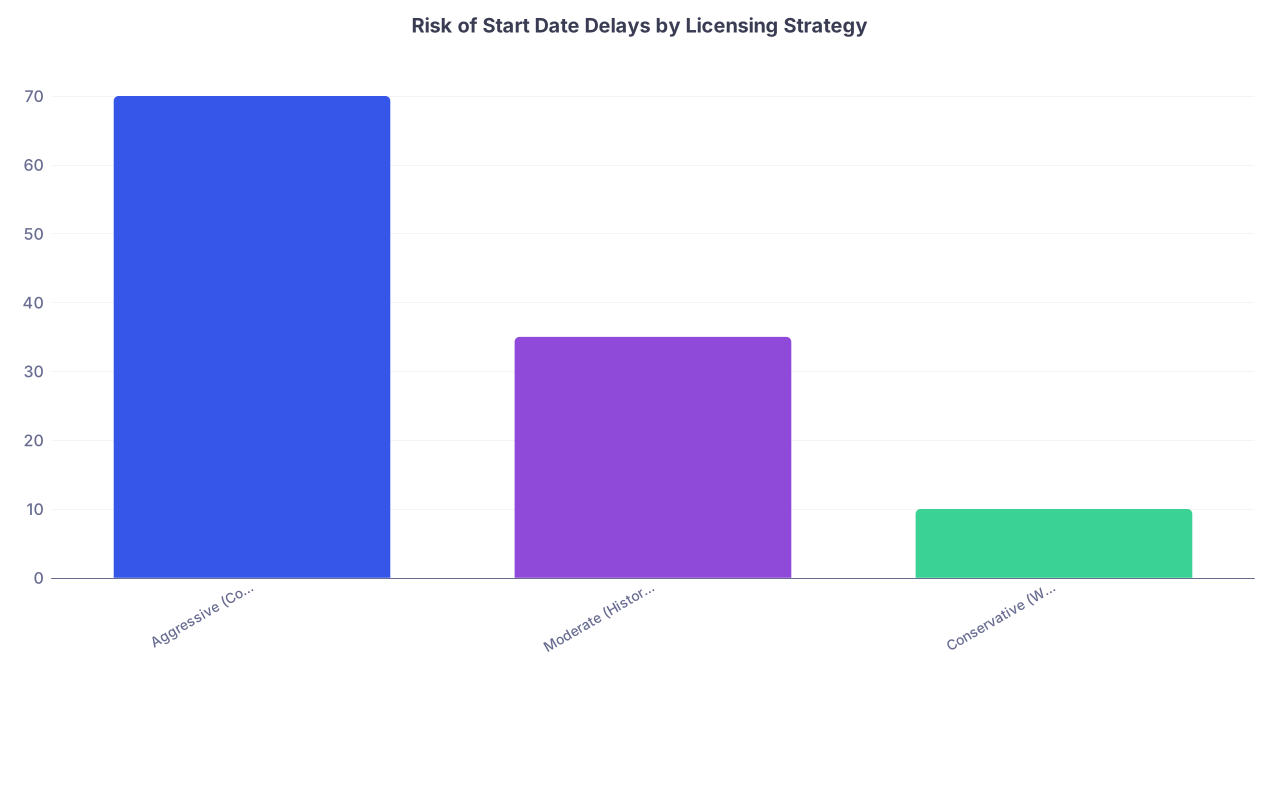
| Category | Value |
|---|---|
| Aggressive (Company Estimate) | 70 |
| Moderate (Historical Avg) | 35 |
| Conservative (Worst Case) | 10 |
The aggressive plan looks better on paper. It is also how people end up doing urgent care locums they hate for six months “until my telemed gig finally starts.”
Trap #3: Ignoring the IMLC (or Misusing It)
The Interstate Medical Licensure Compact (IMLC) is either your best friend or your most overrated fantasy, depending on how you approach it.
The bad assumptions
I see two repeated:
“I am in an IMLC state, so I can get licenses anywhere quickly.”
Wrong. Many high‑volume states for telemedicine are not in the compact or have their own extra hoops.“Being IMLC‑eligible solves all my licensing problems.”
It solves some. It does not:- Fix past disciplinary history
- Fix gaps in training or unaccredited fellowships
- Guarantee speed if the board is under‑staffed
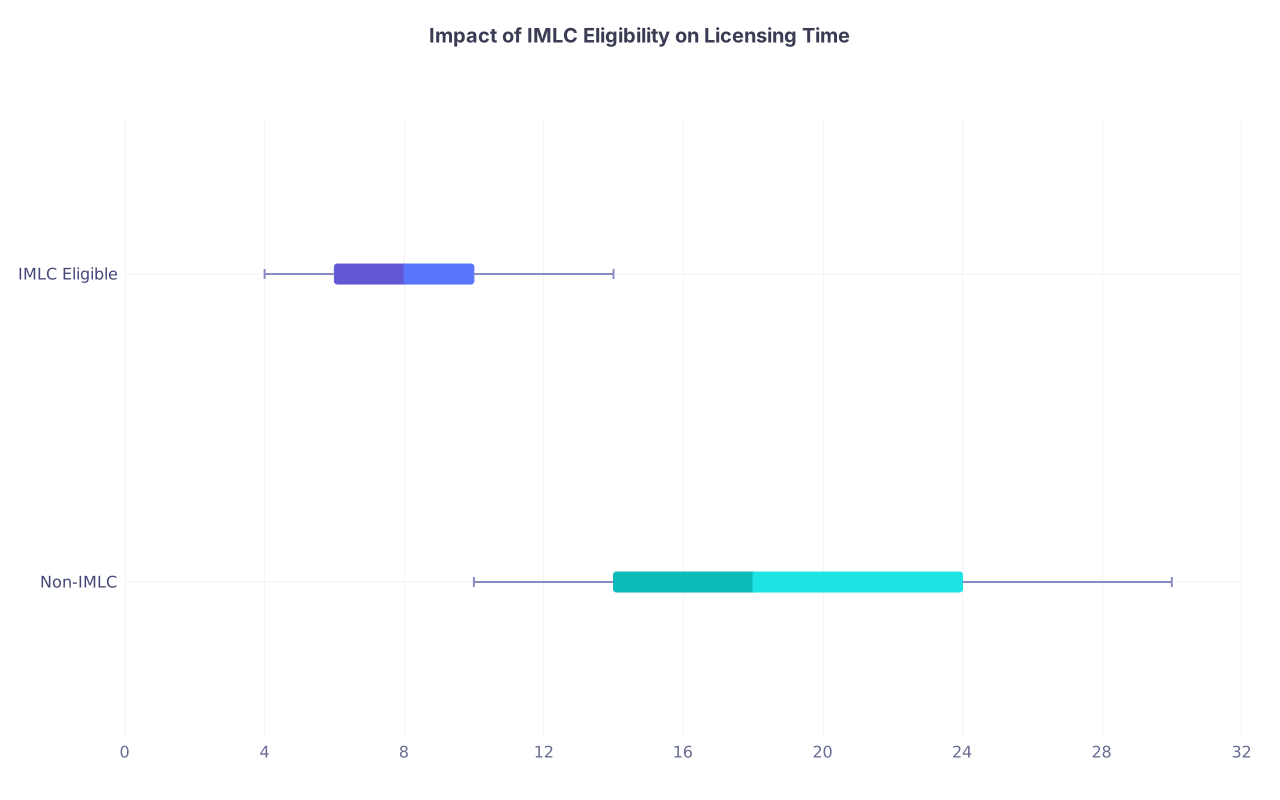
| Category | Min | Q1 | Median | Q3 | Max |
|---|---|---|---|---|---|
| Non-IMLC | 10 | 14 | 18 | 24 | 30 |
| IMLC Eligible | 4 | 6 | 8 | 10 | 14 |
Notice: IMLC helps a lot. It does not equal instant.
Where people get burned
- Recruiter: “If you are IMLC‑eligible, we can have you licensed in 5+ states in a month.”
- Reality: one compact state processes you quickly; another takes 8+ weeks; one state rejects your compact application over a trivial technicality and forces a full traditional application
Now your “multi‑state” job is stuck waiting on the slowest link in the chain.
Avoid these specific IMLC mistakes
Not confirming you are truly IMLC‑eligible before committing to a job that depends on it
Slight issue in your training, previous license problem, or board‑ordered evaluation? That can quietly disqualify you.Letting the company “handle everything” without you tracking board status
I have seen applications sit stalled for weeks because a verification fax never went through. The physician assumed “recruitment is on it.” Recruitment assumed “the physician already responded.” Dead air.Building a whole career plan on compact licenses that are about to expire
If your IMLC Letter of Qualification is close to expiration, get clarity in writing on:- Whether they will pay to renew
- Whether future states will be through compact or traditional filings
If your entire full‑time remote offer only works because of the IMLC, you need a backup.
Trap #4: Letting the Company Own Your Licenses (Instead of You Owning Your Options)
Here is a quiet trap almost no one warns you about: losing practical control of your licenses.
Many telemedicine companies:
- Pay for your licenses
- Pay the renewals
- Handle the paperwork
Sounds great, right? Until you try to leave.
The subtle ways this backfires
Licenses tied to their corporate address
Some states require a practice location or corporate affiliation. Your licenses may list the telemed company’s address exclusively.
Leave the company → letter to the board → sometimes triggers:- Additional paperwork
- Updated supervising physician details
- Even “inactive” or “expired” status if no new practice location is filed
Non‑competes silently linked to “states where you are licensed”
You think your non‑compete limits you to “our patients” or “our platform.”
The contract actually restricts practicing telemedicine in any state where you hold a license obtained under their employment.
You leave → you are suddenly locked out of a half dozen states for telemedicine work for 1–2 years.Licenses lapse quietly when you are on autopilot
If the employer manages renewals and:- You reduce hours
- Or you become “low priority”
- Or you are quietly being phased out
Your renewals can be delayed “by mistake,” leaving you scrambling.
Questions you must ask before letting them sponsor licenses
- Who is listed as the “owner” or primary practice for each license—me or the company?
- What happens to my licenses if I resign? Do you notify boards that I no longer work with you?
- Will you give me complete copies of all applications and board correspondence?
- Is my ability to keep or use these licenses in other jobs limited by our contract?
If you are not asking these questions, you are effectively ceding control of your own legal right to practice.
Trap #5: Failing to Align Licensing Strategy With Your Telemedicine Niche
Not all telemedicine is the same. What licenses you need—and which are worth it—depend heavily on what type of work you actually plan to do.
I watch physicians waste months (and thousands of dollars of company money) chasing low‑yield states that do almost nothing for their career goals.
Common mismatch patterns
- Psychiatrists spending time on low‑population states with minimal telepsych volume instead of focusing on high‑demand, better‑paying large states
- Urgent care / primary care physicians loading up on states that pay poorly per visit while ignoring states with better reimbursement or scheduling
- Subspecialists getting licensed in a long list of states where the company has… almost no cases in their niche
If a company cannot show you a basic volume and revenue map by state for your specialty, they probably do not have a serious strategy.
| Specialty | High-Priority States* | Secondary States* |
|---|---|---|
| Psychiatry | TX, FL, CA, NY | AZ, CO, WA, NC |
| IM / FM UC | TX, FL, GA, OH | MI, PA, NC, CO |
| Derm | CA, FL, NY, IL | AZ, CO, WA, MA |
| Endocrine | TX, FL, CA, NJ | VA, MD, CO, MN |
*Illustrative, not gospel. Every company has its own footprint.
How to avoid this trap
Ask for very concrete answers:
- “In the last 6 months, what were your top 5 states for [my specialty] by visit volume?”
- “Of those, where are you most under‑staffed?”
- “Which states are you willing to fund licenses for this year and why?”
If their answer is some vague hand‑wave about “growing everywhere,” understand what that really means: you are the growth experiment.
Trap #6: Overlooking Supervisory / Collaborative Requirements
Telemedicine does not magically erase supervisory laws. If your practice model requires collaboration or supervision, that has to exist in each state.
Common traps:
- NPs / PAs relying on a collaborating physician who is not licensed in every covered state
- Physicians doing remote supervision across states where they themselves are not fully licensed
- Misunderstanding different rules for controlled substances, especially tele‑prescribing
I have seen a multi‑state NP group discover—after six months of active patient care—that their collaborating physician was not properly registered in two of their highest‑volume states.
Cue: regulatory scramble, internal audits, very tense emails.
How to protect yourself
Confirm for each state:
- Who is your supervising / collaborating MD (if applicable)?
- Are they licensed in that state?
- Is the supervisory relationship properly filed with that board?
If you are the supervising physician:
- Are you being compensated for every state you are covering?
- Is your risk exposure in those states reflected in your contract and malpractice coverage?
This is exactly the kind of compliance gap that surfaces when a competitor complains, a patient files a board complaint, or a payer does an audit.
Trap #7: Letting Compliance Come Last Instead of First
Physicians often treat compliance like a necessary nuisance. Telemedicine punishes that attitude.
The worst pattern I see:
- Physicians focus on comp per hour, schedule flexibility, and “fully remote” hype
- They never ask to speak with compliance or medical leadership before signing
- They assume “this company is big, they must know what they’re doing”
Then:
- Payer pushes back on claims from certain states
- Company changes its risk tolerance overnight
- Suddenly a bunch of multi‑state providers are “temporarily removed from the schedule” while legal sorts it out
You do not want your primary income tied to a company that is barely staying a step ahead of regulators.
What to do differently
Ask for a brief call with compliance or medical director before you sign.
Questions I would ask directly:- “How have your policies changed in the last 12–18 months due to telemedicine regulations?”
- “What are your biggest compliance headaches with multi‑state licensure right now?”
- “Have you ever stopped seeing patients in a state suddenly? What triggered that?”
Pay attention to their attitude.
Red flags:- “We have not really had issues; we just follow standard telemedicine rules”
- “Recruitment can answer all that” (they cannot)
- “We have lawyers for that, you just need to see patients”
If they sound cavalier about compliance, they will be cavalier about your job security.
Trap #8: Non‑Competes and Quiet Geographic Handcuffs
Telemedicine multiplies the reach of a single license. That makes non‑competes nastier.
In brick‑and‑mortar jobs, a non‑compete might be:
- 10–20 miles radius
- 12–24 months
- Specific to a type of practice
In telemedicine, I have seen:
- “No telemedicine practice in any state where you treated a patient through us, for 1–2 years”
- “No work with competing telehealth platforms serving our client base”
- “No telemedicine in X, Y, Z states where we sponsor your license”
You can accidentally lock yourself out of half the remote market because you did not read three lines of legalese.
How licenses amplify non‑compete damage
Let me be blunt:
A single non‑compete tied to multi‑state licenses can:
- Block you from working for major competitors that share payers or client employers
- Devalue the licenses you worked years to accumulate
- Force you back into in‑person work you were trying to get away from
Defensive steps
Have a healthcare attorney review any telemedicine contract that involves:
- Multi‑state work
- Company‑funded licenses
- Any mention of “territory,” “markets,” or “client regions”
Push back on non‑compete language tied to:
- “Any state where you hold a license”
- “Any state where the company operates”
- Overly broad definitions of “competitor”
You are not overreacting. You are protecting your future earning power.
Trap #9: Sloppy License Maintenance and Silent Lapses
Once you have 5–10+ licenses, the risk shifts from “getting them” to “keeping them clean and current.”
The most embarrassing career‑harming mistakes I see:
- Missing a renewal notice because your email changed or went to spam
- Overlooking CME requirements for one specific state
- Forgetting to update address or practice location when you move or switch jobs
The consequence is not just “a small fine.”
It can be:
- Public reprimand for unlicensed practice if you keep seeing telemedicine patients after a lapse
- Mandatory reporting to other states and hospitals
- Job termination for cause if it triggers policy violations

| Step | Description |
|---|---|
| Step 1 | License Renewal Missed |
| Step 2 | Silent Lapse |
| Step 3 | Continue Telemed Visits |
| Step 4 | Board Discovery |
| Step 5 | Discipline or Fine |
| Step 6 | Report to Other States |
| Step 7 | Employer Compliance Review |
| Step 8 | Job Loss or Contract Limits |
Proven ways to avoid this
Maintain your own license tracker:
- Renewal dates
- CME requirements
- Address / practice info
- Supervising physician info (if applicable)
Use redundant reminders:
- Calendar alerts
- Dedicated email folder for board messages
- Annual personal review session
Do not rely entirely on employer reminders. Those are a courtesy, not a safety net.
You are the one the board disciplines. Not your recruiter.
Trap #10: Assuming “Everyone Does It This Way, So It Must Be Fine”
Telemedicine is still in regulatory flux. The worst reasoning you can use is:
- “But another company let me do this”
- “My co‑worker said it was fine”
- “This other platform had no problem with it”
Different companies have very different:
- Risk tolerance
- Legal interpretation
- Relationships with payers and boards
Behaviors I have seen physicians treat as “normal” that are, frankly, dangerous:
- Seeing patients in a state before your license is formally issued because “it is pending and just a formality”
- Prescribing controlled substances across state lines without fully understanding both states’ rules and federal changes
- Doing “cross‑coverage” for patients physically located in a state where you are not licensed because “they are just refill visits”
All of these are potential career‑level problems if they surface in the wrong way—an adverse outcome, a complaint, an audit.
If a company is comfortable asking you to practice in gray zones, you should treat them as a short‑term income source, not a long‑term career anchor.
The Bottom Line: Protect Your License, Then Your Options, Then Your Income
Three core points to walk away with:
Your license strategy determines your telemedicine career ceiling.
Get very specific about which states you truly need, how long they take, and who controls them. Do not let recruiters’ optimism or company growth fantasies dictate your licensing reality.Multi‑state work multiplies both risk and leverage.
More licenses mean more opportunities—but also more ways to get trapped by non‑competes, compliance failures, or renewal lapses. Own your data, your timelines, and your relationship with each board.Telemedicine employers are not all equally safe or competent.
Test them. Ask to talk to compliance. Demand clarity in contracts. If they are vague about states, timelines, or legal obligations, understand the message: they are experimenting with your license.
Avoid these traps, and telemedicine can be an incredible, flexible, high‑impact career after residency. Miss them—and you will learn the hard way that in multi‑state telemedicine, ignorance is not just risky. It is disqualifying.