
You’re logged in. And suddenly… you’re nobody.
You open your usual telemedicine dashboard. Yesterday you saw 35 patients. Your metrics looked solid. You got a “Great job!” email last week.
Today:
No shifts.
No queued visits.
Your status quietly flipped from “active” to “inactive” sometime around 2 a.m.
Support replies with the script:
“Hi Doctor, due to changing business needs, we are no longer able to offer you shifts. We appreciate your contributions and wish you the best.”
No warning. No concrete reason. No performance plan. Just gone.
I’m going to walk you through what actually drives those decisions. Not the sanitized corporate answer. The real calculus behind telemedicine platforms suddenly dropping physicians.
Because I can tell you flatly: it’s almost never about what they say it is.
The unspoken business model: you’re supply, not staff
Here’s what most physicians misunderstand: you think you “work for” the platform. The platform sees you as inventory. Variable supply they can turn on and off in hours.
They don’t build staffing like a clinic. They build it like Uber.
You and I both know the press-facing story: “We use a rigorous, quality-focused network of board-certified physicians to deliver excellent care…” Fine. That’s the brochure.
Behind the curtain, the whiteboard in the ops room has only a few questions next to “Physician Network”:
- How many do we need to cover projected demand at target wait times?
- How cheap can we get that coverage without trashing our metrics?
- How fast can we scale up/down without legal exposure?
If your name doesn’t help those three lines, you’re expendable.
Let me show you how that plays out.
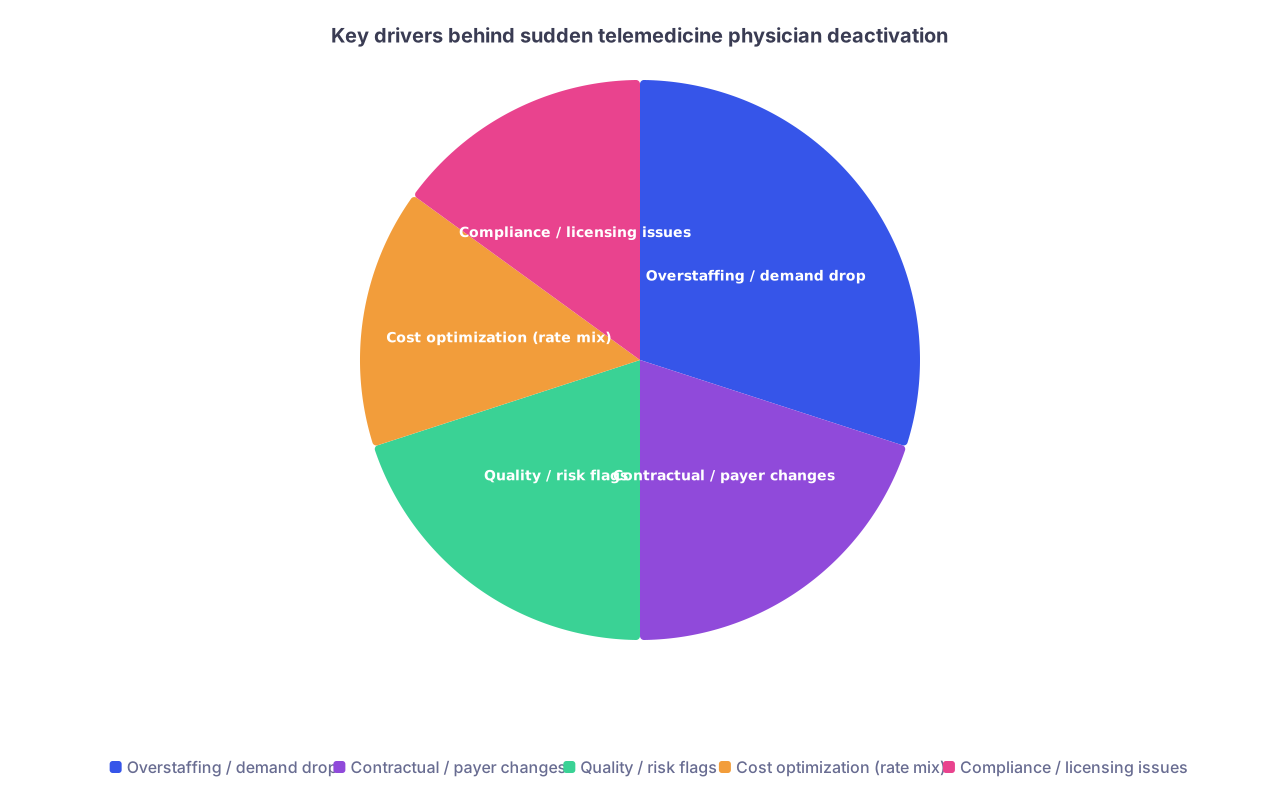
| Category | Value |
|---|---|
| Overstaffing / demand drop | 30 |
| Contractual / payer changes | 20 |
| Quality / risk flags | 20 |
| Cost optimization (rate mix) | 15 |
| Compliance / licensing issues | 15 |
That pie chart is roughly how the conversations sound in leadership meetings when they discuss “network right-sizing.” You get deactivated because of math, contracts, and risk tolerance. Not because some manager decided you’re a bad doctor.
Let me break down the real reasons.
Reason 1: Overstaffing and the brutal math of idle minutes
This is the most common and least talked about reason: they just have too many physicians.
You see “no shifts available.” In the ops dashboard, they see “supply greater than demand, margin getting squeezed.”
Here’s how they think: every minute a physician is logged in and not seeing a paid visit is a cost. On salaried or “minimum guarantee” models, that’s obvious. But even in pure per-visit models, idle physicians tank utilization metrics, drive dissatisfaction, and make recruiting/marketing look bad.
Think about a real scenario I’ve watched play out:
- Big platform signs a large employer contract expecting 20,000 covered lives.
- Adoption is terrible. Only 5–10% of those employees ever log in.
- They built a physician pool as if 40–50% would use it.
- CFO looks at conversion and utilization 3–6 months in: “We’re oversupplied by 30–40% during peak hours, 60–70% off-peak.”
What happens next is simple and cold:
- They rank physicians by a mix of metrics: shift reliability, average handle time, “cost per encounter,” internal quality scores.
- Someone runs a cut line: “We can drop the bottom 20–30% tomorrow and still hit wait time SLAs.”
If you’re below that line, you’re gone. Period.
No remediation. No warning. Because from their risk perspective, warning you doesn’t buy them anything. It just creates noise and potential drama.
And yes, they sometimes do this right after a physician recruiting push. I’ve seen them aggressively onboard hundreds of docs for a “growth wave” that never comes, then quietly deactivate a big chunk 6–9 months later.
So when your dashboard suddenly dries up, sometimes the only “problem” is that their sales team overpromised and the users never showed.
Reason 2: Quiet payer and contract shifts you never hear about
Here’s another truth: your “job security” on a telemed platform is tied less to your performance and more to contracts you will never see.
If a major payer or employer client changes their mind, your fate is sealed in a boardroom you will never be invited to.
Typical scenario:
- A payer has a three-year contract with the platform to provide tele-urgent care in all 50 states.
- At renewal, they decide to:
– Limit telemed in certain states, or
– Switch to their own in-house telemed, or
– Move volume to a competitor with cheaper PMPM pricing.
What does that do? Overnight, demand in certain states drops by 20–50%.
Operational response is predictable:
- “We only need coverage in X, Y, Z high-volume states.”
- “We can’t justify keeping docs in low-volume states active; the regulatory overhead isn’t worth it.”
- “Our state-by-state panel size must shrink to match new contracted volumes.”
You, as the physician, just see: your account is “no longer active in your state” or “no shifts available in your region.”
Nobody tells you, “The BlueCross renewal fell apart and your NPI in Kansas is now a liability, not an asset.”
They also do this when they shift strategy:
- Moving visits from synchronous video to async messaging.
- Outsourcing certain service lines (e.g., mental health) to another vendor.
- Rebuilding their “core markets” focus and abandoning fringe states.
So you’re sitting there thinking, “But my ratings were great.” Doesn’t matter. The client changed the rules, and you’re on the wrong side of the spreadsheet.
Reason 3: Risk, liability, and the invisible “red flag” list
There’s a darker reason some docs disappear from rosters: they quietly get labeled as “risk.”
Not necessarily bad clinicians. Sometimes just inconvenient ones from a legal or PR perspective.
Here’s the internal reality: platforms build shadow profiles on you.
Not the CV you uploaded. The risk fingerprint you create while you work:
- How often do patients complain? (Even trivial stuff gets logged.)
- Any board actions, even minor, show up on monitoring tools?
- Do payers or employer clients ever push back on your notes or outcomes?
- Anything about your scripting that sounds off-brand or noncompliant?
- Any QA reviews flag borderline prescribing, documentation gaps, or adherence issues?
You don’t see this scorecard. But they have it.
There are three big buckets that will get you quietly dropped:
Patterned complaints or low satisfaction from “key accounts.”
If a big Fortune 100 employer complains about the “tone” of their physicians or “overprescribing antibiotics,” they don’t get a memo. They get a spreadsheet of doctors to eliminate.Medical-legal “near misses.”
The nurse reviewing charts flags that you repeatedly fail to document red flag questions. Or you’re too liberal with controlled meds. Or too casual about work notes and disability extensions. Legal gets nervous. Ops doesn’t want a lawsuit that says, “You KNEW this physician had issues and you kept them active.”Off-script behavior.
Using disfavored phrasing with patients. Complaining about the platform in-chart. Recommending competing services. Fighting denials in ways that upset payers. You become “operationally difficult.”
Do they call you and say, “You’re risky”? No. The playbook is: “Per internal review, we are unable to continue your engagement at this time.”
I’ve sat in meetings where a specific physician’s name comes up not because they’re clinically dangerous, but because they triggered the wrong stakeholder one too many times. That’s all it takes.
Reason 4: The quiet war over your rate and “cost per encounter”
Let me be blunt: if you’re more expensive than the alternative and not clearly better on metrics they care about, you’re on thin ice.
Telemed ops teams watch “cost per completed visit” like a hawk. That number has two main levers: how much they pay you per encounter, and how fast you move.
So they classify their network roughly like this:
- Group A: Low rate, high throughput, acceptable quality
- Group B: Medium rate, medium throughput, high quality
- Group C: High rate, medium throughput, acceptable quality
- Group D: Any combination that makes them nervous (slow, costly, risky)
Guess which group gets clipped first when margins tighten.
Where this bites a lot of good physicians:
- You negotiated a higher rate early when they were desperate for coverage.
- You’re not especially slow, but not ultra-fast either.
- Newer docs are coming on at a lower rate, or even off-shore physicians in certain service lines.
- Finance compares: “Why are we paying Dr. X $125/hour when Dr. Y does the same work at $80/hour with slightly faster handle times?”
Your professionalism and board certification do not protect you from that math.
| Group | Rate Level | Throughput | Platform Behavior |
|---|---|---|---|
| A | Low | High | Prioritized, protected |
| B | Medium | Medium | Stable, used as core pool |
| C | High | Medium | Targeted for cuts in slowdowns |
| D | Variable | Low/Risky | First to be deactivated |
You almost never get to see which group they’ve put you in. But your shift offers and visit volume tell you over time, if you’re paying attention.
And when they do a “network right-size,” Group C and D physicians wake up to that generic deactivation email.
Reason 5: Algorithmic triage and being buried alive
One more internal mechanism people underestimate: you can be “dropped” without being formally deactivated. The algorithm just stops feeding you.
I’ve watched platforms do this when they don’t want the HR/legal headache of firing a physician but also don’t want them seeing patients.
How it works:
- They adjust the routing rules: some physicians get visits first; others only when queues are long.
- They change priority weightings based on metrics you didn’t know existed (average documentation time, specific QA flags, even subtle satisfaction patterns).
- They silently experiment with different routing models: nurse-first triage, chat-first, AI pre-triage. Some docs get squeezed out in the experiments.
From your side:
- Your scheduled shifts keep getting cut or reassigned.
- On “open queue” models, you log in and never see patients.
- Support tells you, “Volumes are low” while you know colleagues on the same platform are slammed.
You’re functionally deactivated. Just not on paper.
This is especially common when:
- They’re nervous about your practice style but don’t want a confrontation.
- They anticipate they might need you again in the future if volume spikes.
- They’re still extracting value from your presence (e.g., you make their “network size” numbers look robust for investors).
So no, you’re not paranoid if you notice a slow, unexplained death of your schedule. That’s often intentional.
Reason 6: Licensing, credentialing, and compliance landmines
Some of you are dropped for reasons you’d call “bureaucratic nonsense.” The platform calls it survivable risk management.
Red flags that get you quietly cut:
- Expired, lapsed, or restricted license in any state… even one they don’t use you in.
- An old board action or malpractice case that suddenly surfaces in a monitoring tool or hits the press.
- Incomplete documentation for DEA, CSR, or state PDMP enrollments.
- Failing an internal re-credentialing requirement you didn’t even know was time-sensitive.
Compliance and legal teams live in nightmare mode: “What’s the worst headline a regulator could write about us?” Their answer is never, “We over-dropped physicians.”
It’s always: “Platform knowingly used physician with X prior issue and failed to monitor Y.”
So their threshold is simple: if your file generates too many “hmm” comments from legal/compliance, they drop you.
They don’t call you to negotiate or clarify unless you’re senior leadership or mission-critical. For everyone else: generic deactivation.
I’ve seen excellent clinicians get pulled over something as simple as a slightly messy malpractice history that had already been resolved. But the platform’s tolerance for nuance is low. Their risk calculus just says, “Too complex, too many emails — cut.”
Reason 7: Culture fit and quiet blacklisting
This one is uglier, but real.
Some physicians get removed not for patient care or metrics, but for “cultural problems” on the inside.
I’ve watched:
- Docs who aggressively push back on policy changes in internal forums.
- Physicians who challenge non-clinical leadership on unsafe workloads or bad scripting.
- People who are “high friction” in email threads, constantly questioning, escalating, or refusing to play along with certain initiatives.
You might think raising safety concerns or calling out nonsense would be valued. On the ground? It often gets you labeled as “not aligned” or “not collaborative.”
Leadership shorthand becomes:
- “Every email from this doc is a problem.”
- “He’s going to be a thorn in legal’s side.”
- “She’s not on board with the new clinical pathways; this will blow back on us with clients.”
So when the next “network optimization” discussion happens, your name is already in the mental discard pile.
You’ll never see that written, by the way. They’ll put something benign in your file: “Operational concerns,” “Not a fit for current platform direction.”
But culturally, you crossed an invisible line: you made their lives harder instead of easier.
What you can actually control (and what you can’t)
Let me be brutally honest: there is a big chunk of this you cannot control.
You can’t control:
- Contract renewals with payers and employers.
- Internal financial targets.
- Platform strategy shifts (async vs video, new service lines, outsourcing).
- Leadership’s appetite for risk in any given quarter.
You can influence, but not fully control:
- Whether you get bucketed as “expensive and replaceable” vs “essential.”
- Whether you show up on the risk radar.
- Whether internal people groan or relax when your name comes up.
You do have near-complete control over a few things that matter more than physicians think in telemed land:
Reliability and friction.
Showing up for booked shifts religiously. Not dropping shifts last minute. Not creating admin headaches every week. In ops rooms, they remember who makes their staffing spreadsheets blow up.Documentation discipline.
Clean, consistent notes that hit the platform’s expectations. Responding to QA feedback quickly and cooperatively. That makes you low-risk in legal’s eyes.Tone with patients and internal staff.
You can be assertive without making the support team or clinical QA feel attacked. Quietly, those folks can influence whether your “edge cases” get forgiven or escalated.Awareness that this is gig work with a white coat.
You mentally treat telemedicine platforms like locums with a slick interface, not like a tenure-track job. That changes how you plan your life.

| Step | Description |
|---|---|
| Step 1 | Join Platform |
| Step 2 | Deliver High Reliability |
| Step 3 | Optimize Documentation |
| Step 4 | Diversify Platforms |
| Step 5 | Lower Deactivation Risk |
| Step 6 | Income Stability |
The most seasoned telemed physicians I know follow one core principle: never be dependent on a single platform.
Because they’ve already gotten that 2 a.m. email once.
Why the suddenness feels so brutal
You’re not wrong to feel blindsided. The system is built to keep you in the dark.
Platforms do not:
- Give early warnings about downsizing; that would create panic and attrition.
- Share their true performance/risk scoring algorithms; that would invite arguments.
- Admit publicly that contract or financial issues drove cuts; that would scare investors and clients.
So they default to the bland line: “Business needs changed.”
Behind that euphemism is a messy set of decisions with spreadsheets, legal memos, and hurried calls between ops and finance.
I’ve watched CMOs argue to keep certain physicians. I’ve also watched them lose because the CFO’s version of the spreadsheet carried more weight.
Your inbox only sees the final verdict.
If you’re already on the chopping block
If you’re reading this because it already happened, here’s what I’d do, and what I’ve told colleagues privately:
First, stop personalizing what might be purely structural.
If you were sloppy, unreliable, or ignoring QA? Own it and fix it. But in a lot of cases, you did nothing “wrong” in any meaningful clinical sense. You just lost to the math.
Second, change your telemedicine mindset permanently:
- Assume any single platform can disappear on you with no notice.
- Build redundancy: 2–3 platforms minimum if you want this as a serious income stream.
- Keep your licenses and DEA squeaky clean. Invest time here; it matters more than another online CME course.
- Don’t chase top-of-market rates if it prices you into the “luxury cut list” during downturns.
Third, track your own data:
- How many visits per hour are you averaging?
- How often do you get QA feedback, and how quickly do you address it?
- How does your average documentation time compare to peers (ask quietly, you’ll get a sense)?
You want to be the doc who’s boring to legal, invisible to HR, and gold to operations.
Because those are the ones who survive the next “network realignment” email.
The bottom line
You get dropped from telemedicine platforms suddenly for three big clusters of reasons:
- The business math changed: overstaffing, contract losses, rate pressure.
- Your risk and cost profile looked worse than your peers on their hidden dashboards.
- Your presence created friction — with patients, payers, or internal teams — and they decided you weren’t worth the hassle.
If you remember nothing else, remember this:
You are not “employed.” You are capacity.
They are not a career home. They are a client.
Treat them that way, and you’ll stop being shocked when the platform acts in its own interest instead of yours.